Table of Contents >> Show >> Hide
- From Cautious Optimism To Full-Blown Festival
- Bel Air, Maryland: A Temporary Capital Of 3D Printing
- The Stars Of The 3D Printing World Show Up
- Projects That Turned Heads On The Show Floor
- Beyond Plastic Dragons: Show-Stopping Prints
- ERRF In The Larger RepRap Ecosystem
- From ERRF To 3DPrintopia: The Evolution Continues
- Why The Second Year Mattered So Much
- Hands-On Experiences From The Festival Floor
- Conclusion: A Milestone For Community 3D Printing
If you ever wanted proof that desktop 3D printing is very much alive (and noisily clicking away),
you only had to walk into the second East Coast RepRap Festival in Bel Air, Maryland. What began
as a cautiously optimistic experiment in 2018 exploded in 2019 into a full-blown, community-driven
3D printing festival that felt part science fair, part fan convention, and part giant nerd reunion.
Hackaday’s coverage captured the mood perfectly: the inaugural East Coast RepRap Festival (ERRF)
was a surprise hit, but its second year is when the event really came into its own. Attendance
nearly doubled, more sponsors showed up, and the show floor was packed with printers, projects,
and people who can debate nozzle diameters with the intensity most folks reserve for sports.
In this deep dive, we’ll look at how the second ERRF evolved from its humble beginnings,
what made the 2019 edition so special, and how this once-regional meetup helped shape an event
that would eventually grow into 3DPrintopia, one of the East Coast’s largest 3D printing gatherings.
From Cautious Optimism To Full-Blown Festival
The first East Coast RepRap Festival in 2018 was already an “incredible success” by any reasonable
metric: strong turnout, a friendly venue, and ticket prices that made it easy for hobbyists and
families to attend. Still, it was a brand-new event with no track record, so both exhibitors and
visitors walked in with a little apprehension. Would enough people come? Would the printers behave?
Would the coffee survive the all-day benchmarking?
By year two, the mood had changed dramatically. Attendees knew what to expect, word of mouth had
spread through forums and YouTube, and the East Coast 3D printing community descended on Bel Air
with enthusiasm. The official numbers told the story: attendance nearly doubled compared with the
inaugural year, giving organizers that rare “good problem” of wondering if they’d soon need a
larger venue.
ERRF took its inspiration from the Midwest RepRap Festival (MRRF), long regarded as the original
“3D printer meetup in a field” where open-source hardware makers, vendors, and tinkerers gather to
show off their latest hacks. The East Coast version brought that same spirit closer to home for
makers who didn’t want to fly halfway across the country just to talk about PETG settings in person.
Bel Air, Maryland: A Temporary Capital Of 3D Printing
Bel Air, Maryland might not sound like a global tech hub, but during ERRF weekend it absolutely
earns that title. Over successive years the event would settle into the APG Federal Credit Union
Arena, attracting hundreds of exhibitors and thousands of attendees to the region. Even in the
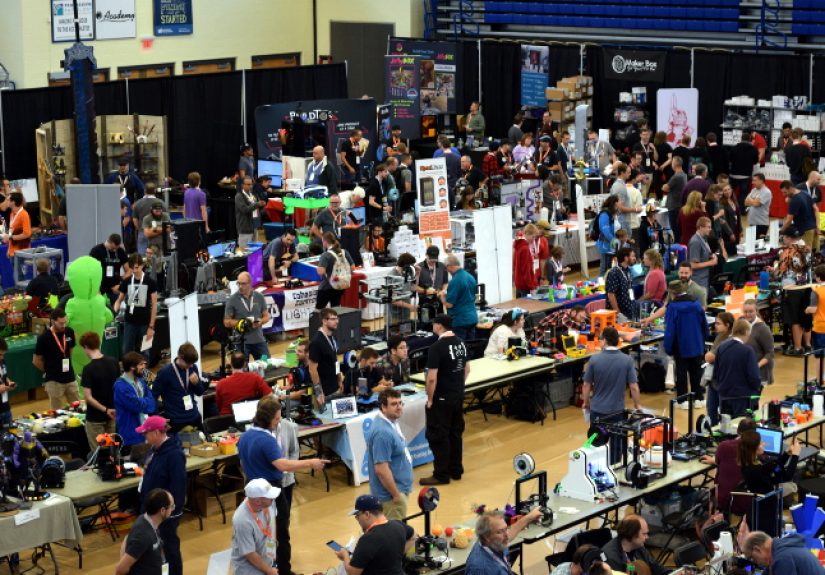
early years, the festival’s layout reflected its “by makers, for makers” roots: rows of home-built
printers next to polished vendor booths, student projects next to advanced research prototypes,
and plenty of room for impromptu show-and-tell sessions at folding tables.
Unlike a traditional trade show, ERRF leaned hard into its community DNA. Companies were invited
to show their latest hardware and filaments, but individuals were just as welcome to roll in with
a heavily modded Prusa or a Franken-printer running on salvaged parts. That mix is what made the
second year feel electric: serious tools sharing space with gloriously weird experiments.
The Stars Of The 3D Printing World Show Up
One of the strongest signs that ERRF’s second year was a level-up moment was the presence of
big-name creators and companies. The 3D printing community has its own version of celebrities,
and many of them were walking the aisles, cameras in hand.
Popular YouTube personalities like the 3D Printing Nerd, 3DMN, and Thomas Sanladerer were at the
festival interviewing exhibitors, live streaming walk-throughs, and generally turning the event
into a rolling content factory. In the first year, ERRF flew somewhat under the radar; by the
second, nearly every major 3D printing channel seemed to produce at least one on-site video.
That flood of coverage introduced ERRF to a global audience and helped lock it into the annual
3D printing calendar.
Prusa Mini Makes A Splash
On the vendor side, the 2019 festival marked a turning point in how seriously companies treated
ERRF. Prusa Research is a great example. In 2018, the company had a modest presence with a few
printers and demo prints. In the second year, Josef Průša himself attended and used ERRF as the
stage to officially unveil the Prusa Mini, a compact yet capable printer that quickly became a
favorite among beginners and seasoned makers alike.
Launching a major product at a community festival rather than a traditional industry show sent a
clear signal: the heart of desktop 3D printing still beats in community spaces, not just corporate
boardrooms. For attendees, it also meant they could ask questions directly, poke at the hardware,
and see the Mini running in real time instead of just in a slick promotional video.
Adrian Bowyer Steals The Show
If there was one person who embodied the spirit of the second ERRF, it was Dr. Adrian Bowyer,
the founder of the RepRap project and widely considered the “father” of modern desktop 3D printing.
His standing-room-only talk connected the dots between his long-running fascination with
self-replicating machines and the first RepRap designs that made it possible for printers to
print many of their own parts.
Bowyer also teased a concept for a radically different kind of 3D printer that would use electrodes
in a vat of liquid to form an object all at once, instead of layer by layer. He acknowledged that
current technology might not yet be up to the task, but that didn’t matter. The point was to expand
the mental horizons of a room full of people who already view plastic filament as a kind of magic.
ERRF’s second year wasn’t just about showing what’s possible today; it was also about imagining
what might be possible next.
Projects That Turned Heads On The Show Floor
One of the charms of a RepRap festival is that the “wow” moments rarely come solely from
big-brand booths. The real magic tends to happen at the tables manned by individual makers who
dragged a suitcase full of parts across several state lines just to share their latest obsession.
An Open-Source Laboratory Autosampler
Among the standout builds highlighted by Hackaday was an open-source laboratory autosampler by
John Pickens. Designed to automate water testing, the system used a NEMA 17-driven syringe pump,
a serpentine conveyor holding up to 50 vials, and a design optimized to fit inside a
temperature-controlled enclosure. Commercial autosamplers can easily cost an order of magnitude
more, so a roughly $2,500 open-source alternative was a big deal for labs and environmental
projects with limited budgets.
Even better, the core components were designed in OpenSCAD and released to the community. That
combination of practical engineering, cost savings, and open documentation is exactly why events
like ERRF exist: someone builds a niche tool, shares the files, and suddenly the barrier to entry
for serious experimentation drops dramatically.
Continuing The Adoptabot Dream
Another project that embodied the “RepRap spirit” at ERRF’s second year was the Adoptabot, a
low-cost, mostly 3D-printed printer originally envisioned by PrintrBot founder Brook Drumm. After
PrintrBot folded, a small community of fans kept the idea alive, iterating on the design to make
it more robust and educator-friendly.
At ERRF, Joel C showed off his evolved Adoptabot design, built using salvaged PrintrBot hardware
and featuring color-coded axes to make motion concepts easier to explain to students. The machine
incorporated aluminum extrusions for stiffness and was deliberately designed to tolerate classroom
abuse. By releasing the design as an Onshape project, Joel gave educators and hobbyists a
transparent way to study, modify, and replicate the printer.
This mix of recycling, education, and open design perfectly captures what makes RepRap festivals
unique. It’s not just about printing phone stands; it’s about empowering people to build the
tools that will teach the next generation of makers.
Beyond Plastic Dragons: Show-Stopping Prints
Of course, it wouldn’t be a 3D printing festival without tables full of jaw-dropping prints.
ERRF’s second year continued the tradition of showcasing both functional and artistic objects:
intricate mechanical assemblies, giant cosplay props, hyper-detailed figurines, and clever
household tools that make you wonder why you ever lived without them.
Attendees could walk past prints demonstrating multi-material techniques, advanced supports,
resin-level detail on FDM machines, and giant single-piece builds that pushed printers to the
edge of their build volume. While practical, functional designs often get the spotlight on
engineering-oriented sites, the purely artistic creations at ERRF proved that 3D printing
has firmly crossed into the creative and decorative world as well.
In later years, community projects like the “community spool holder,” designed collaboratively
and refined after being shown at ERRF, would highlight how the festival helps incubate ideas.
Designs introduced informally at a booth often get refined, uploaded to file-sharing platforms,
and eventually used by thousands of people worldwide.
ERRF In The Larger RepRap Ecosystem
The second ERRF didn’t happen in a vacuum. It was part of a growing constellation of RepRap
festivals worldwideMRRF in the Midwest, events in the Rocky Mountains and the U.K., and
smaller local meetups all tied together by the open-source ethos of the original RepRap project.
Collectively, these events act as real-world checkpoints for the state of hobbyist and
prosumer 3D printing. Sure, you can follow release notes and Reddit threads, but there’s
something uniquely honest about watching someone’s printer struggleor succeedin person.
The second ERRF became one of those important checkpoints: a moment when it was abundantly
clear that 3D printing had moved from “promising niche” to “permanent part of the maker
landscape.”
From ERRF To 3DPrintopia: The Evolution Continues
In the years after that breakout second event, ERRF continued to grow, later adopting the name
3DPrintopia as it expanded its scope beyond the RepRap brand while keeping its
community roots intact. The rebranded festival retained the same core team and mission:
celebrate all things 3D printing, from open-source firmware to industrial-grade filaments,
with a big tent that welcomes hobbyists, vendors, educators, and industry pros.
Later editions would host around 100 exhibitor and sponsor booths and welcome thousands of
attendees over a weekend, with companies launching new filaments, scanners, and printers, and
makers showing off everything from foldable printers to fully 3D-printed footwear. The seeds
of that growth, and that confidence, are clearly visible in the second ERRF: the year it went
from “interesting experiment” to “must-attend event.”
Why The Second Year Mattered So Much
First years are about survival. Second years are about proving it wasn’t a fluke.
That’s what makes the 2019 East Coast RepRap Festival so important in the story of
community-driven 3D printing. The event showed that:
- Community-run festivals can attract major companies and product launches.
- Open-source projects thrive when they’re given a physical space to be shared and discussed.
- Education and outreach (like Adoptabot) are just as central as high-end machines.
- 3D printing is still expanding, not “over,” despite occasional hype cycles.
For attendees, the second ERRF meant new friends, endless inspiration, and a notebook full of
slicer tweaks to test back home. For the broader community, it was a sign that user-driven
innovation is still what pushes 3D printing forward.
Hands-On Experiences From The Festival Floor
Ask anyone who’s attended ERRF (or its successor, 3DPrintopia) about their experience, and you’ll
get a story that starts with “I just went to look around” and ends with “and suddenly it was
Sunday evening and I’d lost feeling in my feet.” These festivals are dense: dense with people,
noise, ideas, and that sweet smell of slightly overheated PLA.
One of the most memorable aspects of the second ERRF was how approachable everything felt.
You didn’t have to be an expert to dive in. If you were a beginner, you could walk up to a
vendor booth, admit you still weren’t sure what “retraction” meant, and leave ten minutes later
with a clear explanation and a sticky note full of suggested settings. Experienced makers, on the
other hand, could get deep into firmware conversations, motion system debates, or nozzle
metallurgy, sometimes with the very engineers who designed the products.
The show floor itself was a kind of living textbook. You could watch a delta printer racing
through tall vases next to a core-XY machine tuned for ultra-precise miniatures. Across the aisle,
someone might be demoing a massive, belt-driven printer capable of seemingly endless prints,
while another exhibitor showed a tiny portable machine powered by a battery pack. Every few
steps, you learned something new about what a 3D printer could be.
Then there were the side activities. The 3D Printed Derby, for example, invited attendees to
design and print gravity-powered race cars. It was equal parts competition and learning
experience: people experimented with infill patterns, wheel geometry, and weight distribution,
all in search of the perfect run down the track. The full-body scanning setups, meanwhile,
proved that the future is here and it wants to capture your slightly awkward convention pose
in 3D.
Conversations didn’t stop when the hall closed. Many attendees extended the festival into late
dinners, hotel lobby hack sessions, and parking-lot show-and-tell. Someone inevitably popped a
car trunk to reveal yet another printer (because of course they brought a spare), and impromptu
debugging parties sprang up around mysterious layer shifts and clogged hotends. If you arrived
alone, you rarely left without at least a few new Discord handles and a shared folder full of
G-code.
Perhaps the most valuable “experience” at ERRF’s second year, though, was perspective. When
you stand in a hall filled with everything from $200 starter machines to carefully engineered,
open-hardware tools that rival professional equipment, it becomes clear just how far the
RepRap idea has come. The dream of affordable, self-replicating, user-modifiable machines isn’t
just aliveit’s walking around, handing out business cards, and asking if you’ve tried printing
nylon at slightly higher temperatures.
That’s why people keep coming back, and why the second East Coast RepRap Festival still feels
important years later. It wasn’t just an event; it was a snapshot of a community in motion,
caught at the moment it realized it was bigger, louder, and more inventive than even its
organizers had imagined.
Conclusion: A Milestone For Community 3D Printing
The second East Coast RepRap Festival marked the point where ERRF stopped being an experiment
and started being an institution. With bigger crowds, major product launches, community-driven
projects, and a star-studded lineup of makers and thinkers, it proved that grassroots events
can have a huge impact on the direction of 3D printing.
Today, as the festival’s spirit lives on in 3DPrintopia and other RepRap gatherings around the
world, the 2019 edition stands as a reminder that innovation thrives where open hardware,
shared knowledge, and a slightly obsessive love for plastic filament come together. If you care
about the future of 3D printing, you don’t just read about these eventsyou put them on your
calendar, pack your favorite prints, and join the crowd.