Table of Contents >> Show >> Hide
- Why a Tiny House Painting Works So Well as a Moving Gift
- What Exactly Is a “Tiny House Painting” Gift?
- When This Gift Is a Home Run (and When to Pivot)
- How to Commission a Tiny House Painting (Without Making It Weird)
- Presentation Ideas That Make the Gift Feel Extra Thoughtful
- Framing, Care, and “How Do I Not Ruin This Beautiful Thing?”
- Choosing an Artist: What to Look For
- Specific Examples: Tiny House Painting Gift Scenarios
- What to Write in the Card (Steal These Lines)
- Common Mistakes to Avoid
- Experiences: What People Notice After Giving a Tiny House Painting (About )
- Conclusion: A Small Gift That Feels Huge
Moving is a magical life event where you discover three universal truths: (1) you own more mugs than any human should, (2) tape is never where you last put it, and (3) someone will inevitably ask, “So… when are you having a housewarming?” If you want to show up with a gift that feels personal, memorable, and not like you panic-bought it while standing in the candle aisle, a tiny house painting hits the sweet spot.
A tiny house paintingwhether it’s a watercolor portrait of their new tiny home, a cozy cottage, an ADU, or a “we survived that rental” apartment façadeturns a move into a keepsake. It’s a love letter to the place where new routines will be built: morning coffee, late-night takeout, and that first moment when they realize the light switch is behind the door (why is it always behind the door?).
Why a Tiny House Painting Works So Well as a Moving Gift
It celebrates the “before” and the “after” in one frame
Most moving gifts fall into two categories: practical (spatulas, toolkits, fire extinguishersvery responsible!) or decorative (throw pillows that may or may not match anything they own). A tiny house painting is different: it captures the emotional part of moving. If they’re relocating into a tiny home, it honors the leap into simpler living. If they’re leaving a beloved space, it’s a beautiful “we’ll remember this chapter” goodbye.
It’s personal without being intrusive
You don’t need to know their paint color preferences, thread count, or stance on scented laundry detergent. You just need a good photo of the home (or the building) and a few thoughtful details. The gift says: “I see what this move means to you,” without saying: “I looked through your cabinets.”
It fits tiny living perfectly
Tiny homes are often defined around very small square footagesometimes 400 square feet or less in certain code contextsso every object inside has to earn its keep. A painting earns its keep. It doesn’t clutter countertops, doesn’t need charging, and doesn’t require assembly instructions written in twelve languages and tiny hieroglyphs.
What Exactly Is a “Tiny House Painting” Gift?
Think of it as a custom house portrait, but tailored to the charm of small spaces. It can be:
- Watercolor (soft, airy, classic)
- Acrylic or gouache (more saturated, modern)
- Ink-and-wash (crisp lines with gentle shading)
- Digital illustration (easy reprints, often faster turnaround)
- Mixed media (collage details like maps, moving dates, or handwritten notes)
The “tiny” can refer to the home itself (a tiny house on wheels, a backyard ADU, a micro-cabin), or it can be the painting format (a small framed piece that’s easy to pack, gift, and hang). Either way, it’s a compact gift with big feelings.
When This Gift Is a Home Run (and When to Pivot)
Perfect moments for a tiny house painting
- First tiny home purchase (a milestone that deserves more than a “Congrats!” text with confetti emojis)
- Downsizing (a brave move that’s equal parts exciting and emotional)
- Moving away from a long-time home (nostalgia, but make it classy)
- Realtor closing gifts (memorable, meaningful, and not another cutting board)
- Housewarming when you want to bring something they’ll keep forever
When to pivot to a different idea
If the recipient is extremely minimalist in a “nothing on walls, nothing on shelves, only vibes” way, consider a smaller format (like a framed postcard-sized piece) or a digital version they can store and print later. Art is personalwhen it clicks, it’s magic. When it doesn’t, it becomes the “I should really hang that…” item that moves from closet to closet like a well-traveled ghost.
How to Commission a Tiny House Painting (Without Making It Weird)
Step 1: Get a great reference photo
Artists can do amazing things, but they’re not psychic. A strong photo makes the painting feel like their place. Aim for:
- Good lighting (bright but not blown-out; golden hour is your friend)
- A clean angle showing the front and key features (porch, windows, roofline)
- High resolution so details don’t turn into “mystery blob architecture”
- Minimal obstructions (cars, trash cans, that one random cone that appears in every photo)
Step 2: Decide what story you’re telling
A tiny house painting can be documentary (“This is exactly how it looked on move-in day”), or it can be a little romanticized: greener landscaping, clearer sky, fewer power lines, and maybe the porch plants they aspire to keep alive. Consider these options:
- Season swap (paint it in fall colors even if the photo was taken in July)
- Add meaningful details (a pet on the steps, a welcome sign, a favorite chair on the porch)
- Include a date or address (subtle, like on a mailbox or signclassy, not billboard)
- Map background (a faint outline of the neighborhood or a route from old home to new)
Step 3: Choose size and format strategically
For tiny home living, popular sizes often land in the “easy to frame, easy to hang” zone: 5×7, 8×10, 9×12, 11×14. If you’re gifting to someone who just moved, keep it manageable. The larger the piece, the more likely it competes with their “Where do we put the broom?” storage crisis.
Step 4: Timing and turnaround
Commissioned art often takes longer than “click, ship, done.” If you’re gifting for a move-in date, plan ahead. If you’re already late (no judgment; moving timelines are chaos), you can still make it special by gifting a “commission certificate” with a printed photo and a note: “Your tiny house portrait is in progressunlike your unpacking.”
Presentation Ideas That Make the Gift Feel Extra Thoughtful
The “new keys, new art” bundle
Pair the painting with something small and practical:
- a keychain engraved with the move date
- a tiny plant (the low-maintenance kindnobody needs extra pressure right now)
- a handwritten card with a short “welcome home” story
The “old home, new adventures” farewell version
If this is a moving-away gift, make it a gentle time capsule:
- Include a short note about a favorite memory from that home
- Add a small envelope with a printed snapshot of the group there
- Write the address on the back of the frame (quiet, meaningful, not front-and-center)
The realtor closing gift upgrade
Real estate closing gifts are often practical, but practical fades fast. A custom home portrait has “forever” energy. If you’re a realtor (or gifting like one), include a professional note and keep it tasteful: “Congratulations on your new homemay it be filled with laughter and fewer surprise repairs than most.” (Okay, maybe skip the last part. Or don’t. Know your audience.)
Framing, Care, and “How Do I Not Ruin This Beautiful Thing?”
If the painting is on paper (especially watercolor), framing matters. Works on paper do best when they’re protected from moisture, dust, and too much light. A few smart choices keep it looking crisp for the long haul:
- Use a mat so the artwork doesn’t touch the glass
- Pick acid-free materials (mat and backing) to help prevent yellowing over time
- Consider UV-filtering glazing to reduce fading from sunlight
- Avoid humid zones (steamy bathrooms are not the vibe for paper art)
If you’re gifting it framed, choose a neutral frame and mat that lets the artwork shine. If you’re unsure about their style, a simple black, white, or natural wood frame is usually safe. Another smart move: present it in a protective sleeve with a temporary mat, then let them pick the final frame once their life stops being 60% cardboard.
Choosing an Artist: What to Look For
You don’t need to be an art critic. You just need a little strategy:
- Consistency: Does their portfolio show steady quality across multiple house portraits?
- Style match: Do they paint crisp architectural lines, or more whimsical, storybook vibes?
- Clear process: Do they explain timelines, revisions, and what they need from you?
- Packaging: Do they ship protected with rigid backing and corner protection?
Pro tip: If you’re gifting to someone moving into a tiny home, look for an artist who understands small-structure charm: the loft window, the trailer wheels, the tiny porch, the clever roofline that screams “I watched 47 tiny house tours on YouTube.”
Specific Examples: Tiny House Painting Gift Scenarios
Example 1: The first tiny house on wheels
Your friend finally bought the tiny house on wheels and won’t stop saying “We don’t need more stuff.” Great. Give them a painting that doesn’t become “more stuff” in a cluttered way. Commission an 8×10 watercolor of their tiny house with two details: their favorite outdoor chair and the string lights they hung on day one. Add a small line on the back: “First night under our own roof.”
Example 2: Downsizing after the kids move out
For parents or relatives moving from a larger home to a smaller place, a tiny house painting can honor both relief and nostalgia. Consider a diptych concept: one small painting of the old home (farewell) and one of the new place (hello). Keep them small, matching, and easy to hang side-by-side.
Example 3: The apartment that became “home”
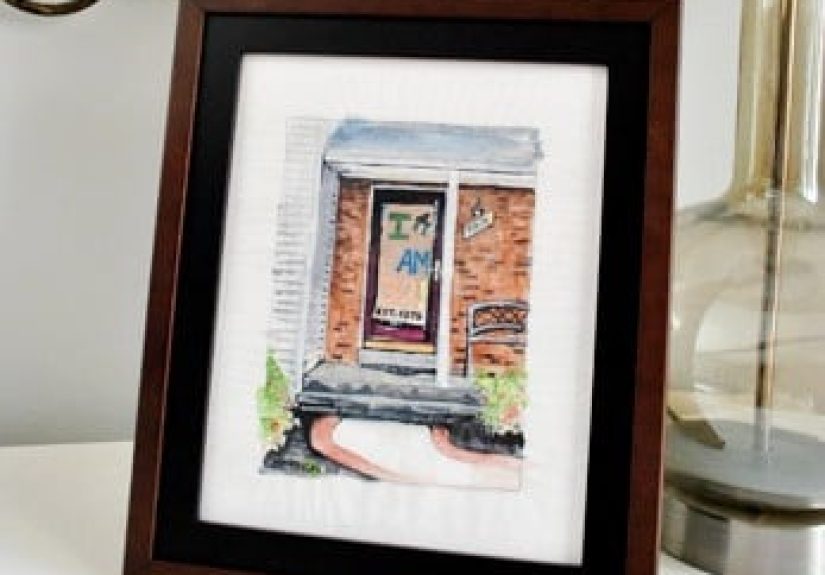
Tiny living isn’t always a tiny houseit’s sometimes a small apartment with big memories. Commission a portrait of the building entrance, the balcony view, or even the favorite corner by the window. It’s subtle, meaningful, and won’t feel like you’re gifting them a painting of their landlord’s questionable paint job.
What to Write in the Card (Steal These Lines)
- For move-in: “May this tiny home hold big joy, big peace, and exactly zero surprise leaks.”
- For moving away: “Some places become part of us. Here’s a little piece you can take with you.”
- For a couple: “Same team, new address. Let the adventure begin.”
- For a realtor closing gift: “Congratulations on your new homemay it be the setting for your best chapters yet.”
Common Mistakes to Avoid
- Using a blurry photo and expecting the artist to “enhance it” like a TV detective
- Waiting too long and then asking for a 3-day turnaround (some artists can, many can’t)
- Overloading details (yes, you love the whole neighborhood, but we’re painting a house, not a city planning map)
- Choosing a frame that’s too bold (the frame should not scream louder than the artwork)
Experiences: What People Notice After Giving a Tiny House Painting (About )
People who give house portraitsespecially tiny house paintingsoften report the same surprise: the recipient doesn’t just say “thank you,” they tell a story. One couple who moved into a tiny house on wheels described how the painting became their “anchor” during the first month. They were living among half-unpacked bins, negotiating where the broom should live (answer: everywhere and nowhere), and learning the rhythm of a smaller space. The painting went up earlybefore the “real” décorbecause it made the home feel real. It wasn’t decoration; it was a flag planted in new ground: we’re here, we did it, this is ours.
In another scenario, a friend gifted a tiny house portrait as a moving-away present to someone leaving a rental they’d lived in for years. The gift worked because it acknowledged something people rarely say out loud: even temporary places can be sacred. The recipient didn’t cry because the building was stunning; they cried because the painting made the memories visible. They pointed at the front steps and laughed about the time the delivery person left groceries on the neighbor’s porch. They pointed at the window and remembered the cat’s favorite sunspot. A good house portrait isn’t just architectureit’s a memory map.
Realtors and friends who’ve used custom home art as a closing gift often describe a “second wave” effect: the gift keeps paying off. Months later, clients send photos of the painting hung in the living room or entryway. It becomes part of the home’s identity, especially for first-time buyers who are building their sense of “home” from scratch. One recipient described it as “the first thing that felt like ours,” which is high praise in a world where new homeowners are usually buried under instruction manuals and opinions about grout.
There’s also a practical emotional benefit people don’t expect: it softens the stress of moving. Moving can feel like constant decision-making boxes, budgets, timelines, utilities, addresses, keys, and that one mystery cord nobody can identify. A tiny house painting interrupts the chaos with a moment of meaning. It’s a pause button. Recipients often display it quickly because it creates comfort without requiring effort. No batteries, no setup, no “some assembly required.”
And for tiny-home folks specifically, the painting can feel like validation. Tiny living is sometimes misunderstood (“Where do you put your stuff?” “Do you have a real bathroom?”). A portrait says: this is legitimate, this is beautiful, this is a home worth celebrating. It turns the tiny house from a conversation piece into a personal landmark. The best part is that even years laterafter moves, upgrades, or a new chapterthe painting remains a compact reminder of a brave choice: living with intention.
Conclusion: A Small Gift That Feels Huge
A tiny house painting as a moving gift works because it’s specific, sentimental, and surprisingly practical for real life. It marks a transition without adding clutter, and it honors a home’s meaning without needing to guess someone’s style. Whether you’re welcoming someone into a new tiny space or helping them say goodbye to an old one, a house portrait turns an address into a memory they can hang on the walland keep long after the boxes are gone.