Table of Contents >> Show >> Hide
If English pronunciation sometimes feels like your mouth is doing parkour without your permission, welcome to the club. Tongue twisters are one of the most entertaining ways to train your speech muscles, sharpen tricky sounds, and turn awkward mumbling into clearer speaking. They are silly on purpose, hard by design, and surprisingly useful when you want to sound more precise in everyday English.
The secret is not speed. That is where people go gloriously wrong. They see a tongue twister, immediately floor the gas pedal, and then wonder why “red lorry, yellow lorry” turns into a verbal car crash. The real value of tongue twisters is that they force you to notice consonants, feel mouth placement, and practice sound contrasts such as s vs. sh, r vs. l, or voiced and voiceless th. In other words, they are tiny pronunciation gyms with worse parking and better jokes.
Why tongue twisters help pronunciation
Tongue twisters work because they pack similar sounds close together. That makes your tongue, lips, jaw, and breath coordination work harder than they normally do in casual speech. When you practice them carefully, you become more aware of how English sounds are formed. You also start hearing the difference between sounds that once seemed nearly identical.
They are especially helpful for English learners who want to improve articulation, rhythm, and confidence. Actors, public speakers, teachers, and language learners have used them for years as warm-ups because they challenge clarity in a playful way. Better yet, they make practice less boring. Repeating isolated sounds for ten minutes can feel like homework. Repeating a line about a suspiciously busy woodchuck feels like chaos with educational benefits.
How to practice tongue twisters the smart way
1. Start painfully slowly
Yes, slowly. Almost annoyingly slowly. Say each word clearly before trying to speed up. Fast mistakes only teach your mouth to make fast mistakes.
2. Focus on one sound pattern at a time
If a twister targets s and sh, pay attention to those sounds first. If it targets r and l, listen for how your tongue changes position. Do not try to fix everything at once.
3. Repeat in short rounds
Try each line three to five times. First slowly, then at a natural pace, then a little faster. If it falls apart, that is not failure. That is feedback wearing clown shoes.
4. Record yourself
Your ears catch things your mouth tries to hide. Recording helps you notice dropped consonants, blurred vowels, and places where you rush.
5. Choose twisters for your weak spots
If th is difficult, use th drills. If r and l fight each other in your speech, choose lines built around those sounds. Targeted practice beats random suffering every time.
100+ English tongue twisters for pronunciation practice
Below, you will find classic favorites and fresh pronunciation-focused practice lines. Use them as warm-ups, classroom activities, speech drills, or a quick daily challenge when your mouth needs a workout.
Easy warm-up tongue twisters
- Big black bug bit a big black bear.
- Fresh fried fish.
- Blue bluebird blinks.
- Twelve twins twirled twelve twigs.
- Quick kiss, quick kick.
- Green glass globes glow.
- Friendly fleas and fireflies flew.
- Busy buzzing bumblebees buzzed.
- Cup of coffee in a copper coffee cup.
- Tiny turtles tiptoe to town.
- Six slick snails slid slowly.
- Seven silver swans swam silently.
- Fine fresh fried fish for Friday.
- Black background, brown background.
- Crisp crusts crackle quickly.
- Eleven elves licked eleven lemons.
- Greek grapes, great Greek grapes.
- Noisy knives need new knobs.
- Red berries really ripen rapidly.
- Wise wives weave wool well.
Tongue twisters for S and SH sounds
- She sells seashells by the seashore.
- Sally softly shooed seven silly sheep.
- Six slippery sharks shared shiny shells.
- Sandy sees six shining city signs.
- Susie shined Sam’s silver shoes.
- Short shiny shoes should stay spotless.
- Seven shy sailors shipped shiny sugar.
- Silly seals sang soft sea songs.
- Sean’s sharp scissors sliced silk socks.
- Sunshine showers should stop soon.
- I saw seven sharks share shrimp.
- Small snakes slide silently south.
- Susan’s sisters sewed shiny shirts.
- Sea spray splashed on six small stones.
- She surely sees the sun shine soon.
- Sasha stitched six short sheets.
- Shell shops sell short shell spoons.
- Six sharp students shared sushi.
- Sweet sherbet slowly slid south.
- Sixty-six slippery silver spoons.
Tongue twisters for R, L, and W sounds
- Red lorry, yellow lorry.
- Rory rarely rolls really round rocks.
- Larry loves rolling little red rollers.
- Real rural rulers rarely rule well.
- Really leery lions like red lilies.
- Will’s red wagon rolled wildly.
- Lily likes lovely little lilac lamps.
- Rural rabbits rarely race red reindeer.
- Laura reads red leather labels.
- Rolling rivers ripple around rocky ledges.
- We really will relay red letters.
- Loyal lawyers rarely lower royal rules.
- Blue lizards leap over lazy llamas.
- Red rails and yellow wheels whirl.
- Walter’s white wool wraps well.
- Little rulers rule large rooms rarely.
- Rarely will Rory wear raw wool.
- Rolling red marbles rattle loudly.
- Lovely yellow lilies lean left.
- Wild red roses really look lively.
Tongue twisters for TH, T, and D sounds
- Thirty-three thirsty thieves thanked Theo.
- Three thin thinkers thought thick thoughts.
- Those thirty brothers bathed Thursday.
- This thin thread ties three thick towels.
- Theo threw three thin things there.
- Theodore thought the thaw was Thursday.
- Thirty thick thistles thrilled the throne.
- They thought that their feathers were thinner.
- These thieves thumped thirty drums.
- Three tough dads threaded tiny needles.
- That theater thrives on thick thunder.
- Those thoughtful authors thank their readers.
- Three tiny turtles tossed thick toast.
- Thick thorns tore the thin cloth.
- This and that are thoroughly different.
- Thirty thankful students threw their hats.
- The dentist thought the tooth was there.
- These northern brothers bathe in thunder.
- Three thunderous thoughts thrilled them.
- Though they thought of Thursday, they studied today.
Tongue twisters for P, B, F, V, K, and G sounds
- Peter Piper picked a peck of pickled peppers.
- Betty Botter bought some butter.
- Victor baked velvet vanilla biscuits.
- Five brave bakers baked brown bagels.
- Fred’s fresh figs fell from five forks.
- Viv’s vivid violets filled five vases.
- Big blue balloons bob by bridges.
- Paul proudly packed purple paper planes.
- Four fine flamingos flipped flatfish.
- Very brave beavers build vast barns.
- Kate cooked crunchy carrot cakes.
- Greg grabbed green grapes quickly.
- Clever cooks keep clean copper kettles.
- Good goats gobble garden greens.
- Crisp crackers crack in crowded kitchens.
- Brave brown bears bake berry bread.
- Victor’s vacuum vibrated very violently.
- Patty’s puppy pounced on pepper pizza.
- Golden geese gobbled garlic grains.
- Five fuzzy ferrets found velvet vests.
Advanced tongue twisters for serious pronunciation practice
- How much wood would a woodchuck chuck if a woodchuck could chuck wood?
- Fuzzy Wuzzy was a bear; Fuzzy Wuzzy had no hair.
- I wish to wash my Irish wristwatch.
- Which witch switched the Swiss wristwatches?
- If two witches were watching two watches, which witch would watch which watch?
- A proper copper coffee pot.
- Lesser leather never weathered wetter weather better.
- I scream, you scream, we all scream for ice cream.
- Six sick hicks nick six slick bricks with picks and sticks.
- The sixth sick sheik’s sixth sheep’s sick.
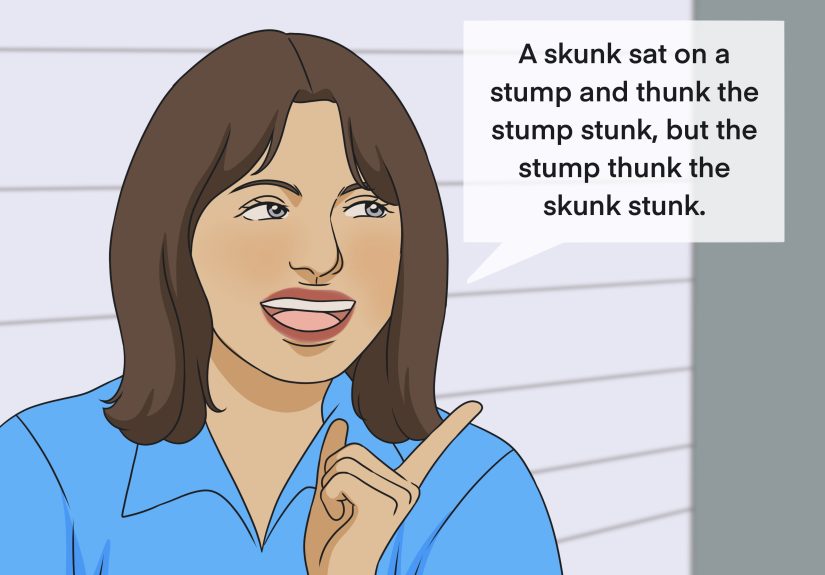
- A skunk sat on a stump and thunk the stump stunk.
- I slit a sheet, a sheet I slit, and on the slitted sheet I sit.
- Drew Dodd’s dad’s dog died.
- Top chopstick shops stock top chopsticks.
- If a dog chews shoes, whose shoes does he choose?
- Can you can a can as a canner can can a can?
How to choose the right tongue twister for your needs
If you want clearer everyday English, do not just pick the hardest line and wrestle it into submission. Choose the sound you actually need. For example, use “She sells seashells by the seashore” for s and sh. Use “Red lorry, yellow lorry” for r and l. Use th-heavy drills when you struggle with words like think, this, those, or thirty. The more specific the match, the more useful the practice.
You can also build a mini routine. Start with two easy warm-ups, move to two targeted drills, and finish with one advanced challenge. Five minutes a day is enough to make pronunciation practice feel regular rather than dramatic. Your mouth does not need a heroic speech boot camp. It needs consistency and a little chaos.
What practicing tongue twisters really feels like
Here is the honest experience nobody tells you about: the first few attempts usually sound ridiculous. Not a little ridiculous. Full cartoon-level ridiculous. You begin with confidence, hit the second or third repetition, and suddenly your tongue files for emotional leave. That is normal. In fact, it is part of the charm. Tongue twisters expose exactly where your pronunciation gets lazy, rushed, or tangled. They are like tiny mirrors for your speech, except these mirrors laugh a bit.
Many learners notice the same pattern. At first, they think the problem is speed. Then they slow down and realize the real issue is sound control. Maybe r turns into w. Maybe s and sh blur together. Maybe the th sound disappears completely and gets replaced by d, t, or s. Tongue twisters make those weak spots impossible to ignore, which is actually a good thing. Once you can hear the problem, you can start fixing it.
There is also a very satisfying moment that happens after a few days of practice. A line that felt impossible suddenly becomes manageable. Not perfect, not magical, but clearly better. Your mouth starts anticipating the sound pattern. Your tongue moves with less hesitation. You stop fighting every syllable and begin to feel the rhythm of the sentence. That tiny improvement is a huge confidence boost, especially for learners who feel shy about speaking English out loud.
Another common experience is that tongue twisters improve more than pronunciation alone. They can make you more alert when listening, because you begin to notice sound differences in real speech. They also help with pacing. If you tend to rush, mumble, or swallow endings, tongue twisters train you to slow down just enough to stay understandable. That is a big win in conversations, presentations, interviews, and classroom speaking tasks.
And yes, there is a social side to all of this. Tongue twisters are one of the few pronunciation exercises people actually enjoy doing together. Friends laugh. Classmates compete. Families get weirdly invested in whether someone can say “Irish wristwatch” without melting into vowels. That fun matters. When practice feels playful, people stick with it longer. And when they stick with it longer, they improve.
The best experience, though, is the shift from fear to curiosity. Instead of thinking, “My pronunciation is bad,” you start thinking, “Interesting, that sound is hard for me. Let me train it.” That mindset changes everything. Tongue twisters turn pronunciation from a scary mystery into a skill you can practice one sound cluster at a time. Messy? Absolutely. Helpful? Also absolutely. Humbling? Oh, without question.
Final thoughts
Tongue twisters in English are not just goofy lines you race through for bragging rights. They are practical pronunciation tools that help you hear better, speak more clearly, and gain control over sounds that usually cause trouble. Start slow, stay consistent, and let the mistakes teach you where to focus. With enough practice, your speech becomes cleaner, your confidence grows, and your mouth stops acting like it has never met English before.