Table of Contents >> Show >> Hide
- The Grand Finale: Cassini’s Daring Last Act
- What Cassini Saw Inside the Rings
- Cassini’s Close-Up View of Saturn’s Atmosphere
- Saturn’s Magnetic Field Was Stranger Than Expected
- Gravity Data Helped Weigh the Rings
- Did Cassini See the Rings Disappearing?
- Why Cassini Had to Die
- What Cassini Changed About Saturn Science
- Experience Section: What It Feels Like to Follow Cassini’s Dive Inside Saturn’s Rings
- Conclusion
- SEO Tags
Imagine being a spacecraft the size of a school bus, carrying twenty years of cosmic mileage, and being told your retirement plan is to thread a narrow gap between Saturn and its rings at highway-speed times “please do not try this at home.” That, in delightfully dramatic terms, was NASA’s Cassini spacecraft during its Grand Finale. After spending 13 years orbiting Saturn, Cassini was sent on a daring series of dives between the giant planet and the inner edge of its rings. No spacecraft had ever explored that region before. Saturn had always looked elegant from afar, like the Solar System’s most fashionable planet wearing a glittering hula hoop. Cassini went closer and discovered that the scene was not just beautifulit was busy, messy, electric, dusty, icy, chemically surprising, and scientifically priceless.
The story of what Cassini saw when it dove inside Saturn’s rings is really a story about turning the end of a mission into a new beginning. The spacecraft was running low on fuel, and mission planners needed to make sure it would not someday crash into Enceladus or Titan, two moons with astrobiological interest. Instead of letting Cassini wander like a confused Roomba in the Saturn system, engineers aimed it at Saturn itself. Before that final plunge, however, they used the last months to collect data from places no machine had ever visited.
The Grand Finale: Cassini’s Daring Last Act
Cassini’s Grand Finale began in April 2017, when the spacecraft started a sequence of 22 close orbits through the gap between Saturn’s cloud tops and the innermost visible rings. That gap was roughly 1,200 miles wide, which sounds huge until you remember Saturn is about nine times wider than Earth and its rings stretch hundreds of thousands of kilometers across. In Saturn terms, Cassini was tiptoeing through a cosmic doorway with a very expensive backpack.
The spacecraft used its large high-gain antenna as a shield during the earliest dives, because scientists did not know how dusty or dangerous the gap might be. Even a tiny particle moving at high speed could damage sensitive instruments. Cassini was not just sightseeing; it was entering an unknown lane of the Solar System where ice grains, dust, magnetic fields, and radiation could all make trouble.
The payoff was enormous. During these dives, Cassini measured Saturn’s gravity and magnetic fields, sampled particles falling from the rings, photographed the planet from ultra-close range, studied atmospheric structure, and helped scientists refine the mass and possible age of Saturn’s rings. It was like using the final chapter of a book to reveal that the previous 400 pages had secret footnotes.
What Cassini Saw Inside the Rings
1. A Surprisingly Empty Gap
One of the first surprises was what Cassini did not see: a dense storm of dust. Before the first dive, mission engineers prepared for a rough crossing. Saturn’s rings are made of countless icy particles ranging from tiny grains to chunks as large as houses. It was reasonable to think the region near the rings might be filled with hazardous debris.
Instead, Cassini’s instruments detected only a few dust “pings” during the first crossing. The Radio and Plasma Wave Science instrument, which could detect impacts from tiny particles, found the gap between Saturn and the rings to be much cleaner than expected. Outside the main rings, Cassini had previously recorded hundreds of particle hits per second. In the gap, the spacecraft encountered far fewer. Scientists had aimed Cassini’s antenna forward like a shield, but the spacecraft basically entered the cosmic equivalent of a freshly swept hallway.
This discovery mattered because it allowed later dives to be conducted with more confidence. The emptiness also raised new questions: why was this region so clean, and what forces were sweeping it? Saturn’s gravity, magnetic field, atmosphere, and ring dynamics were all part of the answer.
2. Ring Rain Falling Into Saturn
One of Cassini’s most fascinating discoveries was “ring rain,” a process in which material from Saturn’s rings falls into the planet’s upper atmosphere. Scientists had suspected for decades that charged particles from the rings could slide along magnetic field lines and enter Saturn’s atmosphere at certain latitudes. Cassini’s final orbits showed that the process was more complex than expected.
The spacecraft detected tiny grains and molecules moving from the rings toward Saturn. Some particles were electrically charged and followed magnetic pathways. Others appeared to be dragged more directly into the equatorial atmosphere. This meant Saturn was not simply wearing its rings like jewelry. It was slowly eating them. Very slowly, yesbut in planetary terms, “slowly” can still mean a spectacular amount of material over time.
Cassini found that water ice, silicates, methane, ammonia, carbon monoxide, nitrogen, carbon dioxide, and organic compounds were involved in the material streaming from the rings. For a planet that looks calm and stately through a backyard telescope, Saturn was running a surprisingly active recycling program.
3. Complex Chemistry in the Ring Material
Before Cassini’s Grand Finale, scientists knew Saturn’s rings were mostly water ice. That is why they shine so brightly. Clean ice reflects sunlight well, which gives the rings their famous glow. But the remaining fraction of non-ice material was more mysterious.
During the final dives, Cassini’s instruments directly sampled material coming from the rings and found a richer chemical mixture than many expected. The spacecraft detected complex organic molecules embedded in tiny icy grains. These organics were not proof of life, and nobody should imagine tiny Saturnian microbes throwing a pool party in the rings. But the chemistry did reveal that Saturn’s ring system is not chemically boring. It contains a variety of compounds that help scientists understand how material moves and changes in the outer Solar System.
The chemistry also suggested that Saturn’s system has multiple reservoirs of organic material. Titan has its own methane-rich chemistry. Enceladus sprays water vapor and organic compounds from its subsurface ocean. The rings, Cassini showed, have their own chemical identity as well. Saturn’s neighborhood is less like a single planet with accessories and more like an entire laboratory with different departments.
Cassini’s Close-Up View of Saturn’s Atmosphere
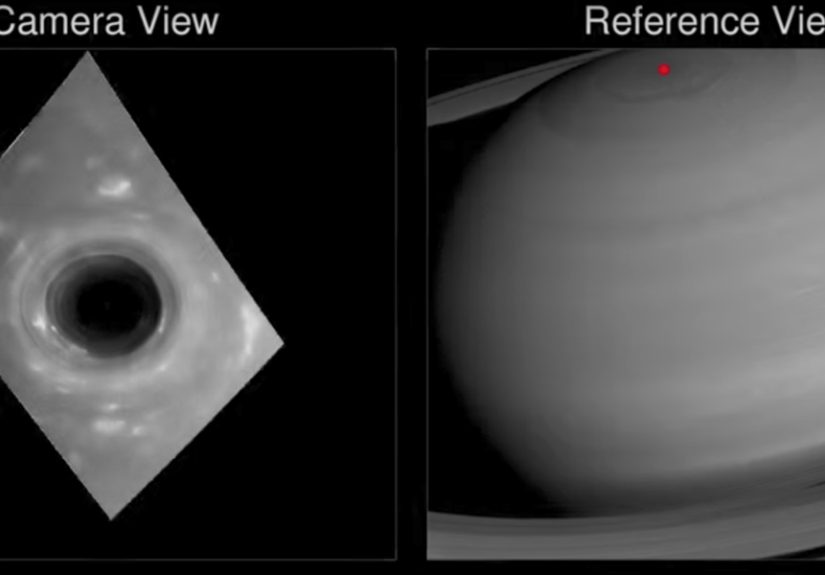
When Cassini passed inside the rings, it flew closer to Saturn’s atmosphere than ever before. Its cameras and instruments observed cloud bands, storms, atmospheric layers, and the planet’s polar regions from dramatic angles. From Earth, Saturn often looks like a pale yellow marble with rings. Up close, it becomes a world of motion: jet streams, waves, hazes, vortices, and storms wrapped around a hydrogen-helium giant.
One of the most iconic features Cassini studied was Saturn’s north polar hexagon, a six-sided jet stream pattern wide enough to swallow Earth. During the mission, Cassini watched this feature change with Saturn’s seasons. The Grand Finale added ultra-close atmospheric data that helped scientists study how Saturn’s upper atmosphere interacts with ring material, charged particles, and magnetic forces.
Cassini also measured Saturn’s upper atmosphere during its final plunge on September 15, 2017. In its last moments, the spacecraft transmitted data in real time as it entered the atmosphere. It continued sending signals until atmospheric drag overwhelmed its ability to point its antenna toward Earth. That final data stream was not a Hollywood explosion shot; it was quieter, more scientific, and somehow more moving. Cassini did not “go dark” until it had worked as long as physics allowed.
Saturn’s Magnetic Field Was Stranger Than Expected
Magnetic fields are invisible, but they shape the behavior of charged particles, radiation belts, auroras, and ring-atmosphere interactions. Cassini’s Grand Finale gave scientists the first direct measurements of Saturn’s magnetic field from extremely close range.
One major surprise was how closely Saturn’s magnetic field lines up with the planet’s rotation axis. Usually, a planet’s magnetic field is tilted at least a little compared with its spin axis. Earth’s magnetic field, for example, is tilted enough that the magnetic north pole and geographic North Pole are not the same place. Saturn’s field, however, appeared astonishingly well aligned. That is a problem for standard dynamo theories, because those theories generally need some tilt or asymmetry to explain how a planetary magnetic field is generated and maintained.
In plain English: Saturn looked at scientists’ models and said, “Cute. Try again.” Cassini’s data pushed researchers to rethink what is happening deep inside the planet, where metallic hydrogen, pressure, heat, and rotation combine to produce the magnetic field.
Gravity Data Helped Weigh the Rings
Another major goal of Cassini’s final orbits was to measure Saturn’s gravity field with extraordinary precision. By tracking tiny changes in Cassini’s motion, scientists could separate the gravitational pull of Saturn from the gravitational pull of the rings. That helped them estimate the mass of the ring system more accurately than before.
The result supported the idea that Saturn’s rings are relatively young compared with the 4.5-billion-year age of the Solar System. They may be only tens to hundreds of millions of years old, meaning they could have formed when dinosaurs were already walking on Earth. That does not mean a T. rex ever looked up and admired Saturn’s jewelry; Saturn was not exactly visible in dinosaur astronomy class. But it does mean the rings may be a recent feature in planetary history.
The reasoning is elegant. Saturn’s rings are bright and icy. Over long periods, dust from space should darken them. If the rings were ancient, they would likely be more polluted and heavier with accumulated debris. Cassini’s ring-mass measurements, combined with their brightness, suggest they may not have been around since Saturn formed. They could be the remains of a shattered icy moon, a disrupted comet, or another violent event in the Saturn system’s past.
Did Cassini See the Rings Disappearing?
Not in the dramatic sense of watching them vanish like a magician’s scarf. Saturn’s rings are still there, still glorious, and still capable of making every other planet look underdressed. But Cassini helped confirm that ring material is gradually falling into Saturn. Along with other observations, this suggests the rings are temporary on cosmic timescales.
That idea changes how we think about Saturn. The rings are not permanent decorations. They are dynamic structures, constantly shaped by gravity, collisions, moonlets, electromagnetic forces, and atmospheric drag. The rings spread, clump, ripple, brighten, darken, and slowly feed the planet below. They are not a static postcard. They are an active system.
Cassini saw waves in the rings created by tiny moons and gravitational resonances. It observed “propeller” features caused by embedded moonlets too small to clear full gaps. It watched ring shadows shift with seasons and revealed vertical structures that rose above the ring plane. The Grand Finale added the missing close-up perspective: what happens at the inner edge, where rings and planet meet.
Why Cassini Had to Die
Cassini’s final plunge was not a failure. It was a carefully planned act of planetary protection. The spacecraft had discovered that Enceladus has a global subsurface ocean and plumes that spray water ice into space. Titan, meanwhile, has lakes and seas of methane and ethane, along with complex organic chemistry. Both moons are scientifically precious. If Cassini had been left uncontrolled, it might eventually have crashed into one of them.
Even though Cassini had spent years in deep space, mission planners did not want to risk contaminating a potentially habitable environment with Earth microbes. So they chose Saturn as the safest final destination. The planet’s crushing atmosphere would destroy the spacecraft completely.
On September 15, 2017, Cassini entered Saturn’s atmosphere and became part of the planet it had studied for more than a decade. It was a poetic ending, but also a practical one. Science may love poetry, but it still checks the engineering spreadsheet.
What Cassini Changed About Saturn Science
Before Cassini, Saturn was already famous. After Cassini, Saturn became personal. The mission revealed the planet as a complex system: rings connected to atmosphere, moons connected to rings, magnetic fields connected to chemistry, and tiny particles connected to giant planetary evolution.
Cassini showed that Enceladus has ingredients that make it one of the most compelling places in the Solar System to study habitability. It mapped Titan through haze and found methane lakes, river channels, dunes, and weather. It observed storms on Saturn, discovered new ring structures, and watched seasonal changes unfold over years. The Grand Finale then delivered the closest, boldest measurements of the planet-ring boundary.
So what did Cassini see inside Saturn’s rings? It saw a gap cleaner than expected, ring material falling like invisible rain, organic compounds riding icy grains, a magnetic field that challenged theory, gravity clues that helped weigh the rings, and a planet still full of surprises after centuries of observation. Cassini proved that even the most familiar wonders in the sky can become strange again when we dare to get close.
Experience Section: What It Feels Like to Follow Cassini’s Dive Inside Saturn’s Rings
Following Cassini’s Grand Finale as a space fan felt a bit like watching a brilliant explorer walk into a storm with a notebook in one hand and a polite goodbye letter in the other. There was excitement, of course, because the mission promised science from a place no spacecraft had ever visited. But there was also a strange sadness. Cassini had been part of modern space exploration for so long that its ending felt personal, even for people who had never touched a spacecraft console or sat inside mission control.
The most powerful part of the experience was realizing how much patience space exploration requires. Cassini launched in 1997, reached Saturn in 2004, and spent years building a deep, detailed portrait of the planet and its moons. In an age when people get impatient if a web page takes four seconds to load, Cassini was a reminder that the universe does not run on snackable content. The best discoveries often arrive slowly, after years of careful observation, calibration, correction, and debate.
Watching the images from Cassini’s final days also changed the way Saturn felt. Through a telescope, Saturn can seem almost unreal, too perfect to belong to the same messy universe as Earth. Cassini’s close views made it feel physical. The rings were not smooth lines; they were lanes of ice, waves, gaps, textures, and shadows. Saturn’s atmosphere was not a painted ball; it was a deep, moving ocean of gas. The planet became less like a logo and more like a place.
There was also something unforgettable about the idea of Cassini using its final moments to keep working. During the last plunge, the spacecraft transmitted data until it could no longer maintain contact with Earth. That detail gives the mission a sense of character, even though Cassini was a machine. It did not have feelings, but it had purpose. Every circuit, instrument, and command sequence had been designed by humans who wanted one more measurement, one more clue, one more honest answer from Saturn.
For readers, students, and casual astronomy lovers, Cassini’s ring dives offer a useful lesson: science is not just about confirming what we already think. It is about building a plan strong enough to survive surprise. Scientists expected danger in the gap and found it cleaner than predicted. They expected ring rain, but the details were stranger and richer than the old models. They expected Saturn’s magnetic field to reveal its rotation more easily, but Saturn answered with a mystery. That is not a weakness of science. That is the fun part. The universe keeps its best jokes hidden in the data.
The experience of learning about Cassini’s dive inside Saturn’s rings is ultimately humbling. A spacecraft built on Earth crossed billions of miles, orbited a giant planet, studied alien moons, flew through an unexplored gap, and ended by protecting future discoveries. That is a pretty good résumé. Most of us are proud when we remember where we put our keys. Cassini remembered how to navigate Saturn.
Conclusion
Cassini’s dive inside Saturn’s rings turned the mission’s final months into one of its greatest scientific achievements. The spacecraft found that the gap between Saturn and its rings was unexpectedly clean, discovered direct evidence of ring material falling into the planet, sampled complex chemistry, measured Saturn’s gravity and magnetic fields, and helped scientists understand the rings’ mass and possible youth. Its final act was not just a farewell. It was a masterclass in how to end a mission with purpose, courage, and a spectacular amount of data.
Saturn’s rings may look eternal, but Cassini showed they are active, changing, and possibly temporary. That makes them even more beautiful. They are not just a decoration around a distant planet. They are a cosmic event still unfolding. And thanks to Cassini, humanity got to fly inside the story.