Table of Contents >> Show >> Hide
- Shipwrecks: The World’s Most Expensive “Do Not Touch” Signs
- Meet OceanOne: A Humanoid “Avatar” With Haptic Hands
- How the Robot Lets You “Feel” Underwater
- Real Shipwreck Missions: From “Hello, La Lune” to One-Kilometer Dives
- What Touch Adds That Cameras and Sonar Don’t
- Conservation First: When Touch Is Also a Risk
- Not Just Shipwrecks: The Same Touch Tech Helps Industry and Science
- What’s Next: Better “Skin,” Smarter Assistance, More Immersive Control
- Conclusion
- Field Notes: What It’s Like to Explore a Wreck Through a Robot’s Hands (Experience Section)
Shipwrecks are basically underwater time capsulesexcept the “capsule” is rusting, covered in silt, and guarded by
physics. Down there it’s dark, cold, and pressurized enough to make a soda can look like it has performance anxiety.
So when scientists say they want to “handle” artifacts on the seafloor, what they usually mean is:
“Please don’t let anything crumble into historical confetti.”
Enter the tactile robot diver: a humanoid underwater robot built to act like a remote human presencean “avatar” that
can swim to a shipwreck, see in 3D, and (here’s the wild part) send touch sensations back to the person driving it.
Not metaphorical touch. Actual force feedback, so the pilot can feel resistance, weight, and contact while staying
dry on the surface. If that sounds like science fiction, don’t worryso did “video calls” and “air fryers.”
Shipwrecks: The World’s Most Expensive “Do Not Touch” Signs
Traditional shipwreck exploration is a constant negotiation with depth limits, decompression schedules, and the fact
that human bodies are not factory-rated for the deep ocean. Even when divers can reach a site, bottom time is short,
visibility can be awful, and fine motor control gets complicated when you’re wearing gloves thick enough to wrestle
a lobster.
Remotely operated vehicles (ROVs) solved part of the problem by letting pilots explore from a ship using cameras and
robotic arms. But here’s what many ROV operators won’t say out loud: doing delicate manipulation with a video feed
alone can feel like trying to thread a needle while watching your hands on a laggy security camera.
That’s why touch matters. Vision tells you where your gripper is. Touch tells you whether you’re crushing a centuries-old
ceramic… or gently lifting it like a museum curator with a PhD and very steady hands.
Meet OceanOne: A Humanoid “Avatar” With Haptic Hands
The best-known example of this tactile robot diver idea is Stanford’s OceanOne familyhuman-shaped up top, streamlined
down below, and designed around a simple goal: let experts interact with deep-sea environments as naturally as possible,
without sending those experts into the danger zone.
Why build a humanoid underwater?
A fish-shaped robot is great at swimming. A work-shaped robot is great at working. Shipwreck exploration often needs
“human-style” tasks: reaching into tight spaces, lifting fragile objects, turning tools, nudging sediment aside without
bulldozing the scene, and positioning cameras as if you were peering around a beam with your own head.
Humanoid proportions also make teleoperation more intuitive. When the robot’s “eyes” sit above its arms the way yours do,
and its hands approach objects from familiar angles, your brain spends less time translating “robot geometry” and more time
doing what it’s good at: careful manipulation.
The hands that talk back
OceanOne’s signature feature is its touch-enabled manipulation. Force/torque sensing and compliant control help it grasp
objects delicately, while the pilot uses force-feedback controls (haptic interfaces) to feel what the robot feels.
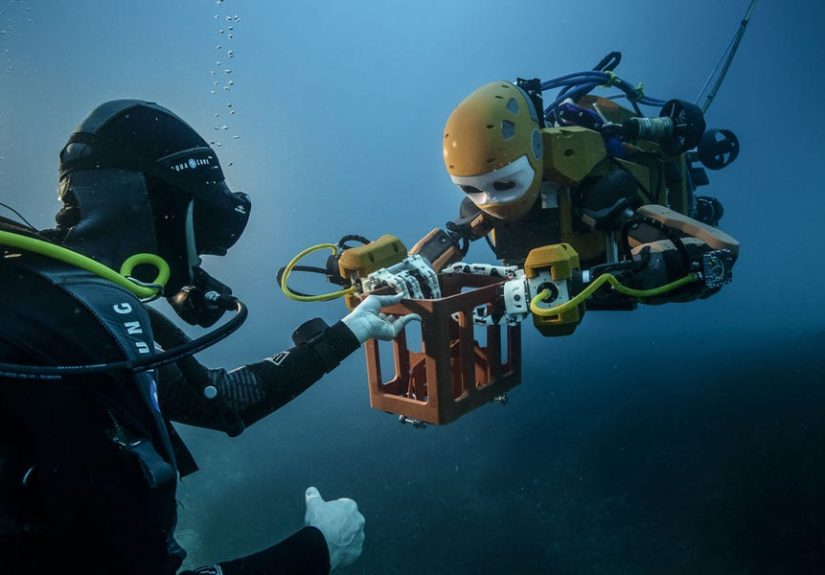
Think of it as a handshake across 300 feet of oceanexcept the handshake is with an artifact basket, and everyone’s trying
not to break history.
How the Robot Lets You “Feel” Underwater
Haptic feedback: not just vibration, but “physics delivered”
“Haptics” gets used casually to mean buzzes and rumbles (your phone does that). But in underwater robotics, the really
valuable piece is force feedback: the system measures interaction forces at the robot’s arms/hands and reflects them back
to the operator through motors in the control device.
When the robot bumps a timber, the pilot feels the contact. When a gripped object resists being lifted, the pilot senses
that resistance. When the robot starts to squeeze too hard, the controls push back, prompting the operator to ease up.
This reduces guesswork and helps prevent damageboth to artifacts and to the robot’s own hands.
Staying gentle in an environment that is not gentle
Water is a noisy medium. Currents push. Sediment swirls. Visibility shifts. Even the robot’s own thrusters can kick up
a dust storm of silt if the pilot isn’t careful. That’s why modern systems blend human control with robotic “assist”
behaviorsstabilizing posture, smoothing motion, and helping maintain safe contact forces.
OceanOneK, a later deep-diving iteration, pairs this tactile telepresence idea with design choices for extreme pressure:
buoyancy materials engineered for depth, careful sealing, and control systems built for stable maneuvering.
The result is a robot that can operate far deeper than diverswhile still letting a human expert do the nuanced parts.
Real Shipwreck Missions: From “Hello, La Lune” to One-Kilometer Dives
This isn’t a lab-only gimmick. OceanOne made headlines for exploring the wreck of La Lune, a 17th-century shipwreck
associated with King Louis XIV’s fleet. The robot’s careful manipulation helped recover a fragile artifact (often described
as a vase) from the sitean early proof that touch-enabled teleoperation can handle delicate recovery without treating the
seafloor like a claw-machine arcade.
Later, OceanOneK expanded the concept to much deeper work. Stanford has described OceanOneK missions that included dives to
explore a range of underwater sitesships, aircraft wrecks, and a submarineand reaching depths approaching 1,000 meters in
the Mediterranean. Those depths are beyond the practical reach of human divers for anything resembling hands-on work.
The key storyline is consistent: the pilot remains topside, but with stereo vision and haptic feedback, the pilot can
interact with the environment in a way that feels far less “remote.” In other words, the robot doesn’t just show you the
shipwreckit gives you a way to physically understand it.
What Touch Adds That Cameras and Sonar Don’t
Sonar is great for mapping. Cameras are great for documenting. But shipwreck exploration is full of moments where neither
can answer the most important question: “What happens if I touch this?”
1) Safer handling of fragile artifacts
Consider a ceramic jug partially buried in silt. A camera can show the exposed rim, but not how firmly it’s wedged.
A haptic system lets the pilot probe gently, feel resistance, and adjust techniquelifting, wiggling, or backing offbefore
anything snaps. That tactile awareness is the difference between “museum exhibit” and “archaeological confetti.”
2) Better work in low visibility
Visibility underwater can go from “crystal clear” to “milkshake” in seconds. When silt blooms, touch becomes a navigation
sense. Feeling contact forces can help the pilot avoid scraping delicate structures, snagging cables, or turning an
exploration into an accidental demolition.
3) Intuitive precision for complex manipulation
Many ROV tasks demand subtle hand skills: aligning a sample container, nudging a camera pole into a narrow opening,
picking up small objects, or working around jagged metal edges. Force feedback provides real-time guidance that reduces
overcorrection and improves precisionespecially for tasks where millimeters matter.
4) A more “human” understanding of a site
Archaeology is partly about context: how objects sit, how materials feel, how structures interact. Touch adds a physical
layer of perceptionweight, stiffness, contactthat complements visual documentation. It’s the difference between watching
a cooking show and actually holding the knife (safely, and preferably not underwater).
Conservation First: When Touch Is Also a Risk
Let’s be clear: shipwrecks are not loot boxes. Many sites are protected by cultural heritage laws, ethical research
standards, and the simple principle that “future scientists deserve a turn.” A tactile robot diver doesn’t change that;
it just changes how carefully experts can do legitimate work.
In fact, better manipulation can support conservation. If an artifact must be recovered for preservation, precise
touch-enabled control can minimize damage. If a site should remain undisturbed, a robot can still document it thoroughly
while avoiding unnecessary contact. The robot becomes a tool for restraintnot just capability.
Not Just Shipwrecks: The Same Touch Tech Helps Industry and Science
The ability to “feel” underwater has obvious benefits beyond archaeology. Offshore energy infrastructure, subsea cables,
and underwater scientific sampling often require delicate operations in hazardous conditions. A touch-enabled telepresence
robot can help operators:
- Inspect and manipulate valves, connectors, and instruments without crushing or stripping components.
- Perform scientific sampling with more finesse than a standard claw-gripper approach.
- Reduce the training burden by making controls more intuitive for domain experts who aren’t full-time ROV pilots.
The direction of travel in underwater robotics is clear: more dexterity, more autonomy where it’s safe, and better human
interfaces where judgment matters. Touch is a big part of that, because underwater work is still, at heart, physical work.
What’s Next: Better “Skin,” Smarter Assistance, More Immersive Control
Today’s systems already prove the point: haptic feedback can make underwater manipulation safer and more precise.
The next leap is richer tactile sensingmore like a distributed “skin” than a few force sensorsso robots can detect
texture, slip, and subtle contact patterns.
Pair that with better autonomy (the robot handles stability, the human handles decisions), and you get something powerful:
a deep-sea platform that can explore shipwrecks gently, document them in detail, and interact only when necessaryguided
by expert hands that never have to leave the ship.
Conclusion
A tactile robot diver changes the vibe of shipwreck exploration from “look but don’t touch” to “touch, but with the care
of a museum conservator and the patience of a saint.” By combining stereo vision, dexterous arms, and haptic feedback,
systems like OceanOne and OceanOneK let experts interact with fragile underwater sites more safely than a human diver can,
and more precisely than a camera-only ROV often allows.
The ocean still keeps its secrets. But with the right robot, we can finally reach out and learnwithout breaking the past
to get to the story.
Field Notes: What It’s Like to Explore a Wreck Through a Robot’s Hands (Experience Section)
Picture this: you’re on a ship, but you’re not gearing up with tanks, weights, and a wetsuit that smells like the last
three summers. Instead, you’re sitting in a control station with two haptic controllerslike joysticks that went to grad
schooland a wall of screens showing a shipwreck that hasn’t been “touched” in centuries.
On the monitors, the robot drifts into view: humanoid torso, arms out front, thrusters quietly keeping position. The pilot
(that’s you, in this scenario) eases the robot closer to a broken beam. The video feed looks crispuntil the current
stirs up silt and the wreck starts fading into beige fog. Your eyes complain. Your hands don’t.
You nudge the controls and the robot’s fingertips make first contact. The controller pushes back just a bitlike tapping
a tabletop with your fingers. That tiny resistance instantly gives you information the camera never could: distance,
firmness, and whether you’re about to scrape something fragile. You pull away. You re-approach from a different angle.
This time, it’s a gentle touch along the surfacelike reading Braille, except the “text” is wood grain, corrosion, and
history.
A marine archaeologist behind you says, “Try that opening.” You guide the robot’s hand toward a dark gap in the hull.
On camera, it’s just shadow. Through haptics, it becomes geometry. The robot’s wrist senses a bumpmetal on metaland the
controller answers with a firm nudge that says, “Nope, that’s a sharp edge.” You rotate a few degrees, re-center, and feel
the resistance drop. Now you’re in.
Then comes the moment every expedition secretly wants: an object. Maybe it’s a small ceramic fragment, maybe it’s a piece
of rigging hardware, maybe it’s a human-made item that’s been waiting patiently for someone to notice it again. You slide
the robot’s fingers underneath. The controller suddenly feels heavier, as if gravity got routed through your palms.
That’s the robot reporting load. You lift slowlyno hero movesbecause you can feel how the object shifts and whether it’s
snagged on silt.
This is where touch is more than cool tech; it’s confidence. With camera-only teleoperation, pilots often “micro-panic”
and overcorrecttiny jerks, stop-and-go movement, the robotic equivalent of trying to carry a full cup of coffee while
walking on ice. With haptic feedback, you move smoother, because your hands are getting continuous guidance. When you
squeeze too hard, the controller fights you. When you’re too loose, you feel the object slip. It’s like the robot is
whispering, “Easy, champ,” in the language of physics.
After the lift, the artifact goes into a recovery basketor maybe you decide not to recover it at all, and instead document
it, measure it, and leave it exactly where it belongs. Either way, you come away with something rare: not just images of a
shipwreck, but a physical sense of it. You felt the contours. You felt the weight. You felt the moment where the past
stopped being a picture and became a thing againhandled carefully, respectfully, and with a robot doing the wet work.
And when you finally stand up from the controls, you realize the weirdest part: you’re tired in your hands, not your lungs.
Deep-sea exploration used to be limited by oxygen. Now it might be limited by how many hours your grip can handle
“historic delicacy mode.” Progress is funny like that.