Table of Contents >> Show >> Hide
- What Makes a Great Ricotta-Spinach Ravioli Filling?
- Ingredients
- Step-by-Step: Ricotta and Spinach Ravioli Filling
- How to Use This Filling for Homemade Ravioli
- Best Sauces for Ricotta and Spinach Ravioli
- Make-Ahead, Storage, and Freezing
- Troubleshooting
- Nutrition Snapshot (General)
- Conclusion
- Extra: Real-Life Experiences (and What You’ll Learn After One Ravioli Day)
If you’ve ever bitten into ravioli and thought, “Ah yes, delicious… but why is it also kind of a swamp?”
you’ve met the #1 enemy of homemade stuffed pasta: wet filling. The good news? A classic
ricotta and spinach ravioli filling is easy, quick, and ridiculously goodif you control moisture,
season like you mean it, and keep the texture’ in that sweet spot: creamy, spoonable, and politely cooperative.
This guide gives you a foolproof ricotta and spinach ravioli filling recipe plus the “why it works”
behind each step, so you can make ravioli that tastes like a cozy Italian trattoria momentwithout turning your pasta dough into papier-mâché.
What Makes a Great Ricotta-Spinach Ravioli Filling?
A winning filling has three traits:
- Dry enough to stay inside the ravioli (no leaks, no soggy seams).
- Seasoned enough to taste like something, even after boiling (water is a flavor thief).
- Balanced texturecreamy ricotta + finely chopped spinach + grated cheese for body.
The trick is not “more ingredients.” The trick is less water. Spinach holds a shocking amount of moisture,
and many ricotta brands come with extra whey. If you remove that liquid, your filling instantly gets thicker, richer, and easier to pipe or spoon.
Ingredients
Makes: about 2 1/2 to 3 cups filling (typically enough for 40–60 medium ravioli, depending on how generous you are).
Core Ingredients
- 15 oz whole-milk ricotta (drained if watery)
- 10 oz spinach (fresh or frozen)
- 1 large egg (binder)
- 1/2 to 3/4 cup finely grated Parmesan (or Parmigiano-Reggiano), plus more to taste
- 1/4 tsp freshly grated nutmeg (classic with spinach + dairy)
- 1/2 tsp kosher salt, plus more to taste
- Freshly ground black pepper
Optional “Make It Yours” Add-Ins
- 1 small garlic clove, finely grated (or 1/4 tsp garlic powder)
- 1 tsp lemon zest (brightens and cuts richness)
- 1–2 tbsp chopped fresh herbs (parsley, basil, chives)
- 2–4 tbsp shredded mozzarella (milder, stretchieruse sparingly to avoid gumminess)
- 1–2 tbsp fine breadcrumbs (only if you need emergency moisture control)
Step-by-Step: Ricotta and Spinach Ravioli Filling
Step 1: Dry the Spinach (Do Not Skip)
If using fresh spinach: rinse, then wilt it in a big skillet with a splash of water (or steam it).
Cook just until collapsed. Drain in a colander, cool slightly, then squeeze hardlike you’re trying to get the last drop of drama out of a group chat.
Chop very finely.
If using frozen spinach: thaw completely, then squeeze it dry in handfuls (or wrap in a clean towel and wring).
Chop again if it’s stringy. Frozen spinach is convenient, but it’s basically a spongesqueeze like you mean it.
Step 2: Drain the Ricotta (Only If Needed)
If your ricotta looks loose, glossy, or leaves puddles in the container, drain it.
Line a fine-mesh strainer with paper towels or cheesecloth, set it over a bowl, and let the ricotta sit
10–30 minutes (or longer in the fridge for very wet ricotta).
Why this matters: excess whey turns your filling runny, which can break seals and make the pasta soggy while it waits to be cooked.
Draining concentrates flavor and improves texture.
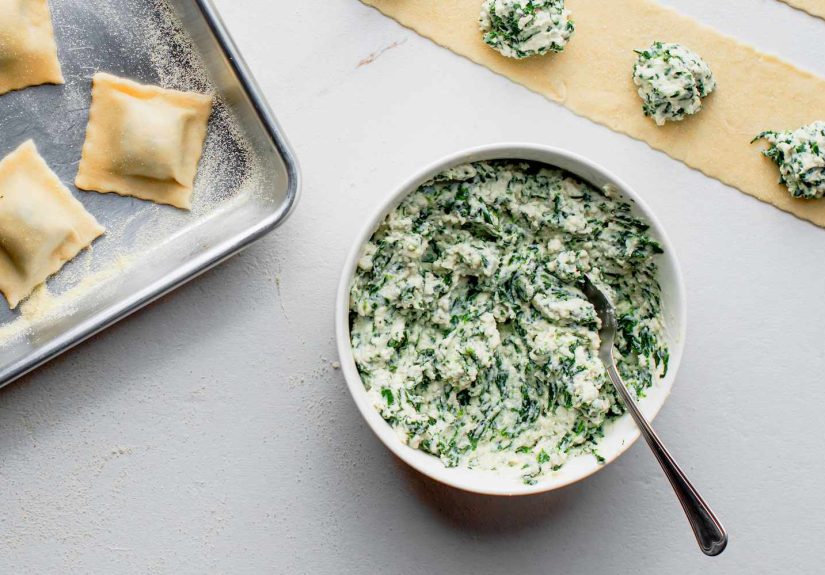
Step 3: Mix the Filling
In a medium bowl, combine:
ricotta, chopped spinach, Parmesan, egg, nutmeg, salt, and pepper.
Add any optional ingredients (garlic, lemon zest, herbs) now.
Mix with a fork or spatula until uniform. You want a texture that’s creamy and thicklike a dip you’d be proud to bring to a party.
If it’s too stiff, add a spoonful of ricotta. If it’s too loose, add a bit more Parmesan (or a spoonful of breadcrumbs as a last resort).
Step 4: Taste and Adjust (The “Chef Move”)
Since the filling contains raw egg, don’t taste it straight unless you’re comfortable doing so.
Instead, microwave a teaspoon of filling on a plate for 10–15 seconds until the egg is cooked, then taste.
Adjust salt, pepper, lemon zest, or Parmesan as needed.
Step 5: Chill Before Filling Ravioli
Cover and refrigerate the filling for at least 15–30 minutes.
Chilling firms it up, helps it hold shape, and makes assembly faster (and less messy).
How to Use This Filling for Homemade Ravioli
This is a classic filling for fresh pasta dough ravioli, but it also works beautifully with wonton wrappers for a speedy shortcut.
Whichever route you take, the goal is the same: tight seals and no trapped air.
Portioning Tips
- Use a piping bag (or a zip-top bag with the corner snipped) for neat, fast portioning.
- Don’t overfill: 1 to 1 1/2 teaspoons for small ravioli, 1 tablespoon for medium, 1 1/2 tablespoons for large.
- Press out air pockets before sealingair expands in boiling water and can pop ravioli seams.
Preventing Leaks
- Keep dough covered so it doesn’t dry out while you work.
- Brush a little water (or egg wash) around the filling before sealing.
- Seal firmly, especially at corners, and crimp if you like extra insurance.
Best Sauces for Ricotta and Spinach Ravioli
This filling is mild, creamy, and slightly sweet from the dairyso it loves sauces that either
(1) keep things light, or (2) bring acidity and contrast.
Classic Pairings
- Brown butter + sage: nutty, aromatic, and fancy with minimal effort.
- Simple marinara: tomato acidity balances the richness.
- Lemon-butter sauce: bright and buttery without overpowering the filling.
- Pesto: basil and garlic play nicely with spinach and Parmesan.
Make-Ahead, Storage, and Freezing
Make-Ahead Filling
You can make the filling up to 24 hours in advance. Store it tightly covered in the refrigerator.
Give it a quick stir before using.
Freezing Ravioli
Freeze assembled ravioli in a single layer on a parchment-lined sheet until solid, then transfer to a freezer bag or container.
Cook from frozenjust add an extra minute or two and stir gently so they don’t stick.
Food Safety Note
Because this filling contains dairy and egg, keep it cold. Don’t let it sit at room temperature for long while assembling.
If you’re working slowly, assemble in batches and keep the filling in the fridge between rounds.
Troubleshooting
My Filling Is Watery
- Squeeze spinach more (yes, more than that).
- Drain ricotta longer (especially if it’s visibly wet).
- Add extra Parmesan 1–2 tablespoons at a time.
- Last resort: add 1 tablespoon breadcrumbs and rest 10 minutes.
My Filling Tastes Bland
- Add salt. Not a dramatic amountjust enough to wake up the dairy.
- Add a little more Parmesan (it brings salt + umami).
- Add lemon zest or a few drops of lemon juice for lift.
- Try a pinch more nutmeg or black pepper.
My Ravioli Burst While Boiling
- You may have trapped air. Press around the filling before sealing.
- Dough may be too thin in spots. Roll evenly.
- Boil gentlythink “happy simmer,” not “hot tub party.”
Nutrition Snapshot (General)
Ricotta and spinach filling tends to be protein-forward (thanks, dairy and egg),
with some iron and folate from spinach. If you want a lighter filling, you can use part-skim ricotta,
but whole-milk ricotta usually gives better texture and flavorespecially when your sauce is simple.
Conclusion
A great ricotta and spinach ravioli filling recipe isn’t complicatedit’s just intentional.
Dry the spinach, drain the ricotta if needed, season with Parmesan, pepper, and a whisper of nutmeg, then chill.
The result is a filling that’s creamy, bright, and stable enough to survive boiling water without leaking like a gossip blog.
Make a batch, freeze extras, and congratulate yourself for pulling off a meal that feels fancyeven if you assembled it while wearing pajama pants.
(That’s the real Italian-American dream.)
Extra: Real-Life Experiences (and What You’ll Learn After One Ravioli Day)
Making ricotta and spinach ravioli filling is one of those kitchen projects that looks serene on the internetsunlight, linen towels, a single perfect ravioli
but in real life, it’s more like: flour on your elbow, a rogue spinach leaf stuck to your sock, and someone asking, “Are we eating soon?”
The funny part is that the chaos is exactly what teaches you the most.
The first thing most people notice is how moisture control feels optional until it absolutely isn’t.
You might squeeze spinach “pretty well” and think you’re done. Then you stir it into ricotta, walk away for two minutes,
and come back to a suspicious green puddle forming at the bottom of the bowl like a tiny swamp monster. That moment is the ravioli rite of passage.
The fix is simplesqueeze again, drain again, add a little Parmesanbut it teaches a bigger lesson:
stuffed pasta rewards patience in the boring steps.
Another common experience: you’ll discover your personal preference on spinach texture.
Some cooks love the filling almost smoothspinach chopped very finely so it melts into the ricotta.
Others want visible flecks and a bit of bite. The first time you make it, you’ll probably land somewhere in the middle,
then adjust next time like a confident pasta philosopher: “This time, we chop finer. We are not here for leafy strings.”
Then there’s the seasoning epiphany. Ricotta is gentle, spinach is mild, and pasta water doesn’t care about your dreams.
Many people under-salt the filling the first time because they’re trying to be “healthy” or “careful.”
The result tastes okay in the bowl but fades after cooking. The second time, you taste-test (by cooking a tiny spoonful),
add a touch more salt, pepper, nutmeg, maybe lemon zest, and suddenly the filling tastes like it has a personality.
Assembly day brings its own set of stories. Even if your filling is perfect, you’ll learn quickly that ravioli is a team sport:
the dough wants to dry out, and the filling wants to sneak out if you overstuff.
People often develop a rhythmroll, pipe, seal, cutthen realize they’re moving too slowly and the dough is getting tacky or brittle.
The fix is practical: cover dough, work in smaller batches, and keep the filling chilled.
But the bigger win is confidence: by the end, you’ll feel like you could run a tiny pasta factory out of your kitchen.
A surprisingly common “experienced cook” move is what happens with leftover filling.
You almost always end up with a little extrabecause it’s hard to portion perfectly unless you’re a ravioli robot.
Instead of forcing it into the last scraps of dough, people turn it into dinner bonuses:
dollop it onto toast, mix it into scrambled eggs, stir it into hot pasta with a splash of pasta water,
or bake it with marinara and mozzarella like a lazy lasagna.
Leftover ricotta-spinach filling is basically a meal-prep cheat code.
Finally, the best experience is the payoff: that first bite of a ravioli you sealed yourself.
The pasta has a little bounce, the filling is creamy and savory, and you realize you just made something that restaurants charge real money for.
Even if your ravioli shapes are “rustic” (read: mildly chaotic), they taste incredible. And honestly,
nobody at the table cares if they’re not perfect squaresespecially once the sauce hits.