Table of Contents >> Show >> Hide
- Why the Navy Needed a New Ship-Killing Missile
- What Exactly Is LRASM?
- From Long Wait to Real Procurement
- How the Missile Changed the Fight
- LRASM in the Real World
- Why This Matters in the Pacific
- How LRASM Fits Beside Other Anti-Ship Weapons
- The Procurement Story Still Matters
- Experiences and Lessons Behind the LRASM Story
- Conclusion
For a long time, the U.S. Navy’s anti-ship missile story had the same vibe as a great diner that never updates the menu. The classics were still there. The service history was impressive. But the competition had gotten faster, stealthier, meaner, and a lot less nostalgic. That is why the Navy’s move to the Long Range Anti-Ship Missile, better known as LRASM, mattered so much. It was not just another weapons buy. It was a long-delayed shift in how the United States plans to sink enemy ships in a serious high-end fight.
The title of this story sounds dramatic, and honestly, the moment deserved some drama. When the Navy moved to buy LRASM, it was finally stepping beyond decades of dependence on legacy anti-ship thinking. What made LRASM “deadlier” was not just raw explosive power. It was the combination of longer reach, better survivability, smarter target-finding, and a design meant to work even when the enemy is trying very hard to blind, jam, spoof, and generally ruin everyone’s day.
Today, that early procurement decision looks even more important. LRASM is no longer just a promising answer on a PowerPoint slide. It is fielded, exercised, expanded to more platforms, and increasingly central to how the U.S. military thinks about maritime combat in the Indo-Pacific. In other words, the Navy did not just buy a missile. It bought itself a more credible way to threaten enemy surface fleets at long range.
Why the Navy Needed a New Ship-Killing Missile
The problem was not that the Navy had no anti-ship missiles. It was that the maritime threat environment had changed faster than the Navy’s shopping list. Rival powers invested in layered air defenses, electronic warfare, better sensors, and longer-range weapons of their own. Suddenly, the old assumption that American forces could just cruise into range, fire, and head home started to look a little too optimistic.
That is where LRASM enters the picture. The missile was designed for the kind of ugly, high-end battle the Pentagon worries about most: a fight against a capable enemy with powerful radars, modern surface-to-air missiles, heavy jamming, and lots of ocean to hide in. The Navy needed something that could reach farther, survive longer, and make smarter decisions after launch. Harpoon was a workhorse. LRASM is the bouncer who shows up wearing a tuxedo and night vision goggles.
There was also a strategic reason for the upgrade. The Pacific is enormous. Distances are punishing. If U.S. forces are going to operate across that theater, they need munitions that let aircraft launch from farther away and still threaten major surface combatants. That requirement only became more urgent as Washington shifted more attention toward China and the broader Indo-Pacific balance.
What Exactly Is LRASM?
A smart missile with a bad attitude
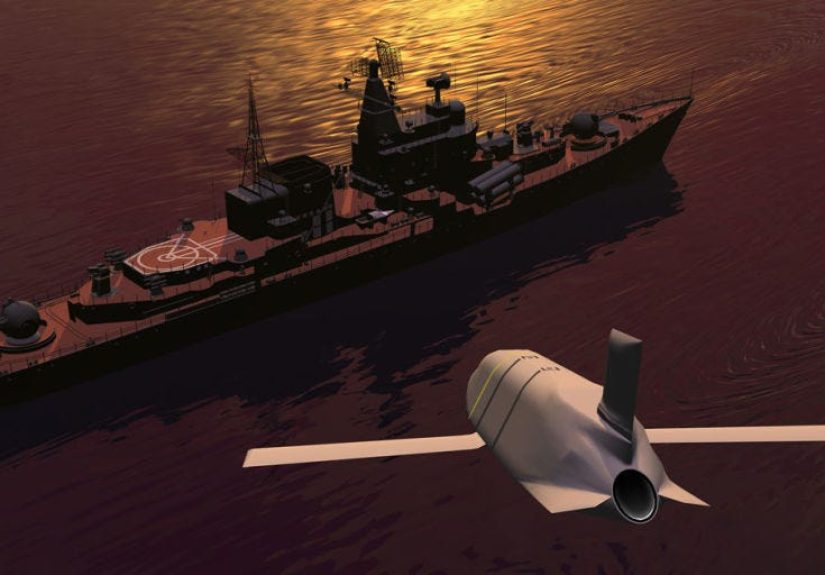
LRASM, formally the AGM-158C Long Range Anti-Ship Missile, comes from the same family as the Joint Air-to-Surface Standoff Missile Extended Range, or JASSM-ER. That lineage matters because it gave LRASM a mature airframe and a long-range standoff foundation. But LRASM is not just a JASSM wearing a sailor hat. It was tailored for the anti-ship mission, which means finding, identifying, and attacking valuable surface targets in crowded, defended maritime environments.
Its appeal lies in the details. LRASM uses semi-autonomous guidance, a multi-mode sensor package, a data link, anti-jam navigation features, and a heavy warhead meant to do serious damage once it gets through. The missile was built to reduce dependence on perfect intelligence, pristine GPS signals, or uninterrupted communications. That is important because future naval warfare will be messy. If your missile needs the digital equivalent of a five-star concierge the whole way to the target, it may not be the missile you want in a real war.
Why “deadlier” is more than marketing
When people hear “deadlier,” they often picture only blast size. That is part of the story, but not the whole one. A truly dangerous anti-ship missile is one that can survive the trip, sort through targets, hit the right ship, and punch hard enough to matter. LRASM checks those boxes better than older designs because it is built for contested environments from the start. That makes it more than just an upgrade. It makes it a shift in philosophy.
In plain English, LRASM is dangerous because it is harder to stop and better at making itself useful. In naval combat, that is a terrifying combination.
From Long Wait to Real Procurement
The “finally” in this story is not accidental. The Navy had spent years talking about the need for modern offensive anti-surface warfare capability. Meanwhile, potential rivals were not sitting around politely waiting for America to finish its paperwork. They were building ships, missiles, sensors, and defenses at a rapid pace.
When the Navy and Air Force moved to the first production lot of LRASM in 2017, it marked a real milestone. At that point, the program had already benefited from DARPA development work and a series of successful tests. The procurement decision meant the missile was graduating from “very promising project” territory into “this is becoming part of the arsenal” territory. Defense programs love to live in the land of eternal demos. LRASM finally got its passport stamped for real-world relevance.
That move also sent a broader message: the Pentagon was willing to prioritize anti-ship strike again. For years, that mission did not get the same cultural spotlight as missile defense, land attack, or counterterror operations. LRASM helped rebalance the conversation. If maritime competition is back, ship-killing capability has to be back too.
How the Missile Changed the Fight
More reach for carrier aviation
One of LRASM’s biggest advantages is what it gives launch platforms: breathing room. Navy strike aircraft do not have to get as close to heavily defended ships to pose a lethal threat. In a conflict where enemy missiles, fighters, and radar networks can make proximity a terrible life choice, that extra distance matters a lot.
For the Navy’s F/A-18E/F Super Hornet community, LRASM added a much more credible long-range anti-surface punch. The missile eventually reached early operational capability on the Navy’s F/A-18E/F, turning the aircraft into a more dangerous maritime strike platform. That matters because naval aviation is not just about protecting carriers. It is also about giving the fleet a way to hit first, hit accurately, and hit at distance.
Not just a Navy weapon anymore
Although the headline is about the Navy, LRASM has always had a joint flavor. The Air Force fielded it on the B-1B, which gave the missile an immediate long-range launch platform with heavy payload capacity. That joint angle is a major strength. The more platforms that can carry LRASM, the harder it becomes for an enemy fleet to predict where the next threat will come from.
And the platform list keeps growing. The Navy has worked on integrating LRASM with the P-8 Poseidon, which is especially interesting because the P-8 already brings excellent maritime surveillance and targeting value to the table. Recent integration work on F-35 variants also suggests the missile’s future is broader than its initial fielding path. The combination of stealth aircraft and a stealthy long-range anti-ship weapon is the kind of sentence that makes opposing naval planners reach for the aspirin.
LRASM in the Real World
A missile program does not become meaningful just because it survives the budget gauntlet. It becomes meaningful when it shows up in testing, exercises, and operational planning. LRASM has steadily crossed those thresholds.
One of the clearest examples came during RIMPAC 2024, when a U.S. Navy F/A-18F employed LRASM during the sinking of the ex-Tarawa. That matters because demonstrations against real maritime targets carry a different weight than brochure-friendly claims. They show the missile is not just theoretically useful. It is participating in the kinds of events that sharpen doctrine, targeting, and joint coordination.
Testing has also pushed the missile into new territory. The Navy and industry have advanced LRASM integration work on the F-35 family, and the P-8 has gone from fit checks to visible flight progress. Each new platform expands operational flexibility. Each successful test makes the missile less of a niche answer and more of a core part of U.S. maritime strike planning.
Why This Matters in the Pacific
If you want to understand why LRASM matters so much, look west across the Pacific and then keep looking, because you will still have a lot of ocean left. The tyranny of distance is not a slogan there. It is a military reality. Aircraft need range. Weapons need range. Commanders need options that do not require flying straight into a wall of missiles just to get a shot.
LRASM helps solve part of that problem. It allows U.S. forces to hold hostile ships at risk from farther away while complicating enemy defensive planning. It also fits a broader strategy of distributed operations, where multiple platforms across wide geography can generate maritime strike effects without bunching together into one obvious target set.
That matters not only tactically but psychologically. A capable anti-ship missile shapes enemy behavior. It forces surface commanders to think about standoff, emissions control, maneuver, and survivability in new ways. A fleet that knows it may be hunted by intelligent long-range missiles behaves differently from a fleet that assumes it can outrange or outsmart the threat.
How LRASM Fits Beside Other Anti-Ship Weapons
LRASM is not the only anti-ship weapon in the U.S. toolkit, and that is the point. The Navy and Marine Corps are also investing in systems like the Naval Strike Missile for different launch platforms and mission sets. Think of LRASM as the heavier, stealthier air-launched specialist for tougher targets and deeper strike geometry, while other missiles fill complementary roles closer to the surface fleet and expeditionary force.
That layered approach is healthier than putting all maritime hopes on one weapon. Modern naval combat rewards variety. Some targets require range. Some require volume. Some require stealth. Some require speed. LRASM’s niche is especially valuable because it gives the joint force a smarter standoff option against defended warships, which is exactly the kind of target you do not want to approach casually.
The Procurement Story Still Matters
One underrated part of the LRASM story is industrial. Buying a smart missile is one thing. Producing enough of them is another. The Pentagon has spent the last few years talking more openly about munitions stockpiles, production bottlenecks, and the need to scale manufacturing for a real prolonged conflict. That conversation includes LRASM.
Budget materials and industrial base investments show a clear pattern: Washington wants more missiles, more resilient supply chains, and faster replenishment capacity. That is not glamorous, but it is vital. A missile that exists mostly in testimony and conference slides is not much comfort in wartime. LRASM’s value depends not only on performance but on quantity, readiness, and the ability to keep building more when demand spikes.
In that sense, the Navy’s buy was important because it helped create momentum. It signaled a market, sustained a production line, and fed a broader push to strengthen precision-strike capacity. In defense acquisition, momentum can be as valuable as buzzwords. Sometimes more valuable.
Experiences and Lessons Behind the LRASM Story
One of the most revealing things about the LRASM story is that it reflects real operational experience more than flashy theory. For sailors, aviators, planners, and testers, the lesson has been simple: modern maritime combat will punish anything predictable. That helps explain why the missile’s development path kept emphasizing survivability, autonomy, and target discrimination instead of relying on the old assumption that American aircraft would always have easy access and uncontested information.
Exercises and test events have reinforced that point. When crews work through maritime strike scenarios, they are not just practicing a launch sequence. They are learning how sensor networks, aircraft routing, target identification, communications discipline, and timing all connect. A missile like LRASM becomes valuable not only because of its hardware, but because it forces the force to think differently. It rewards smarter kill chains and more distributed decision-making. In a very real sense, the weapon teaches the fleet as the fleet learns to use the weapon.
There is also an institutional experience here. The Navy spent years wrestling with the gap between what it had and what it needed. That is not unusual in defense, but LRASM became a case study in how long it can take to move from recognition of a problem to fielding a credible answer. The requirement was clear long before the missile became operational. That lag is a reminder that military modernization is often less like flipping a switch and more like trying to renovate a house while still living in it, during a thunderstorm, while Congress asks for receipts.
The platform integration journey has provided another practical lesson. Getting LRASM onto the F/A-18E/F was important, but the continuing work with the P-8 and F-35 variants shows that real combat value grows when a weapon spreads across the force. Every added launch platform gives commanders more flexibility and gives the enemy more headaches. That is a lived operational truth, not a slogan. A missile carried by one aircraft type is useful. A missile carried by multiple aircraft with different strengths becomes a networked problem for the other side.
The RIMPAC sink exercise offered a particularly vivid example of experience shaping confidence. Sinking old ships during exercises may sound theatrical, and yes, there is always a little blockbuster energy in those events. But for operators, they are serious opportunities to validate concepts under realistic conditions. Watching a weapon contribute to a real sink exercise tells planners something no brochure can. It tells them the kill chain can function when steel, saltwater, timing, and stress all enter the equation.
There is a human lesson too. The LRASM saga reflects years of work by engineers, maintainers, pilots, range personnel, logisticians, and acquisition teams who rarely make headlines. The public sees the finished missile and the dramatic phrase “ship-killing.” What it does not see is the patient grind of integration testing, software refinement, manufacturing fixes, and platform certification. That experience matters because it is how real military capability is built: slowly, expensively, imperfectly, and then suddenly all at once.
In the end, the experience around LRASM suggests something bigger than one missile program. It shows that the U.S. military is relearning how to think seriously about sea denial, long-range strike, and contested logistics after years of very different wars. That is the deeper meaning of the Navy finally buying a new ship-killing missile. It was not just a procurement event. It was a sign that the Pentagon had started adjusting its instincts for the kind of naval competition it expects to face next.
Conclusion
The Navy’s decision to buy LRASM was important when it happened, but it looks even more important now. What once seemed like a long-overdue procurement win has become a larger story about deterrence, modernization, and the return of serious anti-ship warfare. LRASM gives the United States a more survivable, smarter, and more credible way to threaten enemy surface fleets. It strengthens carrier aviation, complements joint force strike options, and fits the realities of long-range Pacific conflict far better than yesterday’s assumptions.
Most of all, LRASM represents a shift from comfort to urgency. The Navy did not just buy a new missile because newer is shinier. It bought one because the maritime fight is harder now, the oceans are not getting any smaller, and legacy answers were starting to look dangerously polite. In that context, LRASM is not merely a deadlier ship-killing missile. It is a signal that the United States is taking the business of naval strike a lot more seriously.