Table of Contents >> Show >> Hide
- Can You Really Learn Ice Skating by Yourself?
- Way 1: Prepare Like a Beginner Who Wants to Skate Again Tomorrow
- Way 2: Learn the Core Ice Skating Moves in the Right Order
- Way 3: Build a Self-Guided Practice System That Actually Works
- Common Mistakes When Learning Ice Skating Alone
- Experience Notes: What Learning Ice Skating by Yourself Really Feels Like
- Conclusion
- SEO Tags
Learning ice skating by yourself sounds slightly dramatic, like announcing you are going to tame a tiny frozen dragon while wearing shoes with knives attached. But the truth is much friendlier: you can teach yourself the basics of ice skating if you move slowly, practice safely, and accept that the wall is not your enemy. The wall is your first coach. It does not give pep talks, but it is very reliable.
Ice skating is a skill built on balance, body position, confidence, and repetition. You do not need to become a figure skater, hockey player, or graceful winter commercial model on day one. Your first goal is simpler: stay upright, move forward, stop without panic, and leave the rink with your dignity mostly intact.
This guide explains three practical ways to learn ice skating by yourself: preparing like a smart beginner, mastering basic movement step by step, and using self-guided practice habits that help you improve without a private coach standing beside you. It also includes real-world experience notes at the end, because ice has a funny way of teaching lessons your brain refuses to learn from reading alone.
Can You Really Learn Ice Skating by Yourself?
Yes, you can learn beginner ice skating by yourself, especially if your goal is recreational skating. Many new skaters learn enough to enjoy public sessions by practicing basic moves such as marching, two-foot gliding, swizzles, snowplow stops, and safe falling. However, “by yourself” should not mean “recklessly alone.” It means you are guiding your own practice while using safe equipment, rink rules, beginner-friendly drills, and common sense.
If you want to learn jumps, spins, advanced edges, hockey stops at speed, or figure skating routines, professional lessons are strongly recommended. Advanced skating involves more risk, more technique, and more opportunities for your knees to file a complaint with management. But for the foundationbalance, forward motion, gentle turns, and stoppingyou can make real progress through organized self-practice.
Way 1: Prepare Like a Beginner Who Wants to Skate Again Tomorrow
The first way to learn ice skating by yourself is to set up your body, gear, and environment properly before you step onto the ice. Beginners often think skating success begins with courage. Not quite. It begins with skates that fit, clothes that move, and a plan that does not involve launching yourself into traffic like a confused penguin.
Choose the Right Skates
Good-fitting skates are essential. If rental skates are too loose, your ankles wobble and your balance disappears. If they are too tight, your feet go numb and you spend the session wondering whether toes are optional. Your skates should feel snug around the foot and ankle without crushing them. Lace them firmly from the toe area upward, with extra support around the ankle. You should be able to bend your knees, but your heel should not slide around inside the boot.
Before skating, check the blades. Sharp blades grip the ice better than dull ones. Dull blades can slide unpredictably or catch in rough spots. If you rent skates and the blades look flat, damaged, or suspiciously ancient, ask the rink staff for another pair. You are learning ice skating, not archaeology.
Wear Protective Gear Without Embarrassment
Beginners fall. That is not failure; that is the ice introducing itself. A helmet is a smart choice for new skaters, especially children, cautious adults, or anyone practicing without an instructor. Wrist guards, knee pads, elbow pads, and padded shorts can also make falls less intimidating. The more comfortable you are with the idea of falling safely, the less stiff your body becomesand stiffness is one of the main reasons beginners fall in the first place.
Wear gloves, not only for warmth but also to protect your hands from rough ice. Choose long socks that rise above the skate boot to reduce rubbing. Dress in layers that allow movement. Avoid long scarves, dangling accessories, or anything that could catch on another skater or distract you.
Pick the Right Practice Time
Self-learning is much easier during a quiet public skating session. Crowded rinks can feel like frozen bumper cars, especially when children, couples, fast skaters, and birthday-party chaos all appear at once. Call the rink or check its schedule for beginner-friendly times. Morning sessions, weekday afternoons, or family sessions are often calmer than peak weekend hours.
When you enter the rink, look both ways, follow the flow of traffic, and move in the same direction as everyone else. Do not stop in the main path. If you need a break, move to the side. Avoid headphones, phones, food, and filming while skating. Your eyes and ears are safety equipment too.
Warm Up Before You Touch the Ice
A simple warm-up helps your balance and reduces stiffness. Before putting on skates, do gentle ankle circles, knee bends, hip circles, and a few bodyweight squats. After tying your skates, stand on the rubber flooring and practice bending your knees. Your skating stance should feel athletic: knees bent, chest lifted, arms relaxed in front or slightly out to the sides.
Here is your first rule: bend your knees more than your waist. Beginners often fold forward like lawn chairs, staring at the ice as if it contains exam answers. That pulls your balance forward. Instead, keep your head up, bend your knees, and imagine sitting slightly into a chair.
Way 2: Learn the Core Ice Skating Moves in the Right Order
The second way to learn ice skating by yourself is to practice beginner skills in a logical sequence. Do not start with speed. Speed is dessert. You must eat your balance vegetables first.
Step 1: Learn How to Fall and Get Up
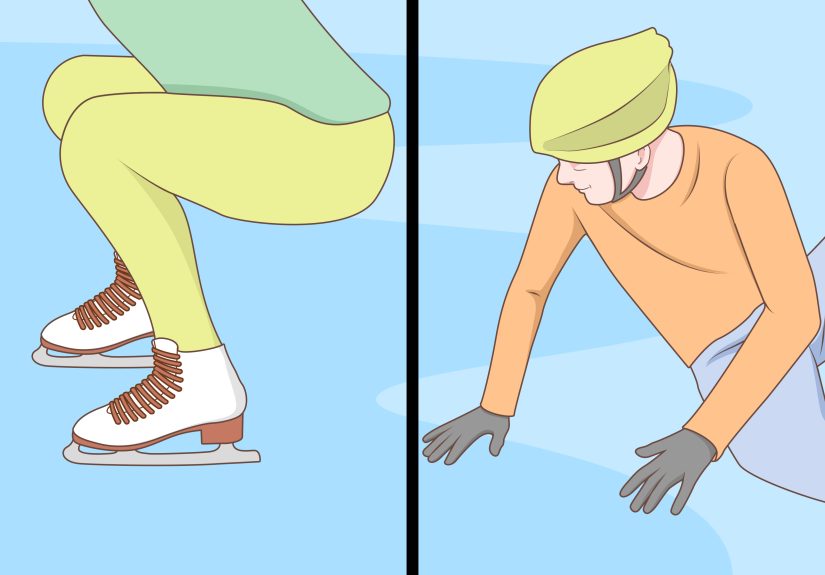
Safe falling is one of the most important beginner ice skating skills. Practice it near the wall before moving into open ice. If you feel yourself losing balance, bend your knees and try to fall to the side rather than straight backward. Keep your chin tucked slightly and avoid throwing your hands behind you.
To get up, roll onto your hands and knees. Place one skate flat on the ice between your hands, then place the other skate beside it. Push up through your legs while keeping your hands near your knees for balance. Do not pull yourself up by grabbing another skater. That turns one fall into a group project.
Step 2: March Before You Glide
Many beginners try to slide immediately. Instead, begin by marching. Hold the wall lightly with one hand, bend your knees, and lift one foot at a time. Take tiny marching steps forward. This teaches your body that the blades can support you.
After several minutes, move a little away from the wall and continue marching. Keep your feet under your hips. Do not let them drift too wide, because wide feet make it harder to recover balance. Your arms can stay in front of you like you are carrying a pizza. Do not drop the pizza. The imaginary pizza is important.
Step 3: Try a Two-Foot Glide
Once marching feels comfortable, push gently with one foot and bring both feet together to glide on two feet. Your knees stay bent, your eyes look ahead, and your arms help balance. The goal is not distance. The goal is calm control.
Practice this pattern: march for five steps, bring your feet together, glide for two seconds, then march again. Repeat until your glide becomes smoother. If you wobble, bend your knees more. If you panic, slow down and return to marching.
Step 4: Practice Swizzles
Swizzles are one of the best beginner drills for learning how blades push against the ice. Start with your heels close together and toes turned slightly outward, forming a small “V.” Bend your knees and press your feet outward, then bring your toes inward so your feet return together. Your blades should draw an hourglass or lemon shape on the ice.
Forward swizzles help you move without picking up your feet. They teach edge pressure, rhythm, and control. Start slowly. Try six to eight swizzles in a row, then rest at the boards. As you improve, make the movement smoother and quieter. Scraping loudly is normal at first, but the long-term goal is controlled pressure, not ice excavation.
Step 5: Learn the Snowplow Stop
Stopping is not optional. It is the difference between skating and politely crashing into the wall. The easiest beginner stop is the snowplow stop. Glide slowly on two feet. Bend your knees. Turn your toes slightly inward and press one or both blades outward against the ice. The inside edge of the blade creates friction and slows you down.
Practice from very low speed. Do not attempt stops while flying across the rink like you are late for a dramatic movie scene. Start near the wall, then move into open space when you can stop gently. A useful drill is “three marches and stop”: march three steps, glide, snowplow stop, reset.
Step 6: Add Simple Turns
After you can glide and stop, begin learning simple turns. Look where you want to go. Your shoulders and hips tend to follow your eyes. Make a gentle curve by leaning slightly into the turn while keeping both skates on the ice. Keep your knees soft.
At first, practice wide half-circles. Avoid sharp turns until your balance improves. If you feel unstable, return to two-foot glides and swizzles. Strong basics make turning easier.
Way 3: Build a Self-Guided Practice System That Actually Works
The third way to learn ice skating by yourself is to treat every session like a mini lesson. Wandering around the rink randomly can be fun, but structured practice helps you improve faster. A good session includes a warm-up, a few focused drills, a confidence-building skill, and a cool-down lap.
Create a 45-Minute Beginner Practice Plan
Here is a simple self-guided plan:
- Minutes 1–5: Off-ice warm-up and skate check.
- Minutes 6–10: Wall practice, knee bends, marching, and getting comfortable.
- Minutes 11–20: March-and-glide drills across a short distance.
- Minutes 21–30: Forward swizzles and two-foot glides.
- Minutes 31–38: Snowplow stops from slow speed.
- Minutes 39–45: Easy laps, gentle turns, and cool-down skating.
Do not practice until you are exhausted. Tired beginners become sloppy beginners, and sloppy beginners meet the ice more often. End while you still feel coordinated.
Use the “One Skill Per Session” Rule
Trying to learn everything at once can make ice skating feel impossible. Instead, choose one main focus per session. For example, your first session might focus on marching and standing up. Your second session might focus on two-foot glides. Your third session might focus on stopping. Progress feels slow at first, but small improvements stack quickly.
Keep a simple skating journal on your phone after you leave the rink. Write down what improved, what felt awkward, and what you want to practice next time. A note like “snowplow stop worked better with more knee bend” is useful. A note like “ice is rude” may be emotionally accurate but less practical.
Film Yourself Carefully
Video can help self-taught skaters, but only if done safely. Do not hold a phone while skating. Ask a friend to film from outside the boards, or set up recording only if the rink allows it and it does not block traffic. Review your posture. Are your knees bent? Are your arms relaxed? Are you looking forward or staring at your skates like they owe you money?
Short clips are enough. You do not need a cinematic documentary titled “One Beginner, Two Blades, Many Regrets.” Thirty seconds of gliding or stopping can reveal plenty.
Train Balance Off the Ice
Off-ice practice supports on-ice progress. You can improve balance and skating strength at home with basic exercises such as single-leg stands, squats, lunges, calf raises, and side steps. Core exercises like planks also help because skating requires your upper and lower body to work together.
Try standing on one foot for 20 seconds, then switch sides. When that becomes easy, bend the standing knee slightly. This mimics the stable skating position. You can also practice “skater steps” by stepping side to side in a low stance, focusing on control rather than speed.
Common Mistakes When Learning Ice Skating Alone
Holding the Wall Too Long
The wall is helpful at the beginning, but it can become a habit. If you cling to it for the entire session, your body never learns true balance. Use the wall to start, then gradually move one arm’s length away. Skate short distances between safe points.
Standing Too Straight
Locked knees make skating harder. Bent knees act like shock absorbers. They help you glide, stop, and recover from wobbles. If one piece of advice solves half of beginner skating problems, it is this: bend your knees.
Looking Down
Looking down feels natural because your feet are doing something suspicious. But your body follows your head. Look ahead in the direction of travel. You will balance better and avoid other skaters more easily.
Trying to Go Fast Too Soon
Speed feels exciting until you remember you do not know how to stop. Build control first. A beginner who can move slowly and stop safely is far better off than a beginner who can go fast and then invent new forms of impact.
Experience Notes: What Learning Ice Skating by Yourself Really Feels Like
The first time you step onto the ice, your brain may react as if the floor has betrayed civilization. Even if you are athletic on land, ice changes the rules. On land, shoes grip. On ice, blades glide. That glide is the magic of skating, but at first it feels like the ground has become a prankster.
Most self-taught beginners experience three emotional stages. Stage one is “I can do this.” This usually happens while tying skates. Stage two is “Why are my feet moving in different political directions?” This happens immediately after stepping onto the ice. Stage three is “Actually, this is fun,” which arrives after the first successful glide. That tiny glide is powerful. It may last only two seconds, but it proves that your body can learn.
One useful experience is to spend the first session with very low expectations. Do not measure success by laps. Measure it by comfort. Can you stand without gripping the wall? Can you bend your knees without wobbling? Can you fall and get up? Can you march ten steps? These small wins matter because they build trust between your body and the ice.
Another experience many beginners share is the surprise of how much posture matters. A person may struggle for twenty minutes, then suddenly bend the knees, lift the chest, and relax the shouldersand skating becomes 30 percent easier. Not perfect. Not Olympic. But easier. Ice skating rewards small technical changes. The difference between panic and control can be as simple as looking forward instead of down.
Stopping often becomes the first major confidence milestone. Before you can stop, every movement feels like a legal negotiation with gravity. After you learn a basic snowplow stop, the rink feels larger and less threatening. You are no longer just hoping the wall will catch you. You have a tool. It may be slow and scratchy, but it works.
Practicing alone also teaches patience. Some days your glide improves. Other days your skates feel weird, your ankles complain, and a seven-year-old zooms past you with the confidence of a tiny superhero. Try not to compare. Children have less fear, lower centers of gravity, and an alarming willingness to fall. Adults often learn more slowly because they understand consequences. That is not weakness; that is having insurance paperwork in your imagination.
The best self-learning experience comes from repetition. Go to the rink regularly, even for short sessions. Your body needs time to understand edges, balance, and ice texture. After a few visits, movements that once felt impossible begin to feel familiar. You stop fighting the ice and start working with it.
Finally, remember that learning ice skating by yourself does not mean refusing help forever. Watch skilled skaters. Ask rink staff simple questions. Take a group lesson if you hit a plateau. Self-teaching is a great beginning, but good advice can save you weeks of frustration. The goal is not to prove you can suffer independently. The goal is to skate better, safer, and with enough joy that you want to come back.
Conclusion
Learning ice skating by yourself is absolutely possible when you approach it with patience, structure, and respect for safety. Start with the right skates and protective gear. Learn the basics in order: falling, getting up, marching, gliding, swizzles, stopping, and gentle turns. Then use a self-guided practice system so every rink visit has a purpose.
The secret is not natural talent. The secret is repetition with awareness. Bend your knees. Look ahead. Keep your speed low until your stopping improves. Follow rink rules. Celebrate small victories. Your first smooth glide may not look dramatic to anyone else, but to you it will feel like discovering a superpowerone chilly, slightly wobbly superpower.
Note: This article is for recreational beginner guidance. For advanced figure skating, hockey skills, jumps, spins, or persistent pain, work with a qualified skating instructor or medical professional.