Table of Contents >> Show >> Hide
- What Is Earth's Core, Exactly?
- The Big Discovery: Earth's Inner Core Is Growing Unevenly
- Why Scientists Think the Core Is Lopsided
- How Can Something Solid Flow?
- The Role of Heat: Earth's Deep Cooling Problem
- Why Indonesia and Brazil Matter in This Mystery
- Is Earth's Core Really “Rapidly” Growing?
- Does a Lopsided Core Affect Life on the Surface?
- Common Misconceptions About Earth's Lopsided Core
- Why This Discovery Matters for Science
- Experience Section: How to Think About Earth's Lopsided Core Like a Curious Explorer
- Conclusion: Earth's Lopsided Core Is a Slow-Motion Clue
- SEO Tags
Deep beneath your shoes, beneath the basement, beneath the subway, beneath even the most ambitious “do not dig here” warning sign, Earth has a metal heart. And according to modern geoscience, that heart is not growing in a perfectly even way. The inner core, a solid ball of mostly iron and nickel, appears to be crystallizing faster on one side than the other. In plain English: Earth’s core is growing lopsided.
That sounds like the opening scene of a disaster movie, right before someone in a lab coat whispers, “We have 72 hours.” Fortunately, this is not that kind of story. The planet is not wobbling like a bad shopping cart, and the inner core is not about to burst through the crust like an angry space meatball. The real story is slower, stranger, and far more interesting. It involves seismic waves, iron crystals, heat flow, gravity, the magnetic field, and a scientific mystery happening about 3,000 miles below the surface.
The phrase “rapidly growing” needs a little geological translation. The inner core grows by roughly a millimeter per year on average. That is not rapid if you are waiting for toast. But inside a planet, over hundreds of millions of years, a millimeter per year is a big deal. It is enough to leave a record in the inner core’s crystal structure and possibly explain why seismic waves move through the core differently depending on direction.
What Is Earth’s Core, Exactly?
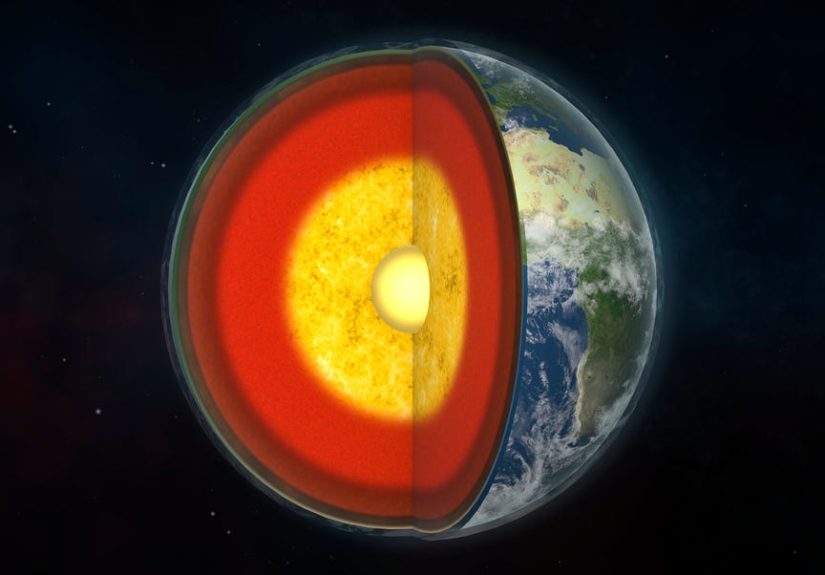
Earth is built in layers: crust, mantle, outer core, and inner core. The crust is the thin rocky skin we live on. The mantle is a thick, hot, slowly moving layer of rock beneath it. Below that sits the outer core, a churning ocean of molten iron and nickel. At the center is the inner core, a solid metallic sphere nearly as hot as the surface of the Sun but squeezed into solidity by crushing pressure.
The inner core is roughly 1,500 miles across, depending on which measurement is being discussed. It is not solid because it is cool. It is solid because pressure at Earth’s center is so extreme that iron atoms are forced into a crystalline structure. Imagine a dance floor so crowded that nobody can move freely, even though the music is still blasting. That is the inner core: hot, energetic, and trapped in place by pressure.
Surrounding it is the liquid outer core. This molten layer is crucial because its movement helps power Earth’s geodynamo, the natural engine that generates the planet’s magnetic field. That magnetic field shields Earth from much of the solar wind. Without it, life on the surface would have a much harder time. So yes, the core may be hidden, but it is not exactly taking a vacation.
The Big Discovery: Earth’s Inner Core Is Growing Unevenly
Researchers studying seismic waves have proposed that Earth’s inner core grows faster on its eastern side, beneath Indonesia’s Banda Sea, than on the opposite side beneath Brazil. The idea is not that the inner core has become visibly misshapen like a dented ping-pong ball. Instead, the growth pattern is asymmetric. More iron crystals appear to form on one side, but gravity redistributes the material, helping the inner core maintain a nearly spherical shape.
This is a subtle but important difference. The core’s growth may be lopsided, while the core’s overall shape remains mostly round. Gravity is the ultimate planetary quality-control inspector. When extra iron crystallizes on one side, gravitational forces help push and even out the new material. The result is a sphere that can hide a very uneven growth history.
Why would one side grow faster? The leading explanation is uneven cooling. As Earth slowly loses heat, molten iron at the inner-core boundary crystallizes and becomes part of the solid inner core. If one region of the outer core or deep mantle removes heat more efficiently, iron may freeze faster there. In this model, the area below Indonesia cools faster than the area below Brazil, causing more rapid crystallization on the Indonesian side.
Why Scientists Think the Core Is Lopsided
Nobody has drilled to the core. The deepest human-made boreholes do not even scratch the mantle in any meaningful sense. So how do scientists study something thousands of miles underground? They use earthquakes. Every large earthquake sends seismic waves through the planet. These waves travel through different materials at different speeds, bending, slowing, speeding up, or disappearing depending on what they encounter.
One of the key clues is seismic anisotropy. That fancy word means that seismic waves move at different speeds depending on direction. In the inner core, waves traveling roughly north-south, along Earth’s rotation axis, tend to move faster than waves traveling east-west. This suggests the iron crystals inside the core are not randomly arranged. They appear to have preferred orientations, like tiny metallic arrows lined up by deep-Earth forces.
For decades, geoscientists have known that the inner core behaves differently in different directions and regions. The lopsided-growth model offers a possible explanation: as iron crystallizes unevenly and gravity redistributes it, crystals may become aligned in ways that affect seismic wave travel times. In other words, the planet’s deepest metal may be recording its growth history in crystal patterns, like tree rings made of iron under ridiculous pressure.
How Can Something Solid Flow?
The phrase “solid inner core” can be misleading. Solid does not always mean rigid in the everyday sense. On human timescales, the inner core is solid. On geological timescales, under extreme heat and pressure, it may slowly deform. Think less “steel safe” and more “very stubborn taffy made of iron.” It can maintain a solid structure while still adjusting over vast stretches of time.
This slow deformation matters because it allows gravity to smooth out asymmetric growth. If one side gains more new crystals, the material does not simply pile up forever. Instead, the inner core can slowly shift, creep, and reorganize. That process may help align crystals and create the directional seismic behavior scientists observe.
Recent research has also suggested that the boundary between the liquid outer core and solid inner core may be more dynamic than previously assumed. Some studies indicate that the inner core’s surface may undergo small structural changes over years or decades, likely influenced by the turbulent outer core. This does not mean the core is unstable. It means the center of Earth is active, responsive, and complicatedbasically the opposite of a boring metal marble.
The Role of Heat: Earth’s Deep Cooling Problem
The inner core grows because Earth is cooling. That cooling is incredibly slow, but it has been happening since the planet formed more than 4.5 billion years ago. As heat escapes from the core into the mantle, liquid iron at the inner-core boundary reaches conditions where it crystallizes. This releases latent heat and lighter elements into the outer core, helping drive convection.
Convection in the outer core is essential for the magnetic field. Hot material rises, cooler material sinks, and Earth’s rotation organizes some of this motion. Moving metallic fluid generates electric currents, and those currents help create the geomagnetic field. The inner core’s growth is therefore linked to the magnetic shield that helps protect the surface from charged particles streaming from the Sun.
If the core is cooling unevenly, the deep mantle may be part of the reason. The mantle is not uniform. It contains hotter and cooler regions, slabs of ancient oceanic crust, and enormous structures near the core-mantle boundary. These variations can influence how heat leaves the core. A colder region above part of the core may draw heat out faster, while a hotter region may slow heat loss. The inner core may be lopsided because the mantle above it is not a perfectly even blanket.
Why Indonesia and Brazil Matter in This Mystery
The lopsided-growth model often describes faster growth under Indonesia’s Banda Sea and slower growth on the opposite side under Brazil. These locations are not important because people there are doing anything unusual at the surface. No one in Indonesia accidentally left the planetary refrigerator door open. The locations matter because they are surface reference points for deep regions inside Earth.
When scientists describe “under Indonesia” or “under Brazil,” they are mapping deep planetary structures onto familiar geography. The actual process happens at the boundary between the inner and outer core, thousands of miles below those places. Still, the contrast is useful because it helps explain the hemispheric pattern: one side of the inner core seems to gain solid iron faster than the other.
This east-west difference may help solve a long-standing puzzle. Seismic waves passing through the inner core show differences between hemispheres, and the crystal alignment needed to explain those differences requires a mechanism. Uneven growth, followed by gravitational redistribution and slow deformation, gives scientists a plausible way to connect core cooling, crystal alignment, and seismic observations.
Is Earth’s Core Really “Rapidly” Growing?
For everyday life, no. The inner core is not expanding fast enough for anyone to notice. Your coffee, commute, and Wi-Fi signal are safe from inner-core growth. But by planetary standards, a millimeter per year is meaningful. Over one million years, that becomes about one kilometer. Over hundreds of millions of years, it becomes a major part of Earth’s internal evolution.
The inner core may be relatively young compared with Earth itself. Some models suggest it began solidifying more than half a billion years ago, while other estimates allow for an older age. This debate matters because Earth’s magnetic field existed before the present inner core may have formed. If the inner core is young, scientists must explain how the ancient geodynamo worked before solid inner-core growth began contributing energy to the outer core.
That is why the lopsided-growth question is not just a quirky fact for science trivia night. It connects to the history of Earth’s magnetic field, the cooling of the planet, and the long-term habitability of the surface. The core may be far away, but it is part of the reason Earth remains a comfortable place for oceans, atmosphere, satellites, birds, dogs, and people arguing about parking spaces.
Does a Lopsided Core Affect Life on the Surface?
Not in any dramatic or immediate way. The lopsided growth of the inner core does not cause earthquakes, volcanoes, bad weather, or your phone battery dying at 18 percent. It is a deep, slow process that operates on geological timescales. The core’s growth pattern may influence the magnetic field over immense periods, but it is not something that changes daily life in a direct, noticeable way.
However, understanding it helps scientists improve models of Earth’s interior. Better core models can improve our understanding of the geodynamo, magnetic field changes, and long-term planetary evolution. Earth’s magnetic field has shifted and reversed many times in the past. While inner-core growth is only one piece of that complex puzzle, it is an important one.
The discovery also reminds us that Earth is not a static rock. It is a dynamic planet from crust to core. Continents move. Mantle rocks flow. The outer core churns. The inner core grows, deforms, and may even change subtly over time. The ground feels still because human lives are short. The planet, meanwhile, is quietly performing a very slow magic trick.
Common Misconceptions About Earth’s Lopsided Core
Misconception 1: The Inner Core Is Becoming Dangerously Misshapen
The growth is asymmetric, but gravity helps keep the inner core nearly spherical. The lopsidedness is more about where new iron crystallizes fastest and how crystals align, not a giant bulge threatening the surface.
Misconception 2: The Core Is Growing Fast Enough to Change Earth Soon
The growth rate is tiny by human standards. It matters over millions of years, not Tuesday afternoon. “Rapid” in this context belongs to the language of geology, where a million years can be considered a brisk little jog.
Misconception 3: Scientists Know the Exact Cause
Scientists have strong models, but the exact cause of uneven cooling is still being studied. The mantle, outer core flow, and core-mantle boundary likely play roles, but Earth’s deepest systems are difficult to observe directly.
Misconception 4: The Core Has Nothing to Do With Us
The core helps power the magnetic field, which helps protect the planet from solar radiation. It may be out of sight, but it is definitely not irrelevant. The core is the quiet coworker doing essential tasks without asking for applause.
Why This Discovery Matters for Science
The lopsided inner core gives scientists a new way to connect several mysteries at once. It may help explain seismic anisotropy, hemispheric differences in seismic wave speeds, and the thermal relationship between the core and mantle. It also gives researchers clues about the age of the inner core and the evolution of Earth’s magnetic field.
It matters because planets are systems. A change in one layer affects another. The mantle controls heat loss from the core. The outer core uses that heat to drive convection. The inner core grows as the planet cools. The magnetic field emerges from the motion of molten metal. Studying lopsided growth is like finding a weird thread in a sweater and realizing it connects to the whole garment.
It also matters for comparative planetology. Earth has a long-lived magnetic field; Mars does not have a strong global magnetic field today. Venus rotates slowly and has a very different magnetic environment. By understanding Earth’s core, scientists can better understand why rocky planets evolve differently, and what makes one planet more friendly to life than another.
Experience Section: How to Think About Earth’s Lopsided Core Like a Curious Explorer
One of the best ways to experience this topic is not by imagining a fiery tunnel to the center of Earthplease do not bring a shovelbut by paying attention to how indirect science works. The story of Earth’s lopsided core is a masterclass in learning from clues. Scientists cannot see the inner core. They cannot touch it. They cannot drop a camera into it and livestream “CoreCam 3000.” Instead, they listen to the planet ring after earthquakes.
That idea alone can change how you experience ordinary ground. The sidewalk under your feet may feel silent, but Earth is constantly vibrating with natural signals. Every major earthquake sends information through the planet. Seismometers record those signals, and researchers compare wave paths, travel times, and tiny differences. It is like diagnosing an engine by sound, except the engine is Earth and the mechanic needs a PhD, a global data network, and possibly a heroic amount of coffee.
For students, writers, and science lovers, the lopsided-core story is a reminder that the most exciting discoveries are not always flashy. Some are hidden in small timing differences. A seismic wave arriving a few seconds faster along one path than another may not sound thrilling at first. But that tiny difference can reveal the orientation of iron crystals thousands of miles below ground. That is the scientific equivalent of hearing a single note and identifying the entire orchestra.
Another useful experience is to compare the core with everyday freezing. When water freezes in a tray, it does not always freeze evenly. Edges may solidify first. Bubbles get trapped. Crystals form patterns. Earth’s inner core is obviously more extremeiron, enormous pressure, solar-surface-like temperatures, no cute ice cubesbut the basic concept of crystallization helps. The inner core grows as liquid metal freezes onto it. If one side loses heat faster, one side grows faster.
This topic also teaches humility. People often imagine science as a warehouse of final answers, but deep-Earth science is more like detective work in a room with the lights off. Researchers build models, test them against seismic observations, revise assumptions, and argue politely in journal articles. The lopsided-growth model is powerful because it links several observations, but scientists still debate details such as the inner core’s exact age, viscosity, crystal structure, and interaction with the outer core.
For anyone writing or teaching about Earth’s core, the best experience is to balance wonder with accuracy. The headline “Earth’s core is growing lopsided” is irresistible, but the explanation must be careful. The planet is not in immediate danger. The core is not wildly deformed. The real marvel is subtler: a hidden iron sphere is growing unevenly, gravity is smoothing it out, and seismic waves are carrying the evidence to the surface. Honestly, Earth did not need to be this interesting, but here we are.
Conclusion: Earth’s Lopsided Core Is a Slow-Motion Clue
Earth’s core is rapidly growing lopsided only when measured on the grand clock of geology. The inner core gains solid iron as the planet cools, and evidence suggests that this crystallization happens faster on one side than the other. Faster growth beneath Indonesia’s side of the planet, slower growth beneath the opposite side near Brazil, and the smoothing force of gravity together create a fascinating picture of a core that grows unevenly while staying mostly round.
This discovery matters because it helps explain how seismic waves travel through the inner core, why iron crystals may be aligned in certain directions, and how Earth’s deep interior connects to the magnetic field that protects the surface. It is not a doomsday warning. It is a deep-time detective story written in iron, heat, pressure, and earthquake waves.
The next time the ground feels perfectly still, remember that far below you, Earth’s metallic heart is cooling, crystallizing, shifting, and keeping secrets. Scientists are learning to read those secrets one seismic wave at a time. The core may be buried under thousands of miles of rock and metal, but it still has plenty to say.