Table of Contents >> Show >> Hide
- Why We Keep Staring at The Starry Night
- Turbulence: The Universe’s Favorite Kind of Chaos
- So… Is Van Gogh’s Sky Actually “Turbulent”?
- The Quantum Physics Phenomenon: Quantum Turbulence
- Where The Starry Night and Quantum Turbulence Overlap
- Why This Matters Beyond a Fun Fact
- Specific Examples to “See” the Connection in Everyday Life
- Experiences That Make the Art–Quantum Connection Feel Real (Extra )
- Conclusion: A Night Sky That Connects Two Worlds
Vincent van Gogh didn’t have a chalkboard, a particle accelerator, or a grant proposal due on Friday. He had oil paint, a restless mind, and a night sky that refused to sit still. And yet, more than a century later, scientists looking at The Starry Night keep bumping into a surprising idea: the painting’s famous swirls share statistical fingerprints with turbulencethe same “messy math” that shows up not only in oceans and clouds, but also in a distinctly quantum phenomenon known as quantum turbulence.
If that sounds like art history accidentally wandered into a physics lab, you’re not wrong. But it’s also the fun part: sometimes nature repeats its favorite patterns at totally different scales, with totally different ingredients. In this case, the ingredients range from wind and atmosphere… all the way down to super-cold quantum fluids where vortices come in neat, quantized packets.
Why We Keep Staring at The Starry Night
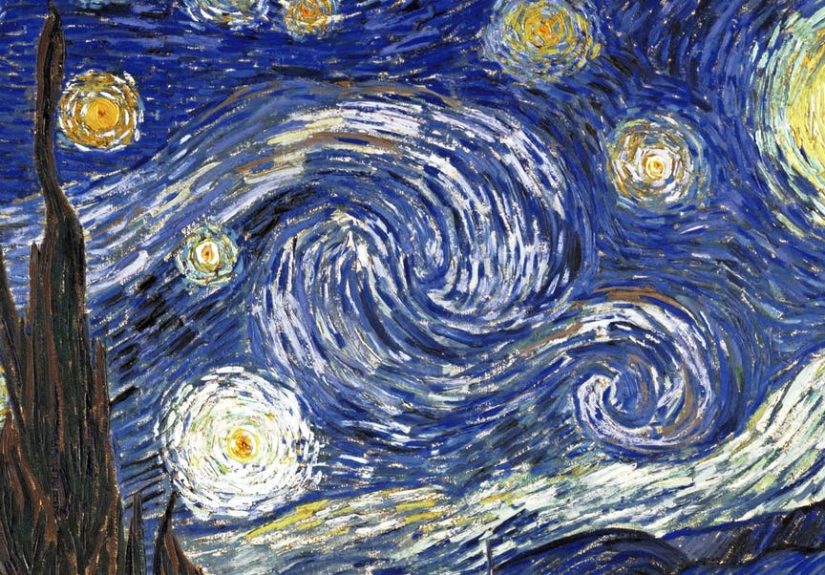
Painted in 1889 during van Gogh’s time in Saint-Rémy-de-Provence, The Starry Night shows a village under a charged, swirling sky, with a cypress rising like a dark flame in the foreground. The scene is partly observed, partly invented, and entirely unforgettable. The sky looks alivelike it’s breathing, rolling, and pouring itself across the canvas.
Art historians often talk about the work’s emotional intensity and expressive brushwork. Physicists, meanwhile, can’t help noticing something else: the swirls resemble the structure of turbulent flowthose chaotic, nested eddies you see in smoke, water, and clouds. The painting isn’t a textbook diagram, but it can still carry the same “signature” that turbulence leaves behind in the real world.
Turbulence: The Universe’s Favorite Kind of Chaos
Turbulence is what happens when a fluid (air counts) moves in a way that becomes chaotic: swirls form, interact, stretch, and break down into smaller swirls. It’s why candle smoke curls, why rivers form whirlpools behind rocks, and why weather forecasts sometimes feel like polite suggestions.
The energy cascade, explained like you’re holding a spoon
One of the core ideas in turbulence is the energy cascade. Energy enters the system at large scalessay, wind pushing a big mass of air. That energy transfers into smaller and smaller eddies, until it reaches scales so tiny that viscosity (fluid “friction”) finally dissipates it as heat.
In the 1940s, Russian mathematician Andrey Kolmogorov proposed a statistical description of this cascade in what’s called fully developed turbulence. The key point: while the exact motion is unpredictable, the statistics often follow strikingly regular patternsespecially power laws that show up as straight lines on log-log graphs. (Yes, turbulence makes graphs. It’s trying to be helpful. It’s just bad at it.)
Where paintings sneak into the story
A painting is not a wind tunnel, but images can be analyzed like data. Researchers can treat luminance (brightness) variations in an image as a kind of “field” that fluctuates across spacethen test whether those fluctuations resemble the statistical behavior of turbulence. The question becomes: do the brightness changes across the sky behave like turbulent differences across a fluid?
So… Is Van Gogh’s Sky Actually “Turbulent”?
Multiple scientific analyses over the years have suggested that in some of van Gogh’s more dynamic worksespecially those featuring swirling skiesthe distribution and scaling of luminance fluctuations can resemble turbulence statistics described by Kolmogorov. In plain English: if you measure how the brightness changes from one point to another across the painted sky, the pattern of those changes can line up with what turbulence theory predicts.
More recent research has pushed this idea further by looking at power spectra (how “structure” is distributed across different spatial scales) and by comparing the painting not only to Kolmogorov-style velocity turbulence, but also to Batchelor-type behavior associated with how turbulence mixes scalar quantities (think temperature or dye concentration).
Important reality check: this doesn’t mean van Gogh “solved” turbulence
Nobody is claiming van Gogh secretly derived equations in the margins of his sketchbook. What these studies suggest is simplerand arguably more impressive: he was an intense observer. Under the right conditions, a human eye (and a bold painter) can capture the visual truth of turbulent structure so well that the statistics echo physics.
Also, the painting includes artistic choices that aren’t literally accurate (because art is allowed to be art). The surprise is that even with artistic license, the pattern language of turbulence can still appear.
The Quantum Physics Phenomenon: Quantum Turbulence
Now we step into the part of the pool where physics starts wearing a cape. Quantum turbulence is turbulence that occurs in quantum fluidssystems like superfluid helium or Bose–Einstein condensates (BECs), where quantum mechanics shows up on a macroscopic scale.
What makes a fluid “quantum”?
In a classical fluid (like water), vortices can have almost any circulation strength. In a quantum fluid, circulation is quantizedvortices come in discrete units. Imagine a world where you can’t twist something “a little” or “a lot”; you can only twist it in whole-number steps. That’s the vibe.
In these systems, turbulence often looks like a tangled web of quantized vortices. The motion is still complex and chaotic, but the building blocks are fundamentally different from classical swirling flow.
Here’s the twist: the statistics can look familiar
Despite the quantized nature of the vortices, quantum turbulence can produce energy cascades and spectra that resemble classical turbulenceespecially in “quasiclassical” regimes, where many vortices interact across a range of scales. In those cases, researchers often find behaviors consistent with Kolmogorov-like scaling (including the famous -5/3 kind of relationship in certain spectra).
This is the deep connection: very different physics can generate similar statistical patterns. Turbulence, in some sense, is a universal languagespoken with different accents by air, water, and quantum fluids.
Where The Starry Night and Quantum Turbulence Overlap
Let’s make the connection crystal clear (as clear as anything involving turbulence can be, which is to say: clearer than a foggy mirror). The overlap isn’t “van Gogh painted quantum vortices.” The overlap is that both systems can display:
1) Cascades across scales
In classical turbulence, energy cascades from large eddies to smaller eddies. In quantum turbulence, energy can also transfer across scalessometimes through interactions of quantized vortices, reconnections, and collective motion that mimics larger-scale flow. Different microscopic rules, similar macroscopic storytelling.
2) Power-law behavior and scale invariance
Turbulent systems often look “self-similar” across a range of scales: zoom in, and you keep seeing swirl-like structure. Researchers analyzing The Starry Night have looked for analogous scale behavior in the painting’s skywhether the spatial fluctuations behave as if they’re part of a cascade.
3) Vortices as the star performers
In classical fluids, vortices are everywhere in turbulenceeddies within eddies. In quantum turbulence, vortices are not just common; they’re quantized and central to the phenomenon. Either way, the visual idea of “swirl structure” is not random decorationit’s the hallmark of turbulent motion.
4) A bridge between art and measurement
The coolest part may be methodological: you can treat a painting as a field of values (brightness, color intensity), then study fluctuations like a scientist studies data from a turbulent flow. That approach doesn’t flatten the art into numbersit adds a second lens. One lens asks, “What does this feel like?” Another asks, “What pattern does it share with nature?”
Why This Matters Beyond a Fun Fact
It’s tempting to file this under “science party trick,” right next to levitating frogs and the fact that bananas are (mildly) radioactive. But the art–physics overlap points to something bigger: human perception is good at recognizing the geometry of nature, even when we can’t write the equations.
Artists often learn the rules of the world by looking harder than the rest of us. Physicists learn the rules by measuring. When both perspectives land on the same patternslike turbulent cascadesit’s a reminder that reality has structure, and we can approach it from multiple directions.
And for quantum turbulence specifically, the connection is a helpful analogy: if you can understand what a cascade is in a storm cloud or river current, you’re already holding the conceptual handle for why a super-cold quantum fluid can behave in a statistically similar wayeven though its vortices are quantized.
Specific Examples to “See” the Connection in Everyday Life
Swirling cream in coffee
Pour cream into coffee and watch the tendrils curl, stretch, and break into smaller swirls. You’re watching a mixing process that turbulence theory tries to describe statistically. The shapes aren’t identical to van Gogh’s brushstrokes, but the family resemblance is obvious: rolling curls, nested structure, and motion that looks organized and chaotic at the same time.
Smoke, clouds, and that one candle you regret lighting indoors
Smoke plumes and cloud edges often show turbulent structure. Van Gogh’s sky captures a stylized version of this: the sense of flow, curl, and layered motion. When scientists analyze images (including paintings), they’re often hunting for that cross-scale structurethe kind turbulence loves to leave behind.
Star “twinkling” and atmospheric turbulence
Stars appear to twinkle because Earth’s atmosphere is turbulent; moving pockets of air refract light differently over time. If you’ve ever looked at a bright point of light on a shimmering summer night and thought, “Why is the sky doing jazz hands?”that’s turbulence again. The Starry Night is an emotional, painterly take on a sky that refuses to be still.
Experiences That Make the Art–Quantum Connection Feel Real (Extra )
If you’ve ever stood in front of The Starry Night in a museum, you probably noticed something odd: the painting feels bigger than it is. You can’t “take in” the sky all at once, because your eyes keep hopping from swirl to swirl like they’re following motion. That’s a very turbulence-like experience. Turbulence pulls attention the way a good plot twist doesyour brain senses structure, then immediately senses instability, and it wants to resolve the tension.
One useful way to experience the physics without needing a lab is to treat your everyday life like a low-budget science exhibit (the best kind, because admission is free). Stir tea and stop suddenly. Watch how the surface keeps moving. Drop a tiny bit of soap into a greasy dishwater film and see patterns race outward. Run water in a sink and gently disrupt the flow with your fingers; you’ll create eddies that roll, merge, and dissolve. These are not perfect replicas of the painting, but they teach the same lesson: motion can be chaotic and still have a recognizable “grammar.”
Now for the quantum twistbecause quantum turbulence sounds like something a superhero would fight at 3 a.m. You can’t see a Bose–Einstein condensate in your kitchen (and you shouldn’t try), but you can feel what makes quantum turbulence mind-bending: the idea that nature sometimes forces continuous things into discrete steps. Think about digital music versus a vinyl record. A record is continuous; digital audio is sampled. Quantum fluids behave as if certain aspects of motionlike circulation around a vortexare “sampled” into allowed values.
Here’s the experience bridge: once you accept that discrete building blocks can still create a continuous-looking pattern, the art analogy clicks. Van Gogh’s sky is made of discrete strokesindividual marks that you can see up closeyet from a few feet away, those strokes become a flowing, stormy field. Quantum turbulence is made of discrete vortices, yet at larger scales it can resemble classical turbulence with familiar cascades and spectra. In both cases, the big picture isn’t a contradiction; it’s an emergence.
A final hands-on experience: try filming steam or smoke with your phone in slow motion (from a safe distance, with good ventilation). You’ll see curls forming, stretching into thinner strands, and sometimes snapping into new shapes. That “stretch-and-break” rhythm is a cousin of the cascade idea. When you return to The Starry Night, you may notice that the painted swirls feel less like fantasy decoration and more like an intuitive portrait of how flow behaves. The painting doesn’t prove a theorembut it invites you to recognize a pattern that physics later formalized, and that quantum systems can echo in their own strange, quantized way.