Table of Contents >> Show >> Hide
- The Film That Turned Totality Into Time Travel
- Meet the Man Behind the Camera: Nevil Maskelyne
- Why the 1900 Eclipse Was Such a Big Moment
- What You Actually See in the Footage
- From Still Photography to Moving Pictures
- Why the Restoration Matters
- What the Film Teaches Us About Eclipses Today
- The Experience of Watching the Oldest Known Eclipse Footage Today
- Final Thoughts
- SEO Tags
Watching a solar eclipse in 2026 usually means one thing: thousands of smartphones pointed skyward, a flood of dramatic reaction videos, and at least one person loudly insisting they “totally don’t need eclipse glasses” right up until everyone else tells them to calm down. But more than a century before eclipse clips took over the internet, one man hauled early movie equipment into the field and captured what is now recognized as the oldest surviving known footage of a total solar eclipse.
That film, shot on May 28, 1900, is more than a curiosity. It is a tiny time capsule from the moment science, cinema, and a little theatrical flair all collided under a darkened sky. The footage is grainy, jittery, and astonishingly alive. It shows the Moon sliding across the Sun, the eerie glow of the corona blooming into view, and the kind of celestial drama that still makes modern viewers go quiet. In an era before digital sensors, before livestreams, and before anyone could say “content creator” with a straight face, this was eclipse filmmaking at its boldest.
So why does this old clip matter so much? Because it is not just a record of an eclipse. It is a record of human ambition. It shows how people at the dawn of the motion-picture age were already trying to use new technology to preserve fleeting natural events. And if you watch closely, you can feel the excitement that must have gripped the people gathered beneath the path of totality that morning. That feeling has not aged a day.
The Film That Turned Totality Into Time Travel
The surviving eclipse footage was filmed during the total solar eclipse of May 28, 1900, from Wadesboro, North Carolina, which had become a magnet for scientists and skywatchers. That was no accident. Wadesboro was considered one of the best observing locations in North America for the event, and the town welcomed a wave of researchers, instruments, and serious scientific ambition. In other words, for one morning, this North Carolina town became the place to be if you enjoyed astronomy, logistics, and carrying large pieces of equipment before sunrise.
The film itself captures a total solar eclipse, the kind of eclipse that happens when the Moon passes directly between Earth and the Sun and completely blocks the Sun’s bright face for observers inside the path of totality. During that brief interval, daylight drops to an eerie twilight, and the Sun’s corona becomes visible. That outer atmosphere is usually hidden by the Sun’s overwhelming glare, which is why total eclipses remain such prized scientific and visual events.
What makes this clip extraordinary is not just its age. It is the fact that it survives at all. Motion-picture film from that era was fragile, easily damaged, and often lost. Yet the surviving fragment endured long enough to be rediscovered, scanned, and restored frame by frame. Once restored, the footage offered modern viewers something almost absurdly moving: the chance to watch people from 1900 looking at the same sky spectacle that still stuns people today.
Meet the Man Behind the Camera: Nevil Maskelyne
The person behind the lens was Nevil Maskelyne, a British magician, early filmmaker, and enthusiastic astronomy supporter. That combination sounds suspiciously like the setup for a period drama nobody asked for, but it was real. Maskelyne understood performance, illusion, and the power of visual wonder. He also believed that film could do more than entertain. It could document reality, preserve scientific moments, and bring astonishing events to audiences who had not witnessed them in person.
To capture the eclipse, Maskelyne used a specially adapted camera setup with a telescopic attachment. That was a big deal. Filming the Sun was not simple in 1900, and filming an eclipse was even harder. Totality is brief, the light changes rapidly, and the equipment of the time offered none of the convenience modern photographers take for granted. No autofocus. No image stabilization. No quick settings menu. Just ingenuity, timing, and nerves.
Maskelyne’s surviving eclipse film is especially important because it appears to be the only known film of his that still exists. That alone would make it historically significant. Add in the fact that it records one of nature’s most dramatic astronomical events, and the result is something far bigger than an old reel of film. It becomes a landmark in both scientific imaging and motion-picture history.
Why the 1900 Eclipse Was Such a Big Moment
The May 28, 1900 eclipse swept across Mexico, the southeastern United States, parts of Iberia, and North Africa. In the United States, observers across the South turned out to watch the event, while scientists used the opportunity to study everything from the solar corona to atmospheric changes caused by the Moon’s shadow. This was not a casual “step outside and have a look” kind of day. It was a serious scientific campaign.
Government meteorologists and researchers tracked changes in temperature, air pressure, and sky conditions. Smithsonian teams were also on the scene. Photographer Thomas Smillie, working with the Smithsonian Solar Eclipse Expedition, rigged cameras to multiple telescopes and successfully produced glass-plate negatives of the eclipse and the corona. So while Maskelyne was capturing motion, other experts were freezing the event in still images for scientific study. The 1900 eclipse, in short, was a full-service spectacle: beautiful, rare, and scientifically useful.
There is also something wonderfully human about the setting. Historic accounts describe Wadesboro as a town transformed by eclipse visitors. Residents welcomed observers, astronomers arrived with imposing instruments, and anticipation built as the morning sky brightened toward a brief encounter with darkness. That context matters because it reminds us that great scientific moments do not happen in abstraction. They happen in real places, among real people, with all the mess, excitement, and caffeine needs that come with it.
What You Actually See in the Footage
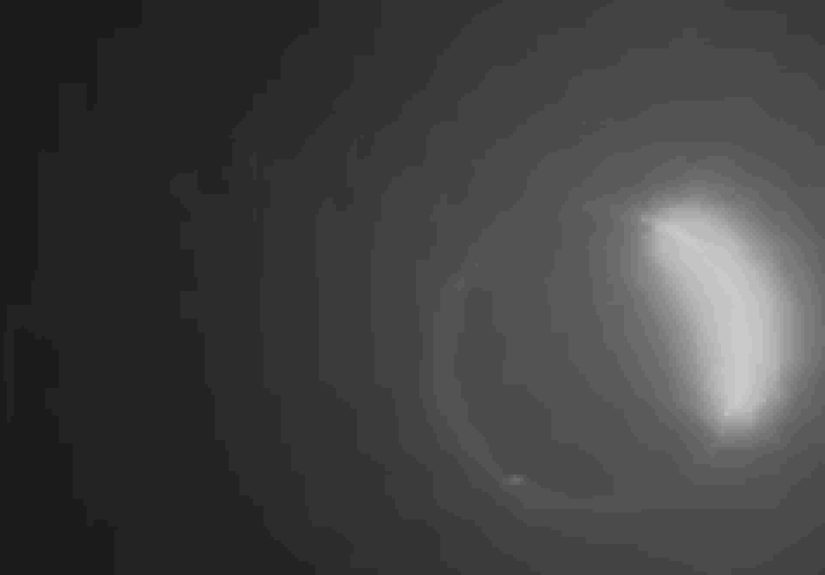
Part of the thrill of the restored clip is how recognizable the eclipse still feels. Even through the flicker and age of the film, the sequence is unmistakable. The Moon covers the Sun. The scene shifts into the strange visual language of totality. Then comes the corona: pale, delicate, and ghostly, stretching around the dark disk like light trying very hard not to be dramatic and failing completely.
Some observers have pointed out that the footage also shows the visual drama near the edges of totality, the moment when sunlight shrinks and then returns in brilliant form. Modern eclipse chasers call one such effect the “diamond ring,” and its appearance remains one of the most celebrated visual moments in total-eclipse viewing. Seeing an early version of that experience on century-old film is enough to make even a casual viewer stop scrolling and stare.
The film is short, but that brevity is part of its power. Totality itself never lasts long. A total solar eclipse is, by nature, a fleeting event. The footage mirrors that reality. It arrives, astonishes, and slips away. That makes the clip feel less like a polished documentary and more like a genuine brush with something rare.
From Still Photography to Moving Pictures
Maskelyne’s eclipse film did not appear out of nowhere. It belongs to a larger history of people trying to record the Sun’s most dramatic disappearances. Before cameras, astronomers relied on sketches. That meant drawing quickly during the brief moments of totality and hoping your hands were steadier than your heartbeat. Eventually, photography changed everything.
One major milestone came in 1851, when Johann Julius Friedrich Berkowski created what is widely recognized as the first successful photograph of a total solar eclipse. That image proved eclipses could be captured with more precision than a hand-drawn sketch. By 1900, scientists and photographers had become much more ambitious. They wanted still images, spectroscopic data, atmospheric measurements, and now, thanks to Maskelyne, motion.
That progression matters because it shows how each generation uses its newest tools to chase the same old wonder. In 1851, the breakthrough was a daguerreotype. In 1900, it was a moving picture. In the 21st century, eclipse watchers use high-speed digital cameras, satellite forecasts, live feeds, and sometimes enough backup batteries to power a small village. Different tools, same impulse: do not let this moment vanish unrecorded.
Why the Restoration Matters
The modern restoration of the film gave the footage a second life. Conservation experts scanned and reassembled the fragment frame by frame, correcting timing and making it viewable for modern audiences. That restoration is not just a technical achievement. It is an act of cultural rescue.
Without restoration, early film often remains inaccessible, buried in archives or too fragile to handle. With restoration, it becomes legible again. It can be studied by historians, appreciated by astronomy fans, and enjoyed by everyday viewers who simply want to see what totality looked like to someone standing under the 1900 sky. The restored clip bridges two eras at once: the age of Victorian experimentation and the age of digital preservation.
It also sharpens the article’s title in an important way. The 1900 film is best understood as the oldest surviving known footage of a total solar eclipse, not necessarily the first attempt ever made. Earlier efforts connected to eclipse filmmaking existed, but survival is everything in archive history. The film we can still watch is the one that changes the conversation. It is the one that makes history visible instead of hypothetical.
What the Film Teaches Us About Eclipses Today
Oddly enough, a film from 1900 still teaches modern viewers how to think about eclipses. First, it reminds us that totality is the main event. Outside the path of totality, you are seeing a partial eclipse, which is still cool, but it is not the same experience. Inside the path, the Sun’s bright face is fully blocked, daylight drops dramatically, and the corona appears. That is the transformation people travel for.
Second, the film underscores how brief and valuable that window is. Totality passes fast. Even when an eclipse lasts longer than the one Maskelyne filmed, the experience still feels alarmingly short. One minute you are adjusting your glasses, checking your camera, and wondering if a cloud is plotting against you. The next, it is over, and you are standing there in a kind of happy disbelief.
Third, it is a quiet reminder about safety. During the partial phases of a solar eclipse, viewers need proper eclipse glasses or safe solar viewers. Only during the brief period of totality, when the Sun’s bright face is fully covered, can direct viewing happen without that protection. It is the least glamorous advice in the world, but it does save eyes, which remain useful for future eclipses.
The Experience of Watching the Oldest Known Eclipse Footage Today
Watching the oldest known footage of a solar eclipse today feels strangely intimate. You know the film is old. You can see the age in every tremble of the frame. But the emotion inside it is fresh. That is the magic of it. The clip does not feel dusty. It feels immediate, like a hand reaching out from 1900 and tugging your sleeve toward the sky.
At first, the experience is almost academic. You notice the restoration, the historical context, the fragile quality of early film. Your brain starts in documentary mode. You think about cameras, archives, and the people who carried equipment into the field at a time when recording moving images was still a daring technical experiment. Then, somewhere in the middle of the footage, the intellectual distance disappears. The Sun, the Moon, and that thin, luminous halo take over. Suddenly it is not just history anymore. It is wonder, preserved.
There is also something deeply moving about knowing how many obstacles had to be cleared for this clip to exist in your browser or on your screen. Someone had to imagine filming an eclipse before that idea was normal. Someone had to build the equipment. Someone had to travel to the right place. Someone had to keep the film from vanishing into the void of neglect, decay, or accident. And more than a century later, someone had to restore it with enough care that modern viewers could see what was hiding in those frames. That chain of effort is part of the experience too.
The footage also creates a rare emotional overlap between eras. When you watch it, you are not just observing a scientific event. You are sharing a reaction with people who lived in a completely different world. Their transportation was slower, their cameras were crude by modern standards, and their daily lives looked nothing like ours. Yet when the sky darkened and the corona appeared, they must have felt the same small shock that people feel now. That continuity is powerful. It suggests that some kinds of awe do not date.
For anyone who has seen a total eclipse in person, the film can trigger a kind of memory echo. You remember the hush. You remember the sudden weirdness of the light. You remember how every plan to “take lots of pictures” collapsed into simply staring upward like a grateful fool. And if you have never seen totality in person, the footage still works as an invitation. It hints at what people chase across continents for: not just a sight, but a sensation. A total eclipse feels less like watching something happen and more like briefly stepping outside the ordinary rules of daytime reality.
That may be why the clip stays with people. It is short, imperfect, and technically primitive, yet it delivers something many polished modern videos do not: a genuine sense of discovery. It lets you feel how radical it once was to capture a moment like this at all. In a time when nearly everything is recorded, that old film restores the lost thrill of firsts. The first surviving eclipse movie. The first viewers to see it in a theater. The first modern audiences to watch it restored. Each layer adds another pulse of excitement.
In the end, the experience is not really about nostalgia. It is about perspective. The film reminds us that human beings have long been willing to travel, tinker, improvise, and risk failure just to hold on to a few seconds of wonder. That impulse is still with us. Every eclipse livestream, every carefully planned photo, every crowd that gasps at totality belongs to the same tradition. Maskelyne’s footage simply lets us see where that tradition looked when it was still young, hand-cranked, and gloriously shaky.
Final Thoughts
The oldest known surviving footage of a solar eclipse matters because it captures more than a rare astronomical event. It captures a turning point in how humans record the universe. Nevil Maskelyne’s 1900 film sits at the intersection of science, storytelling, experimentation, and spectacle. It shows that even in the earliest days of cinema, people were already using moving images to preserve moments that vanish almost as soon as they appear.
And maybe that is why the clip still feels so modern. It is built from the same desire that drives people to chase eclipses today: the need to witness something extraordinary and, somehow, bring a piece of it back. The technology has changed. The awe has not. Watch the film once, and you are seeing history. Watch it twice, and you are also seeing yourself in it.