Table of Contents >> Show >> Hide
- What “radio signals from space” actually means
- The 1994 vibe: why this feels so satisfying
- The best “space signals” you can receive at home
- How to build a “retro-ish” receiving setup (without cosplay)
- Classic problems (and the very 1994 fixes)
- Is this legal? Usually yesjust don’t be weird about it
- Why the nostalgia still matters
- Conclusion
- Experiences: Field Notes From 1994 (When the Sky Beeped Back)
There’s a very specific kind of joy that comes from hearing a strange, wobbly “beep-beep-beep” and realizing it didn’t come from your microwave, your neighbor’s garage door, or your friend’s pager (RIP). It came from space.
And not the glossy, “download this app and watch a 4K livestream from orbit” kind of space. I’m talking about the crunchy, gloriously imperfect, “I built an antenna out of whatever was in the junk drawer” kind of space. The kind where your computer makes noises that sound like a fax machine wrestling a dolphin. The kind that feels like 1994when the internet screamed, Windows crashed with confidence, and hobbyists could still believe they might accidentally discover an alien civilization between local talk radio and weather static.
What “radio signals from space” actually means
When people say “signals from space,” they usually mean one of two things:
- Human-made transmissions from objects in space (satellites, probes, spacecraft).
- Natural radio emissions from cosmic sources (the Sun, Jupiter, the Milky Way, pulsars, and more).
Both are real. Both are fascinating. And both can make you feel like you’re eavesdropping on the universewithout needing a PhD, a government grant, or a secret bunker (those are harder to source than a decent coax crimper).
The 1994 vibe: why this feels so satisfying
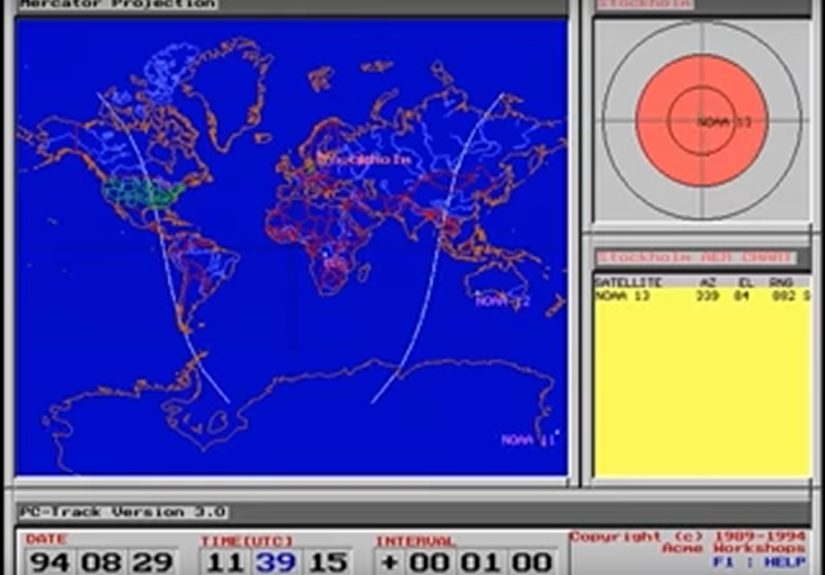
In the 1990s, receiving was half science and half scavenger hunt. You didn’t “subscribe” to space. You tuned into it. You learned the difference between “signal” and “my desk lamp is angry.” You made friends with static. You developed the spiritual patience of a monk because your best satellite pass happened precisely when your neighbor decided to run a leaf blower.
That hands-on friction is the point. It turns the sky into something you can interact withnot just watch. And it teaches you a surprisingly modern lesson: the world is full of data… if you know how to listen.
The best “space signals” you can receive at home
1) Jupiter and the Sun: nature’s loudest radio stations
If you want a true “I am hearing a planet” moment, Jupiter is your celebrity guest. It naturally emits strong radio bursts in the decametric range (roughly 10–40 MHz). These bursts are tied to Jupiter’s magnetic environment and its interaction with its moon Iobasically, an interplanetary science drama told through radio crackles.
The Sun is another excellent broadcaster. Solar flares and eruptions can produce radio bursts across a wide range of frequencies. When the Sun gets rowdy, your receiver may sound like it’s trying to fry an egg in real time.
The charming part is that this is “space” in the purest sense: no encryption, no subscription, no corporate terms of service. Just physics.
2) Weather satellites: the classic “space fax” (and what replaced it)
For decades, one of the most satisfying beginner wins was receiving live-ish weather imagery from polar-orbiting satellites. Hobbyists famously captured analog images transmitted in the VHF range around 137 MHz. You’d hear a distinctive tone, record audio, then decode it line-by-line into cloud maps that looked like they were printed by a haunted dot-matrix printer.
Here’s the very 2026 twist: that classic analog era has largely ended. Several legacy transmissions were shut down as older satellites were decommissioned. If your goal is specifically the “1994 space fax” experience, many people now recreate it using archived recordingsor they pivot to newer digital satellite image modes that require different decoding and (often) different gear.
The good news: the skill you learntracking passes, building antennas, managing Doppler shift, decoding signalstransfers beautifully to modern satellite reception. The universe doesn’t care if your decoder is from 1994 or last Tuesday.
3) Amateur radio satellites: repeaters in the sky
If you want something interactive, amateur radio satellites are the perfect blend of “space” and “I can actually do this on a weekend.” Many act like cross-band repeaters: you transmit on one frequency band and listen on another as the satellite re-transmits what it hears. It’s like a flying relay station that refuses to hold still.
The “1994” magic here is the live nature of it. Signals rise out of the noise, peak, and fade as the satellite moves across the sky. You learn quickly that space is not a fixed directionit’s a moving target. Also, you learn Doppler shift is not a theory; it is a tiny gremlin that slides your signal around unless you chase it.
Even if you don’t transmit, listening to satellite downlinks and beacons can still scratch that retro itch: tuning, tracking, logging, and celebrating when the audio is clear enough to prove it’s not just your fridge.
4) Deep space: when your backyard starts dreaming big
Deep-space probes are the “final boss” category. Spacecraft like Voyager transmit extremely weak signals over enormous distances, typically using high frequencies such as X-band around 8.4 GHz. NASA’s Deep Space Network uses giant antennasthink “your antenna is a building” scaleto pull those whispers out of the cosmic noise.
Can a hobbyist receive deep-space signals? In some cases, with enough hardware, expertise, and a dish that makes your neighbors ask questions. Universities and observatories have detected signals from deep-space probes, and there are documented demonstrations using arrays and serious radio astronomy techniques. Practically speaking, most home setups won’t “decode data” from deep-space missionsbut the concept matters: it shows you that radio is a real physical bridge between Earth and the far edge of human engineering.
If you want the spirit of deep space without needing a small observatory, aim for “near-space” targets (satellites) and natural emissions (Sun/Jupiter). You’ll still be receiving genuine extraterrestrial radio signalsjust with fewer zeros in the distance.
5) The hydrogen line: listening for the Milky Way’s fingerprint
Want a project that feels both retro and profoundly scientific? Try the hydrogen linethe famous 21-centimeter emission at about 1420 MHz. Neutral hydrogen is abundant in our galaxy, and this spectral line is a cornerstone of radio astronomy. Detecting it is like hearing the Milky Way clear its throat.
This is where the hobby turns into science-lab energy. With the right antenna (often a horn or small dish), a low-noise amplifier, and careful filtering, it’s possible to measure changes in signal strength across the sky and begin mapping large-scale galactic structureat least in a humble, “my laboratory is also my garage” way.
Bonus: this frequency neighborhood is special in spectrum management, because radio astronomy has protected bands and observatories take interference seriously. Translation: your setup has to be cleaner, your approach more disciplined, and your respect for the airwaves upgraded from “vibes” to “responsibility.”
How to build a “retro-ish” receiving setup (without cosplay)
You don’t need to time-travel to 1994. You just need the same mindset: be curious, be patient, and accept that your first antenna will be “fine” in the same way your first pancake is “fine.”
Pick a target first, then choose gear
A common mistake is buying a receiver and hoping space shows up like an uninvited guest. Flip it:
- Solar/Jupiter listening: focus on HF (shortwave-ish) and low-frequency setups.
- Satellites (weather, amateur, beacons): VHF/UHF is your home base.
- Hydrogen line: you’re living around 1420 MHz with higher standards for noise control.
Once you choose the target, the antenna and receiver decisions get easier. “What should I buy?” becomes “What do I need to receive this?”
Antennas: the part that makes or breaks everything
Receivers get the glamour. Antennas do the actual work. If your reception is disappointing, the fix is usually not “more expensive radio,” it’s “a better piece of metal pointed in the correct direction.”
Classic space-signal-friendly options include:
- Dipoles and V-dipoles for VHF satellite work (simple, cheap, surprisingly effective).
- Yagis for more gain and better directionality (more “point and chase,” less “hope and pray”).
- Loops for certain HF listening scenarios where noise rejection matters.
- Horns/dishes for higher frequencies (hydrogen line and beyond), where gain and low noise are everything.
And yes, you can build many of these yourself. That’s not just budget-friendlyit’s part of the 1994 magic. The first time you hear a satellite more clearly because of something you built, you’ll grin like you just hacked the universe (legally).
Receivers: old-school radios or modern SDRs (with retro discipline)
A vintage scanner or shortwave receiver can absolutely deliver nostalgia. But modern software-defined radios (SDRs) make the hobby dramatically easier: you can see the spectrum, record wide chunks of frequencies, and decode signals with software rather than mystery boxes.
To keep the “1994” feel, set rules for yourself:
- Try tuning by ear first before relying on a waterfall display.
- Keep a logbook (yes, a real onepaper has unbeatable uptime).
- Do one project at a time: chasing every signal is how you end up with 47 half-finished antennas and a mild existential crisis.
Decoding: turn weird sounds into meaning
Many space-related signals are meant to be decoded: weather images, digital beacons, telemetry, and more. The “receiving” part is only half the thrill. The other half is when you convert audio into something visual or measurablean image, a plot, a confirmation that the signal is real and not your laptop fan auditioning for a techno band.
Classic problems (and the very 1994 fixes)
Problem: “All I hear is noise.”
Welcome. You are hearing the universe’s default setting. Solutions usually include: better antenna placement, fewer cheap power supplies, shorter/cleaner coax, and turning off the one LED lamp in your home that apparently runs on pure chaos.
Problem: “It worked yesterday. Today it doesn’t.”
This is the hobby’s way of building character. Re-check connectors, re-check frequencies, re-check settings, and assume you bumped something. Also, remember: satellite passes change, solar conditions change, and sometimes the sky simply chooses violence.
Problem: “The signal slides around.”
That’s Doppler shift in actionespecially with fast-moving satellites. You compensate by tuning as the pass progresses. This is not optional; it is the price of admission for listening to things that are literally sprinting around the planet.
Is this legal? Usually yesjust don’t be weird about it
In the U.S., receiving many signals (broadcast, weather, amateur beacons, and unencrypted transmissions intended for public reception) is generally allowed. Transmitting is where licensing and rules matter a lot moreespecially on amateur bands and anywhere near protected services (like radio astronomy).
Common-sense guidelines:
- Don’t transmit unless you’re properly licensed and operating within the rules.
- Don’t interfere with protected or safety-critical services.
- Don’t try to “defeat” encryption or access restricted communications.
- Respect quiet zones and spectrum allocationsespecially near radio astronomy bands and facilities.
If you’re unsure about a specific band or use case, check the relevant U.S. frequency allocation guidance and amateur radio resources. The goal is to be the kind of listener the universe would invite back.
Why the nostalgia still matters
“Receiving radio signals from space like it’s 1994” isn’t just retro fun. It’s a hands-on way to understand how reality works:
- Signals weaken with distancefast.
- Antennas are physics, not vibes.
- Noise is everywhere, and extracting meaning is an art.
- Space communication is one of humanity’s most impressive engineering achievements.
When you successfully receive somethinganythingyou feel the world get bigger. Not because you read about space, but because you touched it through radio.
Conclusion
If you want a hobby that mixes science, craftsmanship, problem-solving, and the occasional triumphant “YES!” shouted at a speaker, space signal reception delivers. You can listen to Jupiter’s bursts, follow satellites across the sky, explore amateur radio spacecraft, and even chase the hydrogen whisper of the Milky Way.
And the best part? You don’t need to pretend it’s 1994. You just need to bring back 1994’s attitude: curiosity first, excuses never, and an unshakable belief that if you adjust the antenna one more time, the universe might finally speak up.
Experiences: Field Notes From 1994 (When the Sky Beeped Back)
Imagine it’s a humid Saturday night in 1994. You’ve got a cheap receiver, a notebook, and the kind of optimism only found in teenagers, graduate students, and people who think “one more connector” will fix everything. Your computer is a beige monument to patience. The monitor is deep enough to qualify as furniture. The speakers pop every time the fridge kicks on, which feels less like an appliance and more like a paranormal event.
You start with the ritual: extend the antenna, then extend it again because surely the extra six inches will impress outer space. You tune slowly. The dial feels like a safecracker’s tooltiny movements, long pauses, listening for anything that sounds deliberate. Static dominates, of course. But you’re not discouraged. Static is the ocean; signals are the dolphins. You’re basically doing marine biology, except the dolphins are electromagnetic and the ocean is the entire atmosphere.
Then it happens: a tone that’s too steady to be random. Not music, not voicejust a confident, mechanical sound. It rises, dips, and rises again like it’s breathing. You freeze, because moving might spook it. The signal is faint, but it’s there. You write the time in your notebook with the intensity of someone documenting first contact: “10:42 PM weird carrier, drifting slightly.”
You run a cable from the receiver’s audio out to the computer’s sound input. This is not elegant. It’s a snake pit of wires that would give a modern cable-management influencer a panic attack. You open whatever decoding software you managed to obtainpossibly from a friend, possibly from a floppy disk with a label like “SAT STUFF (DO NOT ERASE).” The software looks like it was designed by someone who hates both fonts and human happiness. Perfect.
The screen begins to draw lines. At first it’s nonsensegray streaks, jitter, a diagonal tear that looks like the image is trying to escape. You adjust volume. You adjust squelch. You adjust the antenna angle by approximately one degree and suddenly everything snaps into place like the universe just decided to stop messing with you. A crude picture forms: clouds and coastline in smeared grayscale, like a ghost took a Polaroid of Earth. You stare at it, stunned. This isn’t a downloaded image. It’s not a TV broadcast. You pulled it out of the air.
You feel like a wizard, but with more solder burns.
Later, you try something even stranger: listening for Jupiter. You’re not entirely sure you’re doing it right. You set up a basic antenna and tune where the instructions said Jupiter might “talk.” For a while, there’s nothingjust hiss. Then you hear it: pops, crackles, bursts that don’t behave like local interference. They come and go, sometimes in clusters, sometimes as lonely ticks. The sound is raw and alien, not because it’s intelligent, but because it’s natural in a way Earth rarely is. You look up at the sky and realize the planet you learned about in school isn’t just a dot. It’s an active, noisy world with a magnetic personality.
By 2:00 AM, you’ve written pages of notes, drawn little arrows, and invented new swear words for when the signal fades at the worst moment. You’re tired. Your setup looks like a science fair project held together by hope. But you’re smiling, because you did the thing: you listened hard enough that space answered. Not with wordsjust with proof.
And that’s the real 1994 experience: the moment you stop being a passive consumer of space and become an active receiver of it. You don’t “watch” the cosmos. You tune in. You chase. You decode. You learn. And for a few crackling minutes, the sky feels close enough to touch.