Table of Contents >> Show >> Hide
- What Was the Lockheed Martin Lunar Lander?
- Why the 2024 Moon Goal Mattered
- How Lockheed Martin’s Lander Fit Into Artemis
- Lockheed Martin and the Human Landing System Competition
- Why NASA Did Not Land Humans on the Moon by 2024
- Technical Strengths of the Lockheed Martin Lunar Lander Concept
- Challenges Facing Any Human Lunar Lander
- Lockheed Martin’s Continuing Role in Lunar Exploration
- Lessons From the “Humans on the Moon by 2024” Era
- Experience Section: What Following the Lockheed Martin Lunar Lander Story Feels Like
- Conclusion
When NASA challenged American industry to help return astronauts to the Moon by 2024, the phrase sounded like a Hollywood trailer with a government badge: ambitious, dramatic, and just risky enough to make engineers reach for coffee. Lockheed Martin, already deeply involved in NASA’s Orion spacecraft, stepped into that conversation with lunar lander concepts designed to move humans from lunar orbit to the surface and back again.
The Lockheed Martin lunar lander was never just a shiny Moon taxi. It represented a larger idea: the United States would not simply repeat Apollo, plant another flag, snap a few heroic photos, and leave footprints for history books. The goal was to build a more sustainable lunar transportation system connected to Orion, the Space Launch System, the Gateway concept, commercial partnerships, and eventually Mars exploration.
Of course, the “by 2024” part has aged like milk left on a launchpad. NASA’s Artemis schedule changed as the agency faced technical, budget, safety, and integration challenges. Yet the original 2024 target remains important because it accelerated the national conversation around human landers, commercial space, reusable lunar vehicles, and long-term Moon infrastructure. Lockheed Martin’s ideas helped shape that discussion, even as NASA later selected other providers for the first crewed landing demonstrations.
What Was the Lockheed Martin Lunar Lander?
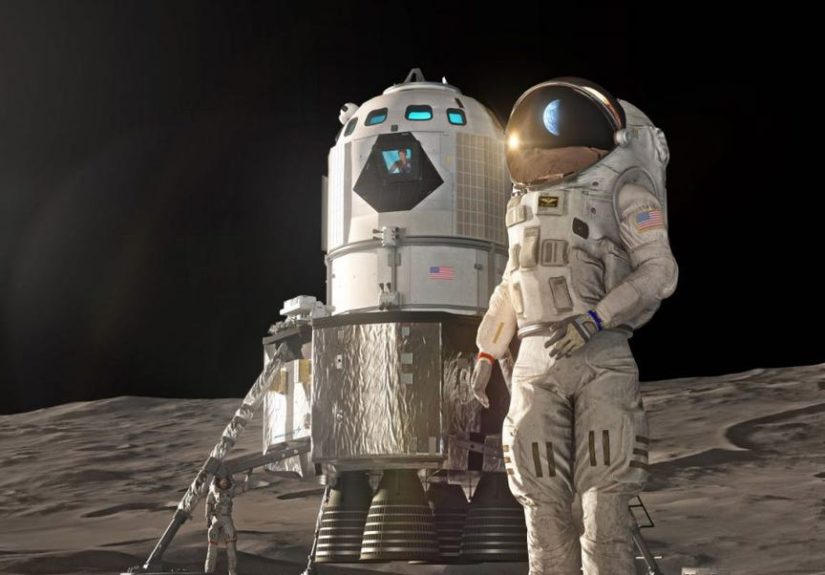
The Lockheed Martin Lunar Lander was a proposed crewed spacecraft concept for NASA’s Artemis-era Moon missions. In its early design, Lockheed Martin described a single-stage, fully reusable lander that could operate between the lunar surface and a small space station in lunar orbit, commonly known as Gateway.
The concept leaned heavily on heritage from Orion, the deep-space crew vehicle built by NASA and prime contractor Lockheed Martin. That mattered because lunar landing is not a place for experimental guesswork wearing a fancy helmet. Systems such as avionics, life support, navigation, communications, and crew safety need to be trusted before anyone asks astronauts to ride them toward a gray world with no atmosphere and very little forgiveness.
A Reusable Lander for a Reusable Lunar Strategy
Unlike Apollo’s Lunar Module, which was designed for one mission and then discarded, Lockheed Martin’s early concept emphasized reusability. The lander would descend from lunar orbit, support astronauts on the surface, launch back to Gateway, refuel, and prepare for another mission. In theory, this would reduce long-term costs and support repeated exploration rather than one-and-done visits.
The lander concept was also large. Early descriptions envisioned room for four astronauts and about 2,000 pounds of cargo, with surface stays lasting up to two weeks. That would have been a major leap beyond Apollo, where crews stayed for far shorter periods and carried much less equipment.
Why the 2024 Moon Goal Mattered
In 2019, NASA’s Artemis campaign was given a bold political and technical target: return humans to the lunar surface by 2024. The goal was to land the first woman and the next man near the lunar south pole, an area of huge scientific interest because permanently shadowed craters may preserve water ice.
Water ice is not just interesting because astronauts get thirsty. It could potentially be used for drinking water, oxygen, radiation shielding, and rocket propellant. In other words, lunar water could turn the Moon from a destination into a supply depot. That is why the south pole became the hottest real estate in a place where the temperature can still ruin your day.
The 2024 goal pushed NASA and industry to move faster on several linked systems: Orion, the Space Launch System rocket, lunar spacesuits, Gateway, surface power, rovers, communications, and the Human Landing System. Lockheed Martin’s lunar lander concept entered this moment as one possible answer to the hardest question: once astronauts reach lunar orbit, how do they safely get down to the Moon and back?
How Lockheed Martin’s Lander Fit Into Artemis
Artemis is not a single spacecraft. It is an exploration architecture. Orion carries astronauts through deep space. SLS launches Orion beyond Earth orbit. Gateway is designed to support operations around the Moon. Human landers ferry astronauts between orbit and the surface. Spacesuits, rovers, habitats, and cargo systems help crews work once they arrive.
Lockheed Martin’s role in Artemis is especially visible through Orion. Orion is designed for crewed deep-space missions and high-speed reentry from the Moon. Because Lockheed Martin already had Orion experience, its lunar lander proposals naturally reused or adapted Orion-derived technologies. That approach promised lower development risk, since engineers would not be starting from a blank whiteboard and a hopeful thumbs-up.
The Gateway Connection
Lockheed Martin’s early reusable lander concept was closely tied to Gateway. The idea was simple in concept and extremely complicated in practice: astronauts would arrive at Gateway in Orion, transfer into the lunar lander, descend to the surface, complete the mission, and return to Gateway. The lander could then be serviced and reused.
This model supported a long-term lunar campaign. Instead of building a new lander for every sortie, NASA and its partners could gradually develop an orbital staging point, reusable transportation, and regular surface access. Think less “camping trip” and more “building the first neighborhood infrastructure,” except the neighborhood has micrometeorites and no grocery store.
Lockheed Martin and the Human Landing System Competition
NASA’s Human Landing System program opened the door for multiple companies to propose ways to land astronauts on the Moon. In 2019, NASA selected several U.S. companies to study and prototype human lander technologies. The following year, NASA awarded initial development contracts to three teams: SpaceX, Dynetics, and a Blue Origin-led National Team that included Lockheed Martin, Northrop Grumman, and Draper.
Under that National Team structure, Lockheed Martin’s experience with Orion and crew systems was highly relevant. The team divided responsibilities among major aerospace players, with Blue Origin focused on its Blue Moon lander architecture and Lockheed Martin contributing crewed spacecraft expertise. It was the kind of team where every participant brought a résumé long enough to require its own filing cabinet.
NASA later selected SpaceX’s Starship Human Landing System for the first Artemis crewed landing demonstration. That decision shifted the immediate path away from Lockheed Martin’s standalone lander concept. However, Lockheed Martin continued to participate in lunar architecture through Orion, advanced lunar concepts, and later work as part of Blue Origin’s team for a sustainable Artemis V lander demonstration.
Why NASA Did Not Land Humans on the Moon by 2024
The original 2024 target was inspiring, but spaceflight does not care about slogans. Human lunar landings require thousands of systems to work together with almost insulting precision. Delays emerged across the Artemis ecosystem, including spacesuit development, lander readiness, SLS and Orion testing, heat shield analysis, funding pressures, and the challenge of integrating commercial spacecraft with government exploration systems.
By 2026, NASA’s architecture had changed significantly. Artemis III, once expected to be the first crewed landing of the program, was reoriented as a low Earth orbit demonstration mission to test rendezvous and docking between Orion and commercial landers. NASA’s updated plan targeted a later surface landing, with Artemis IV positioned as the mission expected to return astronauts to the Moon.
This does not mean the 2024 push failed completely. It forced NASA and industry to mature human lander concepts, accelerate contracts, test commercial partnerships, and confront the hard parts early. In aerospace, a schedule can slip and still produce useful engineering momentum. It is not ideal, but it beats discovering the problems while descending toward the Moon with everyone watching live.
Technical Strengths of the Lockheed Martin Lunar Lander Concept
1. Orion-Derived Systems
One of the strongest arguments for Lockheed Martin’s lander concept was its connection to Orion. Reusing proven designs can reduce uncertainty. For example, avionics, pressure vessel knowledge, crew interfaces, life support lessons, and deep-space operations experience are not minor details. They are the difference between “mission architecture” and “very expensive metal sculpture.”
2. Reusability
A reusable lunar lander makes sense for a sustained Moon program. If the lander can return to orbit, refuel, and fly again, NASA could support repeated missions with fewer throwaway elements. This aligns with the larger Artemis goal of long-term lunar presence rather than a brief Apollo-style encore.
3. Larger Crew and Cargo Capability
The early Lockheed Martin lander concept aimed to support four astronauts and meaningful cargo capacity. More crew and cargo means more science, more tools, more samples, and more operational flexibility. A bigger lander can also support longer stays, which are essential for learning how humans live and work away from Earth.
4. Mars Preparation
Lockheed Martin framed lunar exploration as a stepping stone to Mars. This was not marketing glitter sprinkled on a spacecraft brochure. The Moon offers a nearby test environment for habitats, resource use, surface mobility, radiation protection, autonomous systems, and crew operations. If something breaks on the Moon, Earth is three days away. If something breaks on Mars, the customer service wait time is measured in months.
Challenges Facing Any Human Lunar Lander
Building a human lunar lander is brutally difficult. The vehicle must operate in vacuum, handle abrasive lunar dust, manage extreme temperatures, land precisely on uneven terrain, protect astronauts, and launch from the surface without a runway, atmosphere, or convenient repair shop.
Mass is another enemy. Every pound sent to the Moon must be launched from Earth, pushed through space, slowed into lunar orbit, and delivered safely to the surface. Engineers must balance fuel, structure, engines, landing legs, crew volume, cargo, power, communications, and redundancy. Add too much safety margin and the vehicle becomes too heavy. Remove too much and nobody wants to climb aboard.
Then there is integration. A lunar lander must work with Orion, mission control, spacesuits, docking systems, launch vehicles, fueling plans, communications networks, and astronaut procedures. NASA’s updated Artemis planning shows how complex this integration can become, especially when commercial landers are developed on aggressive timelines.
Lockheed Martin’s Continuing Role in Lunar Exploration
Even though Lockheed Martin’s original standalone lunar lander did not become the first Artemis landing vehicle, the company remains central to the Moon program. Orion is a cornerstone of Artemis. Lockheed Martin has also been involved in lunar mobility concepts, lunar infrastructure studies, and Blue Origin’s National Team for later sustainable human landing systems.
In 2023, Lockheed Martin announced its participation in the Blue Origin-led team selected to develop a human lunar lander for Artemis V. That work points toward the next phase of lunar exploration: not merely getting back, but learning how to go repeatedly, safely, and productively.
This is where the Lockheed Martin lunar lander story becomes bigger than one vehicle. It reflects the messy evolution of modern spaceflight, where government agencies, legacy aerospace companies, and newer commercial providers all compete and collaborate. The Moon is no longer a two-player Cold War chessboard. It is becoming an ecosystem.
Lessons From the “Humans on the Moon by 2024” Era
Ambition Can Move the Industry
The 2024 deadline was aggressive, but it energized NASA’s lunar plans. It encouraged faster contracting, sharper industry focus, and more public attention. Without that urgency, human lander development might have moved at the speed of a sleepy committee meeting.
Safety Still Wins
Human spaceflight has a permanent rule: the schedule matters, but crew safety matters more. NASA’s decision to revise Artemis timelines reflects the reality that landing astronauts on the Moon requires proof, not optimism. A late mission is frustrating. An unsafe mission is unacceptable.
Reusability Is the Future
Lockheed Martin’s reusable lander concept anticipated a key theme in modern exploration. Whether through Starship, Blue Moon, or other future vehicles, reusable lunar transportation will likely be essential for sustained activity on and around the Moon.
The Moon Is a Mars Classroom
Every Artemis lander concept, including Lockheed Martin’s, carries a Mars shadow. Technologies tested at the Moon may influence future Mars missions, from descent systems to crew habitats and resource extraction. The Moon is close enough to practice, but hostile enough to teach hard lessons.
Experience Section: What Following the Lockheed Martin Lunar Lander Story Feels Like
Following the Lockheed Martin lunar lander story is a little like watching a complex puzzle being assembled while someone keeps changing the table. At first, the 2024 Moon landing target created a thrilling sense of momentum. The headlines were bold, the renderings were beautiful, and the message was clear: humans were going back to the Moon soon. For space fans, it felt like the future had finally remembered to show up.
Then the details arrived. Human landers needed contracts. Spacesuits needed development. Orion needed testing. SLS needed successful flights. Gateway planning needed refinement. Commercial landers needed to prove they could dock, descend, survive, ascend, and do it all with astronauts inside. Suddenly, the Moon did not seem far away because of distance alone. It seemed far away because every step required disciplined engineering.
That is what makes Lockheed Martin’s proposal interesting. It was not just a dream machine in a press release. It was built around a serious engineering philosophy: use what has already been developed, especially Orion-related systems, and adapt them for lunar transportation. For anyone who has ever tried to finish a difficult project, that approach feels familiar. You do not reinvent the entire toolbox when the deadline is near. You use the tools that already work.
There is also a human side to the story. Imagine an astronaut stepping from Orion into a lunar lander docked near the Moon. Outside the window, Earth hangs like a blue marble with weather, oceans, politics, traffic, pizza delivery, and everyone the crew has ever known. Below is the lunar surface, silent and bright, waiting like an ancient museum with no roof. The lander is the bridge between those two realities.
From a reader’s perspective, the delay from 2024 may feel disappointing. Nobody likes watching an exciting date slide across the calendar. But space history is full of revised schedules. Apollo itself was built through test flights, redesigns, tragedies, corrections, and relentless learning. Artemis is moving through its own version of that process, only with more contractors, more public scrutiny, and far more complicated long-term goals.
The best way to understand the Lockheed Martin lunar lander is not as a lost spacecraft, but as part of a larger design conversation. Its reusable architecture, Orion heritage, Gateway connection, and Mars-forward thinking all influenced how people discussed sustainable lunar exploration. Even concepts that do not fly can shape the vehicles that eventually do.
For students, engineers, writers, and space enthusiasts, the experience offers a useful lesson: exploration is rarely clean. It is not a straight line from announcement to launch to victory music. It is a chain of studies, prototypes, failures, budget fights, redesigns, and brave decisions made by people who know physics will not negotiate. The Moon may be romantic in poetry, but in engineering it is a strict teacher.
So, “Humans on the Moon by 2024” did not happen as originally imagined. Still, the effort helped push NASA, Lockheed Martin, and the broader aerospace industry toward a more mature lunar future. The next astronauts who step onto the Moon will arrive because many ideas competed, evolved, merged, or retired along the way. Lockheed Martin’s lunar lander concept belongs in that story: not as the final answer, but as an important chapter in humanity’s long return to the lunar surface.
Conclusion
The Lockheed Martin Lunar Lander was one of the most intriguing concepts of the early Artemis era. It promised a reusable, Orion-inspired path between lunar orbit and the Moon’s surface, designed for larger crews, longer stays, and sustainable exploration. Although NASA did not return humans to the Moon by 2024, the urgency of that goal helped accelerate the development of human landing systems and sharpen the national focus on lunar exploration.
Today, the Artemis program has moved beyond the original timeline, but not beyond the original vision. The plan is still about returning astronauts to the Moon, learning how to live and work there, and preparing for Mars. Lockheed Martin’s lander concept remains a valuable example of how aerospace companies think through the next giant leap: not as a single jump, but as a reusable transportation network built one difficult step at a time.