Table of Contents >> Show >> Hide
- What Is Charcoal in Minecraft?
- Charcoal vs. Coal: Why Choose Charcoal?
- Method 1: Smelt Logs in a Furnace
- Method 2: Create a Renewable Tree-to-Charcoal Loop
- Method 3: Break Campfires Without Silk Touch
- How to Use Charcoal After You Get It
- Best Situations for Choosing Charcoal Over Coal
- Common Mistakes When Making Charcoal
- Beginner Strategy: First Night Charcoal Plan
- Advanced Tip: Build a Small Charcoal Station
- Extra Experience: What Players Learn From Using Charcoal Instead of Coal
- Conclusion
Coal is great in Minecraft, but let’s be honest: sometimes the caves are stingy, the mountains are rude, and your first night arrives faster than a creeper with excellent timing. That is when charcoal becomes your best friend. If you can find trees, you can make fuel. If you can make fuel, you can craft torches. If you can craft torches, you can stop living like a nervous raccoon in a dirt box.
This guide explains 3 ways to get charcoal instead of coal in Minecraft, including the classic furnace method, a renewable tree-to-charcoal loop, and a campfire-based trick that can help in the right situation. Whether you are playing Java Edition, Bedrock Edition, a survival island world, or a fresh seed where coal apparently took a vacation, charcoal can keep your base bright, your furnace busy, and your early game moving.
What Is Charcoal in Minecraft?
Charcoal is an item made mainly by smelting wood-based blocks in a furnace. In most practical early-game situations, it works like coal. You can use charcoal as furnace fuel, craft torches, make campfires, create fire charges, and light up your world before hostile mobs start treating your lawn like a festival venue.
The biggest difference is how you get it. Coal usually comes from coal ore, which means mining, exploring, or finding exposed deposits in cliffs and caves. Charcoal comes from trees. That makes it renewable, easy to produce near your base, and especially useful when you spawn in a forest, jungle, mangrove swamp, cherry grove, or any wood-rich biome.
Charcoal vs. Coal: Why Choose Charcoal?
Coal and charcoal are similar, but they are not identical. A single piece of charcoal can smelt up to eight items in a regular furnace, just like coal. You can also use one charcoal with one stick to craft four torches, which is one of the most important survival recipes in the game.
However, charcoal has a few limitations. You cannot craft charcoal into a block of coal, and coal and charcoal do not stack together in the same inventory slot. Villager trades that require coal generally do not accept charcoal as a substitute. So, charcoal is not a perfect replacement for every coal-related task.
Still, for everyday survival, charcoal is excellent. Need torches? Use charcoal. Need to cook food? Use charcoal. Need to smelt iron? Use charcoal. Need to pretend you are a responsible survival engineer instead of someone who accidentally built a house with no roof? Definitely use charcoal.
Method 1: Smelt Logs in a Furnace
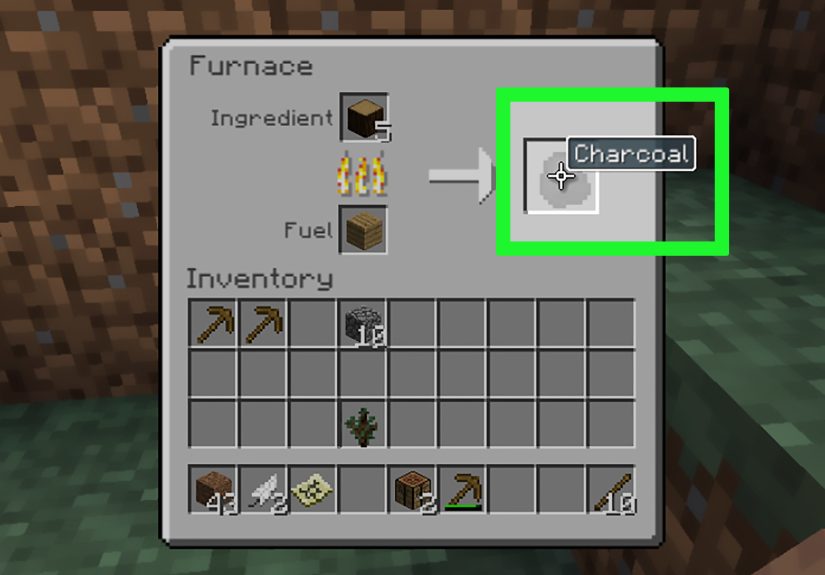
The most reliable way to get charcoal in Minecraft is simple: smelt logs or wood in a furnace. This is the core method every beginner should learn because it works early, requires common materials, and does not depend on cave luck.
What You Need
- One furnace
- Logs, stripped logs, wood, or stripped wood
- A starter fuel source, such as sticks, wooden planks, or another piece of charcoal
Step-by-Step Instructions
- Cut down a tree and collect several logs.
- Mine eight cobblestone or another suitable stone-tier block.
- Craft a furnace using the eight blocks.
- Open the furnace.
- Place a log in the top slot.
- Place sticks, planks, or another fuel item in the bottom slot.
- Wait for the furnace to finish smelting.
- Collect your charcoal from the output slot.
That is the basic recipe: wood goes in, charcoal comes out, and your survival odds improve dramatically. It is not glamorous, but neither is being chased through the dark by a zombie while holding three raw porkchops and a wooden shovel.
Best Early-Game Fuel to Start the First Charcoal
When you do not have coal yet, you need another fuel item to start the first smelting cycle. Sticks and planks are easy options. You can use a couple of sticks or wooden planks to smelt your first log into charcoal. Once you have one charcoal, you can use it as fuel to make more charcoal much more efficiently.
This creates a very useful early-game chain. Your first charcoal can smelt up to eight more logs into eight more charcoal. Then those eight pieces can fuel even more smelting. In other words, the hardest part is getting started. After that, your fuel supply can snowball quickly.
Method 2: Create a Renewable Tree-to-Charcoal Loop
The second way to get charcoal instead of coal is to stop thinking of charcoal as a one-time emergency item and start treating it like a renewable fuel system. This is especially useful if your base is far from mountains, caves, or exposed coal ore.
The idea is simple: grow trees, harvest logs, turn some logs into charcoal, then use that charcoal to smelt more logs. As long as you keep replanting saplings, you have a steady fuel supply without digging underground.
How the Loop Works
- Plant saplings near your base.
- Let the trees grow naturally or use bone meal to speed things up.
- Chop the trees and collect logs plus new saplings.
- Smelt part of the logs into charcoal.
- Use some charcoal as fuel for future smelting.
- Save the rest for torches, cooking, ore smelting, and campfires.
This method is fantastic because it gives you control. Instead of wandering through caves hoping to find coal, you can farm your own fuel beside your base. It also pairs well with other early-game farms. A small wheat field, a tree area, a furnace wall, and a chest full of charcoal can make your starter base feel surprisingly organized.
Best Trees for Charcoal Production
Most tree types can work, but some are more convenient than others. Oak trees are easy because they drop apples and saplings often enough to keep your farm going. Birch trees are simple because their trunks grow in predictable shapes, making them easy to chop without leaving floating logs in the sky like a crime scene for lazy lumberjacks.
Spruce trees are great once you have enough saplings because large spruce trees produce a lot of wood. Jungle trees can also produce huge amounts of logs, but they are messier to farm unless you have a good axe and a little patience. Mangrove trees provide plenty of wood too, though their roots can make harvesting feel like untangling headphones from 2012.
Simple Charcoal Production Ratio
A practical system is to divide your logs into two groups. Use one group for building and crafting, and smelt the other group into charcoal. Once you have a decent supply, keep a stack of charcoal in your furnace area and a stack in your exploration chest. That way, you are always ready to craft torches before heading into a cave.
For beginners, a simple rule works well: whenever you collect a full stack of logs, turn at least sixteen of them into charcoal. That gives you enough fuel and torch materials without consuming your entire wood supply. Later, when you build bigger farms or automatic smelters, you can increase production.
Method 3: Break Campfires Without Silk Touch
The third way to get charcoal is more situational, but it is worth knowing: regular campfires can drop charcoal when broken without Silk Touch. This matters because campfires can generate naturally in some villages, especially taiga-style villages, and they are also common decorative blocks in player builds.
If you find a naturally generated campfire and break it without a Silk Touch tool, it can drop charcoal instead of dropping itself as a campfire block. This gives you a small amount of charcoal without mining coal ore or smelting logs first.
When This Method Makes Sense
This method is useful when you stumble across a village early in the game and need quick fuel or torch materials. If the village has campfires built into chimneys or outdoor decorations, breaking one may give you charcoal. It is not usually the best long-term strategy, but it can help during the first day or two.
There is one important warning: do not confuse this with crafting campfires just to break them for charcoal. A campfire recipe already requires coal or charcoal, plus sticks and logs. Depending on your edition and situation, crafting campfires purely to break them is not the cleanest fuel strategy. It is better to use this method when you find campfires naturally or already have extra campfires you no longer need.
Silk Touch Warning
If you break a campfire with a Silk Touch tool, the campfire drops itself instead of dropping charcoal. That is useful if you want to move the campfire, but not useful if your goal is to collect charcoal. So, for charcoal drops, use a regular tool or your hand.
How to Use Charcoal After You Get It
Once you have charcoal, you can use it in several important ways. The most common use is crafting torches. Place one stick and one charcoal in the crafting grid to make four torches. Torches prevent hostile mobs from spawning in dark areas, help you mark cave paths, and make your base look less like a haunted potato cellar.
Charcoal is also excellent furnace fuel. One charcoal can smelt up to eight items, so it is good for cooking meat, smelting raw iron, making glass from sand, turning cobblestone into stone, or processing other materials. If you are building a starter house with glass windows, charcoal can help you avoid the tragic “open square hole in the wall” architectural style.
You can also use charcoal in recipes that accept coal alternatives, such as regular torches, soul torches, fire charges, and campfires. For many survival players, charcoal becomes the default fuel for the early and middle game, especially in worlds where tree farming is easier than mining.
Best Situations for Choosing Charcoal Over Coal
Charcoal is especially valuable in the early game. If you spawn in a forest, plains village, swamp, jungle, or cherry grove, you can quickly gather wood and create a fuel source before finding coal. This can save time and reduce the risk of exploring caves before you have armor, food, or enough torches.
It is also useful in survival island worlds. Many island seeds have limited exposed stone and fewer obvious coal sources, but if you have even one tree and can keep saplings alive, you can eventually create a renewable charcoal supply. That makes charcoal one of the most important resources for island survival.
Charcoal also shines in peaceful building sessions. If you are working on a large base and do not feel like mining, a tree farm can keep your furnaces running while you focus on construction. It is not always the most compact fuel option, but it is easy to produce and dependable.
Common Mistakes When Making Charcoal
Using All Your Logs as Fuel
One common mistake is burning too much wood too early. Logs are useful for tools, chests, crafting tables, shields, building blocks, and more. If you turn every log into charcoal, you may end up with fuel but no materials. Keep a balance.
Forgetting to Replant Saplings
If you want renewable charcoal, saplings matter. Always replant after chopping trees. A tree farm without saplings is just a sad patch of dirt with memories.
Wasting Charcoal in Empty Furnaces
Furnace fuel keeps burning even if there are no more items to smelt. Since one charcoal can smelt up to eight items, try to smelt items in batches of eight when possible. For example, cook eight raw beef, smelt eight sand, or process eight raw iron with one charcoal. This helps avoid waste.
Trying to Make Blocks of Charcoal
Coal can be crafted into blocks of coal, but charcoal cannot. This means charcoal is less convenient for compact storage and long smelting sessions. If you need massive fuel storage later in the game, coal blocks, lava buckets, dried kelp blocks, or other fuel systems may be better. But for everyday survival, charcoal is still easy and effective.
Beginner Strategy: First Night Charcoal Plan
If you are starting a new Minecraft world and cannot find coal right away, follow this quick plan. First, punch a tree and collect logs. Craft planks, sticks, a crafting table, and wooden tools. Mine enough stone for a furnace and stone tools. Then smelt one or two logs into charcoal using sticks or planks as starter fuel.
Once you have charcoal, craft torches immediately. Place some around your shelter and keep a few for mining. If you have extra logs, smelt more charcoal before nightfall. This gives you fuel for food and light for safety. In Minecraft, darkness is not just inconvenient; it is basically a written invitation for skeletons to practice archery on your face.
Advanced Tip: Build a Small Charcoal Station
A charcoal station does not need to be complicated. Place two or three furnaces near your tree farm. Add one chest for logs and another chest for finished charcoal. Keep a crafting table nearby so you can quickly make sticks and torches. If you want to be fancy, label the chests with signs or item frames.
Later, you can add hoppers to automate part of the process. Put logs in a chest above a furnace, fuel in a side chest, and collect charcoal in a chest below. Even a basic semi-automatic setup can save time when you are producing fuel for a large base, a glass project, or a mining expedition.
Extra Experience: What Players Learn From Using Charcoal Instead of Coal
After many survival starts, one thing becomes clear: charcoal is not just a backup plan. It changes how you approach the first hour of the game. New players often think they must find coal before they can safely explore. That is not true. If you understand charcoal, trees become your first fuel mine.
The best experience with charcoal usually comes from rough starts. Maybe you spawn in a dense forest with no visible stone cliffs. Maybe you dig into a hillside and find copper, granite, and disappointment, but no coal. Maybe sunset is coming, sheep are nowhere to be found, and your shelter is a box that would embarrass a villager. In those moments, charcoal is the quiet hero.
One smart habit is to create charcoal before you go deep underground. Many players rush into caves looking for coal, then get lost because they do not have enough torches. It is much safer to make charcoal at the surface first. Even eight pieces of charcoal can become thirty-two torches, which is enough to explore a small cave, light your shelter, and mark the way back.
Charcoal also teaches resource planning. Since logs can become planks, sticks, tools, chests, doors, fences, and fuel, you learn to divide resources carefully. A good player does not just chop a tree and spend everything randomly. They save some logs, craft some planks, keep sticks ready, and turn part of the wood into charcoal. That simple habit makes survival smoother.
Another useful lesson is location planning. If your base is near trees, charcoal becomes easier than coal. You can build a tree farm beside your house and keep fuel production close. This is especially helpful for builders who spend more time designing roofs than mining tunnels. With a renewable charcoal setup, you can smelt glass, stone, bricks, and food without constantly leaving your project.
In survival island worlds, charcoal can be the difference between progress and frustration. If you have one tree, protect the saplings like treasure. Replant them, wait for more trees, and slowly build a fuel cycle. A single careless moment can leave you without wood, and without wood, charcoal production stops. That makes tree farming feel surprisingly important.
Charcoal is also useful for players who dislike cave exploration early on. Caves can be dangerous before you have armor, a shield, food, and a decent weapon. By using charcoal, you can delay risky mining until you are better prepared. You can cook food, smelt iron from surface-level finds, and craft enough torches to enter caves with confidence.
One practical experience tip is to always carry a small “charcoal kit” when traveling. Bring a stack of logs, a furnace, and a few pieces of charcoal. If you get stuck far from home, you can make more fuel, cook food, and craft torches almost anywhere. It is like carrying a tiny survival kitchen in your backpack, except the kitchen is made of stone and probably smells like oak.
Charcoal is not the flashiest item in Minecraft. It does not sparkle like diamonds, explode like TNT, or make you feel powerful like a netherite sword. But it solves problems. It turns trees into light, warmth, food, and progress. That is why experienced players respect it. Coal is nice when you find it. Charcoal is what you make when the world refuses to cooperate.
Conclusion
Learning how to get charcoal instead of coal in Minecraft is one of the smartest early-game skills you can master. The easiest method is smelting logs in a furnace. The best long-term method is building a renewable tree-to-charcoal loop. The most situational method is breaking regular campfires without Silk Touch when you find them naturally or no longer need them.
Coal is still useful, especially for trading and coal blocks, but charcoal gives you independence. As long as you have trees, a furnace, and a little patience, you can create reliable fuel almost anywhere. So the next time coal refuses to show up, do not panic. Chop a tree, fire up the furnace, and let charcoal carry your survival run like the blocky little champion it is.
Note: Gameplay details in this article reflect standard Minecraft survival mechanics for charcoal, coal, furnaces, torches, and campfires. Some drops and mechanics may vary slightly between Java Edition and Bedrock Edition.