Table of Contents >> Show >> Hide
- What Japan Actually Tested
- From Early Dream to Real Prototype
- Why Japan Is Betting on Flying Cars
- What Happened During the Latest Tests
- The Technology Looks Promising, but Physics Still Has Opinions
- So, Will Flying Cars Actually Work in Japan?
- Why This Prototype Test Matters Globally
- Conclusion
- Experiences Related to “Japan Tests New Flying Car Prototype”
For decades, “flying car” was the kind of phrase people used right before laughing, pointing at a cartoon, or quoting The Jetsons. Japan, however, has been treating the idea less like sci-fi décor and more like a transportation problem with a very ambitious engineering budget. The latest headline-grabbing milestone is the testing of SkyDrive’s newest electric vertical takeoff and landing aircraft, or eVTOL, a compact machine designed for short urban hops rather than cross-country road trips with wings.
And that distinction matters. Japan is not testing a family sedan that suddenly decided to become an airplane. It is testing a battery-electric aircraft built to take off and land vertically, operate from small vertiports, and eventually carry a pilot plus passengers on short routes. In other words, this is less “your next Honda Civic, but airborne” and more “a tiny air taxi trying very hard to earn your trust.”
Still, the phrase “Japan tests new flying car prototype” is not hype pulled from thin air. It reflects a very real push by Japanese companies, regulators, transit planners, and investors to turn advanced air mobility into an actual service. The latest prototype flights show that Japan is moving past concept videos and glossy renderings and into the stage where performance, safety, infrastructure, and public acceptance all have to show up for work.
What Japan Actually Tested
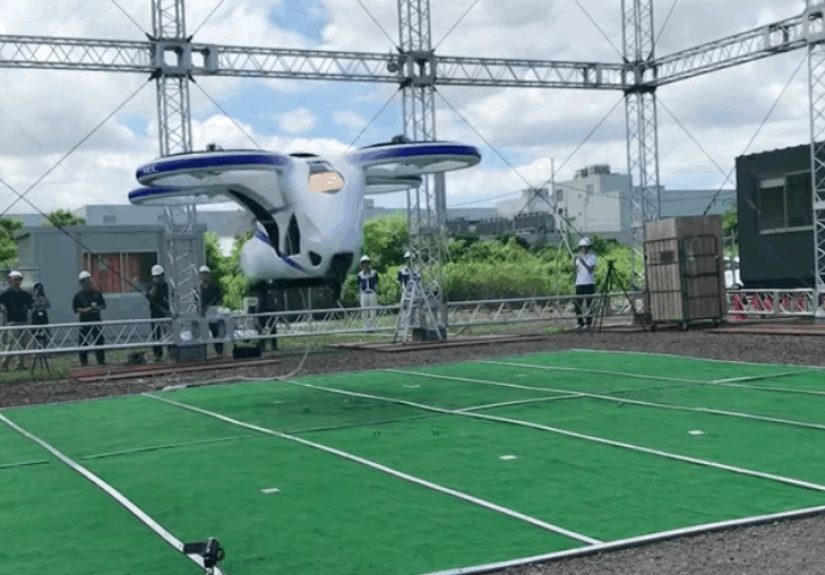
The prototype drawing the most attention is SkyDrive’s SD-05 series, marketed simply as SKYDRIVE. It is a compact, all-electric eVTOL aircraft developed in Japan for short-distance trips in urban and regional areas. The current version is designed to carry three people total: one pilot and two passengers. It uses 12 motors and rotors, has a cruise speed around 100 kilometers per hour, and is currently aimed at a range of roughly 15 to 40 kilometers depending on battery capability and mission profile.
Those numbers tell you something important right away: this is not trying to replace trains, commercial airliners, or even your average highway drive. It is trying to solve a narrower problem. Think airport-to-city transfers, bay crossings, resort links, emergency access, sightseeing routes, or short connections where roads are slow, indirect, or painfully congested.
Japan’s recent tests have also been deliberately practical. In public demonstrations at Expo 2025 in Osaka and later in Tokyo, the aircraft flew in tightly controlled environments, using remote piloting and automated stabilization rather than carrying passengers. That may sound less dramatic than a celebrity stepping out of an airborne taxi in sunglasses, but it is exactly the kind of restraint serious aviation programs need. Airplanes, as a rule, are not impressed by vibes.
From Early Dream to Real Prototype
The long runway behind the headline
Japan’s flying car story did not begin yesterday. The roots go back to the Cartivator project and the early SkyDrive effort, which drew support from engineers and major Japanese industrial players. In 2020, SkyDrive’s earlier SD-03 model made headlines with a public manned demonstration flight in Japan. That test was short, modest, and heavily controlled, but it proved something bigger than distance: the concept had graduated from a nice drawing to a machine that could actually lift a human being into the air.
Since then, the company has moved from a small, experimental one-seater toward a more commercially realistic aircraft. The newer SD-05 series is larger, more mature, and shaped around service operations rather than pure demonstration value. It is also being developed with certification and manufacturing in mind, which is where many futuristic transportation ideas suddenly remember they live in the real world.
Why the new prototype matters more
What makes the latest SKYDRIVE tests more significant than earlier flights is not just that the aircraft flew. It is that the aircraft is tied to an emerging ecosystem. SkyDrive has been working with regulators in Japan and the United States, building aircraft through a manufacturing partnership with Suzuki, planning vertiport operations with Osaka Metro, and running public-facing demonstrations tied to real future routes and passenger flow concepts.
In plain English, Japan is no longer just asking, “Can this thing fly?” It is asking the more adult and less glamorous questions: “Can we certify it, charge it, board it, route it, insure it, scale it, and persuade ordinary people to ride it without white-knuckling the armrest?”
Why Japan Is Betting on Flying Cars
Japan has several reasons to care about advanced air mobility. First, it is a country where geography often argues with convenience. Dense cities, coastal routes, mountainous regions, islands, and bay areas can make short trips feel much longer than they look on a map. A compact eVTOL is attractive in exactly those situations where ground transportation is indirect and helicopters are too expensive, noisy, or operationally inconvenient.
Second, Japan has the industrial muscle for this kind of challenge. The country already has deep expertise in automotive manufacturing, precision engineering, battery development, lightweight materials, and safety culture. That combination helps explain why a company like SkyDrive can partner with Suzuki and why railway operators and metro systems are showing interest. Japan is trying to build flying cars the same way it builds many advanced products: not as isolated gadgets, but as systems that plug into a broader mobility network.
Third, Japan has a habit of using major public events to preview the future. Expo 2025 Osaka gave advanced air mobility a highly visible stage. Public demonstrations there were not just about showing off technology to tourists with cameras. They were also about normalizing the idea that the next generation of transit may include small electric aircraft lifting off from dedicated urban pads as casually as buses pulling out of terminals.
What Happened During the Latest Tests
The most widely discussed public demonstrations involved the SKYDRIVE SD-05 series at Expo 2025 in Osaka and later at Tokyo Big Sight in February 2026. In Osaka, SkyDrive staged public flights as part of the Expo’s advanced mobility showcase, giving media and visitors a close-up look at the aircraft hovering and operating in a real event environment. Later demonstrations expanded that effort through repeated flights, which is more meaningful than a one-off stunt because repetition is where confidence begins.
The Tokyo tests added another layer. They were conducted near Tokyo Big Sight with a route that extended over the sea, and they were paired with a public passenger-experience trial that simulated parts of the future customer journey, including check-in and terminal flow. No one was sold a ticket and whisked into the skyline just yet, but the point was obvious: Japan wants to test not only the aircraft, but the service model around it.
That is a smart move. A flying car service does not fail only because the aircraft underperforms. It can also fail because the boarding process is clunky, the vertiport footprint is too large, the noise annoys neighborhoods, the turnaround time is slow, or the economics collapse under the weight of “wow, this looked cheaper in the slide deck.”
The Technology Looks Promising, but Physics Still Has Opinions
Battery limits are real
The biggest challenge facing every eVTOL program, including Japan’s, is energy. Batteries are improving, but they are still heavy and still far less forgiving than liquid fuel when range requirements grow. That is why so many eVTOL aircraft are optimized for short trips. The technology works best when the mission is narrow, high-value, and close enough that battery constraints do not turn the aircraft into a very elegant lawn ornament.
This is one reason SkyDrive’s current range target remains modest. The company is being realistic. A short-hop aircraft that actually enters service is more valuable than a long-range fantasy machine that exists forever in renderings with suspiciously beautiful sunsets.
Safety and certification are the real mountain
Flying an aircraft once is news. Certifying it for routine passenger service is aviation. Regulators need proof on performance, redundancy, pilot training, flight controls, maintenance, emergency procedures, operating rules, and airspace integration. The broader eVTOL industry has made progress here, especially as regulators develop frameworks for powered-lift aircraft, but the process remains demanding for good reason.
SkyDrive’s work with Japanese and U.S. authorities is therefore a major part of the story. It shows that Japan’s flying car effort is not just trying to win the internet for a weekend. It is trying to clear the paperwork mountain that stands between prototype excitement and commercial reality.
Infrastructure is the unsexy hero
There is also the matter of where these aircraft will actually operate. Vertiports sound futuristic, but they are really just the new version of a timeless transportation question: where do people get on and off safely, efficiently, and without making everyone nearby furious? The good news for compact eVTOLs like the SKYDRIVE is that smaller aircraft may be able to use tighter footprints, including existing rooftop sites or adapted urban locations.
Japan appears to understand this well. The emphasis on compact takeoff and landing areas, metro partnerships, and route planning suggests a strategy built around fitting eVTOLs into the city rather than demanding the city reshape itself overnight.
So, Will Flying Cars Actually Work in Japan?
The honest answer is yes, probably, but only in specific ways at first. The early winners are unlikely to be suburban commuters trying to skip traffic on the way to the office every morning. That version of the future is flashy, but it asks too much from current batteries, pricing models, infrastructure, and regulation.
The more realistic early use cases are much more grounded, despite the obvious irony. Expect routes that save meaningful time over water or rough geography, premium tourism trips, airport connectors, resort links, emergency support, and services in places where road alternatives are awkward. In those niches, Japan’s flying car prototype is not a toy. It is a tool.
And if those routes work, the industry can grow from there. Lower operating costs, better batteries, more mature infrastructure, and public familiarity could gradually move eVTOLs from novelty to option. Not replacement. Option. That is an important word in transportation. Planes did not replace trains. Trains did not replace cars. Smartphones did not replace bad parking decisions. New modes usually join the mix rather than conquer it.
Why This Prototype Test Matters Globally
Japan is not alone in the eVTOL race. U.S. and European companies are pushing hard, regulators are building new frameworks, and cities from Dubai to Tokyo are trying to figure out how these aircraft might fit into real transport systems. What makes Japan especially interesting is its combination of caution and ambition. The country is not moving the fastest in pure hype terms, but it may be positioning itself well in integration terms.
That matters because the eVTOL companies that survive will not necessarily be the ones with the splashiest videos. They may be the ones that solve the boring but brutal problems of manufacturing, certification, infrastructure, route economics, and public trust. SkyDrive’s recent prototype tests suggest Japan is trying to compete on exactly those fronts.
In other words, the headline is not really about whether a small aircraft got off the ground. It is about whether a country known for engineering discipline can turn one of the oldest futuristic promises into a service ordinary people may eventually use. That is a much bigger story, and a much harder one.
Conclusion
Japan’s new flying car prototype is impressive not because it makes science fiction look cool, though it certainly helps there, too. It is impressive because it reflects a serious national and industrial effort to build a workable eVTOL ecosystem. The SKYDRIVE SD-05 series shows that Japan has moved beyond dream-stage sketches and into the much more consequential phase of repeated public tests, certification work, manufacturing partnerships, infrastructure planning, and passenger-experience design.
The road ahead is still full of turbulence. Batteries remain limiting, regulations remain demanding, and the economics of air taxi service will need to prove themselves route by route. But the latest prototype tests make one thing clear: Japan is not merely fantasizing about flying cars. It is stress-testing the idea in public, one controlled flight at a time.
That may not be the instant Jetsons future some people hoped for, but it is probably the smarter path. And in aviation, smart beats dramatic almost every time.
Experiences Related to “Japan Tests New Flying Car Prototype”
The most interesting part of Japan’s flying car story may not be the aircraft itself, but the experience it hints at. Imagine standing near a compact vertiport in Tokyo or Osaka and watching a small electric aircraft rise almost straight up instead of rumbling down a runway. The experience would feel different from almost every form of transport most people know. There is no long platform like a train station, no sprawling gate area like an airport, no taxi line stretching around the block. Instead, the future looks strangely compact. It feels less like boarding a plane and more like entering a tightly choreographed urban mobility service.
That compactness is part of the appeal. A lot of transportation today feels like friction wearing a nametag. You queue, shuffle, wait, scan, sit, sigh, and then repeat the ritual in reverse at the other end. A successful eVTOL experience would have to erase some of that friction or at least make it feel worthwhile. Japan seems to understand this, which is why recent demonstrations have tested passenger flow and terminal operations in addition to the aircraft. The ride cannot just be airborne. It has to be smooth from curb to cabin.
There is also the emotional experience. For many passengers, the first reaction would probably be wonder mixed with a little healthy suspicion. A helicopter already makes some people feel like they are starring in a very expensive emergency. A flying car or air taxi would need to feel calmer, quieter, and more ordinary. That is why the details matter: the check-in flow, the visibility of safety procedures, the confidence of the operator, the stability of the aircraft in hover, the absence of alarming noise, and even the way the cabin is designed. If the experience feels chaotic, people will admire it and then quietly go back to trains.
Japan may have an advantage here because it is unusually good at designing systems people can understand quickly. The best Japanese transit experiences are not just efficient; they are legible. Signs are where you expect them to be. Processes are orderly. Timing feels intentional. If flying car services inherit that design philosophy, the user experience could become one of the country’s strongest competitive advantages. A short flight across a bay or between a station district and a business hub could feel less like an adventure sport and more like a premium extension of public transit.
Then there is the visual experience, which is impossible to ignore. Even a short eVTOL hop would change how people see a city. Roads flatten a place into traffic lights and brake lamps. Low-altitude electric flight would turn the same trip into a moving map of rooftops, water, bridges, parks, towers, and neighborhoods stitched together in a new way. For tourists, that could be magical. For commuters, it could transform dead travel time into something memorable. For operators, that experience may become part of the value proposition. In the early years, people may pay as much for the perspective as for the convenience.
Of course, the experience will only matter if it becomes routine enough to stop feeling like a theme park preview. That is the final test for Japan’s flying car prototype. Not whether crowds stare at it, post it, and call it the future, but whether one day a passenger can step aboard with the same calm expectation they currently bring to a train, a ferry, or a taxi. The dream is not that flying cars stay extraordinary forever. The dream is that they become boring in the best possible way: safe, useful, reliable, and quietly woven into everyday life.