Table of Contents >> Show >> Hide
- Before You Email: Do These 5 Quick Checks
- What a Professor Needs From Your Email
- How to Structure the Email (So It Doesn’t Get Ignored)
- Email Templates You Can Copy and Customize
- How to Ask Without Sounding Like You’re Negotiating With the Calendar
- Common Mistakes That Tank the Request
- If the Professor Says No (Or Doesn’t Reply)
- Special Situations: When to Use Campus Support Channels
- Quick Checklist Before You Hit Send
- Conclusion
- Realistic Student Experiences (and What They Teach You)
- Experience 1: The “two exams at once” calendar collision
- Experience 2: The “I waited too long” regret
- Experience 3: The “medical appointment” that didn’t need a medical novel
- Experience 4: The “I overshared and felt weird about it” moment
- Experience 5: The “professor said no, but still helped” outcome
- Experience 6: The “my email sounded angry” accidental tone
There are few emails in a student’s life that feel as high-stakes as this one: asking your professor to change your exam date.
Your heart says, “Please, I’m a fragile academic flower,” while your professor’s inbox says, “I have 197 messages and one of them is a coupon for printer toner.”
The good news: you can absolutely write this email in a way that’s respectful, clear, and far more likely to get a helpful response.
This guide walks you through what to do before you email, what to say (and what to avoid), and gives you ready-to-use
templates that sound like a real human wrote thembecause a professor can smell a copy-paste request from three syllables away.
Before You Email: Do These 5 Quick Checks
1) Read the syllabus like it’s the exam
Many professors already explain make-up exams, conflicts, and deadlines in the syllabus or course site. Some are flexible; some are strict;
some require documentation; some route make-up exams through a testing center or department process. If the policy is clearly stated,
your email should acknowledge it and work within it. That simple detail signals, “I respect your time and your rules.”
2) Confirm what you’re actually asking for
“Change my exam date” can mean different things:
an earlier exam, a later exam, a different time, a make-up exam,
or taking it with another section. Decide what you need, then offer a couple of workable options.
Professors can’t read your mind, and they shouldn’t have to play email ping-pong to figure out your request.
3) Check whether your reason fits common “approved conflict” categories
Universities often define excused conflicts (think: university-sponsored activities, religious observances, documented illness,
disability accommodations, or emergencies). Some situations may require an official form or approval.
Even if your reason is personal, you can still askjust be honest and professional, and understand that “yes” might not be guaranteed.
4) Ask early (the earlier, the better)
If you email the night before the exam, your professor may not even see it in time, and it can come across as last-minute planning.
If you email a week or two ahead (or as soon as you know about the conflict), you look responsible and you give the professor room to help.
When you can’t ask early (emergencies happen), say that clearly and keep it factual.
5) Decide what to shareand what not to
You do not need to write a memoir. In most cases, a brief explanation is enough. If documentation is relevant,
you can mention you can provide it if needed (or attach it if the policy requests it).
Protect your privacy while still offering the professor what they need to make a decision.
What a Professor Needs From Your Email
Professors are more likely to respond quickly when an email contains the essentials up front. Think of your message like a mini briefing:
who you are, what course you’re in, what you’re requesting, why you’re requesting it (briefly), and what alternatives could work.
Bonus points for sounding like someone who has sent an email before.
Include these core elements
- A clear subject line that includes the course and the purpose
- A proper greeting using their title and last name
- Your identification (name, course/section, meeting time if relevant)
- The exam details (which exam, scheduled date/time)
- Your request stated plainly
- A brief reason (honest, professional, not dramatic)
- Two or three options that show flexibility
- Documentation note only if relevant/required
- A courteous closing and your full name
How to Structure the Email (So It Doesn’t Get Ignored)
Step 1: Write a subject line that does the heavy lifting
Your subject line should make the request instantly understandable. Avoid vague subjects like “Hi” or “Question.”
Good subject lines help your professor triage their inbox and find your email later if needed.
Subject line examples:
- Request to Reschedule Exam 1 – BIO 210 (Section 03)
- Exam Date Conflict – CHEM 101 Midterm on Feb 6
- Make-Up Exam Request – HIST 202 Final (Conflict)
- Request for Alternate Exam Time – PSY 120, Jan 22
Step 2: Use a professional greeting
Start with “Dear Professor [Last Name]” or “Hello Professor [Last Name].” If they’re a doctor and you know it,
“Dear Dr. [Last Name]” is appropriate. If you’re unsure, “Professor [Last Name]” is usually safe.
And yes, you should use punctuation. It’s an exam request, not a group chat.
Step 3: Identify yourself quickly
Don’t assume your professor can instantly recognize your email address. Include your name, course, and section.
If it’s a large lecture, mentioning your discussion/lab section or meeting time can help.
Step 4: State your request clearly and politely
Be direct, but not demanding. “I’m writing to request…” is a classic for a reason. Avoid language that sounds like a negotiation hostage note,
such as “I need you to…” or “You have to…” You’re requesting an exception or accommodation, not issuing a calendar invite.
Step 5: Give a brief, honest reason and show flexibility
Keep your explanation short and factual. Then offer options. When you provide reasonable alternatives,
you’re doing logistical teamwork instead of dropping a problem in your professor’s lap.
Step 6: Close with gratitude and professionalism
Thank them for their time, sign off with “Sincerely” or “Thank you,” and include your full name.
If appropriate, add your student ID number (some professors prefer it; some don’t).
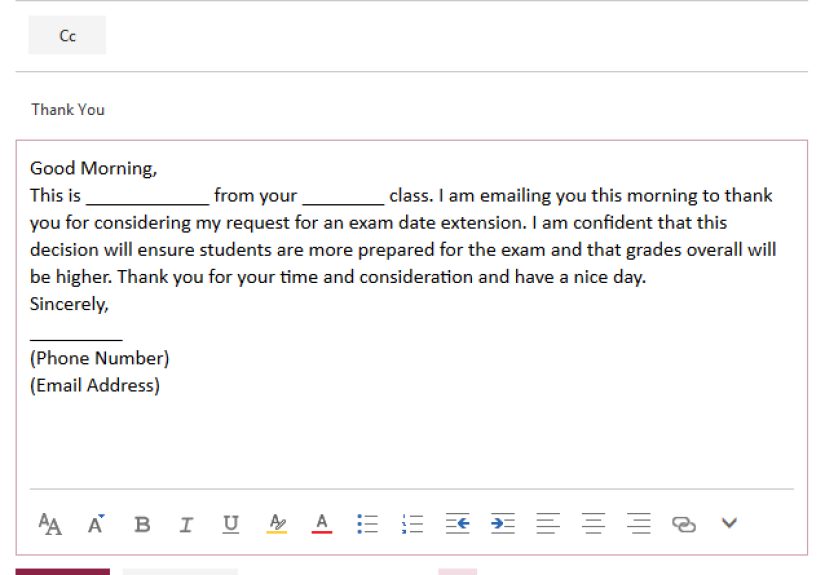
Email Templates You Can Copy and Customize
These templates are designed to sound like a real student who respects time, policies, and basic punctuation.
Customize the bracketed parts and keep the tone consistent.
Template 1: Known conflict in advance (best-case scenario)
Template 2: Unexpected illness or emergency (keep it brief)
Template 3: Two exams scheduled at the same time (classic conflict)
How to Ask Without Sounding Like You’re Negotiating With the Calendar
Use “request” language, not “announcement” language
Better: “I’m writing to request an alternate exam time due to a conflict.”
Avoid: “I won’t be there, so I’ll take it another day.”
Be specific, but don’t overshare
You can say “a medical appointment” without describing symptoms. You can say “a family emergency” without explaining your entire family tree.
Professors are usually looking for clarity, not personal details.
Offer optionsand be flexible
A great request sounds like: “If an alternate arrangement is possible, here are times I’m available.”
A not-great request sounds like: “The only time I can do is next Tuesday at 11:00 a.m. and also I would like it to be open-book.”
Common Mistakes That Tank the Request
- No subject line clarity: “hey” is not a strategy.
- No identification: your professor shouldn’t have to guess who you are.
- Sounding entitled: requests aren’t demands.
- Long, emotional explanations: keep it short and professional.
- Blaming the professor: “You scheduled it at a bad time” is a fast track to “no.”
- Waiting until the last minute: early emails read as responsible; late emails read as chaos.
- Slang, emojis, or texting abbreviations: save those for your group chat.
If the Professor Says No (Or Doesn’t Reply)
If they say no
First: don’t argue in an email thread. If the policy is firm, accept it professionally. You can ask one follow-up question:
“Is there any other option you recommend?” Sometimes the answer is truly no. Sometimes the alternative is a different format,
a make-up exam through a testing center, or an administrative process you didn’t know existed.
If they don’t reply
Wait a reasonable amount of time (often 24–48 business hours), then send a short follow-up that forwards your original message.
Keep it polite, and avoid the “Did you see my email???” vibe.
Special Situations: When to Use Campus Support Channels
Disability accommodations
If you have approved accommodations, your disability services office may have specific procedures for exam timing or location.
Follow those steps and mention the accommodation in a straightforward way (without overexplaining).
University-sponsored travel or required events
Some universities route excused absences or make-up exams through formal processes, sometimes involving a testing center.
If your conflict is an official activity, ask what documentation or procedure is required and comply early.
Testing center make-up exams
Some courses use a testing center to administer make-up exams, which may require advance scheduling.
If your professor mentions this option, respond quickly and treat it like a real appointmentbecause it is.
Quick Checklist Before You Hit Send
- Did I read the syllabus and course announcements?
- Is my subject line clear and specific?
- Did I greet them properly (Professor/Dr. Last Name)?
- Did I include my name, course, and section?
- Did I clearly state the exam and the scheduled date/time?
- Did I politely request an alternative and offer options?
- Is my reason brief, honest, and professional?
- Did I proofread for tone, grammar, and missing details?
Conclusion
Sending a professor an email requesting a changed exam date doesn’t have to feel like walking into a dragon’s cave with a spoon.
If you keep your message clear, respectful, and aligned with the course policy, you drastically increase your odds of a helpful outcome.
Ask early when you can, explain briefly, offer options, and treat the interaction like professional communicationbecause it is.
Even if the answer is no, you’ll have handled it the right way, which is a win that doesn’t show up on your transcript but absolutely counts.
Realistic Student Experiences (and What They Teach You)
The best way to understand how to request a changed exam date is to see what tends to happen in real life. The stories below are
common scenarios students run intoshared as realistic, anonymized examplesalong with the small choices that often make the difference
between a smooth “Sure, here are your options” and a painful “Please refer to the syllabus.”
Experience 1: The “two exams at once” calendar collision
A student realized their chemistry midterm landed at the exact same time as a psychology exam. They didn’t email either professor with
“I can’t do it.” Instead, they emailed both with the conflict details, their course sections, and two alternative windows. They also asked
which exam would be easier to move based on policy. The psychology professor replied first: “We can do a make-up slot in the testing center.”
The student confirmed within an hour and thanked them. Lesson: conflicts happen, but speed + flexibility + clarity turns a crisis into scheduling.
Experience 2: The “I waited too long” regret
Another student had a family event planned out of state and assumed the professor would be fine with a different exam date. They emailed
the night before the exam with a long explanation and a request to take it “sometime next week.” The professor responded the next day:
“I’m sorry you missed the exam. The course policy does not allow make-ups for travel.” Lesson: asking early matters, and the syllabus isn’t
just decorative. If your reason is discretionary (not an official conflict), your best move is to ask well in advance and accept the possibility of no.
Experience 3: The “medical appointment” that didn’t need a medical novel
A student had a required appointment scheduled months in advance that couldn’t be moved. They emailed two weeks before the exam with a short,
factual note: “I have a required medical appointment at that time.” They offered to take the exam earlier that day or during office hours.
The professor replied with a simple solution: “Come 30 minutes early and take it in my office.” Lesson: brief reasons work better than dramatic essays,
and offering a practical option helps a professor say yes without reengineering the course.
Experience 4: The “I overshared and felt weird about it” moment
One student included very personal details about a family situation. The professor was kindbut the student later regretted how much they shared.
In a future request, they kept it short: “I have a family emergency and may need to request a make-up exam. Please let me know the correct process.”
The professor responded with empathy and instructions. Lesson: your professor can help without knowing everything. Protect your privacy and stick to what’s relevant.
Experience 5: The “professor said no, but still helped” outcome
A student requested a changed exam date due to work scheduling. The professor replied that the policy didn’t allow a different exam time for work conflicts.
Instead of arguing, the student replied: “Thank you for clarifying. Is there any option you recommend?” The professor suggested contacting the employer,
provided a letter verifying the exam time, and reminded the student of office hours for review. Lesson: a “no” can still lead to support if you respond professionally.
Experience 6: The “my email sounded angry” accidental tone
A student wrote, “This exam time doesn’t work for me,” and hit send. The professor replied curtly, pointing to the syllabus. The student rewrote the request:
“I’m writing to request…” and added options and a thank-you. The professor then offered a testing-center make-up slot. Lesson: tone is a tool.
Polite phrasing doesn’t make you weak; it makes it easier for someone to help you without feeling cornered.
Put all these experiences together and you get a simple pattern: professors respond best to emails that respect the policy, provide clear logistics,
and keep the tone professional. You don’t need perfect wordingyou need a clear request, a workable plan, and basic email manners.
That combination is surprisingly powerful.