Table of Contents >> Show >> Hide
- What you’re cooking: a quick leg-of-lamb primer
- The “make it taste expensive” flavor formula
- Tools that save your roast (and your reputation)
- Prep: set yourself up for juicy lamb
- Method 1: Classic oven roast (high-heat start, then steady roast)
- Method 2: Slow-roast + high-heat finish (reverse-sear vibes)
- Method 3: Grilled butterflied leg of lamb (smoky, fast, very impressive)
- Doneness and internal temperature (the part that actually decides your fate)
- Resting: the easiest step to mess up (and the easiest to fix)
- Make a pan sauce while the lamb rests (because you’re already a legend)
- How to carve leg of lamb without panic-Googling mid-dinner
- Troubleshooting: common leg-of-lamb problems (and fixes)
- Leftovers: store safely, eat happily
- Conclusion: your feast, your rules (but bring a thermometer)
- Real-Kitchen Experiences: What Cooking Leg of Lamb Feels Like (and What You’ll Learn)
Leg of lamb is the kind of centerpiece that makes people assume you own matching spice jars and fold fitted sheets for fun.
In reality, it’s one of the most forgiving “fancy” roasts you can makeif you follow a few smart rules:
season boldly, cook by temperature (not vibes), and give the meat a proper nap before carving.
This guide walks you through choosing the right cut, building big flavor (without turning your kitchen into a garlic crime scene),
and cooking a leg of lamb that’s juicy, rosy, and worthy of a “wait, you MADE this?” moment.
You’ll get multiple methods (classic roast, slow-roast/reverse-sear, and grilled butterflied lamb), plus carving,
sauce ideas, and leftover safety tips.
What you’re cooking: a quick leg-of-lamb primer
“Leg of lamb” usually means one of three things:
- Bone-in leg of lamb: Big, dramatic, and flavorful. Great for a traditional roast presentation.
- Semi-boneless: Often retains part of the leg bone for flavor but is easier to carve and more uniform.
- Boneless leg of lamb: Often rolled and tied. Cooks more evenly and is easier to stuff and season inside.
For serving size, plan roughly 1/2 pound per person if you want leftovers (highly recommended),
or closer to 1/3 pound per person if it’s part of a bigger feast with multiple mains and sides.
Bone-in roasts yield slightly less meat per pound than boneless.
The “make it taste expensive” flavor formula
Lamb has a rich, distinctive flavor that loves assertive seasonings. If you do nothing else, do this:
salt + garlic + an herb + something bright.
The result tastes like a holiday, even if it’s a random Tuesday and you’re still wearing sweatpants.
Classic crowd-pleaser rub (garlic–rosemary–lemon)
- Kosher salt
- Black pepper
- Garlic (fresh minced or grated)
- Rosemary (chopped) or thyme
- Lemon zest (and a little juice)
- Olive oil
Umami upgrade (secret weapon: anchovy)
If you’re nervous about anchovies, relax: you’re not making fish lamb. Anchovy melts into the seasoning and boosts savoriness.
Think “deeper flavor,” not “ocean roast.” Mix a couple anchovy fillets (or a dab of paste) into the rub with garlic and herbs.
Two other flavor directions (when you want to show off)
- Mustard-herb crust: Dijon + garlic + rosemary + breadcrumbs (or finely chopped herbs) for a fragrant crust.
- Spice-forward: Cumin + coriander + black pepper + garlic + mint + lemon (great for grilling).
Tools that save your roast (and your reputation)
- Instant-read thermometer (or a probe thermometer): This is how you avoid “gorgeous outside, raw inside” tragedy.
- Roasting pan + rack (or a bed of onions/carrots as a “veggie rack”): Keeps heat circulating and prevents sogginess.
- Kitchen twine (especially for boneless): A uniform shape cooks evenlyno dry edges, no underdone middle.
- Sharp carving knife: Dull knives turn carving into a wrestling match you will lose.
Prep: set yourself up for juicy lamb
1) Trim and score (lightly)
Lamb fat carries a lot of flavor, but thick exterior fat can block seasoning and feel greasy.
Trim down any heavy fat cap so it’s modest, not mountainous. If there’s a thick layer, lightly score it in a crosshatch
(don’t cut deep into the meat). Scoring helps rendering and gives your seasoning more places to cling.
2) Season inside and out (especially if boneless)
With a boneless leg, you get a huge advantage: you can season the interior, roll it up, and lock flavor throughout.
Spread your rub over the inside, roll it tight, and tie at 1.5–2 inch intervals.
3) Let it sit before roasting
Taking lamb out of the fridge 45–60 minutes before cooking helps it roast more evenly (especially large cuts).
If your kitchen is very warm, keep it closer to 30–45 minutes. You’re not trying to “warm it up,” just taking off the icy edge.
Method 1: Classic oven roast (high-heat start, then steady roast)
This is the traditional, reliable approach for bone-in or semi-boneless legs.
You start hot to jump-start browning, then lower the heat so the interior cooks gently.
Step-by-step
- Preheat the oven to 450°F. Position a rack in the lower third of the oven.
-
Prep the pan: Place the lamb on a rack in a roasting pan. Optional but excellent:
scatter onions, carrots, and garlic cloves underneath for flavor and future sauce. - Roast at 450°F for 15–25 minutes to build color (size matters; bigger roasts like a little longer).
- Reduce heat to 325°F and continue roasting until your target temperature is reached (see temperature section below).
- Rest the roast (very important!) before carving.
Timing guidelines (use as a map, not a GPS)
Roasting time varies based on shape, bone, oven accuracy, and how cold the meat started.
A common range is roughly 15–20 minutes per pound at 325°F for a bone-in leg, but your thermometer is the real boss.
Start checking earlier than you thinklamb goes from “perfect” to “why is it dry?” faster than you’d like.
Method 2: Slow-roast + high-heat finish (reverse-sear vibes)
If you want a more evenly rosy interior and a calmer cooking process, slow-roasting a boneless leg is a dream.
You cook low until nearly done, then blast heat at the end for a browned crust.
This method is especially great when you’ve rolled and tied a boneless leg into a neat cylinder.
Step-by-step
- Preheat oven to 275°F to 300°F.
- Roast until the lamb is about 10–15°F below your final target temperature.
- Crank the oven to 450°F (or finish under the broiler carefully) to brown the exterior, 8–15 minutes.
- Rest before slicing.
Because the oven is gentler, the temperature gradient is smallermeaning less overcooked outer meat.
The finishing blast gives you that “holiday roast” crust without sacrificing the interior.
Method 3: Grilled butterflied leg of lamb (smoky, fast, very impressive)
If you want lamb that tastes like a backyard victory lap, grill a butterflied (flattened) boneless leg.
Butterflying makes the thickness more even so it cooks faster and more consistently.
It’s also perfect for marinades because you get tons of surface area.
Quick game plan
- Marinate at least 2 hours (up to overnight): olive oil, garlic, rosemary, lemon, salt, pepper (add cumin if you like).
- Set up the grill for two-zone cooking (one hot side, one cooler side).
- Cook mostly over indirect heat with the lid closed, turning occasionally.
- Finish over direct heat briefly for char and crust.
- Rest 15–20 minutes, then slice across the grain.
Grilling rewards you with smoky edges and a juicy center. It also keeps your kitchen coolerhelpful if your oven runs like a space heater.
Doneness and internal temperature (the part that actually decides your fate)
Here’s the honest truth: many chefs and experienced home cooks prefer lamb at medium-rare.
Food-safety guidance for whole cuts of lamb recommends cooking to 145°F and resting before eating.
You can choose your doneness based on your comfort level and who you’re serving.
Common lamb roast temperature targets
- Rare: pull at ~120–125°F, rest to ~125–130°F
- Medium-rare: pull at ~125–130°F, rest to ~130–135°F
- Medium: pull at ~135°F, rest to ~140–145°F
- Medium-well / well: pull higher, but expect a firmer texture
Carryover cooking is real: the interior temperature rises during rest, especially with larger roasts.
That’s why “pull temperature” mattersyour lamb keeps cooking while it relaxes.
Resting: the easiest step to mess up (and the easiest to fix)
Resting isn’t a cute suggestionit’s how you keep juices inside the meat instead of on your cutting board.
Tent the lamb loosely with foil and let it rest:
- Boneless leg: 15–20 minutes
- Bone-in leg: 20–30 minutes
During rest, juices redistribute and the temperature evens out. If you slice too soon, you’ll watch your masterpiece leak.
Dramatic? Yes. Accurate? Also yes.
Make a pan sauce while the lamb rests (because you’re already a legend)
While the lamb is resting, you have a perfect window to turn those browned bits in the pan into something luxurious.
Think “restaurant sauce,” minus the tiny portion size.
Simple red-wine pan sauce
- Pour off excess fat, leaving about 1–2 tablespoons in the pan (keep the browned bits).
- Add sliced shallot or onion; cook 2–3 minutes over medium heat.
- Deglaze with 1/2–1 cup red wine (or broth); scrape up the browned bits.
- Simmer until slightly reduced, then add a splash of broth if needed.
- Finish with a knob of butter, a squeeze of lemon, and salt/pepper to taste.
Prefer something bright? Serve lamb with mint sauce or a quick salsa verde
(parsley, mint, capers, lemon, olive oil). Lamb loves freshness.
How to carve leg of lamb without panic-Googling mid-dinner
Bone-in leg
- Place the lamb on a board with the meatiest side up.
- Slice across the top in thin slices, cutting toward the bone at a slight angle.
- When you hit the bone, rotate and keep slicing meat away in sections.
- Slice any larger pieces across the grain for tenderness.
Boneless (rolled and tied)
- Remove twine.
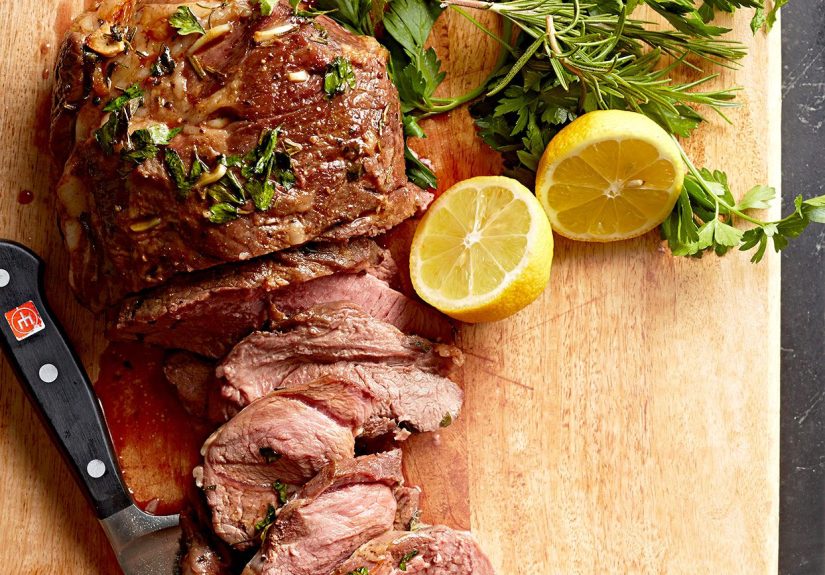
- Slice into 1/4–1/2 inch rounds.
- If you stuffed it, use a serrated knife for cleaner slices.
Troubleshooting: common leg-of-lamb problems (and fixes)
“My lamb tastes too gamey.”
Much of that strong flavor hangs out in the fat. Trim thick exterior fat, season aggressively, and add bright elements (lemon, vinegar-based sauce).
Garlic, rosemary, and mustard also help round out the flavor.
“The outside is done but the middle isn’t.”
Your oven was too hot for too long, or the roast shape was uneven. Next time: tie boneless lamb evenly,
or use a lower roasting temperature after the initial browning. Cook by thermometer, not minutes-per-pound alone.
“It’s dry.”
Overcooking is the usual culprit. Pull earlier, rest properly, and slice thin.
Sauce also helpsno shame in a delicious safety net.
Leftovers: store safely, eat happily
Leftover lamb is a gift. Treat it like one:
- Chill within 2 hours of serving (1 hour if it’s very hot out).
- Slice big pieces into smaller portions so they cool faster.
- Refrigerate and use within 3–4 days, or freeze for longer storage.
- Reheat leftovers until steaming hot (many food-safety sources recommend 165°F for reheating).
Leftover ideas: lamb sandwiches with chimichurri, lamb fried rice, shepherd’s pie, pita wraps with yogurt sauce,
or a fancy salad that makes your lunch look like it has a publicist.
Conclusion: your feast, your rules (but bring a thermometer)
Cooking leg of lamb isn’t about being a “natural.” It’s about doing a few high-impact things well:
choose the right cut, season like you mean it, roast or grill with a thermometer, and rest before carving.
Do that, and you’ll serve lamb that’s juicy, deeply flavored, and worthy of the kind of silence that only happens when people are busy enjoying dinner.
Real-Kitchen Experiences: What Cooking Leg of Lamb Feels Like (and What You’ll Learn)
The first “experience” most home cooks have with leg of lamb is the mental tug-of-war at the butcher counter:
you’re excited because it looks like a celebration, and you’re mildly intimidated because it’s roughly the size of a small backpack.
That’s normal. A leg of lamb feels like a commitment. But the funny thing is, once you start cooking it, the process becomes calmer than
many weeknight dinnersbecause roasting is mostly waiting while your oven does the heavy lifting.
Early on, you’ll notice the smell. Lamb doesn’t whisper; it announces itself.
When garlic, rosemary, and lemon hit hot air, your kitchen turns into an edible postcard. This is the moment people start “checking on you”
(also known as hovering near the oven and asking how long until dinner). You’ll learn quickly that your best defense is a thermometer and a confident sentence like,
“We’re cooking to temperature, not to the clock.” That one line makes you sound like you own a restaurant, even if you’re still Googling how to tie kitchen twine.
If you’re roasting bone-in lamb, there’s usually a short phase where you wonder if the crust is getting dark enough.
This is where experience teaches you the difference between “brown” and “burnt.”
The surface should be deeply browned, not black. You’ll also learn that opening the oven repeatedly is the culinary equivalent of refreshing your email:
it feels productive, but it mostly slows things down. One peek for color, then trust the process.
If you’re cooking a boneless, rolled leg, your biggest “aha” moment is how much shape matters.
The first time someone ties the roast unevenly, they discover a roast can have multiple doneness zones:
the thin end is fully done while the thick center is still catching up. The next time, you tie it more evenly,
and suddenly everything slices like a dreamuniform pink, juicy, and tidy. That’s not luck; that’s geometry.
Another very real experience: the resting period tests your patience.
You pull the lamb out, it looks perfect, and your brain says, “Slice it now!”
Then you rest it anyway, and when you finally carve, the juices stay in the meat instead of flooding the board.
That’s the moment you become a believer. Resting feels like doing nothing, but it’s actually the final cooking step.
Many cooks remember the first time they skipped rest because guests arrived earlyand the slices looked a little drier than they hoped.
After that, resting becomes non-negotiable.
You’ll also learn that “perfect lamb” depends on your audience.
Some guests want rosy medium-rare; others prefer it closer to medium.
Cooking leg of lamb teaches you the art of compromise: aim for a juicy middle doneness, slice thin,
and serve sauces that let everyone customize. A bright herb sauce makes medium slices taste lively,
and pan sauce makes leaner slices taste richer. It’s like giving your guests a flavor volume knob.
Finally, there’s the leftover experiencearguably the best part.
The day after, you’ll discover lamb is unbelievably versatile: it turns into sandwiches, wraps, salads,
and quick skillet meals that feel like “new food,” not second-day repeats. Many home cooks end up loving leg of lamb
not just because it’s a showstopper, but because it quietly upgrades the next three meals.
And that’s the secret: the feast isn’t only the dinner. It’s the whole delicious week you get afterward.