Table of Contents >> Show >> Hide
- From Office Routine to Underwater Reinvention
- Why Underwater Maternity Photography Works So Well
- The Hard Part Was Never Just the Camera
- Safety Is the Difference Between Art and a Bad Idea
- How a Great Underwater Maternity Session Actually Happens
- Why Being Early in Argentina Meant More Than Being Trendy
- What Made the Best Images Stand Out
- The Business Lesson Hidden Under the Surface
- Extended Experience: What Those Early Underwater Maternity Sessions Really Felt Like
- Conclusion
There are ordinary maternity photos, and then there are the kind that make people stop scrolling, squint at the screen, and say, “Wait… was that taken in a pool?” That second category is where underwater maternity photography lives. It is dreamy, strange, elegant, slightly ridiculous in the best possible way, and almost impossible to fake when it is done well.
In Argentina, one of the early photographers to publicly champion the style described a career path that sounds like it was written by a very caffeinated screenwriter: years in banking and IT, a growing desire to spend more time with family, a hard pivot into photography, and then a plunge into underwater maternity portraits that looked unlike anything most local clients had seen before. It was a niche inside a niche, and yet that was exactly the point. When everyone else is standing on dry land telling clients to tilt their chin and hold the belly, being the person who says, “What if we do this underwater?” is one way to make an entrance.
But the real story is not just that the photos looked cool. Plenty of things look cool for five minutes on the internet and then vanish into the same digital graveyard as frosted cupcakes and motivational wall decals. Underwater maternity photography stuck because it offered something regular maternity sessions often struggle to deliver at first glance: weightlessness, softness, movement, and a feeling of quiet. It turned pregnancy into something less posed and more cinematic.
From Office Routine to Underwater Reinvention
The appeal of this story starts with reinvention. There is something deeply relatable about a person staring at fluorescent office lights and deciding they would rather spend their days chasing light through water instead. In many early accounts from photographers who moved into underwater portraiture, the shift was not just technical. It was emotional. They were not simply learning a new genre. They were trying to build a different life.
That matters because maternity photography is built on trust. A client is inviting a photographer into one of the most vulnerable, transitional, and body-conscious seasons of her life. Add water, floating fabric, breath control, wet hair, and the possibility of looking like a glamorous sea goddess or a confused houseplant, and the trust requirement goes up fast.
That is why the earliest underwater maternity photographers did more than market a visual style. They sold confidence. They had to convince clients that the session would be beautiful, controlled, and safe. They had to show that this was not some chaotic “jump in and hope for the best” experiment. It was a craft.
Why Underwater Maternity Photography Works So Well
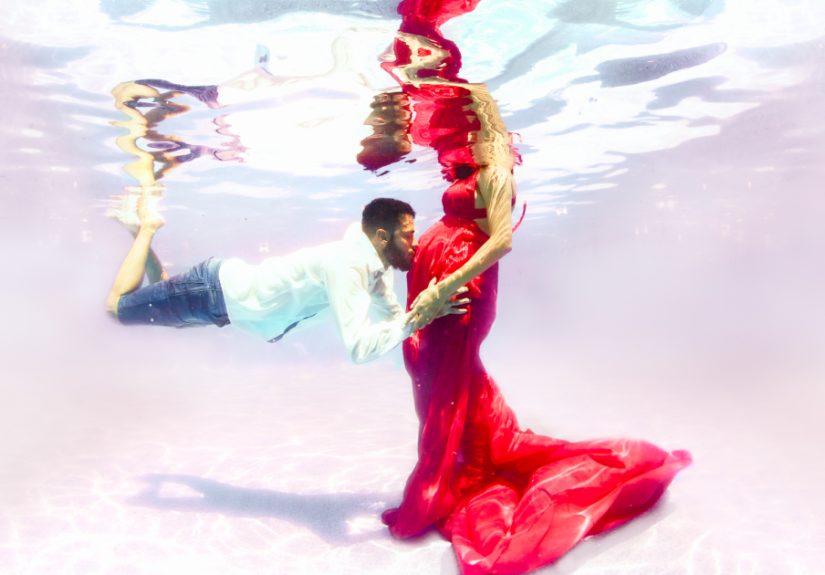
Underwater maternity photography works because water changes everything that portrait photographers usually fight against. On land, dresses fall. Underwater, they bloom. On land, hair goes flat or frizzy or suddenly develops a private grudge against humidity. Underwater, it becomes shape and motion. On land, a body has weight and pressure. Underwater, buoyancy softens posture and creates a natural sense of lift.
For pregnant clients, that visual effect can be especially powerful. Pregnancy already transforms the body into a kind of sculpture. Underwater photography does not hide that transformation. It amplifies it. The curve of the belly becomes central, the surrounding fabric becomes atmosphere, and the whole frame can feel suspended between documentary memory and fantasy.
That is also why the best underwater maternity images do not feel gimmicky. They may be dramatic, but they are not random. They use water as a storytelling tool. A strong frame can suggest calm, anticipation, grace, vulnerability, or strength without shouting any of it. And yes, sometimes it also whispers, “Mermaid, but make it editorial.”
The Hard Part Was Never Just the Camera
From the outside, people often assume the secret is expensive equipment. Equipment helps, of course. Waterproof housings, reliable lenses, controlled lighting, and clean pools are not minor details. But gear is not the real barrier. The real barrier is doing ten things at once while making it all look effortless.
Technical Challenges
Water eats contrast, bends light, softens detail, and loves turning skin tones into odd shades if the photographer is not careful. Focus can drift to bubbles. Fabric can hide the belly at exactly the wrong moment. Hair can cover the face. The dress that looked magical on the first dive can look like a soggy parachute on the third. Even the clearest pool has a talent for revealing every floating particle once light hits it.
That is why early underwater specialists obsessed over preparation. Camera settings were often dialed in before entering the water. Fast shutter speeds helped control motion. White balance and color correction mattered more than many beginners expected. Wide or moderately wide compositions made it easier to work close to the subject while still preserving the environment. In other words, the fantasy image required a very unromantic amount of planning.
Human Challenges
The client is not a mannequin. She is pregnant, probably warm, possibly nervous, and definitely not interested in doing twenty-seven failed dives because the chiffon is being uncooperative. Good underwater maternity photographers learn to direct quickly and calmly. They use hand signals. They keep dips brief. They rehearse poses above water first. They know when the client has reached her limit, and they stop before the session starts feeling like an accidental endurance sport.
That human side is one reason being early in this space mattered. When a photographer introduces a new style in a market, the first job is not photography. The first job is education. Clients need to understand what to wear, how the pool should look, how the session will flow, and what safety boundaries are non-negotiable.
Safety Is the Difference Between Art and a Bad Idea
This is where underwater maternity photography either becomes a refined specialty or a very bad conversation starter. In broad pregnancy guidance, swimming is often treated as one of the more comfortable low-impact forms of exercise. But underwater maternity sessions are not the same thing as casual swimming laps, and they should never be approached like a stunt.
The smartest photographers treat safety like part of the creative brief. They work in controlled pools rather than unpredictable open water. They schedule short submersions instead of prolonged breath-holding. They encourage medical clearance when needed, especially if the client has pregnancy complications or discomfort. They avoid overheating. They skip anything resembling scuba. They plan assistants, towels, breaks, hydration, and easy entry and exit from the pool.
In practical terms, that means the session should feel calm, not heroic. Nobody is winning a medal for staying underwater the longest. The goal is a beautiful image, not an Olympic qualification. The strongest photographers in this niche understand that the best sessions are the ones where the client leaves saying, “That was easier than I expected,” instead of, “I think I just trained for Navy SEAL selection.”
How a Great Underwater Maternity Session Actually Happens
A polished underwater maternity session usually begins before anyone touches the water. The wardrobe is tested. Fabrics are chosen for movement rather than bulk. Poses are practiced on land. The photographer explains how to exhale gently, where to place the hands, and how to keep the face relaxed. This last part is crucial because nothing ruins ethereal elegance faster than accidentally making the universal expression for “I swallowed pool water.”
Once in the pool, the rhythm matters. Dip, pose, float, surface, reset, repeat. The photographer watches for lines: the angle of the torso, the curve of the belly, the direction of the hair, the shape of the dress, the distance from the background. Small adjustments make a huge difference. A half-turn of the shoulder can reveal the belly more clearly. A softer hand can change the mood from tense to tender. A shift of fabric can turn visual clutter into a frame.
The magic happens in fractions of a second. That is why experienced photographers do not chase dozens of random poses. They chase a handful of strong, repeatable moments. They know what to look for and what to ignore. They are not hoping the water will invent the photo for them. They are collaborating with it.
Why Being Early in Argentina Meant More Than Being Trendy
Being one of the early names associated with underwater maternity photography in Argentina was not only about novelty. It was about timing. Maternity photography was already becoming more stylized worldwide. Social media had trained clients to expect images that were not merely sweet, but distinctive. At the same time, digital cameras, waterproof solutions, and online education made specialized genres more accessible than they had been a decade earlier.
That created a window of opportunity for photographers willing to go deeper, literally and professionally. In Argentina, where family imagery carries emotional weight and clients often value keepsake photography, an underwater maternity session could feel both intimate and spectacular. It was personal enough for a family album and dramatic enough for a cover image. That combination is catnip for modern visual culture.
And when a photographer arrived with not just pretty pictures, but a system, that mattered. Workshops, portfolio consistency, stronger editing, and a clear client experience are what turn a strange new offering into a legitimate category. Early adopters do not just make the work. They create the rules clients later assume were always there.
What Made the Best Images Stand Out
The most memorable underwater maternity portraits were never just about the fact that they were underwater. Plenty of images sink under the weight of their own concept. The best ones balanced spectacle with intimacy. They gave you motion, but also emotion. They used fantasy, but did not lose the person inside the frame.
There is a difference between a picture that says, “Look, she is underwater,” and one that says, “This season of life feels suspended, beautiful, and almost impossible to describe.” The second kind lasts. It becomes more than a trendy visual trick. It becomes memory with atmosphere.
That is also why editing matters so much. A heavy-handed edit can make skin look plastic and water look fake. A careful edit preserves softness, clarity, and mood. It enhances the image without sanding off the humanity. In maternity photography, that balance matters. Clients want to look extraordinary, but they also want to look like themselves on one of the most meaningful timelines of their life.
The Business Lesson Hidden Under the Surface
There is a smart business lesson here for photographers of any niche. Being early is not enough. Being early and excellent is where the real advantage lives. Plenty of people are first to try something. Far fewer are first to build trust around it.
Underwater maternity photography demands more planning, more explanation, more post-production awareness, and more client care than standard portrait work. That extra effort is exactly why it can become a signature service. It is difficult enough to be differentiated and emotional enough to be remembered. In a crowded photography market, that is gold.
And for photographers who came from another career entirely, the genre offered something even more valuable than differentiation. It offered identity. It let them stop being interchangeable service providers and start being known for something. In creative work, that kind of positioning is not vanity. It is survival.
Extended Experience: What Those Early Underwater Maternity Sessions Really Felt Like
The experience of creating early underwater maternity work in Argentina was probably far less glamorous than the finished images suggest, and that is exactly what makes it interesting. Every polished frame usually hides a comedy of small adjustments: goggles fogging up, fabric refusing to drift in the right direction, a client surfacing with a laugh because her hair just attacked her face, and a photographer mentally recalculating light, distance, and timing every few seconds.
Imagine arriving at a client’s pool with bags of wardrobe pieces, camera gear sealed in waterproof housing, towels piled like you are preparing for a tiny luxury spa, and a brain that is trying to remember everything at once. Is the water clean enough? Is the light soft enough? Is there enough room to step in and out safely? Did the dress test well? Does the client feel comfortable? Is the assistant ready? Are the neighbors about to start a leaf blower symphony at the exact wrong moment? Art is beautiful. Logistics are undefeated.
Then comes the first dip, and that first dip tells you almost everything. Some clients move naturally in water. They float, extend, and soften right away. Others need time. They are smiling too much, blinking too hard, or tensing their shoulders because they are concentrating on the mechanics of holding a pose. The photographer’s job in that moment is part coach, part director, part emotional translator. “Relax your hands. Slow down. Think long lines. Let the fabric float. Perfect. Again.”
What makes underwater maternity photography memorable is that the session often changes the client’s mood in real time. Many arrive curious but cautious. Pregnancy can make anyone feel hyper-aware of the body. On land, that self-awareness sometimes stiffens a session. Underwater, something unexpected can happen. The body becomes less heavy, movement becomes softer, and the client often stops performing and starts flowing. That shift is where the best images live.
There is also a quiet intimacy to the process. Underwater, sound drops away. Direction becomes simpler. Everyone involved has to be more intentional. A glance, a hand signal, a nod, a surface reset. Compared with the usual chatter of portrait sessions, it can feel almost meditative. The pool becomes a temporary studio where the normal pace of life is suspended for a few breaths at a time.
Of course, not every moment is poetic. Some are hilariously practical. Dresses tangle. Fabrics sink when they were supposed to float. A perfect expression lasts for half a second and disappears. You review the back of the camera and realize one image is magic, the next is chaos, and the third looks like the subject has just discovered an invisible jellyfish. That unpredictability is part of the craft. It forces the photographer to stay humble.
For an early photographer building this genre in Argentina, those sessions likely carried extra pressure. Every successful shoot was not just a job. It was proof. Proof that the concept worked. Proof that clients would trust it. Proof that this unusual style could belong in the local market instead of being admired only from afar. That pressure can be exhausting, but it can also sharpen a photographer’s instincts. When you know you are helping define a category, you pay closer attention. You refine faster. You learn not just how to make a pretty frame, but how to create a repeatable experience clients will recommend to other mothers.
And that may be the most compelling part of the whole story. Underwater maternity photography in Argentina was never only about making women look like mermaids. It was about building a new visual language for motherhood, one session at a time, in a place where that language still felt surprising. The first photographers to do that work were not just taking pictures. They were teaching clients how to imagine themselves differently. That is a much bigger achievement than a trendy image. That is culture, memory, and reinvention sharing the same breath.
Conclusion
How I Was One Of The First Doing Underwater Maternity Photography In Argentina is ultimately a story about more than a visual trend. It is about creative risk, technical discipline, client trust, and the strange power of choosing a path that initially makes other people say, “You do what now?”
That is usually a good sign, by the way.
The early photographers in this niche understood something important: memorable work is rarely born from comfort. It comes from curiosity backed by skill. Underwater maternity photography brought together portraiture, movement, pregnancy, patience, and problem-solving in a way that felt fresh because it was fresh. And in Argentina, that freshness gave a few photographers the chance to build not just a portfolio, but a reputation.
When it works, an underwater maternity portrait does not just document pregnancy. It transforms it into visual poetry with a little chlorine and a lot of nerve. That combination is hard to beat.