Table of Contents >> Show >> Hide
- Meet the Type 100: China’s High-Tech Answer to the Modern Battlefield
- Why Experts Are Paying Attention
- What Makes the Type 100 So Advanced?
- Why China Built This Tank Now
- Could It Really Be the Most Advanced Tank in the World?
- Why Tanks Still Matter in the Drone Age
- Where the Hype Runs Into Reality
- The Experience of Watching Tank Warfare Change in Real Time
- Conclusion
Every few years, a military parade rolls by and the internet collectively loses its mind over a new piece of hardware. Usually, the hype burns off faster than cheap fireworks. China’s new Type 100 tank, however, looks like it may deserve at least some of the fuss. If the public details are even mostly accurate, this is not just another upgraded steel beast with a fresh coat of paint. It appears to be a lighter, smarter, more connected combat vehicle built for the kind of battlefield where drones buzz overhead, sensors see almost everything, and a tank that cannot think fast may not stay a tank for very long.
That is why the Type 100 has drawn so much attention. It combines several ideas militaries around the world have been chasing at once: hybrid-electric propulsion, an unmanned turret, advanced active protection, heavy sensor fusion, augmented-reality support for the crew, and tight integration with drones and other vehicles. In other words, it looks less like a classic tank and more like a rolling combat network with a cannon attached. That is either the future of armor or a very expensive science project. Possibly both.
So, is China’s new military tank really the most advanced in the world? The honest answer is that it may be among the most advanced on paper, but “most advanced” is not the same as “most proven.” The Type 100 has made a spectacular entrance, yet there is still a canyon-sized gap between looking impressive in public and surviving in a modern war. That tension is what makes this tank so fascinating.
Meet the Type 100: China’s High-Tech Answer to the Modern Battlefield
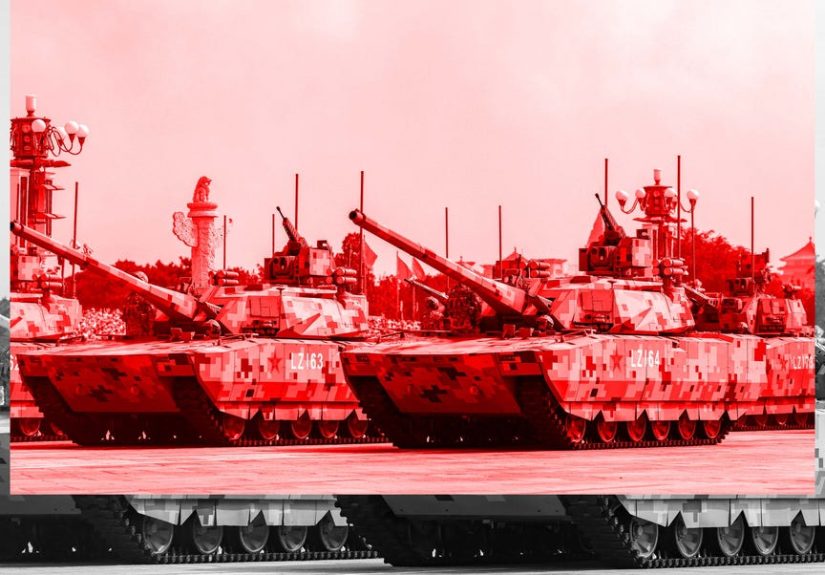
The Type 100 emerged publicly during China’s 2025 Victory Day parade, where it was presented alongside a companion fighting vehicle and described in Chinese state coverage as a next-generation or “highly intelligent” tank. Analysts quickly focused on the same features: the vehicle appears to use a hybrid-electric drive, an unmanned turret, active protection systems, advanced radar and optical sensors, and augmented-reality tools that reportedly help the crew “see” through the hull via distributed cameras and fused data feeds.
That last part is worth pausing on. Traditional tank crews have always lived with a nasty tradeoff: the more armor you add for protection, the less naturally aware the crew becomes of the world outside. The Type 100 seems designed to cheat that old bargain. Instead of relying only on a few vision blocks, sights, and nerves of steel, the crew is expected to lean on a sensor web that feeds them a digital picture of the battlefield. It is a very twenty-first-century solution, and also a very twenty-first-century gamble. When the electronics work, the crew may enjoy extraordinary awareness. When they fail, you have three very anxious people sitting in a very expensive metal box.
Why Experts Are Paying Attention
The reason defense analysts are taking the Type 100 seriously is simple: it mirrors where tank design has been heading globally. Modern armor is moving away from the old “just add more steel and a bigger gun” formula and toward a more balanced mix of mobility, electronics, automation, signature reduction, and active protection. The battlefield in Ukraine has made that shift impossible to ignore. Tanks are still useful, but they are now hunted by cheap drones, loitering munitions, top-attack missiles, and ubiquitous reconnaissance. In that environment, the best tank is not necessarily the heaviest tank. It may be the one that sees first, moves smartly, hides better, and swats away incoming threats before they arrive.
The Type 100 seems built with exactly that logic in mind. Reports suggest it weighs around 40 tons, far lighter than many top-end main battle tanks. That lower weight brings several practical benefits. It is easier to transport, easier to recover, easier on bridges, and friendlier to difficult terrain. It also fits China’s strategic needs. A lighter, more mobile armored force is more useful for mountainous regions, contested islands, and fast-moving expeditionary operations than a giant fuel-hungry monster that needs a support train the size of a small city.
What Makes the Type 100 So Advanced?
1. Hybrid-Electric Propulsion
Hybrid drive may sound like something borrowed from a suburban commuter car, but on a tank it is a serious military advantage. A hybrid-electric system can reduce fuel use, provide quieter movement in limited situations, and generate much more electrical power for onboard electronics. That matters because modern tanks increasingly depend on energy-hungry systems: radars, active protection, jammers, sensors, digital command tools, and eventually perhaps directed-energy defenses.
In plain English, the Type 100 may be advanced partly because it can feed its own appetite. Older tanks were built mainly to move, shoot, and survive. New tanks must do all of that while acting as data nodes, drone managers, and electronic warfare participants. The more power they can produce, the more capable they become. This is one reason hybrid-electric propulsion shows up not only in reporting on the Type 100, but also in discussions of future U.S. armored vehicles. Tank designers everywhere got the memo: batteries and bandwidth now matter almost as much as armor.
2. Unmanned Turret and Protected Crew Layout
The Type 100’s unmanned turret is one of its flashiest features, and for good reason. Moving the crew into the hull can reduce the amount of armor needed around the turret while improving protection for the humans who actually matter. It also frees up internal space for ammunition, automation, and sensors. In theory, it is a clever design. In practice, it demands an extraordinary level of trust in cameras, displays, software, and stabilization systems.
That is the central trade. A crewless turret can help make a tank lighter and safer, but only if the electronics are robust enough to replace the direct awareness crews used to have. Russia’s T-14 Armata popularized this concept years ago, but that program has struggled to prove itself in real wartime conditions. China appears to be taking a similar path, though with what looks like a more practical emphasis on production and integration.
3. Sensor Fusion and Augmented Reality
This may be the Type 100’s biggest headline feature. Reporting indicates the tank uses a large number of optical, infrared, radar, and warning sensors to create 360-degree coverage for the crew. Combined with augmented-reality displays, the goal is to turn raw inputs into a usable combat picture. Instead of making the commander or gunner hunt manually for everything, the system can flag threats, share locations, and speed up decision-making.
That is how advanced military vehicles increasingly win: not by simply hitting harder, but by shortening the time between detection and action. A tank that sees first and shoots first is often the tank that lives. A tank that can also share that picture with drones, nearby vehicles, and command networks becomes even more dangerous.
4. Active Protection and Anti-Drone Defense
If the public descriptions are accurate, the Type 100’s active protection system may be the feature that pushes it into truly top-tier territory. Hard-kill active protection is designed to detect incoming missiles, rockets, or drone-launched threats and destroy them before impact. On today’s battlefield, that is no longer a nice extra. It is close to mandatory.
The drone age has been brutally rude to armored vehicles. Videos from Ukraine have shown tanks hit from above, spotted by cheap quadcopters, stalked by loitering munitions, or disabled by combined artillery and drone teams. That has forced militaries to think about anti-drone defense as part of tank survivability, not as a separate issue. The Type 100 appears to reflect this change directly. Its design seems built around the assumption that being armored is not enough. You must also be able to intercept, jam, confuse, and out-sense the threats closing in on you.
Why China Built This Tank Now
The Type 100 did not appear in a vacuum. It fits a larger Chinese military modernization effort focused on turning the People’s Liberation Army into a more networked, technologically sophisticated force. China’s defense industry has spent years climbing the ladder from copying older foreign designs to producing systems that increasingly reflect its own operational priorities. In armored warfare, those priorities now seem to include lighter weight, better information flow, better survivability against drones and missiles, and stronger performance in a range of theaters.
That matters because China does not need one tank for one map. It needs armor that can make sense near Taiwan, in mountainous border regions, in fast-reacting coastal operations, and in a conflict where logistics and movement matter as much as brute force. Heavier tanks still have a role, especially in direct slugging matches, but China has already shown with the Type 15 that it values lighter armored vehicles for harsh terrain and operational flexibility. The Type 100 looks like the next step in that evolution: a more advanced, more digitally enabled machine that tries to split the difference between mobility and lethality.
Could It Really Be the Most Advanced Tank in the World?
Maybe. But here is where the article title needs its seatbelt.
On paper, the Type 100 checks an extraordinary number of boxes. Hybrid-electric propulsion? Check. Unmanned turret? Check. Advanced active protection? Check. Sensor fusion? Check. Augmented reality? Check. Drone integration and networked targeting? Apparently yes. That is a very modern recipe, and several competing next-generation tank programs in the West are still in prototype, concept, or transition phases.
But “most advanced” is a slippery phrase. A tank can be technologically dazzling and still be operationally awkward. It can carry amazing sensors and still suffer from maintenance headaches, training gaps, software fragility, or doctrine that has not caught up. It can be parade-ready and not war-ready. The world has seen this movie before. Futuristic armored vehicles often look unbeatable right until the moment mud, broken parts, and enemy fire begin editing the script.
There is also the matter of public verification. Much of what is known about the Type 100 comes from state media, parade observation, and external interpretation. That does not mean the tank is fake or unimpressive. It means caution is smart. A vehicle can be advanced in design intent and still not deliver everything promised.
Why Tanks Still Matter in the Drone Age
One of the more interesting things about the Type 100 is that it arrives during a period when people love declaring tanks dead. The obituary writers are always early. Yes, drones have transformed land warfare. Yes, anti-tank weapons are nasty. Yes, modern battlefields are alarmingly transparent. But tanks still offer a rare combination of protected mobility, direct firepower, and shock effect. Armies keep them because nothing else fully replaces what they do in combined-arms warfare.
The real lesson from Ukraine is not that tanks are obsolete. It is that unsupported tanks are in deep trouble. Armor now needs better air defense, better electronic warfare, better reconnaissance, better infantry coordination, and better counter-drone coverage. The Type 100 seems like a direct answer to that lesson. China appears to be designing not just a tank, but a tank meant to survive in a battlefield where everyone is being watched.
Where the Hype Runs Into Reality
For all its promise, the Type 100 still faces the same nasty questions every next-generation combat vehicle faces.
First, can it be produced in meaningful numbers without becoming too expensive or too complicated? Fancy systems have a way of multiplying cost faster than rabbits multiply trouble.
Second, can crews actually use all this technology under stress? Sensor fusion sounds wonderful until alarms, feeds, icons, and warnings begin piling up faster than a crew can interpret them.
Third, how resilient is the system against jamming, cyber disruption, damage, and battlefield chaos? A tank that depends heavily on electronics must assume those electronics will be attacked.
Fourth, what about the gun? Some reporting suggests the Type 100 uses a 105 mm weapon tuned for very high performance rather than the heavier 120 mm or 125 mm guns common on main battle tanks. That may be a clever weight-saving choice, but it is still a tradeoff. If you lighten the tank and shrink the gun, you are betting that awareness, networking, and smart defense will compensate for some traditional mass and brute-force punch.
The Experience of Watching Tank Warfare Change in Real Time
There is something almost surreal about following tanks in 2026. For decades, tanks were the kings of land combat in the public imagination: loud, heavy, intimidating machines that looked like they could drive through history itself. Then the drone era arrived and made the old picture feel incomplete. Now, watching a new tank emerge is less like watching a bigger cannon roll down the street and more like watching a mobile server room put on armor.
That is why the Type 100 feels so important. It captures the strange experience of modern military technology, where the most dangerous machine is not necessarily the thickest or the loudest, but the one that can process, share, and survive information at speed. The old tank was built to dominate terrain. The new tank is being built to survive a battlefield that sees too much.
For anyone who has followed the war in Ukraine, that shift feels deeply familiar. Every major lesson seems to point in the same direction. Crews need better warning. Vehicles need better top protection. Units need drones of their own. Commanders need persistent sensing. Logistics must become leaner because supply lines are visible and vulnerable. Repair has to happen faster. Movement has to happen smarter. You cannot simply armor your way out of this problem anymore. You have to out-detect, out-decide, and out-adapt.
That changes the emotional texture of armored warfare too. The classic image of the tank commander half-exposed from a hatch, scanning the horizon with binoculars, has been replaced by a much more digital picture: crew members inside the hull, eyes on displays, assisted by algorithms, fed by cameras, warnings, and drone links. It is still warfare, still violent, still terrifying, but it feels less mechanical and more computational. Steel remains essential. So does software. And that is a weird sentence to write about a tank, which is exactly the point.
It also changes how military power is perceived. A tank like the Type 100 is not just a battlefield tool. It is a signal. It says China wants to be seen not as the country that catches up, but as the country willing to leap ahead. It says Chinese planners are studying recent wars and trying to design around the ugliest lessons. It says the competition in armored warfare is no longer just about armor thickness or gun caliber, but about which army can build a vehicle that stays useful in a battlefield flooded with sensors, drones, and precision strikes.
There is, however, one more human experience wrapped up in all this: skepticism. Defense watchers have learned not to fall in love too quickly with polished unveilings. Every military loves a dramatic reveal. Real credibility is built later, in training cycles, maintenance bays, production runs, and eventually combat. That is why the Type 100 is so compelling right now. It sits in that tense space between theory and proof. It looks like a glimpse of the future, but the future has not yet filed its final report.
So the experience of following this tank is a mix of awe and caution. Awe, because the design philosophy looks modern in all the right ways. Caution, because war has a cruel habit of humiliating elegant ideas. The Type 100 may turn out to be a landmark in armored warfare. Or it may become a reminder that advanced technology only matters when it survives contact with reality. Either way, the message is clear: the age of the “smart tank” is no longer hypothetical. It has arrived, and everyone else in the armor business is now on notice.
Conclusion
China’s new military tank may indeed be one of the most advanced in the world, and possibly the most advanced in public view right now, if we judge by design features alone. The Type 100 appears to combine the biggest trends in modern armored warfare into one package: lighter weight, hybrid-electric mobility, crew protection through an unmanned turret, rich sensor fusion, active protection, and anti-drone thinking built into the platform from the start.
That said, the final verdict is still pending. Advanced does not automatically mean dominant, and dominant does not automatically mean durable. The real test is whether China can field this tank at scale, sustain it, train crews to exploit it, and make its doctrine as modern as its hardware. Until then, the Type 100 remains what all fascinating new military machines are at first: part breakthrough, part mystery, and part warning shot to every rival still pretending the future of tank warfare will look like the past.