Table of Contents >> Show >> Hide
- What Is Carbon 14?
- Carbon 14 Half Life: Why 5,730 Years Matters
- How Carbon 14 Dating Works
- History of Carbon 14 Dating
- Why Calibration Matters
- Strengths and Limits of Carbon 14 Dating
- Real-World Examples of Carbon 14 Dating in Action
- Common Myths About Carbon 14
- Experiences Related to Carbon 14 Dating: What the Process Feels Like in Real Life
- Conclusion
- SEO Tags
Carbon-14 has one of those rare scientific careers that deserves its own movie trailer voice-over: “In a world full of old bones, burnt wood, and mysterious ruins, one isotope stepped forward.” Dramatic? Absolutely. Wrong? Not really. Carbon-14, often written as C-14 or radiocarbon, changed how scientists understand time. It helped archaeologists stop guessing, gave geologists a sharper clock, and turned scraps of charcoal, bone, cloth, and wood into evidence with a date attached.
If you have ever wondered what carbon 14 is, why the carbon 14 half life matters so much, or how the history of carbon 14 dating transformed science, you are in the right place. This guide explains the basics, the breakthroughs, the limitations, and the very human experience of trying to learn the age of something that has been sitting quietly in the ground for thousands of years.
What Is Carbon 14?
Carbon-14 is a radioactive isotope of carbon. Most carbon on Earth is carbon-12, and a smaller amount is carbon-13. Carbon-14 is the rare, slightly unstable cousin in the family. It forms high in the atmosphere when cosmic rays help create neutrons, and those neutrons react with nitrogen atoms. The new carbon-14 atoms quickly join oxygen to become carbon dioxide, which then enters the atmosphere, oceans, plants, animals, and eventually people.
That last part is the key. Carbon-14 does not stay in some fancy scientific VIP lounge. It gets around. Plants absorb carbon dioxide through photosynthesis. Animals eat plants, or eat animals that ate plants. Humans join the parade by eating, drinking, and breathing. While an organism is alive, it keeps exchanging carbon with its environment. Once it dies, that exchange stops. From that moment on, the amount of carbon-14 in its remains starts to decline.
That decline is the secret behind radiocarbon dating. Nature loads the clock. Death starts the countdown.
Carbon 14 Half Life: Why 5,730 Years Matters
The carbon 14 half life is about 5,730 years. A half-life is the time it takes for half of the radioactive atoms in a sample to decay. Carbon-14 decays by beta decay into nitrogen-14. In plain English, if a dead plant or animal starts with a certain amount of carbon-14, then after 5,730 years only half of that original amount remains. After another 5,730 years, half of the remaining half is left, which means one-quarter of the original amount remains. And so on.
Here is the simple version:
Start with 100% carbon-14.
After 5,730 years: 50% remains.
After 11,460 years: 25% remains.
After 17,190 years: 12.5% remains.
This predictable decay rate is what makes carbon-14 dating useful. Scientists do not need to know every detail of an ancient life story. They need to know how much radiocarbon is left and compare it to expected baseline values.
You may occasionally see an older number, 5,568 years, in historic discussions of the method. That reflects an earlier value used in the early decades of radiocarbon work. Modern explanations typically use 5,730 years, which is the number most readers should remember unless they are deep in the weeds of radiocarbon methodology and enjoying it far more than the average dinner guest.
How Carbon 14 Dating Works
Carbon-14 dating, also called radiocarbon dating, estimates how long it has been since an organism died. Scientists measure the remaining carbon-14 in organic material and compare it with expected atmospheric levels. The less carbon-14 that remains, the older the sample is likely to be.
What Can Be Dated?
Radiocarbon dating works on things that were once alive. That includes charcoal, wood, seeds, paper, textiles, leather, bone, antler, peat, pollen, and sometimes shell or other carbon-bearing materials if the sample is carefully interpreted. It can also date more recent organic remains in environmental science, climate research, and even forensic work.
What Cannot Be Dated Directly?
Most rocks, metals, and fully mineralized fossils cannot be dated directly with carbon-14 because they are not organic remains that still contain usable original carbon. Dinosaur bones are the classic example. They are far too old for radiocarbon dating and usually have lost the original organic material anyway. So when someone says carbon dating proved the age of a dinosaur, that is a red flag waving hard enough to power a wind farm.
How Old Can a Sample Be?
In practice, radiocarbon dating is most effective for material ranging from a few hundred years old to roughly 50,000 years old, with some sources giving an upper range closer to 55,000 or 60,000 years under favorable conditions. Beyond that, too little carbon-14 remains to measure reliably.
How Do Scientists Measure It?
Early radiocarbon dating relied on detecting radioactive decay from a prepared sample. Later, accelerator mass spectrometry, or AMS, changed the game by counting carbon-14 atoms directly. AMS allows labs to work with much smaller samples and often improves efficiency and precision. That is one reason modern radiocarbon dating can analyze tiny amounts of material that earlier researchers would have looked at sadly and put back in the box.
History of Carbon 14 Dating
The history of carbon 14 dating is one of those stories where a smart idea met the right technology at the right time and then proceeded to rewrite multiple fields.
The Discovery of Carbon-14
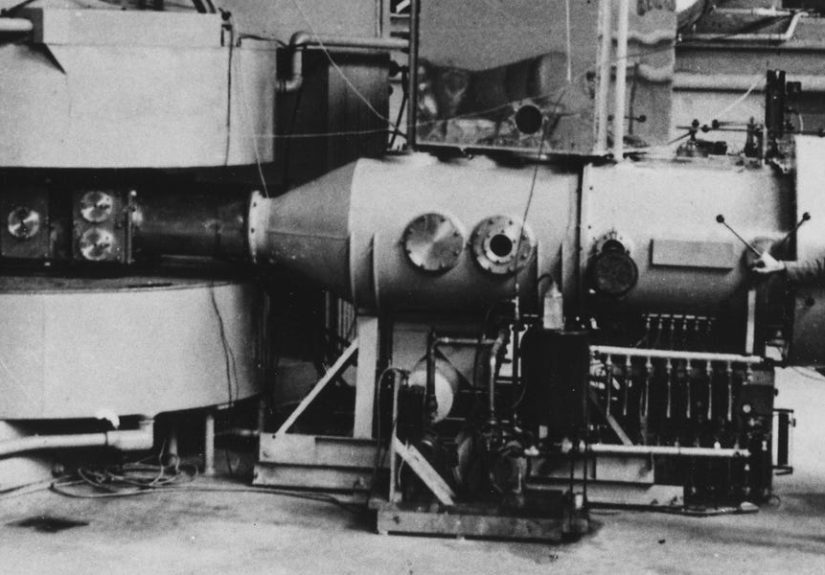
In 1940, Martin Kamen and Samuel Ruben at Berkeley produced carbon-14 artificially using a cyclotron. That discovery mattered well beyond chemistry. Carbon-14 was not just another isotope on a chart. It became a tracer for biological processes and, soon after, the foundation of a dating revolution.
Willard Libby’s Big Idea
After World War II, chemist Willard Libby began working at the University of Chicago. He built on the idea that cosmic rays produce neutrons in the atmosphere, which can create carbon-14 from nitrogen. Libby realized that if carbon-14 entered living things during life and then decayed after death, scientists could estimate age by measuring what remained.
In 1946, Libby formally proposed the concept. It sounds straightforward now, but at the time it was bold. He had to show that natural carbon-14 existed in the environment, that living organisms shared roughly comparable radiocarbon levels, and that the decay signal could be measured accurately enough to be useful.
From Theory to Proof
Libby and his colleagues developed extremely sensitive detection methods and then tested the technique on materials with known ages. Among the classic early samples were tree rings from redwood and fir, plus a timber sample from the funerary boat of the Egyptian pharaoh Senusret III. In 1949, Libby and James Arnold published the famous “Curve of Knowns,” showing that radiocarbon dates matched known-age samples closely enough to prove the method worked.
That was the scientific mic drop. Carbon-14 dating moved from clever theory to trusted tool.
The Radiocarbon Revolution
Before radiocarbon dating, archaeologists often relied on relative dating. One layer was older than another. One pottery style likely came before another. Useful, yes. Precise, not always. Radiocarbon dating changed that by attaching approximate numerical ages to organic remains.
The effect was enormous. Researchers refined timelines for ancient settlements, challenged old assumptions about where civilizations first developed, and improved the dating of glacial retreat, climate shifts, and human migration. The method became so influential that historians of science often describe it as a “radiocarbon revolution.”
Libby received the Nobel Prize in Chemistry in 1960 for developing the method, which is a pretty good sign that his peers agreed this was not a minor hobby project.
Why Calibration Matters
Here is where carbon-14 dating gets more interesting than the simplified classroom version. Atmospheric carbon-14 has not been perfectly constant over time. Natural changes in solar activity, Earth’s magnetic field, and the carbon cycle affect how much radiocarbon is available in the atmosphere. Human activity changed it too. Fossil fuel burning lowers atmospheric radiocarbon because fossil fuels are so old that their original carbon-14 is gone, a trend known as the Suess effect. Atmospheric nuclear testing in the 1950s and early 1960s created a sharp spike in radiocarbon, often called “bomb carbon.”
Because of these shifts, raw radiocarbon ages need calibration. Scientists compare radiocarbon measurements against independently dated records, especially tree rings. Tree-ring research made it possible to map fluctuations in atmospheric carbon-14 through time and produce calibration curves. Modern calibration standards, such as IntCal20, help convert radiocarbon years into more accurate calendar ages.
You will also see dates expressed as years “BP,” meaning “before present,” where “present” is defined as A.D. 1950. That may seem oddly specific, but in radiocarbon science it makes sense because the post-1950 world did strange things to atmospheric carbon.
Strengths and Limits of Carbon 14 Dating
Why It Is So Powerful
Carbon-14 dating is powerful because it applies directly to organic remains and can give an absolute age estimate rather than just placing one object earlier or later than another. It works across archaeology, paleontology, geology, climate science, oceanography, and ecology. It has helped date campfires, wooden structures, seeds from ancient farms, bones from burial sites, and trees buried by glaciers or volcanic events.
Why It Is Not Magic
Radiocarbon dating still depends on context. A charcoal fragment dates the burning of the wood, not necessarily the construction of a nearby wall. Old wood can be reused. Bones can be contaminated. Marine samples can reflect reservoir effects because ocean carbon does not always match the atmosphere perfectly. A sloppy sample can produce a misleading result, which is why serious labs obsess over cleaning, pretreatment, and interpretation.
In other words, the machine gives a number, but science still needs judgment.
Real-World Examples of Carbon 14 Dating in Action
In archaeology, carbon-14 dating can reveal when a hearth last burned, when a burial likely took place, or when a settlement was occupied. In geology, charred wood trapped in volcanic deposits can help date eruptions. In climate science, radiocarbon helps track carbon movement through the atmosphere, oceans, soils, and living systems. In the modern era, bomb carbon has even been used to study environmental turnover and very recent biological materials.
One of the great strengths of carbon-14 is that it is useful both for the ancient past and for understanding modern carbon cycling. That is a rare trick. Most scientific tools are either “old stuff” tools or “current Earth system” tools. Radiocarbon somehow manages to be both.
Common Myths About Carbon 14
Myth 1: Carbon dating can date anything.
No. It works on organic material and certain carbon-bearing samples, not on every object in a museum drawer.
Myth 2: Carbon dating gives an exact birthday.
Also no. Results usually come with uncertainty ranges, and calibration matters.
Myth 3: Carbon dating is unreliable because atmospheric carbon changes.
That change is real, but calibration curves are specifically designed to account for it.
Myth 4: Carbon dating works for dinosaurs.
Absolutely not. Dinosaurs are millions of years too old for the method.
Experiences Related to Carbon 14 Dating: What the Process Feels Like in Real Life
Carbon-14 dating sounds neat and tidy in textbooks, but the real-world experience around it is often a mix of patience, suspense, caution, and occasional scientific heartbreak. Anyone who has spent time near archaeological fieldwork, museum conservation, or environmental sampling learns quickly that getting a radiocarbon date is not like typing a question into a search bar and waiting three seconds. It is more like assembling a legal case for a very old, very quiet witness.
Imagine an excavation team uncovering a dark stain in the soil that might be an ancient fire pit. The exciting part is not the dirt itself. It is the tiny charcoal flecks hidden inside it. Those fragments may be the difference between saying, “This site seems old,” and saying, “This layer dates to roughly 2,400 years ago.” That is a huge upgrade. But before anyone celebrates, the team has to ask annoying but necessary questions. Is the charcoal in the original place? Could it have washed in later? Was the wood already old when it burned? Was the area disturbed by roots, animals, erosion, or modern digging?
Then comes sampling, which feels oddly dramatic for something involving tweezers and labeled bags. Researchers handle samples carefully because contamination is the villain in this story. Modern carbon from skin oils, glue, conservation chemicals, plant roots, or dirty tools can throw off results. Bones may need special cleaning. Charcoal has to be separated from surrounding material. Shells may require extra caution because marine carbon does not always reflect the atmosphere in a straightforward way.
Lab work has its own atmosphere. It is part chemistry, part discipline, part “please let this tiny sample behave.” Pretreatment removes contaminants. The usable carbon is extracted. Then the sample may go through AMS analysis, where astonishingly small amounts of carbon can still provide useful information. For people new to the process, it is almost comical how much effort can go into something that, to the untrained eye, looks like a crumb.
And then there is the waiting. Researchers often know the historical stakes before the date arrives. A result might settle a debate about when a settlement began, whether a burial belongs to one period or another, or whether an artifact was used earlier than scholars assumed. Sometimes the date supports the hypothesis beautifully. Sometimes it flips the table. A sample expected to be medieval turns out to be early modern. A site thought to be a single occupation phase turns out to have multiple episodes hundreds of years apart.
That is one reason carbon-14 dating remains so exciting. It does not just confirm stories; it tests them. It rewards careful context, punishes sloppy assumptions, and occasionally humbles very confident experts. The experience of working with radiocarbon is not just technical. It is emotional in a very scientific way: hope, doubt, surprise, revision, and then the quiet satisfaction of watching the timeline of the past come into clearer focus.
Conclusion
Carbon-14 is more than a radioactive isotope with a memorable half-life. It is one of the most important scientific tools ever developed for understanding the past. Its 5,730-year half-life gives researchers a reliable clock. Its history connects Berkeley, Chicago, chemistry, archaeology, and global carbon science. And its legacy continues today through calibration research, AMS technology, and new applications across environmental and historical fields.
Put simply, carbon-14 dating helped science trade vague guesses for testable timelines. That is not bad for an atom most people only meet because they typed “carbon 14 half life” into a search box five minutes ago.