Table of Contents >> Show >> Hide
- The short answer: what most likely sank the Edmund Fitzgerald
- A giant on the lakes, and maybe a little too giant for comfort
- The final voyage: how a routine run turned into a legend
- What the official investigations concluded
- The theories that refuse to die
- So why do people say, “We might know now”?
- What changed after the disaster
- Why this ship still grabs us by the collar
- Experiences tied to the Edmund Fitzgerald story: what the tragedy feels like up close
- Conclusion
Some mysteries stay unsolved because the clues are gone. The Edmund Fitzgerald is worse: the clues are still there, but they are 500-plus feet under Lake Superior, inside a protected grave site, wrapped in steel, darkness, and one of the most brutal weather systems the Great Lakes can produce. That is why the loss of the “Mighty Fitz” has never stopped haunting maritime history buffs, weather nerds, or basically anyone who has ever heard Gordon Lightfoot and immediately felt the room get 10 degrees colder.
But here is the thing: while we still do not have a courtroom-level, no-doubt-left verdict, we may be closer than ever to a realistic explanation. The best modern reading of the disaster is not one dramatic gotcha moment. It is a chain reaction. The ship likely suffered storm damage, began taking on water, lost freeboard and stability, and then experienced catastrophic flooding so quickly that the crew never had time to send a full distress call. In other words, the Fitzgerald probably did not lose to one villain. It lost to a whole gang of them.
The short answer: what most likely sank the Edmund Fitzgerald
If you want the cleanest modern answer, it is this: the most persuasive explanation today is a cascading flooding event during a violent Lake Superior storm. That basic conclusion lines up with the National Transportation Safety Board’s finding that sudden massive flooding of the cargo hold most likely followed the collapse of one or more hatch covers after the vessel had already been compromised by flooding, list, and reduced freeboard. In plain English, the ship was likely already in trouble before the final, fatal moment arrived.
That does not mean every other theory is nonsense. Far from it. Rogue waves may have helped trigger or worsen the crisis. Structural stress may have made the ship more vulnerable. A shoal strike has long been part of the debate, though official investigators considered grounding unlikely based on the most probable trackline. So when people say, “We might know now,” the smartest version of that claim is not that one tidy theory has won forever. It is that the strongest explanation is now a combined-failure scenario: brutal weather, progressive flooding, and a ship that may already have been under more stress than anyone wanted to admit.
A giant on the lakes, and maybe a little too giant for comfort
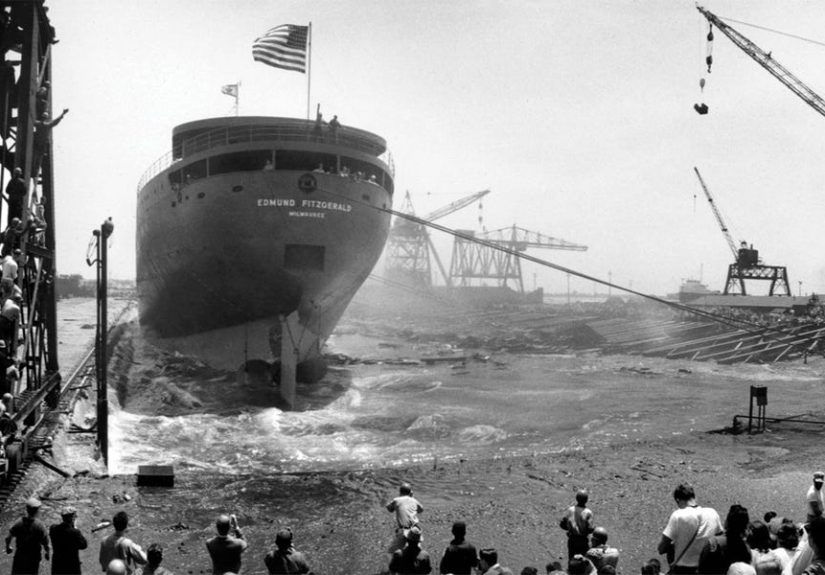
When the Edmund Fitzgerald launched in 1958, it was a marvel. At 729 feet long, it was the largest carrier on the Great Lakes when it entered service. It hauled taconite pellets, was built for serious cargo work, and became famous for record-setting performance. This was not some flimsy rust bucket rattling around the harbor. It was a celebrated machine, one of those ships people pointed at the way kids point at monster trucks, except with more iron ore and fewer flames.
Its size was part of its legend, but size may also have been part of the problem. Great Lakes freighters were built long and relatively narrow so they could move enormous cargoes through the lock system efficiently. That design made economic sense, but it also meant these vessels could be vulnerable to punishing wave patterns and longitudinal stress in rough weather. A giant ship is impressive right up until nature decides to use it as a physics demonstration.
The final voyage: how a routine run turned into a legend
On November 9, 1975, the Edmund Fitzgerald left Superior, Wisconsin, loaded with about 26,000 tons of taconite and bound for the Detroit area. Another freighter, the Arthur M. Anderson, was nearby on a similar eastbound route. As weather warnings intensified, the captains chose a more northerly track across Lake Superior to take advantage of the shelter offered by the Canadian shoreline. That was standard Great Lakes seamanship, not reckless improvisation.
Then the storm deepened. National Weather Service records show winds escalating across eastern Lake Superior, with ship observations reporting sustained winds of 30 to 45 knots, 50-knot winds in the eastern part of the lake, and wave heights around 16 to 18 feet, with rare peak waves potentially much higher. Later analysis suggested the weather forecast had underestimated the actual wave heights. That detail matters, because a crew can prepare for a bad day. It is much harder to prepare for a bad day that suddenly starts bench-pressing the forecast.
During the afternoon of November 10, Captain Ernest McSorley reported damage: railings down, vents damaged, and a developing list. The Fitzgerald also lost radar capability, forcing greater reliance on the Arthur M. Anderson for navigational help. At 7:10 p.m., McSorley’s final transmission was the famous line, “We are holding our own.” Roughly 10 minutes later, the ship vanished from radar. No full distress call. No mayday. No gradual fade-out. Just gone.
What the official investigations concluded
The hatch-and-flooding theory
The NTSB’s probable cause remains the backbone of any serious discussion. Its conclusion was that the cargo hold experienced sudden massive flooding due to the collapse of one or more hatch covers. Before that collapse, investigators believed the vessel had already been taking on water through damage topside and through hatch covers that were not fully weathertight. Flooding of ballast tanks and the tunnel increased trim and list, reduced freeboard, and made the ship more vulnerable to heavy boarding seas. Once one or more hatch covers failed, the final flooding may have been so rapid that the crew had no time to send a distress signal.
That scenario explains several stubborn facts all at once: why McSorley reported trouble hours before the sinking, why the ship seemed to be laboring but still moving, why the end was so sudden, and why the radio stayed mostly silent at the moment of disaster. It also fits the miserable logic of storms at sea: a ship can survive a lot of punishment, until one last failure turns a problem into a countdown.
Why the weather matters more than ever
Later storm reexaminations and modern weather modeling strengthened the idea that conditions on Lake Superior may have been more dangerous than crews and forecasters fully appreciated in real time. Great Lakes waves can be shorter, steeper, and more tightly packed than ocean rollers. That means a vessel can recover from one hit only to get clobbered again before it has a chance to shed water and regain balance. In the Fitzgerald’s case, underestimating the waves was not a small forecasting footnote. It may have been the difference between “severe but manageable” and “this ship is now in a mechanical fistfight.”
The theories that refuse to die
Rogue waves and the “three sisters” idea
One of the most discussed alternatives is the rogue-wave theory. Wisconsin Sea Grant researchers have noted that so-called rogue waves on the Great Lakes can occur in groups, sometimes nicknamed the “three sisters.” The captain of the Arthur M. Anderson reported his own ship was struck by two 30- to 35-foot waves, possibly followed by a third moving toward the Fitzgerald. The idea here is not just that one huge wave hit the ship, but that multiple giant waves arrived in quick succession, overwhelming the vessel before it could recover.
This theory has real appeal because it explains the suddenness of the sinking and the sheer violence of the final moments. It also fits modern understanding that Great Lakes storms can generate nastier wave behavior than older forecasts captured. Still, rogue waves alone may not be the whole answer. A rogue wave can be the knockout punch, but knockout punches usually work best on opponents who are already wobbling.
Structural failure
Another long-running theory is structural failure. The Fitzgerald had worked hard for years, and some researchers and independent investigators have argued the hull may already have been weakened by prior stress, loading practices, or cumulative wear. Popular retellings often focus on the possibility that the ship fractured on the surface before reaching the bottom. That remains debated. What seems more reasonable is the modest version of the theory: structural weakness may not have been the sole cause, but it could have made the ship less capable of surviving heavy seas and progressive flooding.
This is where the story stops being tidy. Maritime disasters are often allergic to neatness. Was the vessel structurally compromised enough to matter? Possibly. Do we have final proof? No. But modern interpreters increasingly treat structural stress as a likely contributing condition, not a magic all-purpose explanation.
Did it hit a shoal?
The shoal-strike theory has enormous staying power, partly because it sounds plausible and partly because other mariners believed it for years. Captain Bernie Cooper thought the Fitzgerald may have passed over dangerous shallow areas near Caribou Island and Six Fathom Shoal. If the ship scraped bottom or cracked steel there, that damage could have allowed flooding to begin long before the final plunge.
But there is a catch, and it is a big one: the NTSB concluded that the most probable trackline of the Fitzgerald lay east of the shoal areas north and east of Caribou Island, making grounding unlikely. That does not erase every question, but it does weaken the shoal theory’s standing. So while it still appears in documentaries and barstool arguments, it is probably better treated as a possibility that never got the same official support as the flooding scenario.
So why do people say, “We might know now”?
Because recent scholarship, modern storm modeling, and decades of comparative analysis have helped narrow the field. The older public conversation often sounded like a buffet of unrelated theories: hatch covers, rogue waves, shoals, fatigue, overloading, sabotage, aliens, probably Atlantis if someone had enough coffee. The newer conversation is more disciplined.
The strongest modern interpretation is a layered one:
First, the Fitzgerald entered a storm severe enough to exceed what many observers had expected. Second, the ship suffered visible damage and began taking on water. Third, flooding reduced freeboard and created list, making the vessel increasingly vulnerable to boarding seas. Fourth, one or more hatch covers likely failed or flooding otherwise became catastrophic. Finally, the end came so fast that there was no time for a real distress call.
That explanation does not satisfy every last curiosity, but it does something better: it makes the pieces fit. It honors the official investigation without pretending that official investigations are omniscient. It also leaves room for rogue waves or structural weakness as contributing factors rather than forcing us to pick a single cinematic culprit in a trench coat.
What changed after the disaster
The wreck of the Edmund Fitzgerald did not just become folklore. It changed Great Lakes shipping. The sinking helped drive improvements in hatch-cover inspections, navigational charts, ship-to-shore communications, emergency equipment, and the wider safety culture surrounding severe weather on the lakes. The disaster also exposed how dangerous it was to underestimate wave conditions and how vulnerable large inland freighters could be when operating near the edge of their design assumptions.
That legacy matters. The Fitzgerald remains the most famous Great Lakes shipwreck not simply because it inspired a famous song, but because it became a turning point. Maritime industries often improve after tragedy, which is not the world’s most cheerful business model, but it is a very real one.
Why this ship still grabs us by the collar
Part of the Fitzgerald’s hold on the imagination is the awful efficiency of the ending. Veteran captain. Massive vessel. Known route. Another ship nearby. A crew that had reported damage but was still moving. Final words that sounded calm enough to be reassuring. Then silence. Humans are wired to hate stories that slam shut without explanation. We prefer villains, motives, and endings with paperwork.
The Fitzgerald refuses to cooperate. That is why each new theory, anniversary, museum exhibit, or weather reanalysis gets attention. We are not only trying to solve a shipwreck. We are trying to negotiate with uncertainty itself. And uncertainty, as Lake Superior has demonstrated for centuries, is not especially interested in being negotiated with.
Experiences tied to the Edmund Fitzgerald story: what the tragedy feels like up close
If you want to understand why the Fitzgerald still matters, facts alone only get you halfway there. The rest is experience. Not survivor testimony, because there was none. Not a dramatic confession from the wreck, because steel does not talk. What stays with people is the physical experience of confronting the story where Great Lakes weather, maritime labor, and memory all collide.
Stand near Whitefish Point on a cold day and the legend starts making emotional sense in about 30 seconds. The shoreline does not look theatrical. It looks spare, exposed, and matter-of-fact, which is somehow more unsettling. The wind cuts sideways. The water does not perform for tourists; it just keeps moving with a heavy, indifferent rhythm. It becomes easier to understand how a captain could be doing everything that seemed reasonable and still find himself in a losing argument with the lake.
Then there is the museum experience, which hits differently than a documentary ever can. Seeing the bell associated with the Fitzgerald’s memorial tradition, or seeing one of the recovered life rafts displayed publicly, turns the ship from a famous headline into a workplace that never came home. It stops being “a mystery from 1975” and becomes 29 interrupted routines. Coffee cups. Watches. Boots. Habit. Skill. Duty. That is the part that sneaks up on visitors. The ship was legendary, yes, but it was also ordinary in the most human way: a place where people did their jobs.
There is also a strange mental experience that comes from learning the final timeline. The closer you get to the sequence of events, the more the tragedy starts to feel compressed almost beyond belief. Damage reported. Radar problems. Heavy seas. A calm-sounding final transmission. Then the disappearance. Your brain keeps trying to stretch the timeline out because it does not want the ending to happen that fast. But that is exactly what makes the disaster so chilling. The final minutes appear to have been brutally short.
Even reading the technical explanations can feel oddly visceral. Terms like freeboard, list, boarding seas, and hatch integrity sound dry on paper, until you realize they describe a ship gradually losing its margin for survival. There is a kind of dread in that. Not movie dread. Engineering dread. The kind that builds when a machine starts running out of second chances.
And then there is the cultural experience. Almost everyone comes into the Fitzgerald story with a different doorway. Some arrive through Gordon Lightfoot’s song. Some through weather history. Some through shipwreck archaeology. Some through family ties to the lakes, ore boats, docks, or Coast Guard work. Yet once people get deeper into the story, they tend to land in the same place: respect. Respect for Great Lakes mariners. Respect for how difficult inland-sea shipping really is. Respect for the fact that the most haunting disasters are often the ones that leave behind just enough evidence to sharpen the pain, but not enough to silence the questions.
That may be the truest experience connected to the Edmund Fitzgerald: the feeling of standing at the edge of an explanation that is finally getting clearer, while knowing that total certainty may never come. It is history, weather, engineering, and grief all tangled together. And maybe that is why the Fitzgerald never quite slips into the past. It still feels present, like the radar blip vanished only a moment ago.
Conclusion
So why did the legendary Edmund Fitzgerald sink? The best answer now is not flashy, but it is convincing: the ship likely entered extreme conditions, suffered damage and progressive flooding, lost stability, and then experienced a sudden catastrophic failure that sent it down before the crew could cry for help. Rogue waves may have contributed. Structural stress may have mattered. A shoal strike remains part of the folklore, but less likely in the official record. Absolute certainty is still out of reach. Still, after decades of debate, the outline of the truth looks sharper than it used to.
The Fitzgerald endures because it sits at the intersection of mystery and evidence. We may never know every last second of what happened on November 10, 1975. But we probably know enough now to say this much with confidence: Lake Superior did not claim the ship through magic or myth. It was a real maritime disaster, shaped by weather, design limits, flooding, and terrible timing. That truth is less romantic than legend, but far more haunting.