Table of Contents >> Show >> Hide
- The Iron Lung, Explained Like You’re Not in Med School
- Why People Needed It: Polio Didn’t Always “Just” Paralyze Legs
- Daily Life Inside a Metal Cylinder
- The Social Side: “Normal” Still HappenedJust Differently
- The Hard Parts People Don’t Put on Postcards
- Why Iron Lungs Fadedand What Replaced Them
- What Life Was Like: The Emotional Weather Report
- Practical Details People Always Ask About
- Conclusion: The Iron Lung Was a Lifelineand a Whole Lifestyle
- Experiences: A 500-Word Look at Life in an Iron Lung
Imagine needing a machine to do something you normally never notice: the gentle, automatic in-and-out of breathing.
Now imagine that machine is the size of a small canoe, made of metal, and it breathes around you by turning the
air pressure in your room into a lever. That was life in an iron lungpart hospital miracle, part daily grind, part
oddball science lesson you never signed up for.
For many Americans during the polio epidemics of the mid-20th century, the iron lung wasn’t a museum object or a
vintage medical prop. It was a loud, dependable roommate that never moved out. It kept people alive when polio
weakened or paralyzed the muscles needed to breathe. It also reshaped every ordinary thingsleeping, eating,
bathing, schooling, flirting, fighting boredom, even deciding what “privacy” meant.
The Iron Lung, Explained Like You’re Not in Med School
An iron lung is a negative-pressure ventilator. Instead of pushing air into your lungs (like most modern
ventilators), it pulls and releases pressure around your chest so your lungs expand and contractcloser to how normal
breathing works.
How it worked (the not-too-scary version)
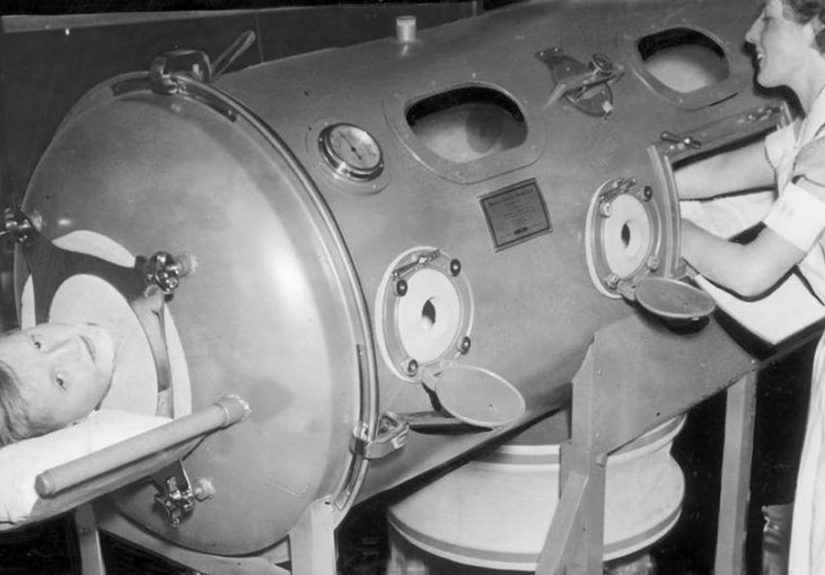
- You lay on a bed that slid into a sealed metal chamber.
- Your head stayed outside, resting on a cushion with a collar/neck seal to keep the chamber airtight.
-
A motor and pump changed the pressure inside the chamber:
- Pressure drops → your chest rises → air flows into your lungs.
- Pressure returns → your chest falls → air flows out.
- The machine repeated that cycle, minute after minute, hour after hour.
Early widely used versions were developed in the U.S. at Harvard by Philip Drinker and Louis Agassiz Shaw, and later
improved and manufactured more broadly (including models associated with John Haven Emerson). In polio wards, rows of
tanks could run in chorusan industrial lullaby you didn’t get to turn off.
Why People Needed It: Polio Didn’t Always “Just” Paralyze Legs
Polio is often remembered for braces, crutches, and weakened limbs. But in severe cases, it attacked the nerves that
control muscles of breathing and swallowing. When the chest muscles or diaphragm were affected, a person could be fully
awake and still be unable to pull in air. That’s where the iron lung entered the story: as emergency breathing support
for respiratory paralysis.
In the United States, 1952 marked the peak of reported polio cases (often cited at 57,628), and fear became seasonal:
summer pools, movie theaters, even friendly neighborhood gatherings could suddenly feel like hazards. Hospitals needed
solutions fast. Organizations like the March of Dimes helped fund and distribute equipmentiron lungs includedbecause
“breathe” is a non-negotiable requirement for living.
Daily Life Inside a Metal Cylinder
The iron lung didn’t just keep you alive. It created a new geography of life: your world was the space your eyes could
see, your hands could reach through portholes (if the model had them), and your caretakers could access without breaking
the seal.
Sleeping: the machine’s rhythm becomes your metronome
Many people describe eventually syncing their sense of time to the machine’s whoosh and thunk.
Sleeping wasn’t always easyimagine trying to get comfortable when your body is mostly inside a rigid chamber and you
can’t shift positions the way you normally would. But fatigue is persuasive, and the steady pulse of pressure changes
could become oddly reassuring: proof the next breath was on schedule.
Eating and swallowing: breathing is only half the job
Eating could be complicated, especially for people with bulbar polio (affecting swallowing). Lying flat makes airway
protection harder, and iron lungs didn’t offer modern airway management. Care teams had to be vigilant about choking
risks and secretion management. For some, meals became carefully paced routines: tiny bites, pauses, repositioning, and
a lot of patience from everyone at the table.
Hygiene and comfort: the unglamorous heroics
People in iron lungs still needed baths, skin care, clean sheets, and relief from pressure points. Caregivers used
techniques that were part nursing skill, part mechanical creativity: sliding sheets, careful repositioning when possible,
sponge baths, and meticulous attention to skin to prevent sores.
Some machines included portholesround windows with sealed sleevesso a nurse could reach in to adjust a limb, tuck a
blanket, or apply hot packs without stopping the machine. If your model didn’t have those conveniences, any extended
care could require opening the chamber, which meant coordinating breathing support and timing the interruption safely.
Communication: your face is free, but your body is not
Your head was outside the chamber, so you could talkwhen you had the breath support and energy to do it. But being
physically separated from your own body can do weird things to the idea of “hanging out.” Visitors might sit by your
head end, hold your hand if it was reachable, or talk at an angle that felt like chatting with someone through the
world’s least convenient piece of furniture.
People got inventive. Mirrors helped you see caregivers working on your body inside the chamber. Books could be propped
up. Radios and later televisions became lifelinescompanions that didn’t require awkward small talk about the elephant
in the room (which, in this case, was literally made of metal).
The Social Side: “Normal” Still HappenedJust Differently
The most surprising part of many iron lung stories is how much ordinary life still tried to squeeze through the cracks.
People studied, worked, wrote, argued, joked, fell in love, got bored, got ambitious, and got stubborn.
School and work: determination with a side of engineering
Some long-term survivors built full lives that included advanced education and careers. One widely reported example is
Paul Alexander of Texas, who lived for decades using an iron lung and became an attorney and author. Accounts describe
him learning techniques like glossopharyngeal (“frog”) breathinga way of gulping air with throat musclesto
spend short periods outside the iron lung, expanding what “independence” could look like.
Another example often cited is Martha Mason of North Carolina, who lived many decades with an iron lung and wrote about
her experiences. Stories like these are not inspirational posters; they’re logistical achievements. They required family
support, medical support, adapted tools, and a relentless willingness to solve problems other people never have to
notice.
Friendships and humor: coping isn’t optional
Humor shows up in many firsthand accounts, sometimes dark, sometimes playful. It’s not that the situation is funnyit’s
that laughter is one of the few things an iron lung can’t restrict. People joked about their “tank,” teased visitors who
didn’t know where to stand, and developed a sharp eye for the absurdity of being in a machine that sounds like a
washing machine trying to learn jazz.
The Hard Parts People Don’t Put on Postcards
Life in an iron lung was not simply “stuck in bed.” It was dependence on electricity, equipment, and a network of humans
who had to be available in the most literal life-or-death way. It was also a constant negotiation between safety and
dignity.
Power outages: the terrifying math of minutes
When the power failed, the machine stopped. Some hospitals and homes had backup systems, manual pumps, or emergency
plans. Still, outages were a real fear. For long-term users, weather could be more than inconvenienceit could be a
threat. Even with a generator, any failure becomes immediate, not theoretical.
Maintenance: when your life depends on spare parts
Iron lungs were built to last, but not forever. As medicine moved to smaller positive-pressure ventilators, these tanks
became rare. That created a strange modern problem: how do you maintain a life-support device that industry stopped
supporting decades ago? For some of the last users, replacement parts and specialized knowledge became as precious as the
machine itself.
Privacy and autonomy: always being “accessed”
Being cared for is not the same as being controlled, but the line can blur when your body is inaccessible without
someone else operating the environment around you. The most sensitive parts of lifehygiene, comfort, even the ability
to scratch an itchcould require help. Many iron lung users developed strong preferences, clear routines, and firm
boundaries to protect their sense of self.
Why Iron Lungs Fadedand What Replaced Them
Iron lungs largely disappeared from routine hospital use as care shifted toward positive-pressure ventilation
(pushing air into the lungs through the airway), which made airway clearance and patient access easier in acute care.
Historical accounts often point to the early 1950s as a turning point, when positive-pressure techniques were used
extensively during outbreaks and then spread.
Negative-pressure ventilation didn’t become “wrong,” but it became less practical for many hospital settings. Yet the
iron lung remains an important chapter in medical history because it turned suffocation into survival for thousands of
peopleand because it shows how technology can rescue life while also remaking it.
What Life Was Like: The Emotional Weather Report
If you’re looking for one mood that defines iron lung life, you won’t find it. People reported fear, boredom, gratitude,
anger, pride, loneliness, humor, and plain old stubbornnessoften in the same day.
There’s also something uniquely human about adapting to the machine’s rhythm. When breathing becomes externalsomething
provided by equipmentyou start noticing the world’s small assumptions: that everyone can roll over, sit up, walk away,
or simply breathe without planning. Iron lung survivors often became expert planners, expert communicators, and expert
advocates, because they had to be.
Practical Details People Always Ask About
Could you move at all?
Movement was limited. Some people could move their head and neck freely; others could move arms a bit if positioned well.
Many had little to no voluntary movement below the neck depending on severity. Portholes could allow caregivers to
reposition limbs, but spontaneous movement like rolling over wasn’t an option.
How did someone go to the bathroom?
With planning and assistance. Hospitals used bedpans and careful timing; long-term home setups were tailored to the
person’s needs and the machine’s design. This is one of those questions that feels awkward until you remember: daily
life doesn’t pause because your lungs need hardware support.
Did people ever get out?
Some did, sometimes for short periods, using alternative ventilation methods or techniques like glossopharyngeal
breathing (when possible). Others relied on the iron lung for sleep but used different devices for part of the day. The
details varied widely based on residual muscle function, medical stability, and available support.
Conclusion: The Iron Lung Was a Lifelineand a Whole Lifestyle
The iron lung was one of the most dramatic life-saving machines ever placed into routine care. It turned respiratory
failure from a near-certain tragedy into a fight people could win. But it also demanded a kind of endurance most of us
can barely imagine: learning to live in a metal cylinder, to accept help without surrendering identity, and to keep
building a life in a space the size of a machine.
If the story feels distant, that’s partly the point: vaccines and public health measures made scenes of iron-lung wards
rare in modern America. But the iron lung still mattersas a reminder of what polio could do, what engineering could
prevent, and what human beings can endure when “normal” is no longer available.
Experiences: A 500-Word Look at Life in an Iron Lung
The first thing you notice is the sound. It isn’t just noiseit’s a schedule. The pump pulls, the chamber pressure
changes, your chest rises. The pump releases, your chest falls. The rhythm becomes your clock, your background music,
your proof that the next minute is coming. People talk about “getting used to it,” but what they mean is something
deeper: your body starts trusting a machine like it’s part of the room’s weather.
Morning doesn’t begin with stretching. It begins with someone checking seals, listening for leaks, making sure the
collar is comfortablecomfortable in the way a neck brace can be “comfortable.” A caregiver greets you face-to-face
because that’s the only part of you fully in the open. If you’re lucky, there’s a routine: a washcloth for your face,
lip balm when the air feels dry, a sip of water timed between breaths so it doesn’t go down the wrong way. If you’re
not lucky, you start the day by negotiatingrequesting, clarifying, insistingbecause dignity often arrives as a series
of small, specific demands.
Visitors hover at the head end at first, unsure where to stand. You learn to guide them: “Pull the chair closer. No,
closer. Don’t worryI’ve heard worse questions than that.” Humor becomes both shield and invitation. People want to know
what it feels like. The honest answer is complicated. It feels safe and claustrophobic. It feels boring and intense.
It feels like being cared for and like being watched. It feels like your life is happening, but the room is always
smaller than you’d like.
The day is made of adaptations. A book on a stand. A mirror angled so you can see what caregivers are doing inside the
chamber. A radio or TV turning silence into company. Conversations paced around breath and energy. Sometimes you’re the
one cheering others up, because you’ve had more practice at holding steady. Sometimes you’re the one who breaks, because
bravery gets tired too.
The hardest moments don’t always look dramatic. Sometimes it’s a tiny itch you can’t reach. Sometimes it’s a sheet
bunched under your shoulder that you can’t fix yourself. Sometimes it’s a storm warning on the news and the realization
that power is not a convenienceit’s oxygen. You learn to plan for emergencies the way other people plan for dinner:
backup power, phone access, someone who will answer at 2 a.m., someone who knows what the machine sounds like when it’s
working right.
And then there are the ordinary victories: finishing a chapter, telling a joke that makes a nurse snort-laugh, watching a
friend’s face relax because you’ve made the situation less scary for them. You may live in a metal chamber, but you are
still building a lifeone breath, one conversation, one stubborn, beautiful day at a time.