Table of Contents >> Show >> Hide
- What Are Small Caps?
- What Counts as a Huge Monthly Gain?
- Why Small Caps Can Explode Higher in One Month
- What Usually Happens After a Huge Monthly Gain?
- The Role of Momentum
- Quality Matters More After the First Pop
- Interest Rates: The Small-Cap Weather System
- What Investors Should Watch After a Huge Small-Cap Rally
- Specific Examples: When Big Gains Changed the Story
- Are Huge Monthly Gains Bullish or Bearish?
- How Long-Term Investors Can Think About Small Caps
- Common Mistakes After a Huge Small-Cap Gain
- Practical Experiences Investors Commonly Notice After Huge Small-Cap Gains
- Conclusion: A Huge Small-Cap Gain Is a Signal, Not a Finish Line
Small-cap stocks are the stock market’s energetic younger siblings. They can sprint ahead, trip over their own shoelaces, get back up, and still somehow steal the spotlight at family dinner. When small caps post a huge monthly gain, investors naturally ask the same question: is this the beginning of a powerful new rally, or did the market just eat too much sugar?
The answer is more interesting than a simple “buy” or “sell.” After a massive monthly move, small caps often enter a period where momentum, valuation, interest rates, earnings expectations, and investor psychology all collide. Sometimes the rally continues. Sometimes it cools off. Sometimes it becomes a messy sideways dance that makes everyone question their spreadsheet.
This article explores what typically happens to small caps after a huge monthly gain, why these rallies happen, what historical patterns suggest, and how investors can think about risk without turning every market move into a dramatic weather report.
What Are Small Caps?
Small-cap stocks are shares of smaller publicly traded companies. In the United States, many investors use the Russell 2000 Index as a common benchmark for small-cap performance because it tracks roughly 2,000 smaller U.S. companies. Other benchmarks, such as the S&P SmallCap 600, also measure smaller companies but apply different quality and profitability screens.
Small caps are not tiny lemonade stands with ticker symbols. Many are real, established businesses in healthcare, industrials, financials, consumer goods, technology, and energy. However, compared with mega-cap giants, they usually have smaller balance sheets, less analyst coverage, less global diversification, and greater sensitivity to the U.S. economy.
That sensitivity is exactly why small caps can move so dramatically. When investors believe the economy is improving, rates may fall, credit conditions may loosen, or earnings growth may broaden beyond the largest companies, small caps can suddenly become market celebrities. One month they are ignored. The next month, everyone is acting like they discovered them in a garage band before they got famous.
What Counts as a Huge Monthly Gain?
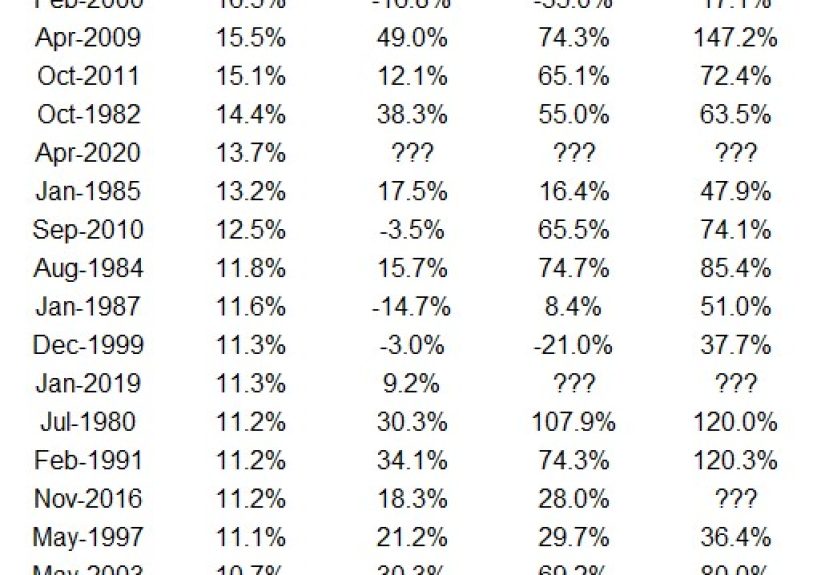
For a broad stock index, a monthly gain of 5% is strong. A monthly gain of 10% is impressive. A monthly gain above 15% is the kind of move that makes market historians put down their coffee.
A famous example came in November 2020, when the Russell 2000 surged 18.3%, its largest monthly percentage gain on record at the time. That rally happened during a powerful shift in market expectations following vaccine news, election clarity, and hopes for economic reopening. Investors moved aggressively into companies that had been beaten down during the pandemic shock.
That example captures a key point: huge small-cap gains usually do not appear out of nowhere. They often follow a major change in the market narrative. Investors suddenly decide that the future looks less scary, and small capsbecause they were priced for troublecan respond like a beach ball released underwater.
Why Small Caps Can Explode Higher in One Month
1. Interest Rate Expectations Shift
Small-cap companies are often more sensitive to borrowing costs than larger companies. Many have higher debt loads, shorter financing histories, or more floating-rate debt. When investors expect the Federal Reserve to cut rates or at least stop raising them, small caps can rally because lower borrowing costs may improve profit margins and cash flow.
This is why small-cap rallies often appear when bond yields fall. Lower rates can act like oxygen for smaller companies. They do not solve every business problem, but they make financial survival and expansion easier.
2. Investors Rotate Out of Mega-Cap Leaders
Sometimes small caps surge because large-cap stocks have already enjoyed a long winning streak. When investors start looking for cheaper or under-owned areas of the market, small caps become attractive. This is called market rotation.
Rotation can be powerful because many institutional investors are underweight small caps after long periods of underperformance. When they begin moving money into the space, prices can rise quickly. The first stage often looks exciting. The second stage is where quality starts to matter.
3. Valuations Become Too Cheap to Ignore
Small caps can go through long stretches where they trade at discounts to large caps. If investors believe earnings will recover, those discounts can look like opportunity. A huge monthly gain may reflect the market suddenly repricing small companies from “probably doomed” to “maybe not so doomed after all.” That may sound unscientific, but market moods often have the subtle emotional range of a teenager choosing a playlist.
4. Economic Expectations Improve
Because many small-cap companies depend heavily on domestic demand, they can benefit when investors expect stronger U.S. growth. Better consumer spending, improving manufacturing activity, stronger bank lending, and healthier small-business confidence can all support small-cap enthusiasm.
5. Short Covering Adds Fuel
When investors bet against small-cap stocks and the market suddenly moves higher, short sellers may rush to buy shares to close their positions. This can create a feedback loop: prices rise, short sellers cover, buying pressure increases, and prices rise again. It is not always sustainable, but it can make the first stage of a rally look spectacular.
What Usually Happens After a Huge Monthly Gain?
After a huge monthly gain, small caps often face three possible paths: continuation, consolidation, or reversal. The market does not send a polite calendar invitation telling investors which path it has chosen.
Scenario One: The Rally Continues
A big monthly gain can sometimes mark the start of a broader advance. This is especially likely when the rally is supported by improving earnings, falling interest rates, stronger economic data, and broad participation across sectors.
In this scenario, the initial surge is not merely a speculative burst. It is the market recognizing that conditions have changed. Investors who were previously cautious begin increasing exposure. Analysts raise earnings expectations. Companies with solid balance sheets start attracting more attention. The rally broadens beyond the weakest or most beaten-down names.
The healthiest small-cap rallies usually include profitable companies, quality businesses, and multiple sectorsnot just a handful of lottery-ticket stocks wearing party hats.
Scenario Two: The Market Catches Its Breath
After a fast move, small caps may simply pause. This is common. A huge monthly gain can pull future returns forward, meaning the market has already priced in some good news. Prices may drift sideways while investors wait for confirmation from earnings reports, inflation data, Fed policy, or economic indicators.
This consolidation phase can frustrate impatient investors. The index may chop around for weeks or months. But consolidation is not automatically bearish. Sometimes it is the market digesting gains before deciding whether the next leg higher is justified.
Scenario Three: The Rally Reverses
Not every huge monthly gain becomes a durable trend. If the rally was driven mainly by short covering, speculative excitement, or a temporary drop in yields, small caps can give back gains quickly.
Reversals are more likely when earnings remain weak, interest rates rise again, credit spreads widen, or economic data deteriorates. Small caps are more vulnerable than large caps during periods of financial stress because many smaller companies have less access to cheap capital and fewer ways to protect margins.
In plain English: a big rally is nice, but cash flow still pays the bills.
The Role of Momentum
Momentum matters in markets. Stocks that rise strongly can continue rising because investor attention, fund flows, and trend-following strategies reinforce the move. Small caps can benefit from this effect after a big monthly gain, especially if the rally breaks a long period of underperformance.
However, momentum in small caps can be jumpier than in large caps. Smaller companies often have lower trading liquidity, wider bid-ask spreads, and more company-specific risk. A strong month can attract new buyers, but those buyers may leave quickly if the macro story changes.
That is why investors should distinguish between price momentum and fundamental momentum. Price momentum means the chart looks strong. Fundamental momentum means earnings, revenue, margins, and balance sheets are improving. When both appear together, the rally has a better foundation. When only price is improving, the market may be running on enthusiasm and espresso.
Quality Matters More After the First Pop
One of the biggest lessons from small-cap history is that the first stage of a rally often lifts almost everything. Beaten-down, unprofitable, highly shorted, and heavily leveraged companies can surge because they were priced for disaster.
But after the initial move, investors usually become more selective. They start asking uncomfortable adult questions, such as: Does the company make money? Can it refinance debt? Are margins improving? Is revenue growth real? Does management have a credible plan?
This is where indexes can behave differently. The Russell 2000 includes a broad universe of small-cap stocks, including many companies that may not be profitable. The S&P SmallCap 600 uses profitability and financial viability requirements, which can make it more quality-oriented. For long-term investors, that distinction can matter.
After a huge monthly gain, quality small caps may continue attracting capital, while the weakest names may fade once the excitement cools. The market’s first reaction may be “small caps!” The second reaction is usually “which small caps?”
Interest Rates: The Small-Cap Weather System
Interest rates are one of the most important forces affecting small-cap stocks. When rates rise, borrowing becomes more expensive, future earnings are discounted more heavily, and investors often prefer larger companies with stronger balance sheets. When rates fall, smaller companies can look more attractive because financing pressure eases.
This does not mean small caps automatically rise every time rates decline. If rates are falling because the economy is sliding toward recession, that can hurt small companies. The best setup is usually a “soft landing” environment: inflation cools, rates ease, and economic growth remains positive.
In that kind of environment, small caps may benefit from both lower financing costs and stronger earnings expectations. If investors believe the economy is strong enough to support smaller businesses but not so hot that the Fed must tighten policy again, small caps can enjoy a sweet spot.
What Investors Should Watch After a Huge Small-Cap Rally
1. Market Breadth
Healthy rallies include many stocks participating. If only a few speculative names are driving the index higher, the move may be fragile. Broad participation across sectors suggests stronger conviction.
2. Earnings Revisions
Watch whether analysts are raising or cutting earnings estimates. A huge monthly gain becomes more convincing when future profit expectations are improving.
3. Credit Conditions
Small-cap companies often rely on access to credit. If lending conditions tighten or credit spreads widen, the rally may struggle. Easier credit can support continued gains.
4. Fed Policy and Bond Yields
Small caps tend to care deeply about interest rates. A rally built on hopes for lower rates can wobble if inflation returns or the Fed signals a tougher stance.
5. Profitability
Investors should separate profitable small caps from companies that depend heavily on future financing. A huge rally can make weak businesses look exciting for a while, but profitability usually reenters the conversation.
Specific Examples: When Big Gains Changed the Story
The November 2020 small-cap rally is one of the clearest examples of a major monthly gain changing investor psychology. After months of pandemic uncertainty, vaccine developments and reopening hopes sparked a strong move into smaller, economically sensitive companies. The Russell 2000 dramatically outpaced large-cap indexes that month.
Another example came during periods when investors anticipated rate cuts or a broadening of market leadership beyond mega-cap technology. In these moments, small caps often rallied because they looked cheap, under-owned, and more tied to domestic economic improvement.
However, not all small-cap surges produced smooth long-term outperformance. Some rallies faded when inflation remained sticky, rates stayed higher, or earnings failed to catch up with prices. This is the central lesson: huge monthly gains are signals, not guarantees.
Are Huge Monthly Gains Bullish or Bearish?
A huge monthly gain is usually more bullish than bearish in the sense that it shows strong demand and a potential shift in leadership. Markets rarely rise sharply because everyone is bored. Big gains often reflect a major change in expectations.
But bullish does not mean risk-free. After a massive move, short-term volatility can rise. Investors who chase after the rally may experience pullbacks, especially if the index has moved too far too fast. The best interpretation is balanced: a huge monthly gain can mark the start of a better cycle, but investors still need to check the quality of the move.
Think of it like hearing applause from the kitchen. Something good may have happened, or someone may have successfully flipped a pancake without checking whether the stove is on fire.
How Long-Term Investors Can Think About Small Caps
For long-term investors, small caps can play a useful role in a diversified portfolio. They may offer higher growth potential, exposure to domestic economic cycles, and diversification away from mega-cap concentration. Academic research has long studied the size premium, which refers to the historical tendency of smaller companies to deliver higher average returns over certain long periods.
Still, the size premium is not a vending machine where you insert patience and receive guaranteed outperformance. Small caps can lag large caps for years. They can suffer deeply during recessions. They can also rebound with surprising force when conditions improve.
The key is to avoid treating a huge monthly gain as a standalone investment thesis. Instead, investors should ask whether the rally is supported by valuations, earnings, financial conditions, and improving business fundamentals.
Common Mistakes After a Huge Small-Cap Gain
Chasing Without a Plan
Buying only because the index had a great month can lead to disappointment. A plan should include allocation size, risk tolerance, time horizon, and rebalancing rules.
Ignoring Quality
Not all small caps are equal. Companies with strong cash flow, manageable debt, and durable business models deserve different treatment from companies surviving mainly on market optimism.
Expecting a Straight Line
Small-cap rallies are rarely smooth. Pullbacks after big gains are normal. Volatility is not a bug in small caps; it is part of the operating system.
Forgetting the Macro Backdrop
Small caps are tied closely to rates, credit, and economic growth. A rally can fade if the macro environment turns against them.
Practical Experiences Investors Commonly Notice After Huge Small-Cap Gains
After a huge monthly gain in small caps, the first experience many investors notice is emotional whiplash. Before the rally, small caps may have felt forgotten, frustrating, and almost permanently out of fashion. Then, almost overnight, they become the market’s exciting comeback story. This sudden shift can make investors feel they are late, even if the rally is only beginning. The pressure to act quickly can be intense, especially when headlines start celebrating a “rotation” or “breakout.”
A second common experience is confusion between index performance and individual stock performance. The Russell 2000 or another small-cap index may rise sharply, but not every small-cap holding behaves the same way. Some stocks may soar 30% or 40%, while others barely move. Investors quickly learn that small-cap exposure is not one single flavor. It is more like a buffet where some dishes are excellent, some are risky, and one mysterious casserole should probably be avoided.
Another real-world experience is the temptation to sell too early. A huge monthly gain can make investors nervous because profits appear quickly. Selling after a sharp move may feel responsible, especially after a long weak period. Sometimes that caution is wise. But in stronger cycles, small caps can continue rising for months as earnings expectations improve and fund flows return. The challenge is that nobody receives a text message from the market saying, “Relax, this one has legs.”
On the other side, investors may chase too aggressively. They see the gain, assume a new bull market has started, and buy the most volatile names without checking fundamentals. This can work briefly during speculative bursts, but it often becomes painful when the rally becomes more selective. The companies that jumped first are not always the companies that lead later.
Investors also experience how quickly narratives change. One week, small caps are described as cheap, unloved, and ready to outperform. A few weeks later, a higher inflation report or stronger bond yield can bring back concerns about debt costs and earnings pressure. Small-cap investing requires comfort with this constant narrative tug-of-war.
A practical lesson is to scale decisions instead of making dramatic all-or-nothing moves. Some investors use rebalancing rules, adding when small caps are underweight and trimming when they become overweight. Others prefer quality-focused funds or diversified ETFs rather than trying to pick individual winners. The goal is not to predict every twist. The goal is to participate intelligently without letting excitement drive the car while risk management sits in the trunk.
The most valuable experience may be patience. A huge monthly gain can be important, but it is only one chapter. The next chapters are written by earnings, interest rates, credit conditions, and investor confidence. Small caps can reward patience, but they also punish carelessness. The best investors treat a big rally as a reason to study harder, not as permission to stop thinking.
Conclusion: A Huge Small-Cap Gain Is a Signal, Not a Finish Line
So, what happens to small caps after a huge monthly gain? Often, the market enters a more important testing phase. The first move shows that investors are interested. The next phase reveals whether the interest is supported by real fundamentals.
Small caps can continue outperforming after a major monthly surge when rates are favorable, economic growth is steady, earnings improve, valuations remain reasonable, and market breadth expands. But if the rally is driven mostly by speculation, short covering, or temporary excitement, gains can fade quickly.
For investors, the smartest response is neither panic nor blind enthusiasm. A huge monthly gain deserves attention, but it also deserves analysis. Small caps may be small by market value, but after a big rally, they can create very large questions.
Note: This article is for educational and editorial purposes only. It does not provide personalized investment advice. Investors should consider their goals, risk tolerance, and time horizon before making financial decisions.