Table of Contents >> Show >> Hide
For decades, nuclear fusion has been the energy world’s favorite overachiever-in-training: brilliant on paper, dazzling in the lab, and always “coming soon” in a way that made people roll their eyes and refill their coffee. But the conversation in the United States has changed. This is no longer just a science-fair dream with a PhD. It is becoming an industrial plan.
Across the country, the U.S. is moving from fusion research to fusion development. Federal agencies are funding roadmaps and milestone programs. Private companies are picking sites, signing power deals, and talking less like physicists and more like utility developers. Virginia is central to one of the most ambitious commercial plans in the field. Washington state is home to another highly watched project. Tennessee is positioning itself as a fusion-friendly launchpad. Put it all together, and the headline “US Plans Nuclear Fusion Plant” suddenly sounds less like science fiction and more like a serious energy strategy.
That does not mean America will flip a switch tomorrow and power whole cities with mini suns. Fusion still faces brutal engineering, regulatory, and economic hurdles. Yet the direction is unmistakable: the U.S. wants to be first in turning fusion from a scientific achievement into a working power business.
Why This Story Matters Now
The timing is not random. The U.S. power system is under pressure from several directions at once. Electricity demand is rising again after years of relative stagnation. Data centers need enormous amounts of reliable power. Heavy industry wants cleaner energy without sacrificing uptime. Utilities need options that can support a low-carbon grid without depending entirely on weather. In that environment, fusion looks almost suspiciously perfect.
In theory, fusion can provide around-the-clock carbon-free electricity using fuel sources derived from common materials, without the same long-lived spent-fuel profile associated with traditional fission plants. It does not rely on burning coal or gas. It does not ask the wind to cooperate or the sun to punch in on schedule. If it works at scale, fusion could become the kind of steady, clean power source that energy planners dream about and spreadsheet models hug at night.
That promise explains why the U.S. government has framed fusion commercialization as a serious national priority. It also explains why private investors, technology companies, utilities, and local governments are no longer treating fusion like a distant moonshot. They are treating it like a race.
What the U.S. Is Actually Planning
Federal strategy is shifting from pure science to commercialization
The federal role is not simply to cheer from the sidelines in a patriotic windbreaker. Washington has been building a structure for commercialization. The Department of Energy has laid out a fusion strategy focused on closing major science and technology gaps, preparing the path for commercial deployment, and expanding partnerships between government, universities, national labs, and private companies.
That matters because fusion is too large, too technical, and too expensive to move from laboratory breakthrough to commercial reality by good vibes alone. The U.S. now has milestone-based programs, collaborative research engines, and public-private initiatives meant to help companies solve the hard problems that stand between plasma demos and real power plants. The message from policymakers is fairly clear: America does not want to be the country that invents the future and then watches someone else manufacture it.
Still, federal planning is not the same thing as a federal plant. The U.S. government is not building one single national fusion station in the way it might build a dam or a highway project. Instead, it is helping create the conditions for multiple commercial pathways to compete, mature, and eventually connect to the grid.
Virginia is one of the biggest fusion stories in America
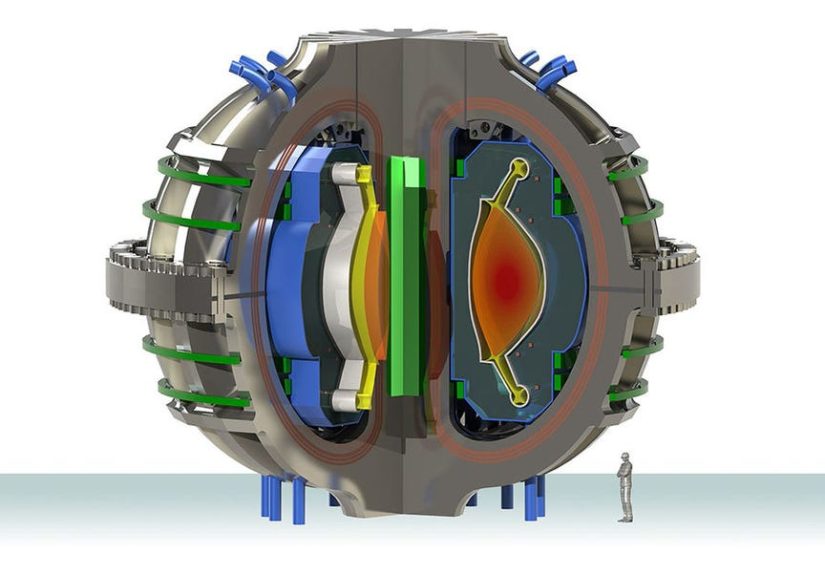
One of the most closely watched projects is Commonwealth Fusion Systems’ planned ARC power plant in Chesterfield County, Virginia. The company says the plant is designed to become the world’s first grid-scale commercial fusion power plant. That is a bold claim, but it is not casual marketing fluff scribbled on a napkin. It comes with a proposed site, utility collaboration, a commercial vision, and a timeline aimed at the early 2030s.
The Virginia plan has become especially important because it turns fusion from a science headline into a regional economic development story. ARC is expected to deliver roughly 400 megawatts of electricity, which is enough to get utilities, manufacturers, and local officials paying very close attention. It also helps that Virginia is already dealing with fast-growing electricity demand, especially from data center expansion. In other words, the state does not just want futuristic power. It has a practical reason to want more of it.
The commercial confidence around ARC grew even louder when Google agreed to buy 200 megawatts from the project. That does not prove fusion power is already in the bag. What it proves is that large corporate buyers are willing to place serious bets on a fusion-powered future. That is a psychological shift as much as a business one. Once major power customers start signing up, fusion stops looking like a laboratory curiosity and starts looking like a market.
Washington state is pushing a different but equally ambitious path
Helion Energy has taken another headline-grabbing route. The company has long argued that fusion can reach commercial relevance faster than many skeptics assume. Its plan centers on delivering electricity from a fusion plant in Washington state, with Microsoft agreeing to purchase power under a landmark arrangement. Helion has targeted production by 2028, a timeline that has made both believers and critics sit up very straight.
Why does this matter? Because Helion is not just talking about a reactor in theory. It has tied its ambitions to an actual customer, a real location, and a commercial deadline. That makes the company’s project one of the clearest examples of the broader U.S. shift from “Can we do fusion?” to “Can we build, permit, finance, and operate fusion as infrastructure?”
The Washington project also highlights a broader American pattern: fusion development is clustering where technical talent, transmission access, industrial know-how, and policy flexibility overlap. In plain English, these companies are not choosing sites with a dartboard. They are choosing places where advanced energy can actually become a business.
Tennessee wants a seat at the fusion table too
Tennessee has entered the conversation through collaboration between the Tennessee Valley Authority and Type One Energy. Their work has focused on a potential 350-megawatt fusion pilot plant and on creating a licensing pathway that could make the state a real fusion hub. That is a big deal because the fusion race is not only about physics. It is also about permitting, regulation, workforce development, and supply chains.
In other words, the first successful fusion states may not be the ones with the flashiest press release. They may be the ones that figure out how to move from concept art to concrete, steel, public meetings, environmental review, and long-term grid integration without turning every step into a bureaucratic obstacle course.
Why Fusion Still Feels Like the Holy Grail
Fusion remains so attractive because it promises a rare combination: high-output, low-carbon, dispatchable power. Unlike fossil fuels, it does not depend on combustion. Unlike intermittent renewables, it is not supposed to vanish when weather conditions shift. Unlike conventional nuclear fission, it relies on a different physical process and is being regulated in the U.S. under a separate framework more tailored to fusion’s risk profile.
There is also a national competitiveness angle. Whoever cracks commercial fusion first could shape the next era of energy technology, manufacturing, high-performance materials, grid design, and industrial exports. This is not just about keeping the lights on. It is about who gets to build the lighting company of the future.
And then there is the scientific prestige. Lawrence Livermore National Laboratory’s ignition milestones gave the U.S. something priceless: proof that fusion progress is real, not imaginary. No, the National Ignition Facility is not a commercial power plant. No, scientific gain in an experiment does not equal an economically viable reactor. But those achievements helped change the mood. Fusion stopped feeling like a forever-theory and started feeling like a problem engineers might actually bully into submission.
The Hard Reality: A Power Plant Is Not a Physics Headline
Here is the part where the article gently removes the party hat and puts on safety glasses. Planning a fusion plant is one thing. Building a profitable, reliable, grid-connected fusion plant is another.
Technical hurdles are still enormous
Fusion systems must control ultra-hot plasma, handle punishing neutron damage, manage heat exhaust, maintain structural integrity, and operate repeatedly and reliably. Then comes fuel cycle management, including the challenge of tritium breeding for many fusion concepts. That is a lot of engineering pain packed into one sentence.
Commercial electricity also requires far more than a successful pulse or lab result. A plant must generate net electricity at useful scale, operate with reasonable uptime, survive maintenance cycles, meet safety requirements, and do all of that at a price the market can tolerate. The difference between “scientifically impressive” and “commercially bankable” is roughly the size of a canyon.
Economics may become the final boss
Even if fusion works technically, the first plants will not be cheap. Early facilities will likely be expensive, complex, and watched by the entire energy industry with the intensity of a reality-show finale. Developers must prove not only that their machines can produce power, but that those machines can be built on schedule, maintained predictably, and financed without causing lenders to faint dramatically onto conference tables.
This is why corporate power purchase agreements matter so much. They are not just symbolic. They help show there may be real demand for fusion electricity, especially from sectors that need dependable clean power and are willing to pay for first-of-a-kind supply.
Regulation could help or hurt the timeline
The U.S. regulatory picture has become more favorable for fusion than many people expected. The decision to regulate fusion differently from fission removes one major uncertainty. But “more favorable” does not mean “friction-free.” States, federal agencies, utilities, and developers still need to align on licensing, radiological oversight, environmental review, construction rules, and grid interconnection.
If America wants a fusion plant to move from blueprint to electrons, it needs regulatory certainty that is both rigorous and practical. Too weak, and public confidence suffers. Too slow, and the technology misses its market window. Fusion developers need a rulebook, not a maze.
What a U.S. Fusion Plant Could Change
If even one of these American projects reaches commercial operation, the consequences could be enormous. It would reshape energy investment logic. It would pressure competitors to accelerate. It would likely trigger a wave of new manufacturing needs for magnets, power systems, materials, and specialized components. Universities would expand training. Utilities would revisit long-term resource plans. States would compete for follow-on projects. And every clean-energy panel discussion would become at least 40% more dramatic.
A first U.S. fusion plant would also change the tone of climate conversations. Today, fusion is usually discussed as future potential. A working plant would move it into the category of deployable infrastructure. That would not make solar, wind, batteries, geothermal, or fission less important. It would make the clean-energy portfolio broader and more resilient.
Just as importantly, it would send a message about American industrial ambition. The U.S. still wants to build difficult things. It still wants to convert frontier science into machines, jobs, and exported know-how. In an era when many national debates feel stuck between delay and dysfunction, fusion offers a surprisingly old-fashioned idea: solve the problem, build the thing, and get it on the grid.
Experiences Around a Fusion Plant Plan: What It Really Feels Like on the Ground
Talk about fusion long enough and the conversation can float into abstract territory: plasma confinement, neutron flux, superconducting magnets, and enough acronyms to make your keyboard feel underqualified. But a planned fusion plant is also a human experience. It touches communities, workers, regulators, utilities, local business owners, and ordinary residents who may not know a tokamak from a toaster but do know when a major project is about to change their town.
For local communities, the first experience of a fusion plant plan usually does not arrive as a beam of scientific glory. It arrives as a meeting announcement, a permit discussion, a utility briefing, or a headline saying their county may host a first-of-its-kind energy project. That moment can create a weird mix of excitement and suspicion. People hear “nuclear” and immediately start asking questions. Is it safe? Will it create jobs? Is this real, or is somebody selling us a futuristic fairy tale with better graphics?
That public reaction is not a side story. It is part of the project itself. A fusion plant needs more than brilliant engineers. It needs trust. Residents want plain English, not technical poetry. They want to know what gets built, what gets transported, who oversees safety, and whether the company will still answer emails after the ribbon cutting. Communities that feel respected often become partners in innovation. Communities that feel talked down to become obstacles, and fast.
For workers, the experience is different. A fusion plant plan looks like opportunity. It means construction jobs, electrical work, welding, controls integration, cryogenics, materials testing, safety operations, maintenance planning, and a whole ecosystem of support roles. It also means retraining. Some of the most interesting fusion sites are connected to places with existing industrial or energy infrastructure, which creates the possibility of translating old energy experience into new energy employment. For a skilled tradesperson or power-sector employee, fusion is not just a concept. It can look like the next career chapter.
For utility planners, the experience is equal parts hope and headache. On one hand, fusion offers the dream package: firm clean power that could support growing demand and strengthen grid reliability. On the other hand, utilities have to plan with dates, costs, and risk assumptions, not inspirational posters. A proposed fusion plant forces them to ask practical questions. Can this resource be counted on in a future load forecast? How should it be priced? What backup would still be needed? Where would transmission upgrades happen? This is where fusion stops being a science story and starts becoming a spreadsheet war.
For technology companies and large electricity buyers, the experience feels strategic. They are staring down huge energy needs from AI infrastructure, cloud computing, and advanced manufacturing. They do not want a vague promise of clean power someday. They want a path to abundant electricity that fits long-term climate goals. That is why agreements involving companies like Microsoft and Google matter so much. These buyers are not simply buying electrons. They are buying optionality in a future where power availability may decide who grows fastest.
And for the broader public, the experience may be surprisingly emotional. A fusion plant plan taps into something bigger than utility procurement. It feels like proof that modern society can still attempt hard, audacious things. It suggests that the future is not limited to rationing, delay, and managing decline. Even people who do not follow energy policy closely can sense that fusion represents a larger question: can America still turn frontier science into real-world abundance?
That may be the most powerful experience of all. A fusion plant plan is not only about what happens inside a reactor vessel. It is about what happens inside a country’s imagination when impossible starts looking expensive, complicated, and difficult instead of impossible. Strangely enough, that is progress.
Final Thoughts
The phrase “US Plans Nuclear Fusion Plant” is both accurate and incomplete. Accurate, because the United States is clearly moving toward commercial fusion through government strategy, private investment, utility partnerships, site selection, and early licensing steps. Incomplete, because this is not one neat national project with a single groundbreaking date and a tidy ribbon ceremony waiting on standby. It is a network of experiments, companies, states, regulators, labs, and customers all trying to drag fusion into the real economy.
Virginia, Washington, and Tennessee now sit near the center of that effort. Federal agencies are creating policy and funding support. National labs are pushing the science. Private developers are making commercial claims that, for the first time, have enough substance to demand serious attention. The U.S. has not finished the fusion journey. But it has definitely stopped treating it like a distant thought experiment.
So yes, America is planning for fusion plants. The bigger question is whether one of those plans can become the moment when fusion finally graduates from scientific miracle to industrial reality. If that happens, the country will not just have built a power plant. It will have built a new chapter in energy history.