Table of Contents >> Show >> Hide
- How hybrid animals happen (the quick-and-fun biology)
- 1) Liger (Male lion × Female tiger)
- 2) Tigon (Male tiger × Female lion)
- 3) Mule (Male donkey × Female horse)
- 4) Hinny (Male horse × Female donkey)
- 5) Beefalo (Domestic cattle × American bison)
- 6) Coywolf (Coyote × Wolf, often with some dog ancestry)
- 7) Pizzly / Grolar bear (Polar bear × Grizzly bear)
- 8) Zorse (Zebra × Horse)
- 9) Wholphin (False killer whale × Bottlenose dolphin)
- 10) Savannah cat (Serval × Domestic cat)
- What hybrids teach us (and what they don’t)
- Experiences: what it’s like to encounter hybrid animals (without making it weird)
- Conclusion
Nature has a habit of ignoring our neat little labels. We draw linesspecies, subspecies, “definitely not dating material”
and then an animal strolls in that looks like it was designed by a committee of two different creatures who couldn’t agree on the vibe.
Those are hybrid animals: offspring produced when two different species (or closely related species/subspecies) mate and have young.
Some hybrids happen naturally when ranges overlap and biology gives a reluctant thumbs-up. Others happen because humans put animals together
in captivity or livestock programs. And plenty are a one-time “wow” because genetics is picky: mismatched chromosomes can make hybrids infertile,
and unusual body plans can come with health challenges.
In this guide, we’ll meet ten of the most famous (and real) animal hybridswhat they’re made of, why they exist, whether they can reproduce,
and what they teach us about evolution. Spoiler: hybrids are part science lesson, part nature documentary, and part “who let the zebra near the horse?”
How hybrid animals happen (the quick-and-fun biology)
1) Overlapping neighborhoods
When closely related species live near each otherespecially in changing habitatshybridization can occur. This is common in some groups
(like canids and bears) and rare in others.
2) Captivity and human-managed breeding
Some famous hybrids (like ligers) are mostly a captivity story. Humans control which animals meet, which can create combinations that would be
extremely unlikely in the wild.
3) Chromosome math matters
Hybrids often struggle to make sperm or eggs because their chromosomes don’t pair neatly. This is why many hybridslike mulesare usually sterile.
(Genetics is basically a group project, and chromosomes are the classmates who refuse to share notes.)
4) Parent-of-origin effects (aka: “Why is the liger so big?”)
Some hybrids differ dramatically depending on which species is the mother vs. the father. Genomic imprintingwhere certain growth-related genes
behave differently depending on the parenthelps explain why some hybrids are larger or smaller than you’d expect.
1) Liger (Male lion × Female tiger)
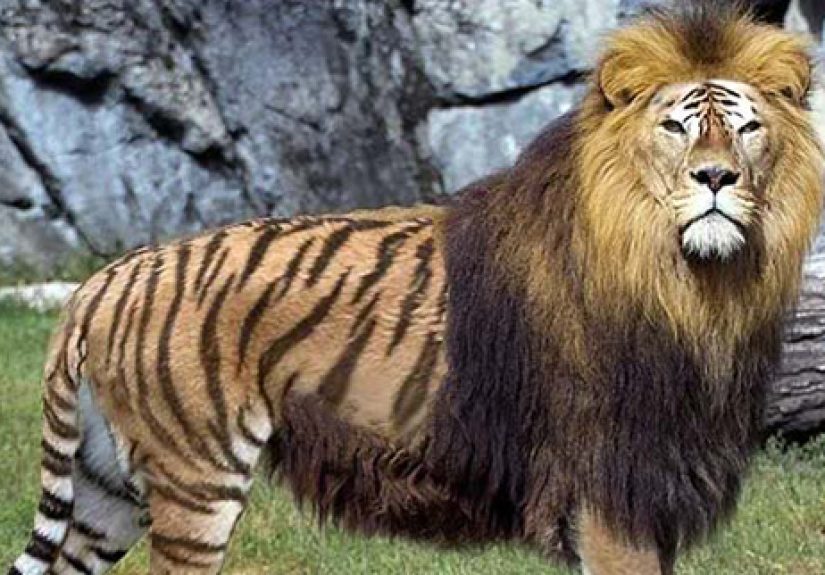
The liger is the celebrity of hybrid animals: part lion, part tiger, and 100% guaranteed to make you say, “That can’t be real.”
Ligers often grow larger than either parent, with a mix of lion-like social traits and tiger-like markings.
What makes it incredible
The liger’s unusual size is often explained by growth-related imprinting effectsbasically, the genetic “volume knobs” for growth aren’t set the same
in lions and tigers, and the hybrid can inherit a combination that favors bigger body size.
Fertility & ethics
Many male ligers are sterile, while some females may be able to reproduce in captivity. Conservation organizations and zoo science teams generally
don’t support creating big-cat hybrids because it doesn’t help protect wild lions or tigers and can introduce welfare concerns.
2) Tigon (Male tiger × Female lion)
Meet the liger’s lesser-known cousin: the tigon. Because the parent roles are reversed, tigons often end up closer in size to their parentsless “mega-cat,”
more “still absolutely not something you want to meet in a dark alley.”
What makes it incredible
Tigons are a great example of how parent-of-origin effects can shape hybrid traits. Flip the mother and father, and you can flip the biological outcome.
Fertility & reality check
Like ligers, tigons are largely a captivity phenomenon. Even when hybrids can exist biologically, ecology and geography usually keep parent species apart in the wild.
3) Mule (Male donkey × Female horse)
The mule is the practical MVP of hybrids. Unlike the “look-at-me” hybrids, mules earned their fame the old-fashioned way: being strong, sure-footed,
and hard-working across centuries of agriculture and transport.
What makes it incredible
Mules often combine a horse’s size and athletic ability with a donkey’s endurance and caution. In real life, that caution can look like “stubbornness,”
but it’s usually a mule deciding it would rather not step into a situation that screams, “Bad idea.”
Fertility (the chromosome twist)
Horses typically have 64 chromosomes; donkeys have 62. A mule usually ends up with 63an odd number that makes chromosome pairing during reproduction
difficult. That’s why mules are typically sterile, though rare exceptions (especially in females) have been documented.
4) Hinny (Male horse × Female donkey)
If a mule is donkey dad + horse mom, a hinny is the reverse: horse dad + donkey mom. Hinnies are generally rarer and can be smaller than mules,
partly because the mother’s body sets the early growth environment.
What makes it incredible
Mule vs. hinny is a perfect reminder that “same ingredients” doesn’t always mean “same recipe.” Parent roles matterdevelopment is more than DNA alone.
Fertility
Like mules, hinnies are usually sterile because the chromosome mismatch problem doesn’t care which parent brought which chromosomes to the party.
5) Beefalo (Domestic cattle × American bison)
Beefalo were developed in livestock programs aiming to combine traits like hardiness and meat production. Unlike many hybrids, beefalo are bred in ways
intended to be stable over generations (at least in theory).
What makes it incredible
“Beefalo” is often described as a specific ancestry blend (commonly cited as 3/8 bison and 5/8 cattle) in breed-program language. It’s a case where hybridization
isn’t just an accidentit’s a managed breeding strategy.
A fascinating modern twist
Recent genetic research has suggested that many animals labeled “beefalo” may contain little to no detectable bison ancestry, highlighting how messy real-world
breeding histories can beand why genetics testing sometimes rewrites the story we thought we knew.
6) Coywolf (Coyote × Wolf, often with some dog ancestry)
The coywolf is less “invented in captivity” and more “nature adapting in real time.” In parts of eastern North America, coyotes interbred with wolves
(and sometimes dogs), producing hybrid populations often called coywolves or eastern coyotes.
What makes it incredible
Coywolves can show a blend of traits: larger bodies than many western coyotes, big jaws, and behaviors that can shift between coyote-like adaptability
and wolf-like social strategies. They’re often discussed as an example of hybridization helping animals thrive in human-altered landscapes.
Science note
Genetic studies have documented coyote-wolf-dog admixture patterns in eastern populations, including evidence that hybridization can be sex-biased
(often involving larger males mating with smaller females).
7) Pizzly / Grolar bear (Polar bear × Grizzly bear)
When polar bears and grizzlies overlap, biology sometimes takes the opportunity to remix two iconic bears into one rare hybrid. Names vary:
“grolar” and “pizzly” are both used, often depending on which species is the father.
What makes it incredible
These hybrids have been confirmed in the wild through DNA testing. They can show mixed traitslike longer grizzly-style claws and a polar bear-ish body shape
plus coat colors that land somewhere between “Arctic cream” and “campfire brown.”
How rare is it?
Despite the attention they get online, wild polar-grizzly hybrids appear to be extremely rare. Large genetic studies have supported the idea that only a small,
closely related set of confirmed hybrids exists so far.
8) Zorse (Zebra × Horse)
The zorse is a “zebroid” (zebra hybrid) that looks like someone tried to paint racing stripes onto a horse… and then the paint decided to become a permanent
lifestyle choice. The result is a horse-like body with zebra striping, usually most visible on the legs and shoulders.
What makes it incredible
Zebra hybrids often inherit zebra striping patterns in striking, unpredictable waysno two look exactly alike. Some people breed zebroids hoping for toughness
or disease resistance, but zebra temperament can also make these animals challenging to handle.
Fertility
Many zebroids are typically sterile due to chromosome mismatches between zebras and horses, though exact outcomes can vary by the zebra species involved.
9) Wholphin (False killer whale × Bottlenose dolphin)
The wholphin is real, rare, and sounds like a creature from a children’s book you’d assume is fictionuntil you learn it happened in captivity.
It’s a hybrid between a false killer whale (which is actually a type of oceanic dolphin) and a bottlenose dolphin.
What makes it incredible
Wholphins can show intermediate traits in size, coloration, and dental counts. One of the best-known individuals, born at a marine park in Hawaii,
drew scientific interest because it demonstrated that even cross-genus cetacean hybrids can surviveand in at least one case, reproduce in captivity.
Reality check
Documented wholphins are exceedingly uncommon. Cetacean hybrids do occur, but they’re far from routine, and the welfare and ethics of captive breeding
always matter in the conversation.
10) Savannah cat (Serval × Domestic cat)
The Savannah cat is a domestic breed developed from crossing a serval (a wild African cat) with a domestic cat. The goal was a cat with a serval-like look
tall, leggy, spottedpaired with more manageable domestic-cat behavior.
What makes it incredible
Savannah cats can vary wildly depending on how close they are to the serval side (often described in generations like F1, F2, etc.). Earlier generations may be
larger, more energetic, and more demandinglike living with a tiny athlete who thinks your curtains are a training obstacle.
Important note for real life
Hybrid pet cats come with serious responsibility: legal restrictions can vary by location, and welfare needs may be higher than typical domestic cats.
“Exotic-looking” should never be the only reason someone considers a hybrid animal.
What hybrids teach us (and what they don’t)
Hybrids are a living reminder that evolution isn’t a straight line. Gene flow between species can happensometimes rarely, sometimes surprisingly often
and it can influence how populations adapt. At the same time, the existence of a hybrid doesn’t automatically mean it’s a good idea to create more.
Conservation groups generally prioritize protecting wild species and their habitats over producing novelty hybrids.
The best takeaway is simple: hybrid animals are fascinating, but the responsible response is curiosity plus carelearning the science without turning living creatures
into experiments for entertainment.
Experiences: what it’s like to encounter hybrid animals (without making it weird)
If you’ve ever met a hybrid animal in real life, you know the feeling: your brain does a quick double-take, like it’s trying to load two different animal files at once.
The most common “in-the-wild” hybrid experience for many people isn’t a liger or a wholphinit’s a mule. You might see one on a farm, on a trail ride,
or working in places where sure-footed strength matters. What stands out isn’t just the look; it’s the attitude. A mule often moves like it’s evaluating
your plan for safety, practicality, and general life choices. If a mule stops, it can feel frustratinguntil you realize it’s basically doing risk management
better than most adults.
In more controlled settingslike accredited zoos, conservation centers, or educational programsyour experience may be less about “wow, a mashup”
and more about genetics and ethics. Signs and keeper talks often explain that many famous hybrids are not part of conservation breeding. That can be a surprise
the first time you hear it, especially if you grew up with internet photos that treat hybrids like collectibles. Hearing professionals frame the topic
shifts the whole experience: you stop thinking “cool combo” and start thinking “what does this animal need to thrive?”
Then there are the “I cannot believe my eyes” moments. A zebroid like a zorse can trigger that instantly: the striping looks painted on, but the pattern wraps around
muscles and joints in a way that only biology can pull off. If you stand still and watch, you may notice something elsehybrids often don’t behave like a perfect
half-and-half split. They’re their own individuals. A zorse might carry zebra alertness and a quick-startle response, which can make the animal feel more intense
than a typical horse. That can be fascinating to observe from a respectful distance and a reminder that “exotic” can also mean “harder to care for.”
The most powerful hybrid experiences are often the ones that connect to bigger stories. Coywolves, for example, aren’t usually something you “go see” on purpose.
Instead, you may hear about them through local wildlife updates, neighborhood sightings, or science articles about how animals adapt to human-altered landscapes.
That kind of hybrid experience feels less like a novelty and more like a live documentary playing in your regionan ongoing lesson in ecology, migration,
and what happens when habitats change.
And even if you never see a wholphin or a pizzly bear in person, reading about them can be an experience in itselfbecause it forces you to hold two truths at once:
life is wildly creative, and life is also fragile. Hybrids can be scientific windows into evolution, but they can also be a reminder that not every “possible” animal
is automatically a good idea to produce. If you walk away with a mix of wonder and responsibility, congratulationsyou had the best kind of hybrid experience:
the kind that changes how you see nature, not how you try to redesign it.
Conclusion
Hybrid animals sit at the intersection of genetics, ecology, and human curiosity. From hardworking mules and adaptable coywolves to headline-grabbing ligers
and ultra-rare wholphins, each hybrid tells a story about what happens when species boundaries get a little blurry. Some hybrids are nature’s response to shifting
habitats. Others are human-made experiments that raise tough questions about welfare and conservation priorities.
The most incredible part might be this: hybrids aren’t just “animal mashups.” They’re living evidence that evolution is dynamicand that our responsibility grows
right alongside our ability to influence it.