Table of Contents >> Show >> Hide
- Why Everyone Suddenly Cares About Your Outlets
- What Is a Tamper-Resistant Receptacle, Really?
- Why Codes Now Require Tamper-Resistant Outlets
- Where Tamper-Resistant Outlets Are Required
- TR vs GFCI vs AFCI vs Weather-Resistant: How They All Fit Together
- What Makes a TR Receptacle “Legit” Under the Standards?
- How to Tell If Your Home Meets Tamper-Resistant Outlet Codes
- Upgrading to Tamper-Resistant Receptacles: Practical Tips
- Why TR Receptacles Are Worth It (Even If You Don’t Have Kids)
- Real-World Experiences with Tamper-Resistant Outlet Codes
- Bottom Line: Tamper-Resistant Receptacles Are Quiet Bodyguards
Why Everyone Suddenly Cares About Your Outlets
If you grew up in a house where the “childproofing plan” was your parents yelling,
“Don’t touch that outlet!”, today’s electrical codes might feel a little over the top.
But there’s a very real reason tamper-resistant (TR) receptacles are now required in
most homes and many public spaces across the United States.
According to analyses of U.S. Consumer Product Safety Commission (CPSC) data, more than
24,000 children under age 10 were treated in emergency rooms over a 10-year period for
electrical receptacle-related injuries that’s roughly seven kids every day.
More recent estimates still put the number at about 2,400 injuries per year.
The majority involve toddlers, small metal objects, and outlets right at eye level.
The electrical industry, safety organizations, and code-making bodies responded with a
simple idea: make the outlet itself smarter and safer. Enter the tamper-resistant
receptacle a device that looks almost identical to a standard outlet but hides safety
shutters inside. Those shutters only open when a proper plug is inserted into both slots
at once.
In this guide, we’ll break down what tamper-resistant receptacles are, how the National
Electrical Code (NEC) requires them, where you must install them, and how they interact
with other outlet types like GFCI and AFCI. We’ll also share real-world experiences and
practical tips so you can stay safe, informed, and code-compliant without needing a
law degree in “Outlet-ology.”
What Is a Tamper-Resistant Receptacle, Really?
A tamper-resistant (TR) receptacle is a standard 15- or 20-amp, 125- or 250-volt
electrical outlet with one important upgrade: it has internal spring-loaded shutters
that block the openings. Those shutters only move when equal pressure is applied to both
slots simultaneously, which happens when you insert a proper plug.
If a curious kid tries to jam a hairpin, paper clip, or toy sword into one slot, the
shutter stays firmly closed. Given that bobby pins, fingers, and keys are among the most
common objects involved in receptacle injuries, this design reduces risk dramatically.
How TR Outlets Behave Day-to-Day
-
Electrically: They work just like “normal” outlets. No special wiring,
no different voltage, and no “smart” tech needed. -
Physically: You may feel a slight resistance when you plug something in.
That’s just the shutters moving out of the way not the outlet “going bad.” -
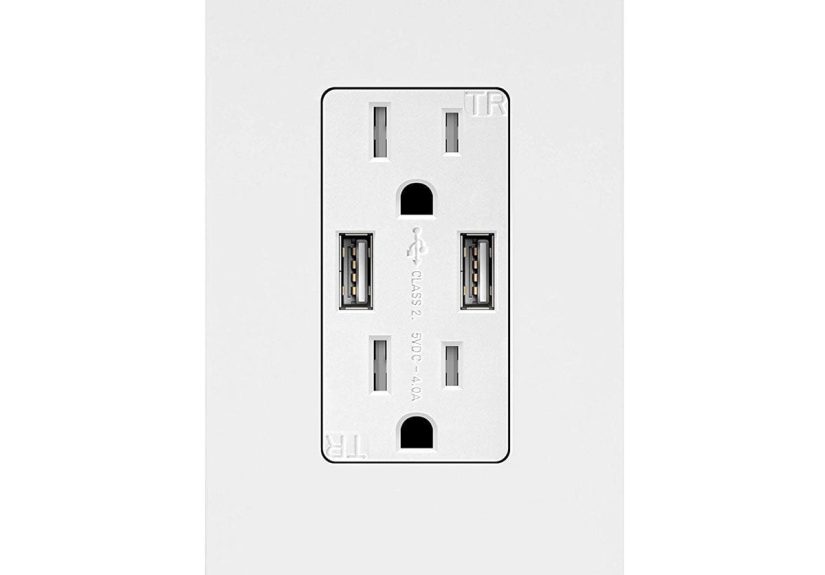
Labeling: Most TR outlets are marked with a small
TRon the face. If you see that, you’re dealing with a tamper-resistant
receptacle.
By the way, “tamper resistant” is the correct spelling but we’ll stick with your
“Tamper Resistent” phrase in the title so search engines (and humans who misspell it)
can still find the information they need.
Why Codes Now Require Tamper-Resistant Outlets
The National Electrical Code® (NEC), published by the National Fire Protection
Association (NFPA), is the model code that most U.S. jurisdictions adopt and adapt as
their electrical rulebook.
Starting with the 2008 NEC edition, tamper-resistant receptacles became a major child
safety requirement.
A Quick Timeline of TR Requirements
-
2008 NEC:
TR receptacles first required in new and renovated dwelling units,
covering most 15- and 20-amp, 125-volt receptacles in areas specified by NEC 210.52
(living areas, bedrooms, kitchens, etc.). -
2014 NEC:
Rules in Article 406 clarified that all nonlocking 15- and 20-amp, 125-volt receptacles
in dwelling units, hotel/motel guest rooms, and child care facilities
must be tamper resistant, with specific exceptions. -
2017 NEC:
The requirement expanded to include 250-volt, 15- and 20-amp nonlocking receptacles,
and more locations like schools, business offices, waiting rooms, places of assembly,
and dormitories. -
2020 & 2023 NEC:
Section 406.12 further refined and expanded TR requirements. The 2023 NEC explicitly
calls for listed tamper-resistant receptacles for all 125- and 250-volt, 15- and
20-amp nonlocking receptacles in dwelling units, including garages and accessory
buildings.
The big picture: as each NEC cycle passes, tamper-resistant outlets are required in more
places, not fewer. The trend is unmistakable TR is becoming the default for most
common-use receptacles.
Do All States Follow the Same Rules?
Not exactly. The NEC is a model code. States and local jurisdictions adopt it
on their own schedules and can modify or delay certain provisions. Some areas might
still be on the 2017 NEC, others on the 2020 NEC, and some have moved to the 2023
edition. Always check with your local building department, licensed electrician, or
inspector to confirm what’s currently enforced where you live.
Where Tamper-Resistant Outlets Are Required
NEC 406.12 is the main section that spells out where tamper-resistant receptacles must
be installed. In current editions, it generally requires TR devices for all 15- and
20-amp, 125- and 250-volt nonlocking receptacles in the following areas:
Typical Required Locations
- Dwelling units: All areas covered by NEC 210.52 living rooms, bedrooms, kitchens, dining areas, hallways, laundry areas, and similar spaces.
- Guest rooms and suites: Hotels, motels, and similar transient lodging.
- Child care facilities: Any facility that regularly cares for children.
- Preschools and elementary schools: Spaces where young children are present.
- Business offices and waiting areas: Especially in medical, dental, and outpatient facilities.
- Certain assembly occupancies: Places like transportation waiting areas, gymnasiums, skating rinks, and auditoriums.
- Dormitories: Student housing and similar sleeping facilities.
In homes, it’s often easier to think of it this way: if it’s a standard-height 15- or
20-amp outlet where people live, work, wait, or study, chances are good it needs to be
tamper resistant.
Key Exceptions You Should Know
NEC 406.12 also lists where TR outlets are not required. Common exceptions
include:
- Receptacles located more than 5½ feet (1.7 m) above the floor.
- Outlets that are part of a dedicated appliance assembly (for example, inside a built-in appliance).
-
Certain industrial or specialized receptacles that aren’t normally accessible to
children or the general public.
So no, you don’t have to climb a ladder to plug in your Christmas lights just so the
outlet can be TR-compliant. Elevated or hidden receptacles are treated differently
because they’re much harder for children to reach.
TR vs GFCI vs AFCI vs Weather-Resistant: How They All Fit Together
One reason people get confused is that modern codes stack multiple requirements on the
same physical outlet. You might need it to be tamper resistant,
ground-fault protected (GFCI), and weather resistant (WR) all at
once, depending on the location.
Quick Comparison
-
Tamper-Resistant (TR):
Prevents insertion of foreign objects with internal shutters. Required in most
residential and child-accessible locations. -
GFCI:
Protects people from shock due to ground faults, especially near water (kitchens,
bathrooms, outdoors, garages, etc.). -
AFCI:
Detects dangerous arcing that can lead to fires and shuts off power. Commonly required
in many living areas and bedrooms under current NEC. -
Weather-Resistant (WR):
Designed for exposure to moisture and outdoor conditions; often paired with TR and
GFCI in exterior outlets.
You can buy devices that combine these features, such as TR/GFCI or TR/WR receptacles,
so you’re not stacking three different boxes on your siding. Manufacturers like Eaton,
Leviton, and others sell combined TR/WR or TR/GFCI devices specifically for outdoor and
wet location use.
What Makes a TR Receptacle “Legit” Under the Standards?
TR receptacles aren’t just “good ideas” they’re covered by detailed product standards
like UL 498, Standard for Attachment Plugs and Receptacles. UL 498 includes
specific requirements and tests for tamper-resistant designs, ensuring that shutters
can’t be easily defeated and that the device performs safely over time.
Other related standards, like UL 498A for current taps and adapters, also reference
tamper-resistance when products have child-appealing or toy-like features.
The takeaway? If your receptacle is listed and labeled by a recognized testing
laboratory (UL, ETL, CSA, etc.), and marked “TR,” you’re on the right track.
How to Tell If Your Home Meets Tamper-Resistant Outlet Codes
Good news: you don’t need X-ray vision or a codebook tattoo to check your outlets.
Simple Checks You Can Do
-
Look for the “TR” marking: Modern TR outlets are usually embossed
or printed withTRon the face. -
Consider the age of your home or last renovation:
If your house was built or fully rewired after your jurisdiction adopted the 2008 NEC
or later, there’s a good chance many or all receptacles in habitable areas are TR by
code. -
Test the feel: With the power on, gently insert a plug. TR outlets
often feel a bit “snug” as the shutters open.
If you see a mix of old-style outlets and TR devices, your home may have been partially
upgraded. It’s worth asking a licensed electrician to review critical areas like kids’
rooms, living spaces, and anywhere children might visit.
Upgrading to Tamper-Resistant Receptacles: Practical Tips
Swapping an existing standard receptacle for a TR model is usually a straightforward
job for a licensed electrician. For experienced DIYers familiar with local permitting
requirements and safe practices, it can be a manageable project but only if you’re
comfortable working inside an electrical box.
Homeowner Checklist
- Turn off the correct breaker and verify power is off with a tester.
- Choose TR receptacles that match the circuit rating (15A or 20A) and configuration.
- In kitchens, bathrooms, garages, outdoors, and laundry areas, make sure you also meet GFCI and WR requirements where applicable.
- Use proper box fill, conductor stripping, and torque on terminal screws per the device instructions.
- Label circuits and document what’s been upgraded for future owners and inspectors.
If any of that list makes your eyes glaze over, that’s your sign to hire a pro. You’ll
still get the benefits of tamper-resistant protection and you won’t have to Google
“why did my breaker trip and what’s that burning smell?”
Why TR Receptacles Are Worth It (Even If You Don’t Have Kids)
While tamper-resistant outlets were originally pushed as a child-safety measure, the
benefits extend beyond toddlers:
-
Protect guests and visiting kids: Even if you don’t have children,
your friends, family, or future buyers might. TR outlets make your space safer for
everyone. -
Reduce “oops” moments: Adults have been known to poke at outlets
with metal tools or jewelry (no judgment). TR shutters add an extra layer of
protection against those spur-of-the-moment bad ideas. -
Support resale value: A home wired to current codes, including TR
receptacles, usually passes inspections more smoothly and reassures buyers that the
electrical system is up to date. -
Align with modern safety standards: Safety organizations like ESFI,
NFPA, and CPSC all emphasize TR receptacles as one of the most reliable protections
against outlet-related injuries.
Real-World Experiences with Tamper-Resistant Outlet Codes
Code language can feel abstract, so let’s ground it in some real-life scenarios. These
examples blend common field experiences from electricians, inspectors, and homeowners
who’ve lived through TR upgrades.
1. The “Outlet Caps Are Enough… Right?” Home
A young couple bought an older house with a toddler on the way. To save money, they
snapped plastic caps into all the outlets. Over time, they noticed:
- They constantly forgot to put the caps back after vacuuming.
- Guests left outlets uncapped after charging phones.
- Their child eventually learned how to pull the caps out which kids see as a fun game.
During a minor kitchen remodel, the inspector pointed out that their jurisdiction had
adopted the 2017 NEC, which required TR receptacles in many existing areas being
modified. They decided to upgrade the main living spaces to TR outlets. The big surprise?
The cost of the receptacles themselves was modest compared with the peace of mind of
not relying on removable plastic caps that toddlers treat like toys.
2. The DIY Kitchen Island Upgrade
A homeowner added a large kitchen island and wanted more places to plug in mixers and
gadgets. After reading about island outlet spacing and GFCI requirements, they realized
their new receptacles also needed to be tamper resistant under the current NEC adopted
in their state.
They ended up using combination TR/GFCI devices on the island and peninsula, along
with weather-resistant TR/GFCI outlets at the nearby deck door. It cost a bit more per
device, but:
- The inspector passed the installation on the first visit.
- Their kids couldn’t poke toys into outlets at counter height.
- They had shock protection around the sink and sliding door to the patio.
The homeowner later said the hardest part wasn’t the wiring it was realizing how many
overlapping requirements (TR, GFCI, WR, AFCI) apply to a single kitchen upgrade. Once
they embraced “just buy the safest, code-compliant devices,” things got easier.
3. The Landlord Who Got Ahead of the Curve
A small landlord owned a four-unit building built in the 1980s. When a local electrician
pointed out that the city would soon adopt the latest NEC edition, the landlord chose
to proactively upgrade:
- All easily accessible outlets to TR receptacles.
- GFCI protection in kitchens, bathrooms, and exterior locations.
- Weather-resistant TR devices outdoors.
The upfront cost was significant, but the benefits were real:
- Future inspections for unit turnovers became routine instead of stressful.
- Parents with small children felt more comfortable renting the units.
- The landlord reduced liability exposure by clearly aligning with current safety practices.
4. The Electrician’s Perspective
Many electricians report that once homeowners understand TR outlets aren’t “fancy
smart gadgets” but simple safety upgrades, the resistance drops. The biggest challenges
they see are:
- Confusion over when the code applies to existing homes versus new work.
- Mismatched devices (for example, installing non-TR GFCI receptacles where TR GFCI units are required).
- Online bargain shopping that leads to non-listed or questionable-quality devices.
Their advice is consistent: follow the NEC as adopted locally, choose listed TR devices
from reputable manufacturers, and treat tamper-resistant receptacles as the new normal,
not an optional upgrade.
Bottom Line: Tamper-Resistant Receptacles Are Quiet Bodyguards
Tamper-resistant receptacles don’t make noise, send notifications, or show up in your
smart home app. They just sit there, day after day, quietly reducing the odds that a
curious kid or distracted adult will turn an outlet into an emergency room visit.
The NEC has steadily expanded TR requirements from homes to hotels, child care centers,
schools, dorms, and more, driven by decades of injury data and safety research. When you
combine TR outlets with GFCI, AFCI, and weather-resistant designs where required, you
get a much safer electrical system that still looks and feels familiar.
If you’re planning a renovation, adding new receptacles, or just wondering whether your
home meets current standards, talk to a licensed electrician or local inspector. A modest
investment in code-compliant tamper-resistant receptacles can pay off in safety, peace of
mind, and smoother inspections even if the only “tamperer” in your house right now is
your cat.