Table of Contents >> Show >> Hide
- What Is Place-Based Learning, Exactly?
- Why Place-Based Learning Works So Well
- Strategy 1: Start Hyperlocal, Not Grand and Glamorous
- Strategy 2: Let Student Questions Drive the Unit
- Strategy 3: Use Mapping as a Thinking Tool
- Strategy 4: Build Community Partnerships Without Making It Complicated
- Strategy 5: Connect Local Issues to Bigger Ideas
- Strategy 6: Design for Inclusion and Belonging
- Strategy 7: Make the Work Public and Useful
- Strategy 8: Keep It Safe, Structured, and Standards-Aligned
- Strategy 9: Start Small, Reflect Often, and Improve Next Time
- Common Mistakes to Avoid
- Conclusion
- Experiences From the Field: What Teaching Place-Based Learning Really Feels Like
Some lessons vanish from a student’s mind before the last bell rings. Others stick because they feel real. That is the magic of place-based learning. Instead of treating school like a sealed container floating somewhere above ordinary life, this approach connects learning to the local community, culture, environment, and everyday questions students already care about. In plain English: it helps students learn from the places they actually live.
Done well, place-based learning is not just “let’s go outside and hope for the best.” It is purposeful, standards-aligned, inquiry-driven teaching rooted in local context. Students might study geometry through neighborhood design, science through a nearby watershed, writing through oral histories, or civics through a town issue people are actively debating. Suddenly, school stops feeling like a worksheet factory and starts feeling like a way to understand the world.
For teachers, that is both exciting and slightly terrifying. Local learning can feel messier than a scripted lesson. Community partners may cancel. Weather may misbehave. A carefully planned activity can turn into a surprise lesson on patience, puddles, or both. But the payoff is worth it. When students see that their knowledge matters in real places with real people, engagement rises and the work gains meaning.
This guide breaks down practical, flexible strategies for teaching place-based learning in a way that feels rigorous, doable, and genuinely useful. Whether you teach kindergarten, high school history, middle school science, or an interdisciplinary program with sticky notes everywhere, these ideas can help you build learning that is local, relevant, and memorable.
What Is Place-Based Learning, Exactly?
Place-based learning is an approach that uses the local community and environment as the starting point for instruction. That “place” can include a neighborhood, schoolyard, town, park, museum, main street, cultural tradition, local business, watershed, transit system, or even a single block students pass every day. The goal is not simply to visit these places, but to use them as rich contexts for deeper learning across subjects.
Unlike random field trips that end with a bus ride and a souvenir pencil, place-based learning is tied to inquiry, reflection, and authentic application. Students investigate local issues, ask questions, gather information, work with community voices, and create products that matter beyond the classroom. It is interdisciplinary by nature because the real world does not organize itself neatly into 42-minute subject blocks.
That matters because local context gives abstract concepts somewhere to land. A lesson on erosion is easier to grasp when students observe a creek bank they know. A lesson on persuasive writing becomes sharper when students draft letters about traffic safety near their school. A lesson on history deepens when students compare official narratives with family or community stories that rarely appear in textbooks.
Why Place-Based Learning Works So Well
The best place-based learning strategies succeed because they tap into three powerful drivers at once: relevance, relationships, and responsibility. Relevance makes students ask, “Wait, this is about us?” Relationships expand learning through peers, families, elders, experts, and organizations. Responsibility raises the stakes because students are not just performing for a grade; they are creating work that can inform, improve, or celebrate their community.
It also supports a stronger sense of belonging. Students are more likely to invest in school when their identities, languages, lived experiences, and neighborhoods are treated as assets instead of side notes. That does not mean every local story is cheerful or simple. In fact, some of the richest place-based units ask students to examine complicated histories, inequities, environmental concerns, or whose voices have been centered and whose have been left out.
In other words, place-based learning is not about pretending every community is a postcard. It is about helping students read a place critically and care about it deeply at the same time.
Strategy 1: Start Hyperlocal, Not Grand and Glamorous
One of the smartest ways to begin is to go small. Teachers sometimes imagine place-based learning requires a giant semester-long project, a fleet of clipboards, and three dozen community partners with matching lanyards. It does not. Start with the schoolyard, the block around the building, the route students take home, or a familiar public space.
A short community walk can spark surprising questions. What kinds of businesses are clustered nearby, and why? Where do people gather? Which areas feel welcoming, and which do not? What evidence of geometry, ecology, migration, art, or local history can students spot? Hyperlocal observation helps students notice that place is not background scenery. It is information.
This smaller start also lowers the pressure for teachers. You are not launching an educational moon mission. You are teaching students to pay attention. That is a pretty strong first move.
Classroom tip
Try a 30-minute “notice, wonder, question” walk. Ask students to record what they see, what surprises them, and what they want to investigate next. Use those notes to build your next lesson or unit.
Strategy 2: Let Student Questions Drive the Unit
Place-based learning works best when inquiry leads the way. Instead of beginning with a fully finished teacher plan carved into stone tablets, begin with a compelling local prompt and let student questions shape the direction. That keeps learning alive and makes student voice more than a decorative slogan on a hallway poster.
For example, a class might ask: Why does flooding happen on our street after heavy rain? Why are some community murals preserved while others disappear? How has our neighborhood changed over time? What plants or animals thrive here, and what does that reveal about our ecosystem? Why do some public spaces feel designed for everyone while others do not?
These questions naturally invite research, interviews, reading, writing, mapping, measurement, data analysis, and discussion. Better yet, they create a reason for learning those skills. Students are not practicing literacy or science in isolation; they are using them to make sense of something that affects their own lives.
Strategy 3: Use Mapping as a Thinking Tool
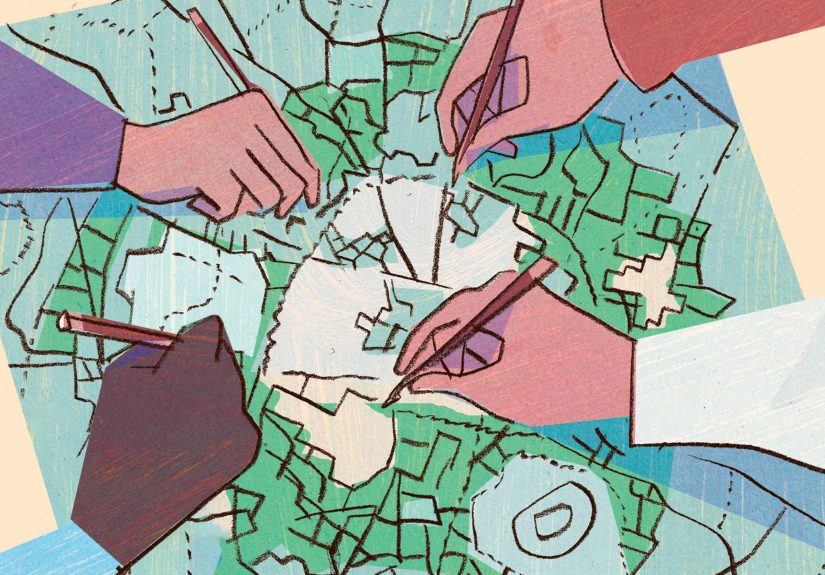
Maps are one of the most effective tools in place-based learning because they help students visualize relationships. And no, this does not mean every project must turn into a unit on cartography with dramatic debates over legends and compass roses. Mapping can be simple, creative, and deeply analytical.
Students can create story maps, asset maps, problem maps, emotion maps, history maps, or future-design maps. An asset map identifies the strengths of a community, such as parks, local leaders, service organizations, gathering spots, or cultural landmarks. A problem map highlights issues students notice, like unsafe crossings, food access gaps, flooding zones, or abandoned spaces. A story map blends geography with narrative by connecting places to interviews, memories, and photographs.
Mapping helps students move from “this is what I noticed” to “this is how the pieces connect.” That shift is where a lot of real learning begins.
Strategy 4: Build Community Partnerships Without Making It Complicated
Strong place-based learning often includes partnerships, but teachers do not need a giant formal network to get started. A school librarian, local historian, parent volunteer, parks employee, artist, public health worker, business owner, tribal educator, museum staff member, or neighborhood organizer can all become valuable collaborators.
The trick is to start with alignment, not celebrity. The best partner is not the most impressive name on a flyer. It is the person or organization that can help students investigate a real question, access credible information, or see how learning connects to community life.
When reaching out, be clear and respectful. Explain the learning goal, what students are studying, how much time is needed, and how the partner’s expertise will be used. Community collaboration works better when it feels reciprocal. Ask how student work might also serve the partner or community, whether by raising awareness, collecting observations, creating educational materials, or sharing findings publicly.
Strategy 5: Connect Local Issues to Bigger Ideas
Great place-based learning is local, but it should not stay trapped there. One of the most powerful teaching moves is helping students connect a neighborhood-level issue to broader themes in science, civics, economics, literature, sustainability, or public policy.
A project about storm drains can lead to conversations about climate resilience. A study of local food systems can connect to supply chains, water use, labor, and public health. Oral histories from longtime residents can open questions about migration, housing, identity, and memory. Students begin to understand that local life is not separate from global systems. It is one of the places where those systems become visible.
This also keeps place-based learning academically rigorous. Students are not just “doing community stuff.” They are analyzing patterns, evaluating evidence, comparing perspectives, and applying disciplinary knowledge in a meaningful context.
Strategy 6: Design for Inclusion and Belonging
Not every student experiences the same place in the same way. That is why equitable place-based teaching matters. A neighborhood that feels exciting to one student may feel invisible, unsafe, or emotionally loaded to another. Teachers should make room for multiple experiences and avoid presenting a single “official” version of a place.
Centering marginalized voices is especially important. Invite students to examine whose stories are remembered publicly, whose labor shaped the community, whose languages and traditions are visible, and whose perspectives are missing. This makes place-based learning richer, more honest, and more respectful.
Practical inclusion also matters. Offer multiple ways to participate, especially for students with mobility needs, sensory differences, language needs, or limited prior background knowledge. Use flexible grouping, scaffolded tasks, visual supports, sentence frames, translated materials when possible, and varied options for showing understanding. A community-connected lesson should widen access, not accidentally narrow it.
Strategy 7: Make the Work Public and Useful
One signature move in place-based learning is creating authentic work for an audience beyond the teacher. That could mean student exhibitions, community presentations, podcasts, zines, proposals, murals, field guides, digital story maps, museum labels, informational brochures, or letters to local decision-makers.
Public work raises quality because students know somebody besides their teacher will see it. It also gives their efforts a sense of purpose. A student may drag their feet on paragraph three of a generic essay, but hand them a project that will be shared with a local garden committee or historical society, and suddenly revision becomes less painful. Not fun, exactly. But less painful.
The key is to choose an audience that fits the learning goal. Authentic does not always mean huge. A small exhibition for families or a presentation to one community partner can be just as meaningful as a large public event.
Strategy 8: Keep It Safe, Structured, and Standards-Aligned
Place-based learning thrives on flexibility, but it still needs structure. Students take more intellectual risks when the environment feels physically, socially, and emotionally safe. Before sending students into a schoolyard, neighborhood, or community interview, establish routines clearly. What is the purpose of the activity? How will students gather evidence? What respectful behavior is expected? What will happen afterward with the information they collect?
Standards alignment matters too. Teachers should be able to point to the reading, writing, speaking, math, science, social studies, or arts goals being addressed. A strong place-based unit is not an “extra” squeezed in after the real curriculum. It is the curriculum, taught through a meaningful lens.
This is also where formative assessment becomes your best friend. Use exit tickets, reflection journals, group debriefs, draft checkpoints, critique sessions, and student self-assessments throughout the unit. That way, you can adjust instruction before a promising project turns into an attractive pile of confusion.
Strategy 9: Start Small, Reflect Often, and Improve Next Time
You do not need to create the perfect place-based unit on the first try. In fact, that is usually a recipe for stress and dramatic coffee consumption. Begin with one short inquiry, one local text set, one interview, or one partner visit. Reflect on what students learned, what surprised them, and what you would change.
Place-based learning improves through iteration. Maybe your first unit reveals that students need stronger question-writing skills. Maybe you discover the best local data source is the city library, not the website you originally planned to use. Maybe students become fascinated by a subtopic you never expected. That is not failure. That is design information.
The goal is not perfection. The goal is more meaningful learning, one place-connected step at a time.
Common Mistakes to Avoid
First, do not confuse “local” with “easy.” A nearby topic can still require serious planning, strong texts, and deep thinking. Second, do not let the activity overshadow the learning. A community walk is helpful only if students use it to analyze, question, and create. Third, do not treat community members as props. Build partnerships with care and respect. Fourth, do not overlook difficult local histories or inequities just to keep things tidy. Real places are complex. Good teaching can handle complexity.
Conclusion
Teaching place-based learning is really about teaching students to notice, question, connect, and contribute. It turns the community into a classroom, but it also turns the classroom outward, reminding students that knowledge is not just something stored in a textbook or hidden in a test prep packet. It lives in streets, stories, ecosystems, public spaces, local challenges, and community wisdom.
When teachers start small, center student inquiry, build thoughtful partnerships, invite multiple perspectives, and design work for real audiences, place-based learning becomes more than a trendy phrase. It becomes a powerful instructional strategy that makes school feel relevant again. And in a world where students are often asked to memorize information detached from life, that kind of relevance is not a bonus. It is the whole point.
Experiences From the Field: What Teaching Place-Based Learning Really Feels Like
If you talk to educators who use place-based learning regularly, they often describe the same moment: students begin a project a little skeptical, maybe even mildly allergic to enthusiasm, and then something clicks. It usually happens when students realize the topic is not imaginary. The creek behind the school is actually polluted. The crosswalk near campus really is dangerous. The vacant lot on the corner really does have a history. Once that realization lands, the energy shifts. Students start asking better questions because the answers suddenly matter.
One common experience is that quiet students often become more vocal when the learning is rooted in familiar places. A student who rarely volunteers during a textbook discussion may light up while explaining a local mural, a family-owned business, or a neighborhood tradition. That is one of the hidden strengths of place-based learning: it creates more entry points for expertise. In a traditional lesson, the teacher usually holds the map. In a place-based lesson, students often hold pieces of it too.
Teachers also learn quickly that planning matters, but overplanning can backfire. Many educators report that their best place-based moments came from leaving some room for surprise. Maybe a community walk reveals a question nobody predicted. Maybe a guest speaker says something that shifts the entire unit. Maybe students notice a pattern in the built environment that leads to a stronger driving question than the one on the lesson plan. Place-based teaching rewards structure, but it also rewards listening.
Another frequent experience is that community partnerships tend to start smaller than expected. A teacher may imagine launching a big districtwide collaboration, only to discover that the first meaningful partner is the librarian down the hall, a parent who works in public health, or a local gardener willing to talk with students for 20 minutes. That is not a downgrade. In many cases, those smaller partnerships are what make the work sustainable. They are easier to maintain, easier to trust, and often more responsive to student needs.
There are challenges, of course. Weather changes plans. Transportation can be tricky. Administrators may need reassurance that the unit is academically rigorous. Some students love open-ended inquiry; others want a cleaner path and fewer unknowns. But experienced teachers often say the same thing afterward: the mess is productive. Students remember these units because they can see where the learning happened, who it involved, and why it mattered.
Perhaps the most meaningful experience is seeing students move from observation to ownership. They stop asking, “Is this for a grade?” and start asking, “Can we share this with someone?” That question is gold. It means the work has become real. And once students feel that their ideas can contribute to a real place with real people, school no longer feels like practice for life later on. It feels like life now.