Table of Contents >> Show >> Hide
- The Riddle (Quick Recap)
- Short Answer: The Classic 45-Minute Solution
- Step-by-Step Explanation
- Why the Solution Works (Without Hand-Waving)
- Common Mistakes People Make
- What This Riddle Teaches About Problem-Solving
- Variations and Extensions (Because One Brain Teaser Is Never Enough)
- Practical Ways to Use This Explanation in a Blog, Classroom, or Puzzle Night
- Extended Experience Notes (Added 500-Word Section)
- Final Takeaway
Some riddles are polite. They knock, introduce themselves, and let you solve them with a pencil. The Burning Rope Problem is not one of those riddles. It shows up looking simple (“two ropes, one lighter, 45 minutes… easy, right?”), then immediately steals your assumptions and runs off laughing.
If you’ve ever thought, “I’ll just burn three-quarters of a rope,” congratulations: you’ve fallen into the exact trap this puzzle was designed to set. The ropes do not burn evenly along their length, which means this riddle is really a test of logic, not measuring skills. In this guide, we’ll walk through the classic solution, explain why it works, cover common mistakes, and look at what makes this puzzle such a great brain workout.
The Riddle (Quick Recap)
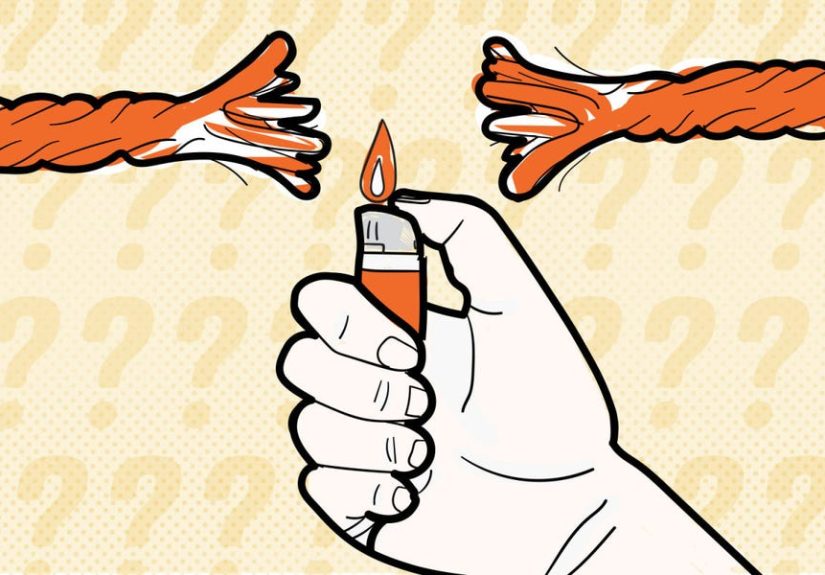
You have two ropes and a lighter. Each rope takes exactly 60 minutes to burn from end to end. However, the ropes burn at inconsistent ratessome sections burn faster, some slower. Your challenge is to measure exactly 45 minutes.
Translation: the rope is a terrible ruler but a reliable timerif you use it correctly.
Short Answer: The Classic 45-Minute Solution
Here’s the winning sequence:
- Light both ends of Rope A.
- At the same time, light one end of Rope B.
- When Rope A finishes burning, exactly 30 minutes have passed.
- At that moment, light the other end of Rope B.
- Rope B will finish in 15 more minutes.
Total time: 30 + 15 = 45 minutes.
Step-by-Step Explanation
Step 1: Burn Rope A from Both Ends
A rope that burns in 60 minutes from one end will burn in 30 minutes if lit from both ends. That part is true even if the rope burns unevenly. Why? Because the flames are eating the rope from both directions at once. Unevenness affects where the flames are at any moment, but not the total burn time once both ends are lit simultaneously.
Think of it like two people eating the same pizza from opposite sides. They may not take equal bites, but the pizza still disappears faster when both are eating.
Step 2: Start Rope B at the Same Time (One End Only)
While Rope A is being attacked from both ends, Rope B begins burning from one end only. After 30 minutes, Rope B has burned for 30 minutes of timebut not necessarily half of its physical length. That detail matters, because the puzzle wants you to let go of “length thinking.”
At the 30-minute mark, Rope B has exactly 30 minutes of burn time remaining, no matter how much rope is visibly left.
Step 3: Light the Other End of Rope B
Once Rope A goes out (your perfectly timed 30-minute signal), light the unlit end of Rope B. Now Rope B is burning from both ends, and the remaining burn time gets cut in half: 30 minutes remaining becomes 15 minutes.
Add it up and you get your exact 45-minute interval.
Why the Solution Works (Without Hand-Waving)
The key idea in the Burning Rope Problem solution is this: the puzzle guarantees total burn time, not burn speed by length.
Many people get stuck because they picture rope as a ruler. But this puzzle treats rope as a weird, smoky clock. The rope’s shape, thickness, and burn pattern can vary wildly, yet the total time from one end to the other is fixed.
So when someone says, “But what if the remaining piece looks tiny?” the answer is: it doesn’t matter. If it has 30 minutes of burn time left and you light the other end, the remaining time is halved to 15 minutes. The visible length is a red herring.
The Trap This Riddle Sets
The riddle tempts you to assume:
- Half the rope = 30 minutes
- Three-quarters of the rope = 45 minutes
- You can estimate by length
Nope, nope, and absolutely nope. This is why the puzzle is so good: it tests whether you can stop using the wrong model and switch to the right one.
Common Mistakes People Make
1) Measuring Length Instead of Time
The most common mistake is trying to “eyeball” a fraction of the rope. Since the rope burns irregularly, a short section might take longer than a long section (or vice versa). The puzzle is specifically written to eliminate length-based strategies.
2) Forgetting You Can Light Multiple Ends at Once
The hint in many versions says you can light multiple ends simultaneously. That’s the unlock. If you ignore that, the puzzle feels impossible. If you use it, the solution becomes elegantly simple.
3) Assuming Both Ropes Must Be Used the Same Way
Another subtle trap: people try to apply a symmetrical strategy to both ropes. But the answer is asymmetric on purposeone rope creates the 30-minute checkpoint, and the other finishes the 15-minute sprint.
What This Riddle Teaches About Problem-Solving
The burning rope puzzle is more than a party trick. It teaches a few powerful habits used in math, coding, engineering, and everyday decision-making:
Separate What Is Guaranteed from What Is Not
Guaranteed: each rope burns in 60 minutes total. Not guaranteed: uniform burn speed along the rope. Good problem-solvers identify constraints first, then build strategies around only those constraints.
Create a Reliable Checkpoint
Lighting both ends of Rope A gives you an exact 30-minute event. Once you have a dependable checkpoint, the rest of the puzzle becomes manageable. This is a great general strategy: break a hard problem into precise milestones.
Use the System Against Itself
The ropes are intentionally unreliable in one way (length), but reliable in another way (total time). The solution works because it exploits the reliable part. Smart puzzle solving often means turning the problem’s “gotcha” into your advantage.
Variations and Extensions (Because One Brain Teaser Is Never Enough)
Can You Measure 30 Minutes?
Yes. Light both ends of a single 60-minute rope. Done. (This is the “training wheels” version.)
Can You Measure 15 Minutes?
Yesonce you can create a 30-minute checkpoint. If a rope has 30 minutes of burn time remaining, lighting both ends makes it finish in 15 minutes.
Can You Measure Other Times?
In broader rope/fuse puzzles, you can often combine events (like one rope finishing) to create new timing checkpoints. Some advanced versions use ropes with different total burn times, more ropes, or additional ignition points, which opens the door to much richer strategies.
In other words, this “cute little 45-minute riddle” is secretly the gateway to a whole family of timing puzzles. It’s the puzzle equivalent of saying, “I’ll just watch one episode,” then waking up in a full-blown logic marathon.
Practical Ways to Use This Explanation in a Blog, Classroom, or Puzzle Night
If you’re sharing the solution to the Burning Rope Problem with readers, students, or friends, present it in this order:
- State the puzzle clearly.
- Emphasize that the ropes burn unevenly.
- Let people try (and fail) with length-based thinking.
- Reveal the 30-minute checkpoint idea.
- Explain why visible rope length doesn’t matter.
This sequence makes the “aha!” moment much stronger. And honestly, half the fun of this riddle is watching someone go from “This is impossible” to “Wait… that’s brilliant.”
Extended Experience Notes (Added 500-Word Section)
One of the most interesting experiences people have with the Burning Rope Problem is how fast confidence and confusion can swap places. At first glance, the puzzle feels almost too easy. Two ropes, one lighter, 45 minutessurely this is just a fraction problem. Then the “burns unevenly” condition lands, and suddenly the brain has to change gears. That moment is memorable because it mirrors real-life problem solving: the first idea is often reasonable, but not always usable.
In puzzle groups and classroom-style discussions, a common pattern shows up. Someone proposes marking the rope visually at the three-quarter point. Another person objects, pointing out the uneven burn rate. Then everyone starts negotiating with the rule, as if the rope might agree to behave better if asked nicely. It never does. That shared frustration is actually productive. It pushes people to stop relying on intuition based on shape and length, and start reasoning from time and constraints instead.
Another experience tied to this riddle is the “checkpoint breakthrough.” Once a solver realizes that lighting both ends creates an exact 30-minute event, the puzzle suddenly becomes less mysterious. People often describe this as the moment the fog clears. The puzzle hasn’t changed, but their model of the puzzle has. Instead of thinking, “How do I measure 45 directly?” they begin thinking, “How do I build reliable timed events and combine them?” That shift is valuable far beyond riddles. It’s the same mental move used in project planning, debugging, and even cooking when you coordinate overlapping steps.
There is also a fun emotional arc when explaining the solution to others. The first reaction is often skepticism: “Wait, why does the second rope finish in 15 minutes? What if there’s only a tiny piece left?” This is where the explanation becomes more satisfying than the answer itself. Walking through the difference between remaining length and remaining burn time helps people see why the puzzle is elegant rather than tricky for the sake of being tricky. It rewards precision, not guesswork.
For content creators, this riddle is especially useful because it naturally supports layered writing: a hook, a challenge, a reveal, a proof, and a lesson. Readers get entertainment and a reasoning skill in one package. It also performs well as interactive content because people love testing their own logic before reading the solution. The best discussions often come from wrong answers, not right ones, because wrong answers reveal hidden assumptions.
Finally, many people remember this puzzle long after they forget the exact steps. What sticks is the principle: don’t confuse what you can see with what the problem guarantees. That’s a surprisingly powerful lesson from two ropes and a flame. Not bad for a riddle that looks like it belongs on a napkin.
Final Takeaway
The Solution to Riddle of the Week #6: The Burning Rope Problem is a classic because it rewards careful reading, not complicated math. By lighting one rope at both ends and using it as a precise 30-minute marker, then converting the second rope’s remaining burn time into a 15-minute interval, you measure exactly 45 minutes. Simple tools, clever sequencing, and one very smug lighter.