Table of Contents >> Show >> Hide
- What Is Retinoblastoma?
- Retinoblastoma Symptoms: Early Signs You Should Never Ignore
- Causes of Retinoblastoma: The RB1 Gene Story
- How Retinoblastoma Is Diagnosed
- Retinoblastoma Treatment Options
- Retinoblastoma Outlook and Prognosis
- Practical Checklist for Families
- Human Side of Retinoblastoma: of Real-World Experience
- Conclusion
A blurry selfie is annoying. A white glow in your child’s pupil in a flash photo? That can be a medical emergency.
Retinoblastoma is rare, but it moves fastand when families act fast, outcomes are usually very good.
This guide walks you through what retinoblastoma is, the early warning signs, what causes it, how doctors confirm it,
which treatments are used today, and what life can look like afterward.
We’ll keep things clear, practical, and human. No panic. No jargon soup. Just real, evidence-based information explained
in plain American Englishwith enough depth to be useful for parents, caregivers, students, and anyone researching childhood eye cancer.
Think of this as your “what matters most” roadmap.
What Is Retinoblastoma?
Retinoblastoma is a cancer that starts in the retina, the light-sensitive tissue lining the back of the eye.
It happens mostly in very young children, usually before age 5, and often before age 2. It can affect one eye
(unilateral) or both eyes (bilateral).
Although it is the most common eye cancer in children, it is still rare overall. In the U.S., only a few hundred new cases
are diagnosed each year. The rarity can make it unfamiliar to many familieswhich is exactly why awareness is so important.
The earlier it is detected, the better the chance to protect life, and in many cases, vision too.
Retinoblastoma Symptoms: Early Signs You Should Never Ignore
1) Leukocoria (a white pupil reflex)
This is the classic sign. Instead of a normal “red-eye” reflection in photos, one pupil may look white, pale yellow, or silvery.
It can show up only in certain lighting or camera angles, which is why parents sometimes notice it in photos first.
2) Strabismus (eyes that don’t align)
If one eye turns inward or outward and alignment seems off, it can be a clue that vision in one eye is reduced.
Strabismus is common in children for many reasons, but it always deserves a professional eye exam.
3) Other possible symptoms
- Persistent eye redness or swelling
- Reduced vision or poor tracking
- Pain (less common early, more concerning if present)
- Differences in iris appearance
Important reality check: these symptoms do not always mean cancer. But they do mean “get checked now.”
With retinoblastoma, timing matters more than internet guesswork.
Causes of Retinoblastoma: The RB1 Gene Story
Retinoblastoma is driven mainly by changes in the RB1 tumor suppressor gene. Normally, RB1 helps control cell growth.
When RB1 function is lost, retinal cells can divide uncontrollably and form tumors.
Heritable vs. non-heritable retinoblastoma
There are two broad patterns:
-
Heritable (germline) retinoblastoma: A child is born with an RB1 change present in many or all cells.
This form is more likely to present earlier and involve both eyes. -
Non-heritable (sporadic) retinoblastoma: RB1 changes occur only in retinal tumor cells.
This usually affects one eye.
A key family planning point: if a child has a heritable RB1 mutation, there can be a 50% chance of passing that mutation to future children.
That is why genetic counseling is not an “optional extra”it is part of modern, high-quality care.
What did parents do “wrong”?
Usually, nothing. Retinoblastoma is most often a genetic event, not a parenting mistake, not a diet mistake,
and not caused by your child watching too many cartoons at 6 inches from the TV. (Their neck might disagree, but not their RB1 gene.)
How Retinoblastoma Is Diagnosed
Red reflex screening and urgent referral
In pediatric care, red reflex exams are used to screen infants and young children. An abnormal reflexespecially asymmetric or whiteshould trigger urgent ophthalmology evaluation.
This step saves time, and time saves vision.
Dilated ophthalmic exam (often under anesthesia)
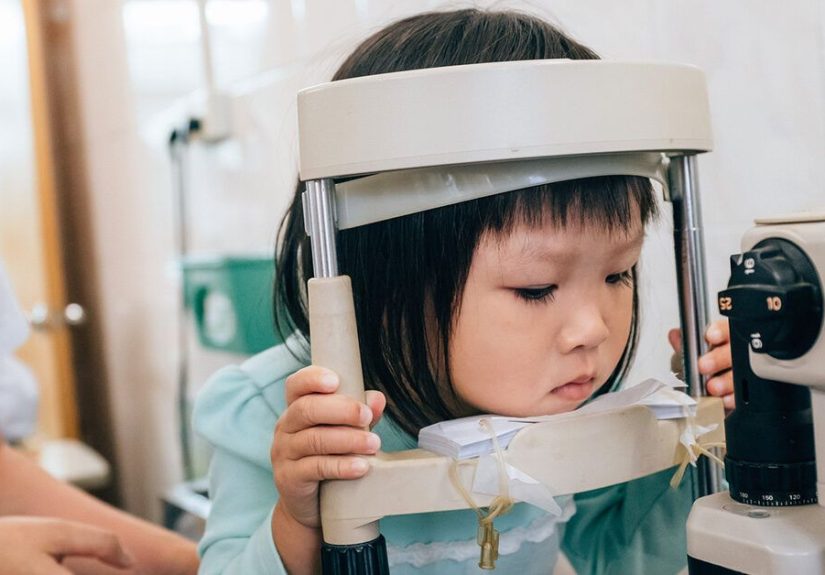
Pediatric ocular oncologists perform a detailed retinal exam using dilated pupils. Many children need an exam under anesthesia (EUA) so doctors can evaluate both eyes precisely and safely.
Imaging and staging workup
- Ocular ultrasound to assess tumor features
- MRI of the brain/orbits to evaluate spread and related risk
- Additional tests if extraocular spread is suspected
Why biopsy is usually avoided
Unlike many cancers, intraocular tumor biopsy is typically avoided in retinoblastoma because of concern for tumor spread.
Diagnosis is usually made with specialized eye exam plus imaging.
Genetic testing
Testing for RB1 mutation status helps determine inherited risk, surveillance strategy, sibling screening, and long-term follow-up.
It also helps families make informed decisions about future pregnancies and early surveillance for newborns.
Retinoblastoma Treatment Options
Modern treatment has three goals:
(1) save life, (2) save the eye when possible, (3) preserve useful vision.
The plan depends on tumor size, location, whether one or both eyes are involved, and whether disease has spread.
1) Chemotherapy-based approaches
Chemotherapy can shrink tumors (chemoreduction), making local eye-sparing treatments more effective.
Common delivery methods include:
- Intravenous chemotherapy: systemic delivery through a vein
- Intra-arterial chemotherapy: medicine delivered through the ophthalmic artery
- Intravitreal chemotherapy: medicine injected into the vitreous for selected cases, including vitreous seeding
In many centers, combining chemotherapy with local therapy has significantly improved eye salvage rates,
especially in less advanced intraocular groups.
2) Focal (eye-sparing) local therapies
- Laser therapy: destroys tumor tissue or feeding vessels
- Cryotherapy: freezes small tumors
- Plaque brachytherapy: localized internal radiation for selected lesions
These techniques are precise and often repeated in planned sessions. Think of it less like one dramatic “all done” procedure
and more like strategic rounds in a smart treatment campaign.
3) Surgery (enucleation)
When a tumor is too advanced for visual recovery, or when there is high risk to life, removing the eye
(enucleation) may be the safest option. This is emotionally hard, but often lifesaving.
After healing, many children receive an ocular prosthesis that looks natural and supports facial symmetry.
4) Radiation therapy
External beam radiation is now used more selectively than in the past, partly because of long-term second-cancer risks
in children with heritable RB1 mutations. Localized radiation (like plaques) may still play an important role depending on case specifics.
5) Advanced or extraocular disease treatment
If disease extends beyond the eye, treatment intensity increases and may include multi-agent chemotherapy,
radiation, and in selected scenarios high-dose therapy with stem cell rescue. Outcomes can still be meaningful,
but prognosis is generally worse when spread is presentespecially with CNS involvement.
Retinoblastoma Outlook and Prognosis
In the United States, overall cure rates are high, and most children with retinoblastoma survive long-term,
especially when diagnosed early and managed at experienced centers.
What affects outlook?
- How early the tumor is found
- Whether one eye or both eyes are involved
- Tumor group/stage and presence of vitreous or subretinal seeding
- Whether cancer has spread outside the eye
- RB1 mutation status and long-term surveillance adherence
Vision outcomes
Survival is the first priority, but visual outcomes are often good in eyes diagnosed before advanced damage.
Some children maintain excellent functional vision. Others may have low vision and need support services,
adaptive tools, or classroom accommodations.
Long-term follow-up matters
Children with heritable retinoblastoma need structured surveillance for new ocular tumors in early childhood and monitoring for second cancers later in life.
Follow-up can include periodic eye exams, imaging in specific risk groups, skin checks, and fast evaluation of unexplained symptoms.
Practical Checklist for Families
- If you notice a white pupil reflex or new strabismus, request urgent ophthalmology referral.
- Ask whether your child should see a pediatric ocular oncology team.
- Request RB1 genetic counseling/testing discussions early.
- Understand treatment goals: life, eye, visionin that order.
- Plan for emotional support, school support, and sibling communication.
- Keep a treatment binder: scans, pathology, medications, follow-up schedule, and emergency contacts.
Human Side of Retinoblastoma: of Real-World Experience
The medical facts are essential, but families live the story between clinic visits. Here are composite experiences based on common patterns
reported in pediatric oncology and ophthalmology careshared to make the journey feel less lonely and more navigable.
Experience 1: “It was just one weird photo… until it wasn’t.”
One mom noticed that in a birthday picture, her toddler’s left eye looked white while the right eye looked red.
She almost dismissed it as camera glare, then remembered seeing the same thing in two older photos. Her pediatrician moved fast,
an ophthalmologist confirmed concern, and treatment started within days. Her words were simple: “I’m so glad I trusted my gut.”
The lesson: patterns beat single moments. If you notice repeated asymmetry in photos, get it checked quickly.
Experience 2: “Genetics felt scary, then empowering.”
A family with no known cancer history was stunned when genetic testing showed a heritable RB1 mutation.
At first, the result felt like a label. Over time, it became a map. They used it to guide sibling screening,
relatives’ counseling, and future pregnancy planning. What once felt like bad news became practical information:
better surveillance, earlier detection windows, fewer unknowns.
Experience 3: “Enucleation was the hardest yes of our lives.”
Parents of a child with advanced unilateral disease were told the eye likely could not be saved safely.
They described the decision as heartbreakingand then, later, as clarifying. Their child recovered well,
adapted quickly to depth-perception changes, and returned to playground life faster than expected.
The prosthetic eye looked natural enough that classmates usually didn’t notice unless told.
Their message to newer families: grieving and relief can coexist, and choosing safety is not “giving up.”
Experience 4: “Treatment is not one giant event; it’s a series of sprints.”
Families often expect one operation and done. Real life is usually cycles: EUA visits, chemo sessions, local therapies,
imaging, and follow-up plans. Parents who did best operationally treated it like project management:
shared calendar, medication checklists, backup childcare, and one “communications lead” for extended family updates.
It reduced chaos and freed emotional energy for their child.
Experience 5: “Survivorship has phases.”
After active treatment, many parents expect instant emotional relief. Instead, some experience delayed anxiety before each follow-up scan.
Teens and older children may ask identity questions: “Why me?” “Will this affect my future job?” “Can I drive?”
Survivorship clinics, counseling, peer groups, and school-based accommodations can make a huge difference.
Families who built long-term support networksnot just acute treatment plansreported better quality of life.
If there’s one shared message across these stories, it’s this: retinoblastoma care is medical, emotional, logistical, and social all at once.
Families don’t need to be perfect. They need a capable care team, good information, and permission to ask the same question twice.
(Or ten times. Oncology teams are used to that.) Progress in treatment is real. Hope is not denial. It’s a strategy with a calendar.
Conclusion
Retinoblastoma is rare, serious, and increasingly treatable. Early signsespecially leukocoria and new strabismusdeserve immediate evaluation.
Most cases are linked to RB1 gene changes, and genetic testing helps guide care far beyond the first diagnosis.
Today’s treatment options range from eye-sparing local therapies and targeted chemotherapy routes to enucleation when safety demands it.
In the U.S., outcomes are generally strong when children are diagnosed early and treated by experienced multidisciplinary teams.
If your family is facing this diagnosis, focus on what you can control: fast specialist care, clear questions, consistent follow-up, and emotional support.
You are not expected to know everything on day one. You are expected to show upand that already counts as excellent medicine.