Table of Contents >> Show >> Hide
- What “Potentially Habitable” Really Means
- How Scientists Find Potentially Habitable Exoplanets
- Famous Potentially Habitable Exoplanets Worth Knowing
- Why a Potentially Habitable Exoplanet Might Still Be a Bad Place to Live
- What Scientists Look For Beyond the Habitable Zone Label
- The Next Decade of the Search
- Why This Topic Grabs People So Hard
- Experiences Related to the Search for a Potentially Habitable Exoplanet
- Conclusion
If there were an award for the most overworked phrase in space science, “potentially habitable exoplanet” would at least make the podium. It sounds dramatic, hopeful, and just mysterious enough to make you stare at the night sky like you’re expecting a callback. But the phrase means something very specific in astronomy, and it is far less wild than “we found alien condos with ocean views.”
A potentially habitable exoplanet is a planet outside our solar system that may have conditions suitable for liquid water, which is still the best practical starting point scientists have for life as we know it. That usually places the world in a star’s habitable zone, sometimes nicknamed the Goldilocks zone, where temperatures might allow water to exist on the surface. Not too hot. Not too cold. Just right. Or at least not immediately ridiculous.
Still, a habitable-zone address is not the same thing as a guarantee of life, forests, weather apps, or even a decent atmosphere. The real story is much more interesting. A potentially habitable exoplanet sits at the crossroads of astronomy, planetary science, climate modeling, chemistry, and human imagination. It is where scientists ask one of the oldest questions in the most modern way possible: Is Earth special, or are we one example in a crowded cosmic neighborhood?
What “Potentially Habitable” Really Means
In plain English, “potentially habitable” means a planet has some basic qualities that make it worth taking seriously in the search for life. Usually, astronomers want a rocky planet rather than a gas giant, a temperature range that could support liquid water, and a stable enough environment that does not roast, freeze, or strip away an atmosphere every Tuesday.
That said, the phrase is intentionally cautious. Scientists use it because they often do not know enough yet to say whether a planet truly has oceans, continents, clouds, or even a surface you could stand on without becoming a physics lesson. Many exoplanets are discovered from extremely limited data: a dip in starlight, a wobble in a star, a rough estimate of mass, radius, or orbit. From that, researchers infer possibilities. They do not jump straight to “pack a suitcase.”
The habitable zone is the beginning, not the verdict
A planet can orbit in the habitable zone and still be a terrible place for life. Venus is the classic warning label in our own solar system. It sits near the inner edge of the Sun’s habitable zone, yet its runaway greenhouse effect makes it brutally hot and crushingly hostile. Mars, meanwhile, occupies a more forgiving neighborhood than its frozen deserts suggest. Distance from a star matters, but it does not decide everything.
Real habitability also depends on atmosphere, pressure, chemistry, magnetic protection, long-term climate stability, and how moody the host star happens to be. A planet with the right temperature range but no atmosphere may be as lifeless as a microwave plate after the pizza has been removed.
How Scientists Find Potentially Habitable Exoplanets
Astronomers do not usually spot these worlds as tiny blue marbles in telescope photos. Most exoplanets are found indirectly, which is both brilliant and slightly rude. Scientists often never see the planet itself at first; they see what it does to its star.
Transit method
The transit method looks for a small dip in a star’s brightness when a planet passes in front of it. Missions such as Kepler and TESS turned this technique into an exoplanet factory. If the dimming repeats on a regular schedule, astronomers can estimate the planet’s size and orbit. That is how many famous potentially habitable worlds first entered the conversation.
Radial velocity
The radial velocity method measures how a planet’s gravity tugs on its star. If the star wobbles slightly, there may be a planet pulling on it. This helps astronomers estimate mass, which matters because a planet’s density can hint at whether it is rocky, watery, gassy, or basically a cosmic confusion.
Atmospheric follow-up
After discovery comes the hard part: figuring out what the planet is actually like. Telescopes such as the James Webb Space Telescope analyze starlight that passes through a planet’s atmosphere during transit. This can reveal gases such as water vapor, carbon dioxide, methane, or other molecules. It is not the same as finding life, but it is a major step toward understanding climate, chemistry, and whether a planet deserves the word “habitable” in anything more than a hopeful draft.
Famous Potentially Habitable Exoplanets Worth Knowing
The catalog of confirmed exoplanets now numbers in the thousands, but only a smaller subset gets constant attention as potentially habitable candidates. These worlds are not all equal, and that is exactly what makes the field so fascinating.
Kepler-186f
Kepler-186f remains a milestone because it was the first validated Earth-size planet found in the habitable zone of another star. That discovery mattered less because it proved Earth 2.0 existed, and more because it showed Earth-size planets in habitable zones were real targets instead of science-fiction wish lists with equations attached.
Kepler-186f is slightly larger than Earth and orbits a red dwarf star. It may be rocky, but scientists still do not know the details of its atmosphere or surface conditions. It is famous because it opened a door, not because it settled the argument.
TOI-700 d and TOI-700 e
The TOI-700 system became a favorite because it contains multiple small worlds, including TOI-700 d and TOI-700 e in the habitable zone. These are especially valuable because they are Earth-size and comparatively nearby by exoplanet standards. “Nearby,” in this case, still means “do not expect a weekend trip.”
TOI-700 e is especially intriguing because it is about 95 percent of Earth’s size and likely rocky. Worlds like this help astronomers refine the shortlist of planets that deserve repeated atmospheric study.
TRAPPIST-1 e
If exoplanet systems had celebrity status, TRAPPIST-1 would have its own documentary series and suspiciously dramatic soundtrack. The system contains seven Earth-size planets, with several in or near the habitable zone. TRAPPIST-1 e often stands out as one of the most promising targets because its size, density, and orbit make it a compelling rocky-world candidate.
But there is a catch, because there is always a catch. TRAPPIST-1 is a red dwarf, and red dwarfs can be active, flare-prone stars. Recent Webb observations have helped rule out some atmospheric possibilities for certain TRAPPIST-1 planets and sharpened the debate about which of them might retain atmospheres over time. The system remains exciting precisely because it is still unresolved.
Proxima Centauri b
Proxima Centauri b gets attention for one very convenient reason: it orbits the star closest to the Sun. In terms of cosmic geography, that makes it our next-door neighbor. It has a mass close to Earth’s and orbits in the habitable zone of Proxima Centauri.
Unfortunately, that star is not exactly a calm suburban sun. Proxima Centauri is active, and its high-energy radiation may threaten any Earth-like atmosphere. So Proxima b is both thrilling and frustrating: close, rocky-looking, and possibly battered by stellar violence.
K2-18 b
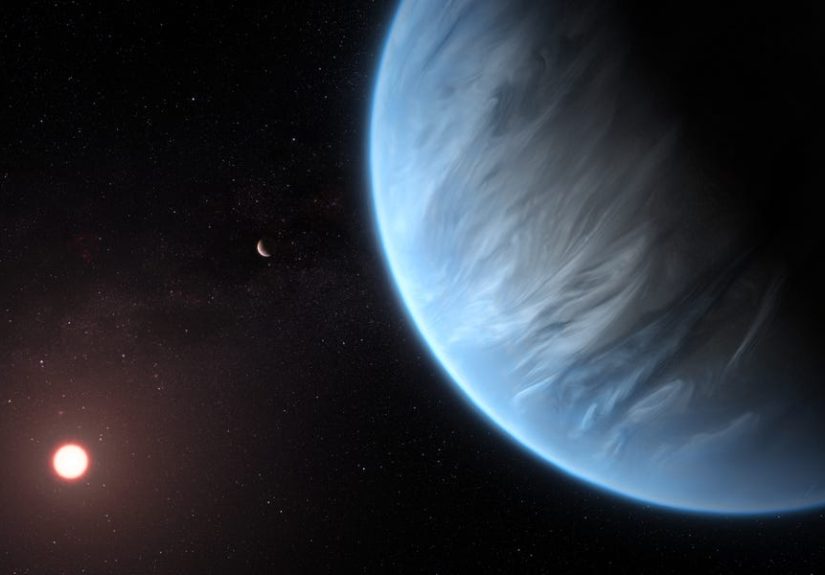
K2-18 b often appears in headlines because it orbits in the habitable zone and has shown atmospheric interest. It is not, however, a clean Earth twin. It is much larger and more massive than Earth, likely placing it in a category closer to sub-Neptune or a possible water-rich world. Scientists are studying it because it may help reveal what kinds of atmospheres exist on worlds between Earth and Neptune in size, not because anyone should confidently label it a second Earth.
Why a Potentially Habitable Exoplanet Might Still Be a Bad Place to Live
The phrase “potentially habitable” can be misleading because it sounds friendlier than it is. A planet can check one box and fail six others in spectacular fashion.
Red dwarf trouble
Many of the best candidate planets orbit red dwarf stars because those stars are common and make small planets easier to detect. But red dwarfs can unleash strong flares and intense ultraviolet radiation. Over long timescales, that activity may erode atmospheres and sterilize surfaces, especially for planets orbiting close in.
Tidal locking
A planet in the habitable zone of a cool, dim star may orbit so closely that it becomes tidally locked, showing the same face to its star at all times. One side could endure permanent daylight, while the other lives in endless night. That does not automatically kill habitability, but it complicates climate models. A thick atmosphere or ocean circulation could redistribute heat. A thin atmosphere could fail miserably.
Atmospheric uncertainty
No atmosphere means no stable surface liquid water. Too much atmosphere can mean a runaway greenhouse effect. The wrong chemistry can produce toxic conditions or crush the planet in pressure. Habitability is not just about temperature. It is about whether the entire planetary system behaves like a long-running climate engine instead of a short-lived disaster movie.
Magnetic fields and geologic activity
Scientists also care about magnetic fields and interior dynamics. A magnetic field may help protect an atmosphere from stellar wind. Plate tectonics or volcanic cycling may help regulate climate over geologic timescales. None of these ingredients are easy to measure directly on distant worlds, which is why the word “potentially” earns every letter.
What Scientists Look For Beyond the Habitable Zone Label
Modern exoplanet science is moving beyond simple location-based definitions. Researchers want context. They want to know what the atmosphere is made of, how the planet formed, whether it kept water, and whether its host star is helpful or hostile.
That is where biosignatures enter the conversation. A biosignature is a chemical, pattern, or combination of signals that may suggest biological activity. Oxygen and methane are famous examples, especially if found together in a way that is hard to explain geologically. But biosignatures are tricky. Oxygen can sometimes be produced without life, and life can exist without creating an obvious oxygen signal. In exoplanet science, context is king, queen, and most of the cabinet.
So when scientists discuss a potentially habitable exoplanet today, they are really building a layered case. Is it rocky? Is it temperate? Can it keep an atmosphere? Does the host star behave? Can we detect water-related chemistry? Could any atmospheric gases be misleading? The field has matured from simple hype into careful planetary detective work.
The Next Decade of the Search
The search for potentially habitable exoplanets is entering a more ambitious phase. Finding planets is no longer enough. The goal now is characterization: learning what these worlds are actually like.
James Webb is already transforming atmospheric studies of selected exoplanets, especially small planets around dim stars. Ground-based instruments continue measuring masses more precisely. Future efforts, including NASA’s Habitable Worlds Observatory concept, are aimed at directly imaging potentially habitable planets and analyzing their atmospheres for water, oxygen, methane, and other meaningful gases.
That matters because the biggest unanswered question is no longer whether planets are common. We already know they are. The bigger question is how many rocky planets with stable, life-friendly conditions exist around nearby stars. One NASA-SETI analysis even suggested the Milky Way could host hundreds of millions of potentially habitable worlds. That is not proof of life. It is proof that the search is worth taking very seriously.
Why This Topic Grabs People So Hard
A potentially habitable exoplanet is not just a data point. It is a mirror. Every time astronomers identify one, people instinctively compare it to Earth. Could it have oceans? Clouds? Seasons? Could anything live there? Could intelligence appear there? Would they also argue online about weather forecasts and overprice coffee?
The reason these worlds matter so much is that they force a perspective shift. Earth stops being the default template and becomes one case study. Suddenly, habitability is not a given. It is a fragile planetary achievement made of chemistry, timing, geology, and luck. Studying distant worlds teaches us not only how life might emerge elsewhere, but how unusual and precious our own biosphere may be.
Experiences Related to the Search for a Potentially Habitable Exoplanet
One of the most remarkable things about the search for a potentially habitable exoplanet is how human the experience feels, even though the subject is unimaginably far away. For scientists, the process is often less like a movie revelation and more like patient, careful suspense. A team may spend months or years collecting tiny changes in starlight, correcting instrument noise, checking false alarms, rerunning models, and arguing over whether a signal is real. The moment of discovery is thrilling, but it is usually built on long stretches of discipline, doubt, and repetition.
For students, the experience can be unexpectedly personal. Many first encounter exoplanets through classroom light-curve exercises, where a star’s brightness dips by a tiny amount and a world seems to appear from pure mathematics. It feels a little magical the first time you realize that a line on a graph can represent a planet crossing a distant sun. That experience often turns astronomy from “interesting science” into something emotionally immediate. The universe stops being decoration and starts becoming a place with addressable worlds.
Public fascination adds another layer. People gather around new NASA releases, artist’s renderings, and telescope updates because potentially habitable planets sit in the sweet spot between rigor and imagination. Unlike black holes, which are amazing but obviously unwelcoming, these planets invite questions that feel almost intimate. What would the sky look like there? Would the light be redder? Would oceans exist? Could there be weather, shorelines, or some bizarre equivalent of moss stubbornly doing its thing under another star?
There is also the experience of scale, which can be oddly humbling. A nearby candidate world like Proxima Centauri b sounds close until you remember that “close” still means more than four light-years away. TRAPPIST-1 sounds like a trendy coffee order, yet its planets are dozens of light-years distant. Even so, people feel connected to them because science has given us a method to know something real about places we cannot visit. That is not small. That is one of humanity’s great achievements.
For amateur skywatchers, the experience can be beautifully backward. You look up at ordinary stars with the knowledge that planets may be circling them right now. Some may be scorched, some frozen, some wrapped in clouds, and some hovering in the narrow range where liquid water might exist. The stars do not look different, but your mind does. The night sky becomes less of a ceiling and more of a map filled with unresolved possibilities.
And then there is the emotional experience shared by both scientists and the public: restraint. Exoplanet research teaches patience. Every exciting headline comes with caveats. Every “promising” world may turn out to be too hot, too gassy, too battered by radiation, or too weird in ways no one predicted. Yet that does not diminish the wonder. It sharpens it. The search for a potentially habitable exoplanet is compelling precisely because the universe refuses to hand over easy answers. It makes us earn every conclusion, and in doing so, it turns curiosity into a long, collective adventure.
Conclusion
A potentially habitable exoplanet is not a promise of alien life. It is a scientifically grounded maybe, and in astronomy, maybe is often where the best stories begin. These planets matter because they help researchers test how common rocky worlds are, how atmospheres survive, how climate works beyond the solar system, and how life might fit into the broader architecture of the galaxy.
The most important takeaway is simple: habitability is not a single trait. It is a layered planetary condition shaped by orbit, atmosphere, chemistry, geology, and stellar behavior. The worlds making headlines today, from TOI-700 e to TRAPPIST-1 e and Proxima Centauri b, are not final answers. They are high-value clues. Each one brings science a little closer to understanding whether Earth is a rare miracle, a common outcome, or something in between. Either way, the search has already changed how humanity sees its place in the universe, and that alone makes every potentially habitable exoplanet worth watching.