Table of Contents >> Show >> Hide
- What Does a Peacock Feather Symbolize?
- Why Peacock Feathers Feel So Symbolic in the First Place
- Peacock Feather Meaning in Mythology
- Peacock Feather Meaning in Religion and Sacred Art
- Common Spiritual Meanings of Peacock Feathers Today
- What It Means If You Find a Peacock Feather
- Peacock Feather Symbolism in Dreams
- Peacock Feather Meaning in Modern Life
- How to Interpret Peacock Feather Symbolism for Yourself
- Experiences Related to Peacock Feather Meaning and Spiritual Symbolism
- Conclusion
Some symbols whisper. A peacock feather absolutely does not. It walks into the room like it owns the chandelier, flashes jewel tones from three different angles, and somehow looks both elegant and slightly dramatic. That visual intensity is exactly why people have attached spiritual meaning to peacock feathers for centuries. They are impossible to ignore, which is usually where symbolism begins.
Across mythology, religion, art, and modern spiritual practice, peacock feathers have been associated with beauty, confidence, renewal, immortality, awareness, royalty, and divine presence. At the same time, they can also carry a cautionary message about vanity, ego, and showmanship. In other words, the peacock feather is not a one-note symbol. It is more like a spiritual mood board with excellent lighting.
If you have ever found a peacock feather, received one as a gift, or simply wondered why this bird’s plumage shows up in everything from sacred art to home décor, this guide breaks down the deeper meaning in a practical, grounded way. No mystical fog machine required.
What Does a Peacock Feather Symbolize?
At a glance, peacock feather meaning is usually tied to these ideas:
- Beauty and self-expression
- Confidence and personal power
- Awareness and watchfulness
- Renewal, resurrection, or spiritual rebirth
- Royalty, prestige, and abundance
- Protection in some cultural traditions
- Pride, ego, or vanity as a shadow meaning
That mix of meanings makes sense when you look at the feather itself. It is ornate without apology. Its famous “eye” pattern feels observant and almost supernatural. Its shifting color suggests change, transformation, and mystery. A plain gray pigeon feather says, “Hello, I am from a bird.” A peacock feather says, “You are meant to reflect on your destiny.”
Why Peacock Feathers Feel So Symbolic in the First Place
The feather is designed to get attention
Part of the peacock feather’s symbolism comes from biology. The male peafowl’s spectacular train evolved as a display used in courtship. Those shimmering eyespots are not there for subtlety. They are there to be noticed. That natural purpose helps explain why people often connect peacock feathers with attraction, charisma, confidence, and presence.
There is also the matter of iridescence. Peacock feathers do not just have color; they seem to change color while you look at them. Depending on the angle and light, the feather can flash blue, green, bronze, and gold. Spiritually, that has made the feather an easy symbol for perspective, hidden depth, and the idea that truth can reveal itself differently as you grow.
The “eye” pattern invites interpretation
The eyespot at the end of a peacock feather is one of the most recognizable patterns in nature. Because it looks like an eye, many traditions and later interpretations connect it to awareness, protection, vision, or the ability to see beyond the obvious. Even people who are not especially spiritual tend to react to it as something watchful and strangely alive.
This is one reason peacock feather spiritual symbolism often includes intuition and discernment. The feather seems to ask a quiet question: What are you noticing that you did not notice before?
Peacock Feather Meaning in Mythology
Greek mythology: Hera, Argus, and the eyes in the tail
One of the most famous stories behind peacock symbolism comes from Greek mythology. The peacock was associated with Hera, queen of the gods. In the myth of Argus, the hundred-eyed watcher, Hera placed Argus’s eyes onto the peacock’s tail after his death. That story helped establish the peacock as a symbol of watchfulness, memory, majesty, and divine authority.
Because of that myth, the feather’s eye-like pattern became more than decoration. It suggested vigilance. It hinted at the idea that nothing important escapes sacred sight. In modern symbolic language, this often turns into themes of intuition, perception, and spiritual alertness.
A symbol with both light and shadow
Greek and later European art did not always treat the peacock as purely positive. In some contexts, the bird could also suggest pride. That dual meaning still matters. Peacock feather symbolism is powerful partly because it reflects a tension many people understand: the difference between healthy confidence and ego that performs for applause.
So when someone interprets a peacock feather as a message, the message may not always be “shine brighter.” Sometimes it is “shine honestly.” Big difference. Same amount of sparkle.
Peacock Feather Meaning in Religion and Sacred Art
Christian symbolism: immortality and resurrection
In Christian art, the peacock often came to symbolize immortality, paradise, and resurrection. Early and medieval traditions repeated the belief that peacock flesh did not decay quickly, which helped connect the bird with eternal life. As a result, peacocks appear in church art, mosaics, and decorative objects as visual shorthand for spiritual endurance and life beyond death.
When viewed through this lens, a peacock feather can symbolize hope after hardship, renewal after loss, and the idea that beauty can survive even when the world feels worn down. It becomes less about ornament and more about persistence.
South and East Asian symbolism: divinity, strength, and dignity
In broader Asian artistic and cultural contexts, peacock imagery has also been connected with power, strength, confidence, divinity, and high status. The bird’s beauty naturally lent itself to royal and sacred symbolism. Peacock-feather motifs appeared in luxurious objects, courtly settings, and visual traditions that emphasized radiance, abundance, and prestige.
That matters for spiritual interpretation today because many modern meanings did not appear out of thin air. They are part of a long history in which people looked at the same extraordinary bird and saw nobility, sacred energy, and a larger-than-life presence.
Common Spiritual Meanings of Peacock Feathers Today
1. Confidence without shrinking
One of the most common modern interpretations is confidence. A peacock feather often symbolizes the permission to be visible, expressive, and unapologetically yourself. For people who have spent too long minimizing their gifts, this meaning feels especially strong.
That does not mean becoming loud for the sake of being loud. It means letting your strengths be seen. The spiritual lesson here is not performance. It is embodiment.
2. Renewal and rebirth
Because peacock symbolism has long been linked to immortality and renewal, a feather can represent personal transformation. Many people interpret it as a sign that they are leaving an old identity behind or entering a more vibrant phase of life.
This is why peacock feather meaning often shows up in conversations about healing, self-discovery, or post-breakup glow-ups. Spiritual rebirth does not always look solemn. Sometimes it looks like finally buying the bold color you swore you could never pull off.
3. Protection and watchfulness
The “eye” pattern makes peacock feathers a natural symbol of awareness and protection. Some people keep them in personal spaces because the feather feels watchful, almost like an emblem of alertness. In symbolic terms, it can represent seeing through deception, staying aware of your surroundings, and trusting your instincts.
Whether someone reads that literally or metaphorically, the message is useful. Pay attention. Not everything shiny is wise, and not everything quiet is harmless.
4. Beauty with substance
Another popular interpretation is that true beauty is layered. Peacock feathers are stunning from afar, but they are equally fascinating up close. Their color comes from structure, light, and angle, not just surface pigment. Symbolically, that makes them a lovely reminder that depth matters more than appearances alone.
In spiritual language, this becomes a lesson about inner radiance. The most compelling people are not merely attractive; they are dimensional.
5. A warning about vanity
Not all peacock feather symbolism is flattering. In some contexts, the bird can represent pride, arrogance, or image obsession. This does not cancel the more uplifting meanings. It balances them.
That shadow meaning can actually be helpful. If a peacock feather appears in your life during a season of overcompensation, comparison, or performance, it may be asking whether your self-expression is authentic or merely strategic. Are you sharing your truth, or just curating an impressive costume?
What It Means If You Find a Peacock Feather
People often attach personal significance to found feathers, and a peacock feather usually feels especially meaningful because it is so distinctive. A found peacock feather may be interpreted as a reminder to stand taller, protect your energy, trust your perception, or embrace a new chapter with confidence.
That said, symbolism works best when it is personal rather than rigid. There is no universal cosmic customer service desk issuing standardized feather memos. The most useful question is not, “What does this mean for everyone?” It is, “Why does this feel meaningful to me right now?”
If you find one during a period of transition, you may read it as encouragement. If you find one after feeling overlooked, it may feel like a nudge toward visibility. If you find one while wrestling with ego, the message may be more humbling. Symbolism becomes powerful when it meets real life.
Peacock Feather Symbolism in Dreams
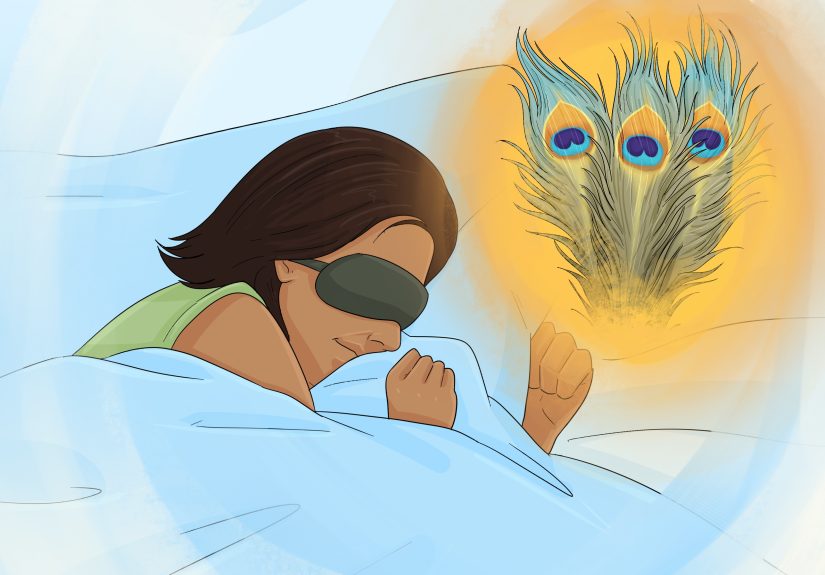
In dream interpretation, peacock feathers are often associated with self-image, confidence, spiritual awareness, and the desire to be recognized. A bright, healthy feather may suggest rising self-worth or creative awakening. A damaged feather may point to insecurity, wounded pride, or fear of being judged.
If the dream emphasizes the eyespot, the theme may center on perception. What are you refusing to see? What truth is finally becoming visible? If the dream emphasizes color and beauty, it may speak to joy, artistry, and the recovery of vitality.
As with any dream symbol, context matters. Dreams are not crossword puzzles with one perfect answer. They are more like emotional theater with props.
Peacock Feather Meaning in Modern Life
Today, peacock feather symbolism often appears in a more personal and less doctrinal way. People use it in journaling, meditation corners, mood boards, weddings, branding, and home décor because it communicates drama, elegance, intuition, and individuality all at once.
There is also a reason peacock imagery appeals to people going through reinvention. The feather carries a message many adults secretly need: you are allowed to grow into someone more vivid. You do not have to stay emotionally beige just because it makes other people comfortable.
At its best, the peacock feather represents alignment between outer expression and inner truth. At its worst, it warns against confusing attention with substance. Both meanings are useful. The symbol becomes wise precisely because it is not simplistic.
How to Interpret Peacock Feather Symbolism for Yourself
If a peacock feather keeps showing up in your thoughts or surroundings, consider these questions:
- Where in my life am I being asked to be more visible?
- Am I expressing confidence or performing for approval?
- What truth am I beginning to see more clearly?
- What part of me is ready for renewal?
- How can I balance beauty, dignity, and humility?
The strongest spiritual symbols are the ones that help you live more honestly. Peacock feather meaning is not about decorating your life with mystical glitter. It is about understanding what beauty, awareness, and self-respect look like when they are rooted in something real.
Experiences Related to Peacock Feather Meaning and Spiritual Symbolism
Many people do not become interested in peacock feather symbolism because they read a textbook or wandered into an art history lecture by accident. Usually it starts with an experience. Someone sees a feather in unexpected light and feels oddly emotional. Someone receives one during a difficult season and decides it must mean something. Someone notices peacock imagery showing up over and over when life feels messy, uncertain, or ready to change. These experiences are subjective, of course, but that is exactly why they matter. Symbolism becomes meaningful at the point where facts meet feeling.
One common experience is finding a peacock feather during a period of self-doubt. In that moment, the feather can feel like a tiny but memorable interruption. You may have been moving through life trying not to take up too much space, and then suddenly there it is: a feather that looks like confidence turned into architecture. People often describe feeling encouraged by that contrast. The symbol does not magically solve anything, but it can act like a mirror. It reflects back the version of yourself that is more vivid, more awake, and a little less willing to apologize for existing.
Another experience happens in homes. Some people keep a peacock feather on a desk, shelf, or altar-like corner because it changes the emotional tone of the room. It can serve as a visual reminder to stay alert, grounded, and expressive. On hard days, the feather may symbolize resilience. On creative days, it may symbolize inspiration. On chaotic days, it may simply remind you that beauty still exists, even when your inbox is performing a dramatic monologue and your to-do list is behaving like a villain.
People also connect peacock feathers with identity shifts. Someone starts a new career, leaves an unhealthy relationship, moves to a new city, or begins healing old wounds, and suddenly the feather feels relevant in a new way. Its iridescence becomes symbolic of layered growth. You are not becoming one flat, simple version of yourself. You are becoming someone with depth, range, and changing color depending on the light. That can be a comforting idea when transformation feels awkward, because real growth rarely looks graceful in the middle.
There are also experiences that feel more cautionary. Not everyone sees a peacock feather and thinks, “Wonderful, this is clearly a sign of enlightened self-expression.” Sometimes it prompts more uncomfortable reflection. Am I chasing admiration instead of meaning? Am I too focused on appearance? Am I confusing attention with worth? In that sense, the feather can work like a symbol of accountability. It asks whether your shine is coming from authenticity or performance. That question is not always pleasant, but it is often useful.
For many people, the deepest experience related to peacock feather meaning is not supernatural at all. It is personal. The feather becomes attached to a memory: a grandmother’s house, a museum visit, a moment of grief, a season of reinvention, a prayer answered slowly, or a decision finally made with courage. The symbolism grows because the experience grows around it. Over time, the feather stops being just an object and becomes a shorthand for a lesson: be visible, stay aware, trust your growth, and do not let your beauty become disconnected from your character.
That may be the most enduring spiritual meaning of all. A peacock feather does not have to predict the future to be significant. It only has to help you see yourself and your life a little more clearly. Sometimes that is the most sacred thing a symbol can do.
Conclusion
Peacock feather meaning and spiritual symbolism are rich because the feather itself is rich. It has inspired myth, sacred art, decorative tradition, and modern personal reflection for good reason. Depending on the context, it can symbolize confidence, awareness, immortality, renewal, royalty, protection, or the cautionary edge of pride. The most honest interpretation usually holds both beauty and wisdom together.
If a peacock feather resonates with you, let it be more than a pretty object. Let it remind you to notice what is changing, honor what makes you distinct, and carry yourself with a little more truth and a little less fear. In a world that often rewards blandness, the peacock feather offers a very different message: be radiant, but be real.