Table of Contents >> Show >> Hide
- What Is the Game of 58 Holes?
- Why the New Discovery Matters
- From Pharaohs to Cattle Herders: A Game for Everyone
- How Hounds and Jackals May Have Been Played
- Why Egypt Was Long Considered the Birthplace
- The Board Game as Bronze Age Wi-Fi
- Is It Really the World’s Oldest Board Game?
- Why Ancient Board Games Still Matter
- What This Discovery Changes
- Personal Experiences and Modern Reflections on an Ancient Game
- Conclusion: The Past Was More Playful Than We Imagine
Long before family game night meant arguing over missing Monopoly money or flipping a table after a suspiciously lucky dice roll, people were already huddling around boards, moving pieces, and hoping the next throw would save them from embarrassment. One of the most fascinating examples is the ancient board game known today as Hounds and Jackals, or more simply, the Game of 58 Holes.
For years, many historians believed this ancient board game began in Egypt around 4,000 years ago. That idea made sense. Some of the best-preserved examples came from Egyptian tombs, including elegant boards with animal-headed playing pins, carefully carved holes, and symbols tied to good fortune and protection. But archaeology has a funny habit of tapping accepted history on the shoulder and saying, “Actually, we need to talk.”
Recent research into game boards found in present-day Azerbaijan suggests that Hounds and Jackals may be older, more widespread, and more culturally complex than previously believed. Instead of being a purely Egyptian invention that traveled outward, the game may have had deeper roots in southwestern Asia, where herders, traders, and travelers used play as a bridge between communities. In other words, one of the world’s oldest board games may have been the Bronze Age version of “let’s break the ice with a quick round.”
What Is the Game of 58 Holes?
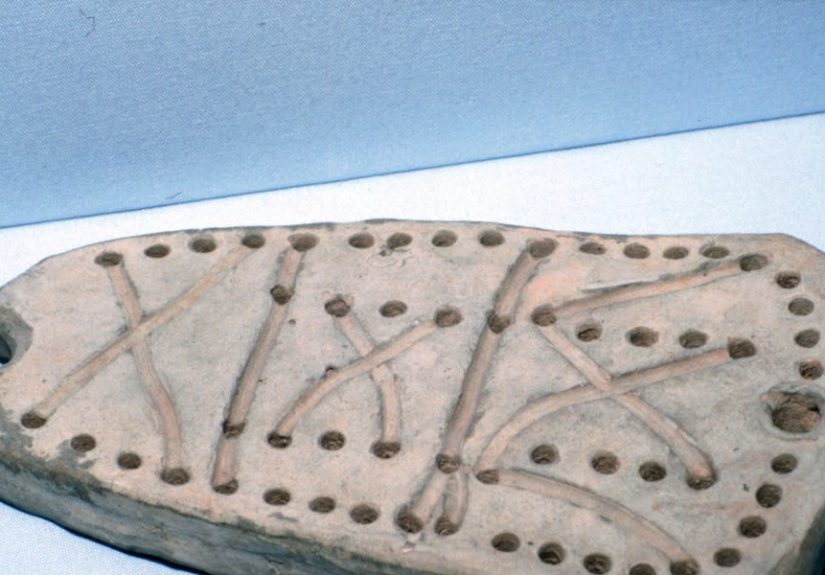
The Game of 58 Holes is a two-player race game. Its name comes from the layout: a board with 58 holes, usually arranged as two central rows surrounded by an outer arc. Each player likely moved a set of pegs along a track toward a final goal, using dice, casting sticks, knucklebones, or another chance-based tool to determine movement.
The game is also called Hounds and Jackals because one famous Egyptian set included ten pins: five topped with hound heads and five topped with jackal heads. That detail gives the game a little personality. Modern board games have plastic tokens shaped like shoes, cars, and tiny battleships. Bronze Age players apparently preferred stylish canine drama.
How the Board Was Designed
The classic layout includes two parallel rows of holes in the center and a horseshoe-shaped arc around them. Some boards also include special markings, connecting lines, larger goal holes, or symbols that probably changed gameplay. These features may have worked like shortcuts, penalties, safe spaces, or bonus squares. If that sounds familiar, it should. The basic idea resembles modern race games such as Chutes and Ladders, Ludo, Parcheesi, and parts of backgammon-style play.
Of course, no complete instruction manual has survived. Nobody has found a Bronze Age booklet titled “Hounds and Jackals: Official Rules, No Cheating, Even If You Are Pharaoh.” Archaeologists reconstruct the game by studying board layouts, pieces, ancient contexts, and comparisons with other race games.
Why the New Discovery Matters
The exciting twist comes from carved game boards discovered on the Abşeron Peninsula and nearby areas in Azerbaijan. Researchers identified multiple examples of the 58 Holes pattern at sites including Çapmalı, Ağdaşdüzü, Yeni Türkan, and Dübəndi. Some were carved into rock surfaces. Others appeared on movable stone pieces or in burial contexts.
These discoveries matter because several of the boards appear to date from the late third millennium to early second millennium BCE. That places them around the same time as, and possibly earlier than, the oldest securely dated Egyptian examples. This does not prove beyond all doubt that Azerbaijan was the birthplace of the game. Archaeology is not a courtroom TV show where someone dramatically points at a stone slab and wins the case. But the evidence does challenge the older assumption that Egypt must have been the origin point.
Instead, the game may have developed in a broader cultural zone that included the Caucasus, Anatolia, Mesopotamia, Iran, and Egypt. The more archaeologists look, the more the Game of 58 Holes appears not as a local Egyptian curiosity, but as a shared ancient pastime carried across trade routes, seasonal migration paths, and social networks.
From Pharaohs to Cattle Herders: A Game for Everyone
One of the most interesting parts of the discovery is not just where the boards were found, but who may have played them. In Egypt, Hounds and Jackals appears in elite settings, including tombs. The Metropolitan Museum of Art’s famous Middle Kingdom board is a finely made object, with ebony, ivory, animal-headed pins, and a drawer for storing the pieces. It is not exactly the kind of thing you toss into a backpack next to a half-eaten granola bar.
In Azerbaijan, however, at least some boards were associated with rock shelters and seasonal pastoral communities. That suggests the game was not limited to palaces, officials, or wealthy tomb owners. It may also have been enjoyed by cattle herders, travelers, and people living far from urban centers. This makes the game feel wonderfully human. Whether you were a high-status Egyptian official or a herder sheltering near the Caspian Sea, you still needed entertainment, competition, and maybe a chance to boast after a lucky move.
A Social Tool, Not Just a Toy
Ancient games were more than idle amusement. They helped people interact. When two strangers shared a game, they shared rules, gestures, laughter, frustration, and trust. A game could turn awkward silence into friendly rivalry. It could help traders pass time, travelers build relationships, and communities exchange customs without needing a formal treaty or a very boring committee meeting.
This is why scholars sometimes describe board games as “social lubricants.” The phrase sounds like something from a corporate team-building retreat, but it makes sense. Games smooth social interaction. They give people a reason to sit together, follow the same rules, and recognize each other as partners in play rather than outsiders.
How Hounds and Jackals May Have Been Played
Because no ancient rulebook survives, the exact gameplay is uncertain. Still, most reconstructions agree on the basics: two players raced pieces along a track of holes. Each player probably had five pins. Movement may have been decided by casting sticks, dice, or knucklebones. The goal was likely to move all pieces to the endpoint before the other player.
Special holes may have changed the flow of the game. On some Egyptian boards, certain spaces are marked with the hieroglyph nefer, meaning “good.” These likely gave the player some advantage. Other holes were connected by lines, possibly creating shortcuts or setbacks. Imagine landing on a space and discovering that your piece either leaps ahead heroically or slides backward like it stepped on a banana peel. Human frustration, apparently, is ancient.
The larger top hole may have represented the finish. On some Egyptian examples, this goal is associated with the shen symbol, connected with eternity and protection. That symbolic layer matters because games in ancient Egypt were often more than entertainment. They could reflect ideas about fate, order, danger, luck, and the journey beyond life.
Why Egypt Was Long Considered the Birthplace
Egypt earned its reputation as the likely home of Hounds and Jackals because many early and beautiful examples came from Egyptian archaeological contexts. The dry climate helped preserve delicate materials such as wood and ivory. Tombs also protected objects that might have vanished elsewhere. When archaeologists find more examples in one place, it is tempting to assume that place is the origin.
But preservation can be misleading. A wooden board in a damp region might decay. A game scratched into dirt might disappear after one season. A portable board could be traded, gifted, stolen, copied, or carried across hundreds of miles. The archaeological record is not a complete library; it is more like a box of puzzle pieces that survived a flood, a fire, and several thousand years of bad luck.
The Azerbaijan finds help correct that imbalance. They show that similar game patterns existed far from Egypt, in contexts that were not always elite or urban. That broadens the story from “Egypt invented it, everyone copied it” to something more interesting: multiple regions may have participated in creating, adapting, and spreading the game.
The Board Game as Bronze Age Wi-Fi
One reason the Game of 58 Holes is so fascinating is that it reveals ancient connection. Today, trends travel through social media, streaming platforms, and group chats. In the Bronze Age, ideas traveled by caravan, boat, migration, marriage, diplomacy, and trade. A game board could move with merchants. A traveler could teach the rules at a campsite. A local craftsperson could copy the pattern onto stone, wood, clay, or ivory.
In that sense, Hounds and Jackals functioned like cultural Wi-Fi. It connected people across distance without needing a shared empire or language. The board’s pattern became recognizable enough that communities from Egypt to Anatolia and the Caucasus could understand it, adapt it, and make it their own.
Regional Variations Tell a Bigger Story
Not every board looks identical. Some have different shapes. Some have more elaborate lines. Some are portable, while others are carved into rock. Egyptian boards tend to show certain regular patterns, while boards from southwestern Asia sometimes include crossover lines or different arrangements. These variations are not mistakes. They are clues.
When a game spreads, people modify it. Think of how card games change from one family to another. One household plays with strict rules. Another invents a “bonus round” that nobody can explain but everyone defends passionately. Ancient players probably did the same. The board stayed recognizable, but local versions emerged.
Is It Really the World’s Oldest Board Game?
Here is where we need to be precise. Hounds and Jackals is one of the world’s oldest known board games, but it is not the only ancient contender. Egypt’s Senet and Mehen, as well as the Royal Game of Ur from Mesopotamia, are also extremely old. Some date back to the third millennium BCE or earlier. The oldest possible gaming objects are even harder to interpret because archaeologists must decide whether a pattern of holes is truly a game, a counting tool, a ritual object, or something else entirely.
So the best way to say it is this: the Game of 58 Holes is among the oldest recognizable board games with a wide ancient distribution, and new evidence suggests its early history may stretch farther north and deeper into southwestern Asia than many scholars once thought.
That makes the story better, not weaker. Instead of a simple “oldest game found” headline, we get a richer picture of ancient creativity. This was not just a toy. It was a portable system of rules, chance, strategy, symbols, and social connection.
Why Ancient Board Games Still Matter
Ancient board games matter because they remind us that people in the distant past were not always building monuments, fighting wars, or looking solemnly at the horizon like museum statues. They were also relaxing, laughing, competing, and probably accusing each other of suspiciously lucky throws.
Board games reveal the everyday side of ancient life. They show how people spent downtime. They hint at how children learned counting, how adults built friendships, how travelers passed long evenings, and how communities shared ideas. A board carved into stone can tell us about trade routes, social class, symbolism, and leisure all at once.
The Game of 58 Holes is especially powerful because it crossed boundaries. It appeared among Egyptian elites, Near Eastern traders, Anatolian communities, and Caucasus herders. That range suggests the game was easy enough to learn, meaningful enough to keep, and fun enough to spread.
What This Discovery Changes
The Azerbaijan evidence does not erase Egypt from the story. Egyptian examples remain essential, especially because they are often beautifully preserved and richly symbolic. But the new discoveries expand the map. They suggest the game’s origin and early spread were more complicated than a single-country invention story.
Instead of imagining Hounds and Jackals as a game that simply radiated outward from Egypt, we can imagine a lively network of Bronze Age players. Some carved boards into shelter floors. Some placed luxury sets in tombs. Some carried small boards across trading routes. Some may have drawn temporary versions in dust, played a few rounds, and left no trace for archaeologists to find.
This is why a few carved holes in stone can matter so much. They do not just show that people played a game. They show that ideas moved, rules traveled, and fun had a geography.
Personal Experiences and Modern Reflections on an Ancient Game
Thinking about Hounds and Jackals today makes modern board game nights feel part of a very long human tradition. The next time someone groans because they rolled badly, it is comforting to imagine a Bronze Age player doing the same thing 4,000 years ago. Different language, different clothes, same emotional damage from a terrible turn.
One of the best ways to connect with this topic is to recreate a simple version of the board. You do not need ivory, ebony, or a tomb-ready storage drawer. A sheet of paper, a pencil, ten small tokens, and a few coins or dice can capture the basic experience. Draw two central rows of holes, curve an outer track around them, mark a few special spaces, and create a finish point. The rules can be simple: roll, move, race, and let marked spaces send players forward or backward.
Playing a reconstructed version quickly changes how you think about archaeology. The board stops being a museum object and becomes a living system. You notice how suspense builds when two pieces approach the same area. You start wondering whether special holes were rewards, traps, safe spaces, or shortcuts. You realize that even a simple race game can create drama, rivalry, and laughter.
This experience also shows why the game spread so well. It is portable in concept. Once someone teaches you the pattern and basic rules, you can reproduce it almost anywhere. Scratch it into dirt. Carve it into stone. Paint it on wood. Draw it on cloth. The materials change, but the play survives. That flexibility may explain why the Game of 58 Holes traveled across such a wide region.
There is also something surprisingly emotional about ancient games. Tools show work. Weapons show conflict. Jewelry shows identity and status. But games show free time, imagination, and the desire to connect. A game board says, “Someone sat here with another person and cared about what happened next.” That is a small sentence with a huge human echo.
For educators, parents, writers, and history fans, Hounds and Jackals is a perfect doorway into the ancient world. It does not require memorizing a list of kings or battles. It begins with a simple question: “Want to play?” From there, it opens into archaeology, trade, symbolism, cultural exchange, and the psychology of competition.
It also offers a useful reminder for the digital age. Our games are flashier now. They glow, update, track scores, and occasionally demand a 12-gigabyte download at the worst possible time. But the heart of play has not changed much. We still gather around shared rules. We still cheer for lucky turns. We still learn about people by how they win, lose, bluff, joke, and recover.
That may be the real reason one of the world’s oldest board games still feels fresh. Hounds and Jackals is not just older than we thought. It is closer to us than we expected.
Conclusion: The Past Was More Playful Than We Imagine
The Game of 58 Holes proves that ancient history is not only about temples, tombs, kings, and conquests. It is also about people making time to play. New evidence from Azerbaijan suggests that Hounds and Jackals may have been part of a wider Bronze Age gaming culture that connected Egypt, the Caucasus, Anatolia, Mesopotamia, and Iran.
Whether the game began in Egypt, southwestern Asia, or somewhere still waiting to be excavated, its importance is clear. It crossed borders, social classes, and landscapes. It belonged to elites and herders, tombs and rock shelters, luxury objects and simple carved surfaces. It was strategy, luck, art, and conversation all packed into 58 little holes.
And that is the charm of it. Thousands of years before modern board game shelves became dangerously crowded, ancient players already understood the magic of a good game: a few pieces, a shared rule, a little chance, and the irresistible belief that the next move might change everything.
Note: This article is based on real archaeological research, museum records, and science-history reporting. External source links are intentionally omitted from the HTML for clean web publication.