Table of Contents >> Show >> Hide
- What Exactly Is the Matenadaran?
- First Impressions: Stone, Silence, and Serious Gravitas
- What You’ll Actually See Inside
- How Manuscripts Were Made (And Why That Matters in Matenadaran)
- The Preservation Science Behind the Beauty
- Why Matenadaran Feels Different from a Typical Museum Visit
- Tips to Get More from Your Visit
- Conclusion: Why This Museum Belongs on Your Cultural Bucket List
- Extended Experience Journal: A 500-Word Walk Through Matenadaran
Some museums make you whisper. Matenadaran makes you rethink time itself.
Perched above Yerevan like a stone guardian of memory, this legendary manuscript museum is where language, faith, science, and art all shake hands across centuries. You don’t walk in and see “old books.” You walk in and meet human voices that survived empires, invasions, climate, fire, and bad storage decisions by people long gone.
If you love history, typography, religion, medieval art, conservation science, or simply the thrill of seeing how civilization writes itself into existence, this place is an absolute knockout. Matenadaran is often introduced as a museum of ancient manuscripts, but that description is like calling the Grand Canyon “a hole.” It’s true… and wildly incomplete.
Inside, you’ll find illuminated Gospels, scholarly texts on medicine and astronomy, legal writings, chronicles, and translations that preserved ideas that disappeared elsewhere. You’ll also find something unexpectedly modern: world-class preservation work that keeps parchment, pigments, and bindings alive for future generations. In other words, this is where the past is not just displayedit’s actively protected.
This guide takes you inside the Matenadaran experience: what it is, why it matters, what you’ll see, and how to appreciate the museum like more than a quick “photo stop.” Bring your curiosity. And maybe leave your “I can skim this in 15 minutes” mindset at the door.
What Exactly Is the Matenadaran?
A National Treasure with Global Importance
“Matenadaran” broadly refers to a manuscript repository, and in modern usage it points to the Mesrop Mashtots Institute of Ancient Manuscripts in Yerevan. It functions as museum, research center, and conservation institution all at once. That combination is key: this is not a frozen display of relics, but a living scholarly ecosystem.
The institution is named for Mesrop Mashtots, the monk and scholar associated with creating the Armenian alphabet in the early 5th century. That alphabet wasn’t just a writing upgrade; it changed cultural destiny. Once Armenian became a powerful written medium, scholars translated major works and produced original literature that helped preserve theology, philosophy, history, and science for the region and beyond.
Not Just Armenian, Not Just Religious
Yes, Armenian illuminated manuscripts are the visual stars of the showand deservedly so. But the intellectual breadth is what surprises many visitors. Manuscript traditions here extend into medicine, astronomy, geography, law, and linguistics. You begin to understand that medieval manuscript culture was not niche. It was infrastructure.
And while Armenian identity is central, the wider cultural web is impossible to miss. Manuscript traditions connect Armenia to Greek, Syriac, Persian, Arabic, and broader Eurasian intellectual worlds. Think of Matenadaran as a crossroads archive: local roots, global conversations.
First Impressions: Stone, Silence, and Serious Gravitas
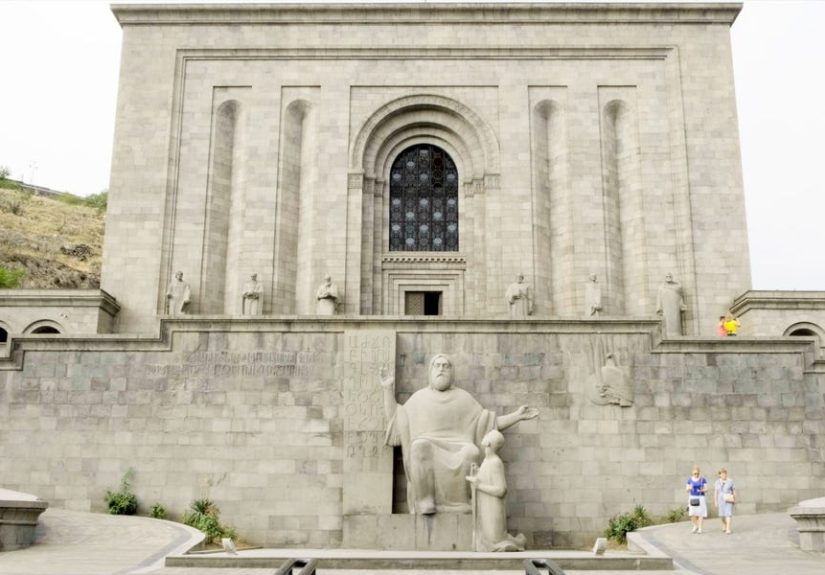
Arriving at Matenadaran feels cinematic in the best way. The architecture is monumental, with a dramatic stair approach and the commanding presence of Mesrop Mashtots at the entrance. Before you even see a single folio, the building announces the museum’s mission: language is civilization, and civilization needs guardians.
Step inside, and the mood shifts from grand exterior drama to focused calm. Lighting is controlled, noise drops, and your pace naturally slows. You stop being a “tourist checking boxes” and start becoming a reader of visual clues: script styles, marginal marks, pigment choices, binding structures, and tiny signs of human handling.
If you usually race through museums, Matenadaran will gently (or not so gently) retrain you. This is a place that rewards attention. One manuscript can hold theology, craftsmanship, politics, travel routes, and private emotion all on the same page.
What You’ll Actually See Inside
Illuminated Manuscripts That Still Feel Electric
Armenian Gospel books and devotional manuscripts are often the first visual “wow” moment. Gold leaf, intricate initials, narrative miniatures, and dynamic layout design show the confidence of a mature manuscript culture. These books were not just copied texts; they were designed objects meant to communicate authority, beauty, and meaning.
Look closely and you’ll notice that medieval page design was already solving problems modern designers still care about: hierarchy, pacing, visual rhythm, and attention control. In other words, your favorite app designer from 2026 has medieval cousins.
Texts That Prove the Middle Ages Were Not “Dark”
Beyond religion, you encounter works tied to practical knowledge: medicine, natural science, chronology, legal codes, and educational material. These manuscripts reveal a world that observed, recorded, translated, and debated. The stereotype of medieval society as uniformly anti-intellectual collapses quickly when you meet these pages.
Some of the most compelling pieces are those that blend traditions: religious text beside scientific notes, scholastic commentary beside artistic innovation. Manuscripts were often multifunctional knowledge platforms, not single-topic books.
Material Clues: Ink, Parchment, Damage, Repair
One of the most fascinating parts of the Matenadaran experience is learning to read manuscripts as physical objects. Parchment quality varies. Rulings guide text alignment. Pigments reveal workshop choices. Repairs show historical care decisions. Marginal notes expose how later readers interpreted the same text.
Once you see these clues, manuscripts stop being “precious old things behind glass” and become evidence-rich artifacts of real use. They were touched, carried, kissed, taught from, copied, corrected, and sometimes patched in ways that are almost endearingly practical.
How Manuscripts Were Made (And Why That Matters in Matenadaran)
To appreciate the collection deeply, it helps to understand medieval book production. In many traditions, manuscript making followed several major stages: preparing parchment or vellum, ruling pages, writing with quill and ink, adding illumination (including metallic leaf and pigments), then sewing and binding gatherings into durable codices.
That process demanded teamworkparchment makers, scribes, illuminators, bindersand high material literacy. You can see echoes of these steps in the finished objects at Matenadaran: script density, page planning, pigment layering, and binding wear patterns all tell production stories.
There’s a practical lesson here for modern readers: durability is designed. These manuscripts survived not by luck alone but by skilled fabrication plus centuries of care. Longevity is a craft outcome.
The Preservation Science Behind the Beauty
Why You Don’t See Bright Spotlights Everywhere
Paper and parchment are vulnerable to light, heat, humidity swings, and pollutants. That’s why responsible manuscript display spaces feel a bit dim and disciplined. Controlled lighting and tightly managed environmental conditions are not aesthetic quirks; they are survival strategy.
Museums and conservation centers worldwide emphasize environmental monitoring, protective housing, and careful exhibition rotation for fragile collections. Matenadaran’s presentation style makes much more sense once you recognize this conservation logic.
Damage Is Part of the Story
If you spot repaired tears, stitched parchment defects, or awkward page irregularities, don’t dismiss them as flaws. They are historical data. They show manufacturing constraints, user habits, and preservation choices across centuries. Some “imperfections” are, in fact, the most intimate proof that these books were used by real communities.
Why Matenadaran Feels Different from a Typical Museum Visit
Most museums give you objects; Matenadaran gives you continuity. You see how a language became a civilizational tool, how scholarship survived political upheaval, and how art and information coexisted on every page. It’s deeply human and surprisingly emotional.
There is also a quiet intellectual thrill in realizing that many manuscripts are part of larger diaspora networks and scholarly exchange. The story doesn’t stop in one building, one city, or one century. Matenadaran is a node in a much larger map of memory.
Tips to Get More from Your Visit
- Give yourself real time. This is not a 20-minute museum.
- Read labels fully. Colophons and production notes are goldmines.
- Compare at least three manuscripts side by side. Script and layout differences become obvious fast.
- Notice material details. Binding, page edges, repairs, pigment densitythese are part of the narrative.
- Pace your attention. Alternate close looking with short breaks; manuscript fatigue is real.
Conclusion: Why This Museum Belongs on Your Cultural Bucket List
Matenadaran is one of those rare places where history doesn’t feel abstract. You can almost sense the hand pressure of scribes, the patience of illuminators, and the urgency of communities preserving knowledge under pressure. It’s a museum of ancient manuscripts, yesbut also a museum of human persistence.
If you care about language, archives, medieval art, or the long story of how ideas survive, this museum is unforgettable. You leave with more than photos. You leave with a new respect for the people who copied, carried, protected, and reinterpreted texts so the future would still have a past.
Extended Experience Journal: A 500-Word Walk Through Matenadaran
You start at the base of the stairs with sunlight on stone and the feeling that you’re approaching a fortress built to defend memory instead of territory. The city hums behind you, but the climb changes your tempo. By the time you reach the entrance, your breathing has slowed and your attention has sharpened. That’s your first clue: this place asks you to arrive differently.
Inside, the air feels cooler and more deliberate. You move from gallery to gallery and quickly realize that every manuscript is doing two jobs at once: carrying content and performing identity. One page proclaims faith, another displays scholarship, another quietly signals status through costly pigments and careful ornament. You thought you were coming to see old texts; instead, you’re reading social history line by line.
In front of a richly illuminated Gospel, you catch yourself leaning in like you’re trying to hear it speak. Gold accents still hold light with startling confidence. Tiny figures in the margins seem both symbolic and alive. It’s impossible not to imagine the people who made this pagethe scribe measuring lines, the artist grinding color, the binder tightening structure so the book could endure hands, travel, and time.
Then your eye lands on a repaired tear. A stitch. A patched gap. Suddenly the manuscript becomes even more human. Someone, centuries ago, chose to mend rather than discard. That choice echoes into your present moment. Conservation isn’t only technical; it’s ethical. It says: this still matters.
As you continue, the themes widen. Religious works stand beside texts tied to medicine, law, and learning. You begin to feel how manuscript culture functioned as a civic system, not merely devotional art. Knowledge lived in codices the way modern infrastructure lives in servers. Different medium, same stakes.
You notice how your body behaves in the galleries: quieter steps, longer pauses, fewer reflex photos, more actual looking. In most museums, your attention scatters. Here, it concentrates. Even visitors who arrived chatting loudly tend to lower their voices and slow down. The manuscripts seem to teach etiquette without saying a word.
Somewhere in the middle of the visit, you get the emotional core of the place. These works survived because people repeatedly decided they were worth savingthrough political upheaval, migration, and changing technologies. Matenadaran doesn’t present survival as a miracle without labor; it shows survival as accumulated care.
When you finally step back outside, Yerevan feels brighter, louder, and somehow newer. You just spent hours with objects older than many states, yet you come out thinking about the future: what we preserve, what we digitize, what we teach, what we let disappear. That is the museum’s final trick. It sends you in to look backward and sends you out looking forward.
And that’s why the experience lingers. Not because the manuscripts are ancient, but because they feel immediate. They remind you that culture is not inherited automatically. It is copied, repaired, translated, curated, and handed onagain and againby people who believe tomorrow deserves access to yesterday.