Table of Contents >> Show >> Hide
- From Czech Workshop to Design Crush
- Why Porcelain Makes This Leap So Well
- The Rise of Functional Decor
- How JIPO Works in Real Rooms
- What Makes It So Attractive, Exactly?
- The Limits of the Fantasy
- Experience: What It Feels Like to Actually Live With Lab Ware at Home
- Conclusion: The Hypothesis Holds Up
Some objects practically beg to be admired. Others just want to get the job done. JIPO’s porcelain lab ware somehow manages to do both at once, which is exactly why it feels so surprisingly at home outside the lab. At first glance, a porcelain beaker, mortar, or pouring dish sounds like the kind of thing that belongs beside goggles and a stern safety poster. But look a little closer and the whole category starts to feel less like science equipment and more like the dreamiest kind of design: unfussy, useful, sculptural, and quietly confident.
That is the central hypothesis here: JIPO’s porcelain lab ware is pretty enough to bring home because it was never relying on prettiness alone. Its appeal comes from proportion, purpose, and material honesty. These pieces look good not because someone added flourishes, but because the forms were refined by function. In a home full of overdesigned gadgets and decorative objects that contribute little beyond collecting dust, that kind of restraint feels almost luxurious.
And maybe that is why this look lands right now. American interiors have been shifting toward natural materials, practical beauty, open shelving, and objects that earn their keep. We are living in the era of the visible kitchen, the styled utility room, and the bathroom counter that somehow has to feel both useful and serene. In that world, JIPO’s porcelain lab ware does not read as clinical. It reads as crisp, thoughtful, and a little bit genius.
From Czech Workshop to Design Crush
JIPO is tied to Jizerská porcelánka, a Czech porcelain maker with roots that go back to the 19th century. The company history matters because it explains why these pieces feel so assured. This is not a novelty brand trying to cosplay as a science lab. It comes from a long manufacturing tradition that began with utility ceramics and later moved into technical porcelain and laboratory wares. In other words, the DNA here is not decorative theater. It is practical making, refined over time.
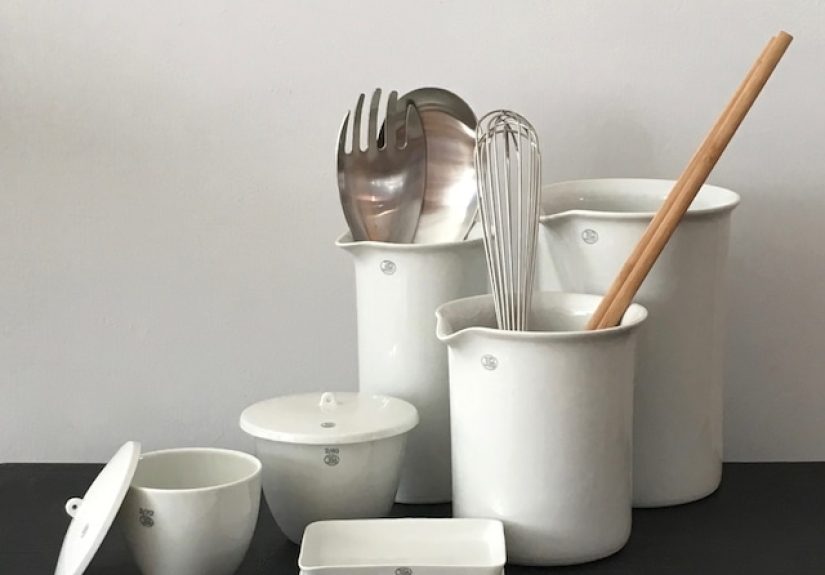
That backstory gives the collection a kind of authority you can feel, even if you never read a word about the brand. The beakers have that steady, balanced look of things designed to be handled. The pouring dishes have lips and curves that make visual sense before you even use them. The mortars and pestles are satisfyingly weighty, not fussy little countertop actors auditioning for a rustic kitchen drama.
It also helps that JIPO’s forms are unusually clean. They are laboratory objects, yes, but they are laboratory objects with the kind of simple geometry that design lovers reliably lose their minds over. A cylinder is a classic for a reason. A shallow bowl with a spout is still a beautiful shape. A white porcelain slab is never exactly going to start a visual argument with your walnut table or brushed steel faucet.
Why Porcelain Makes This Leap So Well
It has the right visual language
Porcelain carries a lot of cultural baggage, and for once that is a good thing. Historically, it has been prized as a refined domestic material, associated with tableware, display pieces, and carefully made household objects. So even when porcelain appears in a lab form, your brain still registers some part of it as familiar and domestic. It may be a beaker, but it is also white, smooth, tactile, and elegant. It already speaks a language the home understands.
That dual identity is the magic trick. Glass labware often feels transparently scientific. Stainless tools can lean industrial. Plastic containers scream “temporary solution.” But porcelain lands in the sweet spot between technical and timeless. It feels calm. It feels considered. It feels like it belongs near coffee beans, sea salt, hand soap, and peonies.
It was built to work
Porcelain is not just a pretty face with a superiority complex. Ceramic materials are valued for traits like hardness, heat tolerance, and chemical resistance, though they can also be brittle if dropped. That combination of toughness and vulnerability is familiar to anyone who has loved good ceramics: dependable right up until gravity decides to become involved. JIPO’s laboratory pieces benefit from that practical heritage, which is one reason they feel more substantial than purely decorative ceramics.
That working pedigree matters in the home. People are increasingly drawn to objects that feel honest, durable, and specific. We like a brush that looks like a brush, a stool that looks like a stool, and a vessel that seems capable of doing something more important than merely existing near a candle. JIPO fits neatly into that appetite for useful beauty.
The Rise of Functional Decor
One reason JIPO’s porcelain lab ware feels so current is that interiors have become friendlier to visible utility. Design media has been championing the idea that kitchenware, storage, and work tools can double as decor, especially in smaller homes and open-plan spaces where the practical stuff is already on display. In that context, a porcelain measuring pitcher or beaker is not clutter. It is part of the room’s visual rhythm.
That is a real shift. For years, “nice things” and “useful things” were treated like bickering cousins at Thanksgiving. Decor was meant to be styled. Tools were meant to be hidden. Now, the line is blurrier in a much more interesting way. Shelves hold bowls, books, grinders, jars, and found objects together. A workaday item can become part of a vignette if it has good form, good texture, and a little conviction.
JIPO’s pieces have all three. They are minimalist without being cold, practical without being ugly, and neutral without being boring. They play well with stone, steel, wood, linen, concrete, and glass. That is a rare social skill for an object category originally designed to help evaporate solvents.
How JIPO Works in Real Rooms
In the kitchen
This is the easiest case to make. A porcelain beaker can hold wooden spoons, tasting spoons, cocktail picks, or tea sachets. A shallow pouring dish can corral flaky salt, lemons, garlic skins, or prep scraps while you cook. A mortar and pestle can do what mortar and pestles have always done best: grind spices, smash garlic, bruise herbs, and make you feel dramatically more competent than you were five minutes ago.
The key is that these objects do not have to be hidden after use. A lot of kitchen gear is visually exhausting. JIPO pieces are not. Leave them on the counter and they look intentional. Put them on open shelving and they contribute shape and brightness without shouting for attention.
That said, common sense deserves a seat at the table. If you want to use any lab-style porcelain for food preparation, serving, or heating, verify the maker’s care and safety guidance for that specific piece first. “Looks like it could hold aioli” and “is officially intended for aioli” are not always the same thing.
In the bathroom
Bathrooms love an object that can be both crisp and soothing. JIPO’s white porcelain works beautifully with soap, cotton pads, toothbrushes, bath salts, and skin-care tools. A slim vessel beside the sink feels tidier than a random assortment of packaging, and a low porcelain dish can bring a little order to rings, hairpins, and the one bobby pin that has apparently been living there rent-free since spring.
Because the material reads clean and spare, it helps reduce visual noise. Even when the counter is busy, porcelain has a way of making a setup look more composed.
On a desk or shelf
Office supplies are usually one bad step away from looking like a junk drawer exploded in public. Porcelain changes the mood. Pens, clips, matches, notes, charging cords, and even that mysterious adapter you refuse to throw out all look better when contained by something with a little dignity. JIPO’s lab forms bring structure without heaviness, which is especially useful in creative workspaces where you want the room to feel alive but not chaotic.
On bookshelves, the same logic applies. A few porcelain pieces can punctuate rows of books and softer textiles with a cool, matte brightness. The effect is less “chemistry classroom” and more “person with taste who understands negative space.”
What Makes It So Attractive, Exactly?
The short answer is proportion. JIPO pieces are often based on archetypal forms: cylinders, shallow bowls, spouts, rounded interiors, and broad, stable bases. These are shapes that feel inevitable. When a design looks inevitable, people tend to read it as beautiful, even if they cannot explain why.
The longer answer is that the collection taps into a design principle that has been around forever: form and function are not enemies. When an object is well made for its purpose, the result can be visually satisfying in a way that ornament alone rarely achieves. Bauhaus thinking made a religion out of this idea, but you do not need a design history lecture to appreciate it. You just need to notice how relaxing it is to encounter something that is not trying too hard.
JIPO’s porcelain lab ware has that quality. It is restrained, but not sterile. Precise, but not stiff. Familiar, but not common. It feels like the design equivalent of a person who speaks softly and still somehow runs the room.
The Limits of the Fantasy
Now for the part where we respect reality. Porcelain is durable in many ways, but it is still ceramic. Drop it on a hard floor and it may chip or crack. Stack it carelessly and you may get more “archaeological fragment” than “design object.” A laboratory heritage does not make it invincible; it just means the pieces were developed with demanding use cases in mind.
There is also a styling trap to avoid. If you fill your kitchen with too many overtly lab-like items, the room can slide from “intelligent minimalism” into “science fair but make it beige.” The trick is to use these pieces as accents, not a theme park. Pair them with wood boards, woven textiles, fresh produce, cookbooks, or brushed metal. Let them be part of a home, not a costume for one.
And finally, remember that not every beautiful object needs a heroic purpose. Sometimes it is enough that a thing is useful and lovely at the same time. That is not frivolous. That is good editing.
Experience: What It Feels Like to Actually Live With Lab Ware at Home
Here is where the theory becomes real. Imagine bringing home one JIPO beaker, just one, because you are a sensible adult who definitely does not need another vessel. You set it on the kitchen counter and, at first, it is just there: very white, very neat, very “I probably have a specific purpose.” Then life starts happening around it.
On Monday morning it holds teaspoons beside the coffee setup, and suddenly the whole corner looks sharper. Your grinder is still the same grinder. Your coffee beans are still trying their best. But the scene looks more edited, like someone with a good eye made one tiny, intelligent decision on your behalf. On Tuesday the beaker migrates to the sink and becomes a temporary home for dish brushes. Annoyingly, it still looks great. On Wednesday it is on the table holding tulips, and now you are confronting the possibility that the object may actually have a more active social life than you do.
That is the sneaky pleasure of this kind of piece. It encourages use, not just admiration. You stop thinking in rigid categories like kitchen thing, bath thing, or decor thing. Instead, you start noticing where a well-made object can reduce friction and improve a room at the same time. A pouring dish becomes a catchall for citrus peels while you cook, then a bread-dipping dish at dinner, then a landing spot for keys by the door. A mortar and pestle starts as a spice tool and ends up being the thing you reach for when you want pesto that tastes brighter, garlic that smells more alive, or a kitchen ritual that feels slower in the best way.
There is also a subtle emotional shift that comes with living alongside objects like this. Many household items ask almost nothing of us except storage space. JIPO-style porcelain asks for a little attention. Not constant babying, just awareness. You place it down instead of dropping it. You wash it with the kind of care reserved for things you plan to keep. That is not a burden. It is part of the pleasure. It nudges the day into a more deliberate rhythm.
And then there is the aesthetic experience, which is harder to measure but very easy to feel. White porcelain catches light in a quiet way. Morning sun makes it look clean and bright. Evening lamplight warms it up. Against marble it looks crisp. Against wood it looks soft. Against stainless steel it feels almost poetic, which is not a phrase normally associated with anything that could once have been classified under “technical porcelain.” Yet here we are.
Perhaps the best part is that guests rarely know exactly what they are looking at, and that mystery works in its favor. Someone asks, “Is that a vase?” and the answer is, “Today, yes.” Another person picks up a dish and assumes it came from a niche ceramics studio with a waiting list and a founder who only communicates in lowercase. You get to say, with possibly too much satisfaction, that it is lab ware. This is the moment when the object achieves its final form: useful, beautiful, and just a little smug.
Living with porcelain lab ware does not turn your house into a museum or a laboratory. It simply makes everyday routines feel more intentional. Coffee prep looks cleaner. Countertops feel calmer. Shelves gain structure. Cooking feels slightly more tactile and less rushed. It is a small upgrade, but a meaningful one. Not because the object is fancy, but because it proves a lovely point: sometimes the things designed for work are exactly the things that make home feel better.
Conclusion: The Hypothesis Holds Up
So, is JIPO’s porcelain lab ware pretty enough to bring home? Yes, but that undersells it. The better answer is that it is useful enough, restrained enough, and well-designed enough to belong there naturally. Its beauty is not extra. Its beauty is the result of clarity, material intelligence, and forms that have been simplified until they feel inevitable.
That is why these pieces work in American homes right now. They align with the best current instincts in interior design: buy less, choose better, let practical objects stay visible, and favor materials that age with grace. JIPO’s porcelain lab ware slips into that conversation effortlessly. It can organize, grind, hold, pour, style, and occasionally make you feel like the kind of person who labels spices with a proper pen.
Not bad for something with laboratory roots. Hypothesis confirmed.