Table of Contents >> Show >> Hide
- First, a 60-second cheat sheet: “fake” can mean a few different things
- Step 1: Do the “side profile” test (your best defense against doublets & triplets)
- Step 2: Watch the play-of-color like a suspicious detective, not a dazzled fan
- Step 3: Use magnification to look for “manufacturing tells” (bubbles, foil, and the famous honeycomb)
- Step 4: Run safe “reality checks” (weight, temperature feel, and light behavior)
- Step 5: Verify like a grown-up (paper trail, seller language, and a pro opinion)
- Common “fake opal” scenarios (so you don’t get emotionally ambushed)
- Buying tips that save you money (and reduce regret)
- Conclusion: Your 5-step opal “fake check” in one breath
- Field Notes: of Opal Experience (The “I Learned This the Hard Way” Edition)
Opals are the magicians of the gemstone world: they look like they’re holding a tiny thunderstorm, a lava lamp, and a rainbow hostageall at once. Unfortunately, that same “wow” factor makes opals a favorite target for fakes, “enhanced” stones that forgot to mention the enhancement, and assembled stones sold like they popped out of the earth fully formed and ready for your ring box.
The good news: you don’t need a lab coat or a degree in sorcery to spot many fake (or misrepresented) opals. You need a bright light, a cheap 10x jeweler’s loupe, and a willingness to look at your stone like it owes you money. Below are five practical steps you can do at home to separate natural opal from obvious impostersand to recognize the common “gray areas” like doublets and triplets.
First, a 60-second cheat sheet: “fake” can mean a few different things
People say “fake opal,” but they often mean one of these:
- Imitation opal: glass or plastic made to look like opal (not chemically the same).
- Synthetic (lab-created) opal: man-made material designed to mimic opal’s optical effect; may show “too perfect” structure.
- Assembled opal: a thin slice of real opal glued to a backing (doublet) or sandwiched under a clear dome (triplet).
- Treated opal: real opal that has been stabilized, dyed, smoked, or otherwise altered to change color or durability.
None of these categories are automatically “evil.” The problem is when the stone is sold without clear disclosure, priced like the real thing, or described with vague marketing fog (“genuine,” “natural,” “premium,” “unicorn tears,” etc.).
Step 1: Do the “side profile” test (your best defense against doublets & triplets)
If there’s one step you should never skip, it’s this: look at the opal from the side, not just from the top. Many assembled opals look fantastic face-up and give you exactly zero warning until you view the “layer cake.”
What to do
- Hold the stone (or jewelry) under a bright light.
- Use a 10x loupe (or your phone camera zoomed in) and inspect the edge/girdle.
- Rotate slowly. You’re hunting for a straight line, seam, or sudden change in material.
What you might see
- Doublet clue: A thin colored opal layer sits on a darker backing. The join line can look like a neat, straight boundary.
- Triplet clue: The top looks like a clear dome (often quartz or glass) over a thin opal layer, with a backing underneath. From the side, you may spot three distinct layers.
- Glue line “shine”: Under magnification, adhesive can show as a glossy, suspiciously uniform layer at the boundary.
A quick reality check: if the top is a perfect, glassy dome and the color seems to “float” beneath it like a tiny TV screen, you may be looking at a triplet. That doesn’t mean it’s worthlessbut it should be priced and described as an assembled stone.
Example
You find a “black opal” pendant online for the price of a casual dinner. Face-up, it’s dramaticneon greens and reds on a deep black body color. Side-view, though, you notice a thin slice of color sandwiched under a clear cap. That’s the classic “triplet glow-up”: a small amount of opal made to look larger and darker with backing and a dome.
Step 2: Watch the play-of-color like a suspicious detective, not a dazzled fan
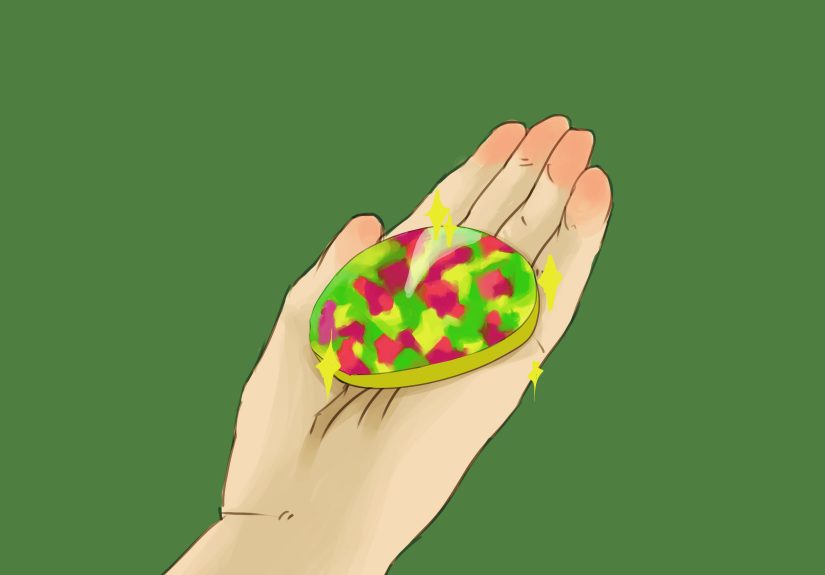
Real opal’s famous “play-of-color” comes from how light diffracts through microscopic structure. That means the color changes as you tilt the stonesometimes subtle, sometimes like a disco ball having an emotional breakthrough.
What to do
- View the opal in at least two lighting conditions: daylight near a window and a warm indoor light.
- Tilt it slowly, then quickly. Look for how the color moves.
- Pay attention to whether the pattern looks organic or “printed.”
Green flags for natural-looking behavior
- Variation: patches, streaks, pinfire specks, or irregular zones that don’t repeat perfectly.
- Depth: color may appear to come from within the stone rather than sitting on the surface.
- Non-uniformity: not every millimeter flashes the same way; nature doesn’t do copy-paste.
Red flags that deserve a closer look
- Too perfect “tile” pattern: a uniform honeycomb/chicken-wire look that repeats evenly.
- Color that acts like a decal: the flash appears as a surface film rather than internal structure.
- Suspiciously consistent sparkle: every angle gives the same tidy fireworks show, like a looped GIF.
Important nuance: some natural opals can show polygon-like patterns too, and some natural Ethiopian material can display a “lizard-skin” effect that resembles synthetics. So treat pattern as a cluenot a courtroom verdict. This is why Step 2 pairs best with Step 3.
Step 3: Use magnification to look for “manufacturing tells” (bubbles, foil, and the famous honeycomb)
If Step 1 is your defense against assembled stones, Step 3 is your lie detector for glass/plastic imitations and many synthetics. The loupe is where the truth lives. (It’s also where you discover how much dust exists in your home. You’ve been warned.)
What to do
- Clean the opal gently with a soft cloth. (No harsh chemicals. Opal is not a cast-iron skillet.)
- Use a 10x loupe or a macro phone lens.
- Inspect both the face and the edge; then try viewing with light coming from the side.
Common “fake” clues under magnification
- Gas bubbles: Round bubbles can be a classic glass sign. Natural opal typically won’t show “soda-pop” bubbles.
- Foil backing: Some imitations use reflective foil to boost color. You may see a metallic, crinkly look at the base or edges.
- Plastic softness: Plastic imitations may show tiny surface scuffs or dents more easily, especially around edges.
- Honeycomb / snakeskin / chicken-wire: A consistent small-cell pattern is often associated with lab-grown products and some opal imitations.
- Column-like structure: Some synthetics show organized structure that can look more engineered than natural texture.
Example
You inherit an “opal” ring that looks like it has confetti inside. Under the loupe, you notice perfectly round bubbles near the edge and a uniform sparkly sheet at the bottomlike a glitter phone case from 2012. That’s your sign the stone may be a glass/plastic imitation rather than natural opal.
Pro tip: if you can, compare your stone to a known real opal in person (a jeweler’s display case is fine; you’re not stealing it, just learning). Training your eye on the “texture” of play-of-color helps you spot when something looks printed or overly uniform.
Step 4: Run safe “reality checks” (weight, temperature feel, and light behavior)
No, you don’t need to do anything involving fire, needles, or the kind of experiments that end with a heartfelt apology. These checks are non-destructive and mostly about common-sense physics.
Check A: Compare weight (especially vs. plastic)
Opal is a real mineral material and usually feels “stone-like” for its size. Plastic imitations often feel oddly light. If you have two similarly sized stones (or jewelry pieces), compare how they sit in your hand.
Check B: Temperature feel (stone vs. plastic)
Many natural stones feel cooler to the touch than plastic at room temperature and warm up more slowly. This isn’t foolproof (metal settings and room conditions matter), but it’s a useful supporting clue.
Check C: Light transmission at the edges
Hold the stone near a bright light and see if the edges behave strangely. Some triplets can show an obvious clear cap. Some glass imitations can look uniformly translucent with color that doesn’t have depth.
Check D: UV flashlight (optional, not a solo verdict)
Some materials fluoresce under UV, some don’t, and results can vary by type and treatment. Use UV as an extra clue onlynever the only reason you declare a stone real or fake.
What NOT to do
- Don’t scratch-test unless you’re okay with damaging the stone (and your relationships).
- Don’t heat it to “see what happens.” What happens is heartbreak.
- Don’t soak it as a test. Some opals absorb water and can change appearance temporarily.
The goal of Step 4 is to catch obvious imposters without harming anything. If the stone passes Steps 1–4 but still feels “off,” Step 5 is where you level up.
Step 5: Verify like a grown-up (paper trail, seller language, and a pro opinion)
The most convincing “fake opal” isn’t always a plastic imitationit’s a real opal product sold with fuzzy wording and an inflated price. Your best protection is verification: what exactly is being sold, and who is willing to put that in writing?
Ask these questions before you buy
- Is it natural opal, synthetic opal, imitation opal, or an assembled doublet/triplet?
- Is it treated? If yes: how (smoked, dyed, stabilized, sugar/heat, etc.)?
- What is the return policy? A strong return window is a confidence signal.
- Any documentation? Receipts, appraisals, or lab identification reports help reduce ambiguity.
Watch seller language
Be cautious with phrases like “opal look,” “opal style,” “created opal,” or “lab opal” without a clear definition. If the listing title screams “NATURAL BLACK OPAL!!!” but the description quietly says “simulated,” that’s not a vibeit’s a warning siren.
When to involve a professional
If the stone is expensive, sentimental, or meant for everyday wear (like an engagement ring), get a professional identification from an independent gemologist or a gem lab. A pro can confirm whether it’s natural opal, synthetic, imitation, treated, or assembledand sometimes spot details invisible to the naked eye.
Think of it this way: you wouldn’t buy a used car based only on how shiny it looks in the photos. You’d want the report. Opals deserve the same grown-up energy.
Common “fake opal” scenarios (so you don’t get emotionally ambushed)
1) The “opal doublet/triplet sold as solid opal”
Assembled stones can be pretty and wearable, but they should be disclosed and priced accordingly. If you discover a seam, a dome, or a backing layer, assume “assembled” until proven otherwise.
2) The “too-perfect synthetic”
Many lab-grown opals have a consistent pattern that looks engineered. Under magnification, the texture may appear uniform and honeycomb-like. Some natural opals can show polygon effects, so this isn’t a single-clue convictioncombine it with Steps 1 and 3.
3) The “plastic opal that looks shockingly good online”
Photos can flatter plastic imitations because the camera loves sparkle and doesn’t care about depth. In person, plastic can feel light, warm quickly in your hand, and show surface scuffs fast.
4) The “treated opal with a surprise backstory”
Treatments exist across the gem world. The issue isn’t treatment itself; it’s lack of disclosure. If the listing avoids specifics, ask direct questions. If you get vague answers, shop elsewhere.
Buying tips that save you money (and reduce regret)
- View it in multiple lights: opal can look dramatically different under warm vs. cool lighting.
- Prefer sellers who name the product clearly: “solid natural opal,” “opal triplet,” “synthetic opal,” etc.
- Don’t pay premium prices for mystery wording: clarity in description should match the price tag.
- Use a loupe as your default: if you buy gems, a loupe isn’t optionalit’s your seatbelt.
- Choose protective settings for daily wear: opal is softer than many popular gemstones and benefits from careful design.
Conclusion: Your 5-step opal “fake check” in one breath
To tell if an opal is fake, don’t rely on sparkle alone. Check the side profile for seams (doublets/triplets), evaluate how the play-of-color moves (organic vs. “printed”), use magnification to find bubbles or honeycomb structure, run safe reality checks like weight and edge behavior, andwhen the stakes are highverify with documentation or a professional. That’s how you stay dazzled without getting duped.
Field Notes: of Opal Experience (The “I Learned This the Hard Way” Edition)
If you spend enough time around opalsshopping, inheriting, browsing estate sales, or falling into the internet rabbit hole at 1:00 a.m.you’ll notice a pattern: most “fake opal” stories aren’t villain plots. They’re misunderstandings with good lighting.
One of the most common situations happens at craft fairs and flea markets. Someone hands you a ring that looks like a tiny galaxy, and your brain immediately starts composing a victory speech about your “rare find.” Then you tilt it and the color behaves like a sticker: the flash stays stubbornly on the surface, the pattern repeats too neatly, and the stone feels warm within seconds. That’s usually plastic doing its best impression of a gemstone. The seller might not even be lyingsometimes they bought it wholesale as “opal jewelry” and never asked what kind of opal. Step 4 (temperature feel and weight) is often the fastest way to bring your expectations back to Earth without embarrassing anyone.
The second most common story is the “grandma ring surprise.” You inherit a piece, and because it’s old, it must be naturalright? Not always. Assembled opals have been around a long time, and a triplet can look outrageously good when it’s clean and viewed from the top. The emotional whiplash comes when you finally examine the side and realize you’re looking at layers: a clear dome on top, a thin opal slice in the middle, and a dark backing underneath. Here’s the thing: that doesn’t erase the sentimental value. It simply changes what you should do next. If you planned to wear it daily, you’ll want to protect ittriplets rely on adhesives and layered construction, and rough handling can be harder on them than on a solid cabochon. Step 1 turns “mystery heirloom” into “informed care plan,” which is a win even when it’s not the answer you expected.
Then there’s the online shopping talethe one where the photos look like someone trapped the northern lights in a gemstone. A smart habit is to pause before buying and ask one boring question: “Is this a solid opal, a doublet/triplet, synthetic, or imitation?” Sellers who are legitimate don’t get offended by that question; they answer it. Sellers who get weird about it are doing you a favor by waving a red flag early. Another good move is requesting a side-view photo. If they won’t provide one, assume it’s assembled until proven otherwise. This single request has saved more wallets than any “secret trick” ever could.
Finally, here’s the truth experienced buyers learn: you don’t need to “win” every identification battle at home. Your goal is to know when you’re looking at a straightforward situation (like bubbles in glass) versus a high-stakes purchase where a professional opinion is worth the fee. When you treat your loupe like a best friend instead of a party trick, opals become fun againsparkly, strange, and honestly kind of emotional, but in a good way.