Table of Contents >> Show >> Hide
- What Is Milky Spore, Exactly?
- Before You Start: Three Quick Reality Checks
- Powder vs. Granular Milky Spore
- How to Apply Milky Spore: 9 Steps
- Step 1: Confirm That Japanese Beetle Grubs Are Really the Problem
- Step 2: Choose the Right Milky Spore Product for Your Lawn Size
- Step 3: Time the Application for Active Grub Feeding
- Step 4: Prep the Lawn Before You Apply
- Step 5: Mark Out Your Pattern or Calibrate Your Spreader
- Step 6: Apply the Milky Spore Evenly
- Step 7: Water the Area Lightly After Application
- Step 8: Do Not Sabotage the Treatment
- Step 9: Monitor the Lawn and Manage Expectations
- Common Mistakes to Avoid
- What Results Should You Expect?
- Experience-Driven Tips Homeowners Learn Along the Way
- Conclusion
Note: Milky spore is designed for Japanese beetle grubs. If your lawn troublemakers are some other grub species, this treatment is basically showing up to the wrong party.
If your lawn has mysterious brown patches, loose turf, or wildlife that suddenly treats your yard like an all-you-can-eat buffet, grub damage may be the culprit. And if those grubs are Japanese beetle larvae, milky spore is one of the best-known biological options homeowners consider. It has been around for decades, sounds delightfully weird, and appeals to anyone who would rather not blast the yard with harsher treatments right away.
That said, milky spore is not a miracle powder you toss around on Saturday and admire by Sunday morning. It is a long-game strategy. It works when Japanese beetle grubs ingest the spores while feeding in the soil. That means timing matters, identification matters, and expectations matter a lot. In other words, milky spore can be useful in the right situation, but it is not lawn wizard dust.
This guide breaks down exactly how to apply milky spore in 9 clear steps, plus what to avoid, what kind of results to expect, and how real homeowners often experience the process over time. So grab your gloves, your spreader or dispenser, and your patience. The bugs are not going to surrender dramatically, but your lawn may thank you later.
What Is Milky Spore, Exactly?
Milky spore is a biological treatment made from a naturally occurring bacterium associated with Japanese beetle grubs. Once those grubs ingest the spores, the bacteria multiply inside them. Over time, infected grubs die and release more spores back into the soil, which is why milky spore is often described as a treatment that can build over time rather than hit like a fast chemical rescue.
Here is the fine print that matters: milky spore is highly specific. It is mainly intended for Japanese beetle grubs, not every white grub that happens to be lounging under your lawn. That means you should not assume it will solve every grub issue just because your grass looks rough and a raccoon has been doing midnight landscaping.
Also important: university guidance on effectiveness is mixed. Some extension sources still explain how to use milky spore properly, while others note that modern trials have shown inconsistent results. The practical takeaway is simple: use it as a targeted, lower-toxicity option when you have confirmed Japanese beetle grubs and are comfortable with a slower, less dramatic timeline.
Before You Start: Three Quick Reality Checks
- It is not for every grub. Confirm that Japanese beetle grubs are your problem before applying anything.
- It is not instant. Milky spore is more “slow and strategic” than “boom, problem solved.”
- The label rules. Powder and granular products can have different directions, so always follow the label on the exact product you buy.
Powder vs. Granular Milky Spore
| Product Form | How It Is Usually Applied | Best For |
|---|---|---|
| Powder | Placed in spots on a checkerboard-style grid, often about every 4 feet | Targeted application and traditional spot treatment |
| Granular | Broadcast with a lawn spreader according to label settings | Faster coverage on larger lawns |
If you have a small yard and do not mind a little extra effort, powder is often the classic choice. If your property is larger and your lower back already has trust issues, granular can be easier to spread. Either way, label directions come first.
How to Apply Milky Spore: 9 Steps
Step 1: Confirm That Japanese Beetle Grubs Are Really the Problem
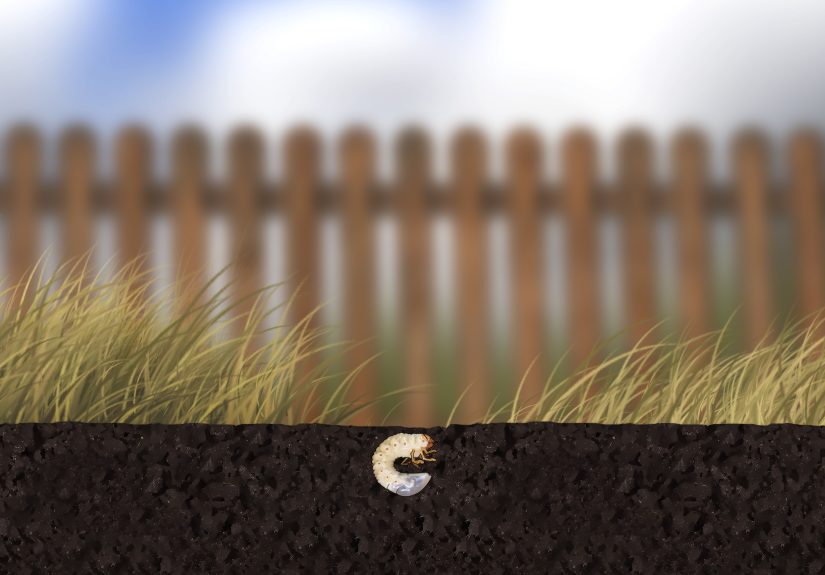
Do not skip this step. Milky spore is too specific to use as a random lawn gamble. Pull back a small section of damaged turf with a shovel and inspect the top few inches of soil. White grubs are typically C-shaped with brown heads and visible legs. If you find only a few scattered grubs, you may not even have enough pressure to justify treatment.
If you are not sure what species you have, contact your local extension office or compare what you find with extension identification guides. This is the lawn-care version of reading the recipe before preheating the oven. It saves regret.
Step 2: Choose the Right Milky Spore Product for Your Lawn Size
Once you know milky spore makes sense, choose between powder and granular based on your yard and your preferred application method. Powder is often applied in measured spots across the lawn, while granular products are generally spread more broadly with a spreader.
Read the label carefully for coverage. One product may be designed for 2,500 square feet, another for 10,000 square feet, and another may recommend a multi-season application program. Guessing here is how people end up with half a treated lawn and one untouched corner where the grubs keep living their best life.
Step 3: Time the Application for Active Grub Feeding
Milky spore works best when grubs are actively feeding near the surface, because they need to ingest the spores. In many regions, the prime window is late summer into early fall, when recently hatched grubs are feeding in the root zone. A spring window may also exist in some areas when grubs return closer to the surface for a shorter feeding period.
If the ground is frozen, waterlogged, or baked like a parking lot in August, wait for better conditions. You want the spores to reach the soil where feeding grubs are active, not just sit uselessly on top like powdered optimism.
Step 4: Prep the Lawn Before You Apply
Mow if the grass is tall, remove heavy debris, and avoid applying over thick layers of leaves or thatch. The product needs contact with the soil surface so it can move down into the root zone. If your lawn is bone-dry, a light watering beforehand can help create better conditions for the spores to settle in.
This is also a good time to measure the treatment area. Knowing your square footage helps you avoid under-applying, over-applying, or wandering the yard in circles like a confused flamingo.
Step 5: Mark Out Your Pattern or Calibrate Your Spreader
For powder products, the traditional method is a checkerboard-style pattern, often with a measured amount placed every 4 feet in rows 4 feet apart. Some homeowners lightly mark the lawn with flags, chalk, or mental landmarks so they do not lose track halfway through.
For granular products, calibrate the spreader according to the label. This is not the moment for “close enough.” Too little coverage reduces the chance of success, and too much wastes product without giving you superhero-level results.
Step 6: Apply the Milky Spore Evenly
If you are using powder, shake or fluff the product if the label says to do so, then apply the recommended amount at each marked interval. Many labels describe using a dispenser tube or similar tool to release roughly a teaspoon per spot in that 4-by-4-foot grid.
If you are using granular milky spore, walk at a steady pace and spread it evenly across the lawn, following the exact coverage instructions on the bag. Consistency matters. The goal is not random artistic expression. The goal is thorough, even placement where grubs are feeding.
Step 7: Water the Area Lightly After Application
After applying milky spore, water the treated area lightly to move the spores into the soil. This step helps get the product off the grass blades and closer to the root zone, where grubs are actually feeding. Think “gentle soak,” not “monsoon reenactment.”
A light watering is usually enough. You want the spores to settle in, not wash away or float off to who-knows-where. If rain is expected soon, you may be able to let nature handle this part, as long as the forecast does not look wildly dramatic.
Step 8: Do Not Sabotage the Treatment
If you are relying on milky spore to build in the soil, do not immediately follow it with a strong grub-killing insecticide unless the label or a local expert specifically recommends a compatible plan. That can work against the whole idea, because milky spore needs host grubs in the soil to multiply over time.
In practical terms, pick a strategy and stick with it. Milky spore is the patient route. Fast-acting rescue insecticides are the urgent route. Trying to do both at the same moment can be like putting your lawn on two diets and three workout plans at once.
Step 9: Monitor the Lawn and Manage Expectations
Milky spore is not the treatment you choose because you want dramatic results by next weekend. It is the treatment you choose because you want a targeted, biologically based option and are willing to give it time. Continue checking the lawn for grub activity, animal digging, and turf recovery over the coming seasons.
Also remember that controlling grubs in your lawn does not guarantee zero adult Japanese beetles on your ornamentals. Adult beetles can fly in from other areas. So if your roses still get visitors, do not assume the milky spore failed. Lawn grub control and adult beetle pressure are related, but not perfectly linked.
Common Mistakes to Avoid
- Applying it to the wrong pest: If the grubs are not Japanese beetles, results may be disappointing.
- Expecting instant control: Milky spore is gradual by nature.
- Skipping water-in: Spores need help reaching the soil.
- Ignoring the label: Powder and granular products are not interchangeable in application method.
- Using rescue insecticides right after: That may interfere with the long-term strategy.
- Treating a lawn with barely any grubs: Sometimes the best move is monitoring, not automatically buying a product.
What Results Should You Expect?
The most realistic answer is: modest, gradual, and situation-dependent. In the right lawn, with confirmed Japanese beetle grubs and proper timing, milky spore may help reduce grub pressure over time. In other lawns, results may be inconsistent. That is why many extension sources emphasize correct identification, patience, and reasonable expectations.
What you should not expect is a cinematic lawn transformation where the clouds part, the grass glows greener, and every beetle sends a handwritten apology. A more realistic win is fewer grubs, less turf damage, and a lawn that stops looking like it lost a wrestling match with skunks.
Experience-Driven Tips Homeowners Learn Along the Way
In many yards, the experience of using milky spore follows a very familiar pattern. First comes the discovery phase: patches of grass turn odd colors, the lawn feels spongy, or a section peels back far too easily. Then comes the wildlife subplot, where raccoons, skunks, or birds arrive like unpaid inspectors and begin tearing into the turf. At that point, milky spore starts to look less like a niche garden product and more like a beacon of hope.
Then reality steps in. The homeowner reads the label, realizes this is not a five-minute spray-and-go job, and suddenly becomes a part-time surveyor. There is measuring, pacing, marking, and trying to remember whether that corner near the mailbox was already treated or merely stared at with determination. Powder products especially can make people feel like they are setting up a tiny, invisible chessboard for microbes.
One of the biggest lessons people learn is that milky spore rewards calm, methodical work. The homeowners who tend to feel best about the process are usually the ones who slow down, cover the area evenly, and water lightly afterward instead of rushing through it because dinner is in an hour and the mosquitoes have started their evening shift. The people who treat half the lawn carefully and freestyle the rest often end up wondering why results seem patchy. Usually, the answer is hiding in the phrase “patchy application.”
Another common experience is emotional whiplash. After applying milky spore, many people watch the lawn like a detective watches suspects in a crime drama. Every brown blade of grass looks suspicious. Every beetle spotted on a flower feels personal. But the homeowners who stick with it usually adjust their mindset. They stop looking for immediate visual proof and start paying attention to broader patterns over time: less digging by animals, fewer severely damaged patches, and a lawn that recovers more evenly after stress.
There is also a practical lesson about expectations. People often hope milky spore will solve both the grub issue under the lawn and the adult beetle issue on shrubs, roses, and other favorite plants. Sometimes it helps indirectly over time, but it does not create a beetle-proof force field. That realization can actually be helpful, because it pushes homeowners toward a smarter overall strategy: milky spore for confirmed Japanese beetle grubs, plus separate plant protection methods when adult beetles show up for their annual buffet.
Finally, many homeowners say the biggest benefit is not just what milky spore may do to the grubs, but how it changes the way they manage the yard. They become better observers. They start checking the soil instead of guessing. They treat only when needed. They read labels more carefully. They stop assuming every lawn problem needs the strongest product on the shelf. In that sense, milky spore can be part of a more thoughtful lawn-care approach. And honestly, any product that makes people less likely to panic-buy three random grub treatments at once deserves at least a polite nod.
Conclusion
If you want the short version, here it is: milky spore can be a smart option when you have confirmed Japanese beetle grubs, want a targeted biological approach, and are willing to be patient. The key is applying it correctly, watering it in lightly, and understanding that this is a long-term lawn strategy rather than a same-week rescue mission.
Follow the 9 steps above, respect the product label, and keep your expectations grounded in reality. If your lawn issue is truly Japanese beetle grubs, milky spore may become a useful tool in your yard-care arsenal. If not, at least you now know enough to avoid tossing the wrong product at the wrong problem, which is already a solid homeowner victory.