Table of Contents >> Show >> Hide
- The Riddle
- Why This Riddle Goes Viral (It’s Not Just the 5s)
- The Clean, Intended Version of the Problem
- Solution: Count the 5s Without Losing Your Weekend
- The Answer
- Common Wrong Answers (And Why They Feel So Right)
- But Wait… Isn’t the Wording Kind of Messy?
- Want to Level Up? Try Variations That Use the Same Trick
- A Quick “Brain Teaser” Checklist for Future You
- Conclusion: The Digit 5 Is Innocent, Your Timeline Isn’t
- Real-Life “How Many 5s” Experiences ( of Been-There, Counted-That)
Some viral math riddles are basically a warm hug for your brain. This one? This one is a tiny, rectangular gremlin that crawls into your group chat and starts a comment war.
The prompt usually shows up like this:
The Riddle
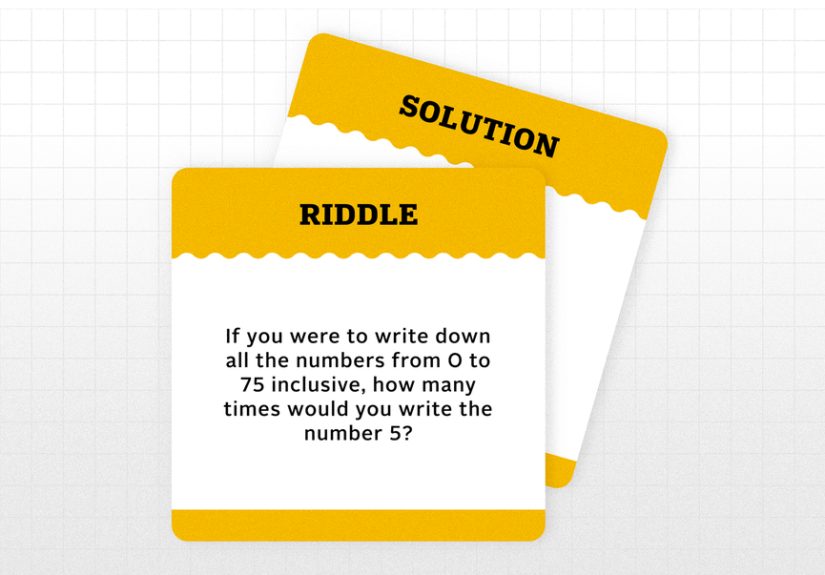
“If you write down all the whole numbers from 0 to 75 (inclusive), how many times would you write the number 5?”
People answer confidently. People answer loudly. People answer wrong with the energy of a TED Talk. And because it’s a “How many 5s?” question, the arguments get oddly personallike the digit 5 owes someone money.
Before you scroll for the answer, try it yourself. Seriously. Give it 30 seconds. (If you already have a number in mind, congratulationsyou are now emotionally invested, which is exactly how this riddle wins.)
Why This Riddle Goes Viral (It’s Not Just the 5s)
This puzzle spreads because it hits a perfect social-media trifecta:
- It looks easy (numbers you’ve known since childhood).
- It invites speed (everyone thinks they can do it in their head).
- It’s wording-sensitive (so two people can “solve” different problems and still feel correct).
That last point is the big one. When people hear “between 5 and 75,” some interpret “between” as strictly between (excluding endpoints). Others include endpoints. Some count the digit 5, others count the number 5, and a few chaotic geniuses point out that there are infinitely many decimals between 5 and 75 that contain a 5 and… okay, yes, technically, but please do not do that at family dinner.
The Clean, Intended Version of the Problem
To solve what the riddle clearly intends, we’ll use a practical interpretation:
- You are writing whole numbers only (integers).
- You are counting how many times the digit “5” appears while writing them.
- The list is 0 through 75, inclusive.
Under that interpretation, there is one correct answerno drama required.
Solution: Count the 5s Without Losing Your Weekend
Step 1: Count 5s in the Ones Place
From 0 to 75, a number ends in 5 every 10 numbers. Those numbers are:
5, 15, 25, 35, 45, 55, 65, 75
That’s 8 numbers. Each contributes one 5 in the ones placeexcept 55, which is going to be extra in a minute.
Ones-place 5s so far: 8
Step 2: Count 5s in the Tens Place
Now look at numbers with a 5 in the tens place: that’s the whole block from 50 to 59.
50, 51, 52, 53, 54, 55, 56, 57, 58, 59
That’s 10 numbers, and each has a 5 in the tens place.
Tens-place 5s: 10
Step 3: Handle 55 Correctly (Don’t Accidentally “Fix” It)
Here’s where a lot of answers go off the rails. The number 55 contains two 5s. In our method, that’s already handled naturally:
- 55 was counted once in the ones-place list.
- 55 was counted once in the tens-place block.
That is correct because we’re counting digits written, not “numbers that contain a 5.”
Total 5s written from 0 to 75 = 8 + 10 = 18
The Answer
18
If your answer was 18, congratsyou just avoided the most common trap: forgetting the entire 50–59 decade is basically a “5 festival.” If your answer wasn’t 18, congrats anywayyou are now exactly the target audience for every viral brain teaser ever created.
Common Wrong Answers (And Why They Feel So Right)
Wrong Answer #1: 8
This happens when someone only counts the ones place: 5, 15, 25, 35, 45, 55, 65, 75. That’s 8. It’s clean, fast, and incompletelike saying you “read the article” because you looked at the headline.
Wrong Answer #2: 9
This one often appears on trivia cards and in screenshots. People get 8, then “remember” that 55 has two 5s and add 1. That logic would make sense only if you were counting numbers that include a 5 (and even then, it’s still off in other versions). For counting digits written, you can’t ignore the entire 50–59 block.
Wrong Answer #3: 17
This is what you get if you count ones-place 5s (8) and tens-place 5s (10) and then mistakenly subtract 1 because you think you “double-counted” 55. But 55 should be counted twice because it has two 5s. Subtracting 1 is like refusing to count both slices of pizza because they came in the same box.
But Wait… Isn’t the Wording Kind of Messy?
Yes. And that’s part of the viral magic.
If someone says, “How many 5s are there between 5 and 75?” a literal-minded person could argue:
- “Between” might exclude 5 and 75.
- “Number 5” could mean the single number 5 (which would appear once).
- “Between” could include decimals, and there are infinitely many decimals containing 5.
But in the version that actually gets shared as a quick brain teaser, the intended meaning is: write the integers in the range and count how many times you write the digit 5. Under that interpretation, the answer is still 18.
Want to Level Up? Try Variations That Use the Same Trick
Once you understand the place-value approach, you can solve a whole family of “How many 5s?” puzzles without listing every number.
Variation A: How many 5s from 1 to 100?
Think in two buckets:
- Ones place: 5, 15, 25, …, 95 = 10 numbers → 10 fives
- Tens place: 50–59 = 10 numbers → 10 fives
And 55 contributes two fives, which is already included naturally.
Total from 1 to 100: 20 fives.
Variation B: How many 5s from 1 to 1000?
If you consider 000 to 999 (a neat trick called “leading zeros”), each digit position cycles evenly:
- In the ones place, 5 appears 100 times.
- In the tens place, 5 appears 100 times.
- In the hundreds place, 5 appears 100 times.
Total: 300 fives across 000–999. Excluding 000 doesn’t change the count of 5s, because 000 contains no 5s anyway. Including 1000 doesn’t add any 5s either.
So, from 1 to 1000, the digit 5 appears 300 times.
A Quick “Brain Teaser” Checklist for Future You
Next time you see a viral math puzzle, ask these questions before you commit to an answer in the comments (where screenshots live forever):
- Are we counting digits or numbers? “How many 5s” usually means digits.
- Are endpoints included? If it says “from 0 to 75 inclusive,” yes.
- Are decimals involved? If it’s a social media card game, almost certainly no.
- Is there a ‘block’ hiding in plain sight? Like 50–59, where every number contains a 5.
Conclusion: The Digit 5 Is Innocent, Your Timeline Isn’t
The viral “How many 5s are there?” riddle is a classic example of place value doing all the heavy lifting. If you write the integers from 0 to 75 and count the digit 5, you get 18: eight 5s in the ones place (5, 15, …, 75) plus ten 5s in the tens place (50–59). The number 55 proudly contributes two 5s like it’s auditioning for a sequel.
And the best part? You don’t need to memorize the answer. You can solve it in secondsthen use the same method on any digit-counting math puzzle that tries to go viral in your feed.
Real-Life “How Many 5s” Experiences ( of Been-There, Counted-That)
What makes the “How many 5s are there?” riddle so relatable is that it mirrors how math shows up in real life: not as a worksheet, but as a tiny problem wrapped in messy language and social pressure. You’re not just counting digitsyou’re also navigating interpretation, assumptions, and that one friend who confidently declares, “It’s obviously 9,” like they’re delivering a verdict in court.
One of the most common places this puzzle pops up is the group chat. Somebody posts a screenshot, and within minutes the chat splits into factions: Team Fast Answer, Team Actually-Let-Me-Think, and Team Chaos (the person who says “infinite” because decimals exist and refuses to elaborate). The funny part is that everyone’s brain is doing the same thing: grabbing the most visible pattern first. “I see 5, 15, 25…” feels satisfying, like you’ve found the trail. But the riddle is designed so that the bigger clue50 through 59is hiding in plain sight. It’s the math equivalent of forgetting there’s a whole extra aisle at the grocery store because you entered through the bakery.
Another real-life moment this riddle recreates is what happens in classrooms and tutoring sessions when students first learn place value. Kids can count by fives all day long, but connecting that skill to how digits behave in tens and ones places is a different leap. The “50s block” is basically a live demo of place value: when the tens digit becomes 5, it stays 5 for ten straight numbers, while the ones digit cycles from 0 to 9. That’s not just a trick for puzzlesit’s the backbone of how we read, write, and reason about numbers quickly.
And then there’s the experience of being “right” for the wrong reason. Plenty of people land on 18 after a messy mental tally, but they can’t explain it. That’s a fragile victorylike winning a race because everyone else tripped. The satisfying version is when you can explain it cleanly: eight in the ones place, ten in the tens place, and 55 counts twice because it literally has two 5s. That explanation feels sturdy. It travels well. It’s the difference between “trust me” and “here’s why.”
Finally, the riddle highlights a very human habit: we treat math like it’s about speed, when it’s often about clarity. Viral puzzles exploit that. They reward the quick answer with confidence and punish it with nuance. In a weird way, that’s why these riddles stickthey remind us that careful reading matters, patterns matter, and sometimes the most important number in the room is the one you didn’t bother to look at: 50.