Table of Contents >> Show >> Hide
- What Is a Quarter Shrinker, Exactly?
- The Big Idea: Magnetic Fields Can Push Metal (Hard)
- Why the Quarter Gets Smaller (But Heavier-Feeling)
- What’s Inside the Machine (Conceptually)
- What Physics Principles Are You Watching in Real Time?
- Why It’s Loud, Smelly, and a Little Dramatic
- Real-World Context: This Isn’t Just a Party Trick
- Specific Examples of Quarter Shrinker Demonstrations
- Is It Legal to Shrink a Quarter?
- Safety Reality Check (Yes, This Deserves Its Own Section)
- Extra: Real Experiences and Moments People Associate With a Quarter Shrinker
- 1) “They Made Us Stand Back… and Now I Know Why”
- 2) “It Smelled Like… Ozone? Hot Pennies? Science?”
- 3) “The Coin Looked Fake… Until I Held It”
- 4) “It Was Over Before I Even Processed It”
- 5) “The Presenter Called It a ‘Physics Flex’”
- 6) “It Turned Into a Souvenir With a Story”
- 7) “It Made Me Respect ‘Stored Energy’ in a New Way”
- Conclusion
A “quarter shrinker” is one of those science demos that feels like a magic trickexcept it’s powered by real physics,
real engineering, and a very real “please stand behind the line” safety lecture. A full-size U.S. quarter goes in,
and moments later you’re holding something that’s about dime-sized, thicker, and strangely proud of itselflike it just
finished an intense workout and wants you to notice.
Here’s the non-spoiler version: a quarter shrinker uses a brief, extremely intense pulsed magnetic field
to squeeze a coin inward without touching it. It’s a dramatic demonstration of electromagnetism,
eddy currents, Lenz’s Law, and Lorentz forcesplus a reminder that energy
doesn’t need much time to be impressive. In this article, we’ll break down how it works, why the coin changes shape,
what you’re really seeing (and smelling), and why scientists love this demo so much.
What Is a Quarter Shrinker, Exactly?
A quarter shrinker (sometimes called a shrinking quarter machine or coin shrinker) is a
pulsed-power device that uses a high-current pulse through a copper coil to generate a powerful magnetic field around a coin.
That magnetic field induces large circulating currents inside the coin. Those induced currents experience strong forces that
drive the coin’s metal inward, permanently deforming it.
This is related to a broader industrial technique called electromagnetic forming (or high-velocity magnetic
forming). In factories, similar physics can crimp, shape, or swage conductive metals without direct contact. The quarter
shrinker is basically the “show-and-tell” versionloud, smoky, and unforgettable.
The Big Idea: Magnetic Fields Can Push Metal (Hard)
If you’ve ever played with magnets, you know they can pull and push. But a quarter shrinker doesn’t rely on two fridge magnets
having an argument. Instead, it creates a short-lived magnetic field that is extremely strong.
The key is that the field changes very fast, which is exactly what triggers intense currents in the coin.
Step 1: A Fast Pulse of Current Creates a Giant Magnetic Field
At the heart of the machine is a sturdy coil (often copper) shaped so the coin sits centered inside it. When a burst of
electrical current flows through that coil, it generates a magnetic field around the coil and through the coin’s space.
The faster and larger the current, the larger the magnetic field.
The “pulse” part matters because we don’t want a gentle magnetic field that politely asks the quarter to move. We want a field
that arrives like a surprise partyinstant, intense, and gone before the quarter can file a complaint.
Step 2: The Coin Responds by Making Its Own Currents
A quarter is a conductor, so when it sits in a rapidly changing magnetic field, it develops eddy currents:
loops of current that swirl inside the coin. This is a standard electromagnetic effect you’ll also see in induction cooktops,
metal detectors, and some braking systems.
Then comes the principle that gives physics students both hope and homework: Lenz’s Law.
The induced currents in the coin flow in a direction that opposes the change that created them.
In practical terms, the coin’s induced currents produce their own magnetic field that fights the coil’s magnetic field.
Step 3: Opposing Magnetic Fields Create a Crushing Inward Force
Once you have a strong current in the coil and strong induced currents in the coin, you get strong forces between them.
The simplest way to visualize it: the coil’s field and the coin’s induced field repel each other.
That repulsion creates pressure on the coin’s circumference, effectively squeezing it inward.
More formally, the induced currents in the coin interact with the magnetic field via Lorentz forces
(forces on moving charges in a magnetic field). The result is a net inward “pinch” that can exceed the metal’s yield strength,
causing plastic deformationmeaning the coin doesn’t bounce back to its original shape.
Why the Quarter Gets Smaller (But Heavier-Feeling)
Here’s the part that makes people squint at the result coin like it’s trying to trick them: the coin’s mass is essentially
the same, but its diameter is smaller. So where did the metal go?
The Metal Flows: Diameter Down, Thickness Up
Metals can “flow” under high stress without melting. When the quarter is squeezed inward, the material has to go somewhere,
so it thickens. The coin becomes shorter in diameter and thicker in cross-section. This is why a shrunken quarter often looks
like a chunky tokensame face design (sometimes softened), but more compact and dense.
It Can Happen So Fast That Heat Becomes Part of the Story
Those eddy currents aren’t just for show. Current through resistance produces heat (Joule heating). In the brief moment of the
pulse, the coin can heat up significantly. Heating can lower the metal’s yield strength, making deformation easier, and it also
adds a sensory layer to the demo: you may see smoke, smell hot metal/insulation, or watch the coin come out warm.
The key point: the quarter shrinker isn’t “cutting” or “grinding” anything away. It’s using electromagnetic forces to reshape
the coin by pushing the metal past its elastic limit.
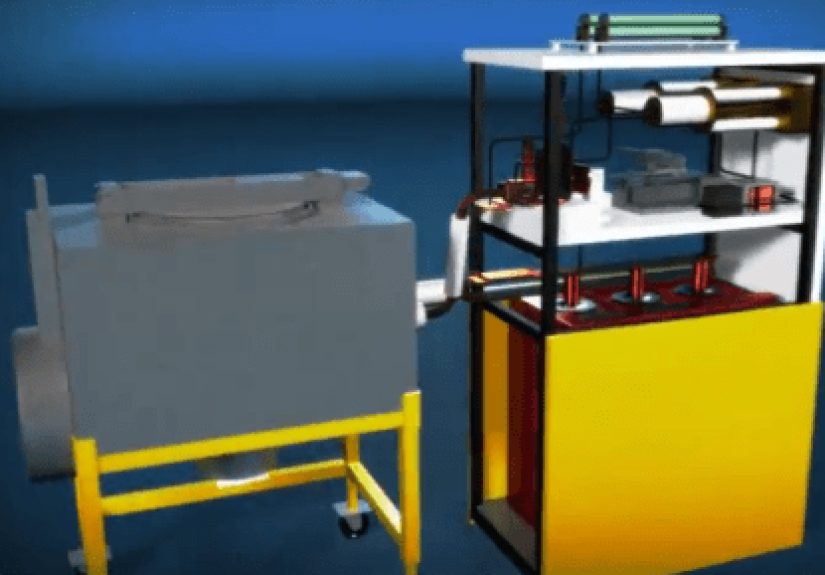
What’s Inside the Machine (Conceptually)
Without drifting into “how to build one” territory (because this is genuinely dangerous equipment), we can still describe the
major building blocks at a high level:
1) Energy Storage
The machine stores energy and then releases it quickly. In pulsed-power systems, that usually means an energy-storage stage
that can deliver a huge burst over an extremely short time. Think of it like saving up a month’s worth of “push” and spending
it in a blink.
2) A Switching Stage
The system needs a way to release stored energy into the coil rapidly. The “rapidly” part is crucial: a slow release would
make a weaker changing magnetic field, inducing weaker currents and producing a disappointing non-shrink moment (scientists do
not enjoy disappointing moments; they will recalibrate until joy returns).
3) The Work Coil
The coil is the interface between stored electrical energy and the magnetic field that does the work. It must survive intense
electrical and mechanical stress for at least the fraction of a second that matters. Some quarter shrinker designs treat the coil
as a consumable component because forces can be severe enough to damage it.
4) The Coin (The “Workpiece”)
In electromagnetic forming, the object being shaped is called the workpiece. In this case, the quarter is the workpiece, and
its conductivity and geometry influence how eddy currents form and where forces concentrate. That’s why a “quarter shrinker”
works especially well on conductive coins and other similarly shaped metal objects.
What Physics Principles Are You Watching in Real Time?
Eddy Currents
Eddy currents are loops of induced current inside a conductor exposed to a changing magnetic field. They’re the reason induction
cooktops heat pans and the reason some amusement-park braking systems can slow rides without friction pads. In a quarter shrinker,
eddy currents are the coin’s immediate reaction to the pulse.
Lenz’s Law
Lenz’s Law tells you the induced currents oppose the change in magnetic flux. That opposition is what sets up the repulsive
interaction between the coil and the coin’s induced field.
Lorentz Force
Moving charges in a magnetic field feel a force. When a conductor carries current in a magnetic field, it experiences a mechanical
force. Multiply that by extremely strong fields and currents, and you get a force big enough to deform metal.
Plastic Deformation and Yield Strength
If the stress stays below a metal’s yield strength, it deforms elastically and returns to shape. If stress exceeds yield strength,
it deforms plastically and stays deformed. A quarter shrinker pushes the coin into the plastic zoneso the “shrunken” shape is permanent.
Why It’s Loud, Smelly, and a Little Dramatic
Quarter shrinker demos have a reputation: a sharp bang, a puff of smoke, and that unmistakable “electronics met physics and it
got intense” smell. That’s not a marketing feature; it’s the byproduct of moving a lot of energy quickly.
The Bang
Rapid forces can create a mechanical shock. The coil and nearby structures feel a sudden stress. Even if nothing “breaks,” the
impulse can produce an audible pop or bang.
The Smoke/Smell
Heating can singe insulation, dust, or residues. Some demos also produce ozone-like smells from electrical arcing in the broader
environment. In professional demonstrations, the setup is designed to manage these byproducts with shielding and ventilation.
The “Why Did the Coil Look Angry?” Factor
The same electromagnetic forces squeezing the coin can also stress the coil itself. When large currents flow, conductors
experience strong magnetic forces that can try to expand or twist the coil. This is one reason the demo is typically performed
by trained staff with protective measures and careful maintenance.
Real-World Context: This Isn’t Just a Party Trick
The quarter shrinker is a dramatic example of physics that has industrial cousins. Electromagnetic forming is used
for shaping metals in ways that can reduce tool wear and improve surface finish because it can be contactless and extremely fast.
In manufacturing, similar principles can form tubes, crimp fittings, or shape sheet metal.
The demo’s value in education is that it compresses multiple “textbook” ideas into a single unforgettable moment:
circuits, magnetic fields, induction, energy transfer, and material behavior. It’s a STEM lesson that refuses to be ignored.
Specific Examples of Quarter Shrinker Demonstrations
University and Museum Demos
Several universities and science organizations have documented coin shrinker demonstrations because they’re excellent teaching tools.
These demos often emphasize electrodynamics and the way induced currents and magnetic fields interact to create mechanical forces.
Maker and Hacker Community Builds (Observed, Not Recommended)
The maker community has also discussed quarter shrinkers as examples of pulsed-power experimentation. If you’ve ever browsed those
discussions, you’ll notice a consistent theme: people treat the device with serious respect due to hazards like high voltage,
mechanical shock, and the possibility of flying debris. That caution is not “overprotective”it’s earned.
Is It Legal to Shrink a Quarter?
People often ask whether shrinking a coin is “illegal.” In the U.S., laws and enforcement focus on fraudulent alterationchanging
coins with intent to deceive or pass them off as different value. In educational settings, the coin shrinker result is clearly a novelty
and not used as money. Many public demos treat the shrunken coin as a souvenir and explicitly present it as altered.
Practical note: a shrunken quarter typically won’t work in vending machines or parking meters anyway, because diameter and thickness
matter for acceptance mechanisms. So even if someone had goofy intentions, the coin itself usually isn’t “useful” for fraud.
Safety Reality Check (Yes, This Deserves Its Own Section)
A quarter shrinker is not a beginner electronics project. It involves hazards that can cause severe injury, including high voltage,
high currents, intense electromagnetic forces, hot components, loud impulse noise, and potential shrapnel if parts fail.
That’s why reputable demos are run by trained operators with shielding, procedures, and controlled environments.
If you’re curious (and you should becuriosity is the whole point), the safe way to explore the idea is through:
museum demonstrations, university physics outreach, and high-quality explainer resources
that focus on the physics rather than DIY replication.
Extra: Real Experiences and Moments People Associate With a Quarter Shrinker
The quarter shrinker isn’t just a deviceit’s an experience. If you ask people who’ve seen one in action what they remember,
you’ll get answers that sound oddly similar, like everyone attended the same thrilling, slightly chaotic concert where the headliner
was “Electromagnetism (Live).” Here are some of the most common experiences people describe, and what’s actually happening behind the scenes.
1) “They Made Us Stand Back… and Now I Know Why”
Almost every public demo starts with crowd control: a taped line, a shield, a warning, maybe even a friendly joke like,
“If you can read the label on the machine, you’re too close.” People often laughuntil the pulse fires and the room
gets a sudden bang. Then the laughter turns into a synchronized blink.
That moment teaches something subtle: physics isn’t always gentle. A quarter shrinker releases energy quickly, and quick energy
is what makes the sound, the motion, and the “wow” factor. The safety procedures aren’t there to kill the fun. They’re there
because the fun is powered by serious forces.
2) “It Smelled Like… Ozone? Hot Pennies? Science?”
People love to describe the smell afterward. Some say it’s like a hot electronic component. Others swear it’s “ozone-ish.”
A few call it “burnt dust and victory.” In many setups, that smell comes from heat and tiny residues getting cooked:
a bit of dust on the coil, a whiff from insulation, or small byproducts of a high-energy electrical event nearby.
The smell becomes part of the memory because it’s unexpected. Your brain thinks it’s watching a coin shrink. Your nose adds,
“Also, the air just learned a new personality.” That multi-sensory punch is why science demos stick with people.
3) “The Coin Looked Fake… Until I Held It”
A shrunken quarter looks like a novelty tokenlike something you’d win in a boardwalk arcade. But the moment someone holds it,
they notice the weirdly “dense” feel. That’s because the same mass is now packed into a smaller diameter and a thicker profile.
It’s a tactile lesson in material conservation: you didn’t lose metal; you redistributed it.
People also notice the design details can look softened or slightly warped. That’s not because the machine “scrubbed” the coin.
It’s because the metal flowed under stress. Fine features can deform, and the surface can show the story of how it was squeezed.
4) “It Was Over Before I Even Processed It”
One of the most common reactions is pure disbelief at the timing. The pulse happens so fast that your eyes catch the setup
and the aftermath, but not the full action. It feels like a magic cut: beforenormal quarter; aftertiny quarter.
That speed is the point. A slow push wouldn’t generate the same induction and forces. The dramatic result depends on the rapid change.
5) “The Presenter Called It a ‘Physics Flex’”
In outreach demos, presenters often frame the quarter shrinker as the ultimate proof that “electricity is not just for powering
your phone.” It’s also a tool for making matter move. That’s a powerful message for students: physics isn’t only equations.
It’s the invisible rules that can bend metalliterally.
Some presenters connect it to real technology: electromagnetic forming in industry, induction heating, magnetic braking, and
the general concept of energy transfer through fields rather than contact. The quarter shrinker becomes a gateway to understanding
how modern engineering can shape the world using forces you can’t see.
6) “It Turned Into a Souvenir With a Story”
If you’ve ever been to a science museum gift shop, you know people love a physical reminder of a cool moment. A shrunken quarter
is the perfect souvenir because it carries a built-in conversation starter: “Why is your quarter… tiny?” And then you get to explain
eddy currents like you’re casually doing stand-up comedy for the laws of electromagnetism.
It’s also memorable because it feels personal. It’s not a generic trinketit’s an object that used to be ordinary and then had
a very intense afternoon. And the best souvenirs are the ones with a plot twist.
7) “It Made Me Respect ‘Stored Energy’ in a New Way”
People leave quarter shrinker demos with a different understanding of the word “energy.” It’s not just a number on a nutrition label.
It’s something you can store and release, and when you release a lot of it quickly, you get dramatic physical effects.
That insight is one reason educators love the demo: it upgrades “electric circuits” from abstract diagrams to something that has
weight, sound, and consequences.
If you remember nothing else, remember this: the quarter didn’t shrink because someone pressed it or melted it.
It shrank because the universe allows magnetic fields and currents to push on matterhardwhen you change things fast enough.
That’s not magic. That’s electromagnetism doing what it does best: being invisible, powerful, and slightly theatrical.
Conclusion
A quarter shrinker works by firing a short, intense pulse of current through a coil, creating a rapidly changing magnetic field.
That field induces strong eddy currents in the coin. Those currents oppose the change (Lenz’s Law) and experience forces in the
magnetic field (Lorentz forces), producing an inward pressure that permanently deforms the quartershrinking its diameter and
increasing its thickness. It’s a perfect collision of circuit behavior, field physics, and material science, delivered in one
loud, smoky, unforgettable moment.