Table of Contents >> Show >> Hide
- The day the notes went quietand why it mattered
- Hacking, Eddie-style: “No instrument existed like that”
- Hack #1: The Frankenstratwhen a Fender and a Gibson fell in love (in a hardware store)
- Hack #2: The feel upgradeslocking tremolos, fast controls, and stage-ready tricks
- Hack #3: The “Brown Sound”tone as a science project (without becoming a robot)
- Hack #4: Two-hand tappingturning the fretboard into a keyboard
- Hack #5: Songwriting choicesbecause riffs are the real magic trick
- The inventor’s résumé: patents, prototypes, and the courage to be “unfinished”
- What modern players can steal from Eddiewithout copying him
- Fan and player experiences: the Eddie effect in real life
- Conclusion: the real hack was turning curiosity into a career
When Eddie Van Halen died at 65, rock didn’t just lose a flashy soloistit lost a restless inventor who treated the electric guitar like a garage project
that was never “done.” He wasn’t simply playing riffs. He was engineering them, sanding off the limits of the instrument the way a hot-rodder
shaves weight off a car: relentlessly, joyfully, and with a slightly mischievous grin.
Most legends leave behind albums and stories. Eddie left behind a mindset: if the gear in the store can’t make the sound in your head, you don’t “settle.”
You tinker. You combine parts that were never meant to meet. You break rules politely (and then loudly). The result is a legacy measured not only in
platinum sales, but in a million bedroom guitarists thinking, Wait… we’re allowed to do that?
The day the notes went quietand why it mattered
Eddie Van Halen died on October 6, 2020, after a long battle with cancer, and the news landed like a muted power chord: the shape is familiar, but the
sound is wrong because something essential is missing. Tributes rolled in from musicians across genres because his impact wasn’t confined to hard rock.
He didn’t just influence guitaristshe rewired what audiences expected a guitar could do.
If you’re wondering why his passing hit so many people so hard, here’s the simplest explanation: Eddie’s playing felt like discovery happening in real
time. Not perfection-polished-to-death. Discovery. The kind that makes you laugh out loud because you didn’t know a human could pull that sound out of
wood, wire, and attitude.
Hacking, Eddie-style: “No instrument existed like that”
Eddie’s “hacks” weren’t gimmicks. They were solutions. In interviews over the years, he described a constant frustration: guitars had some things
he loved and other things he couldn’t stand. His response wasn’t to write an angry review. It was to build a new guitar with the good parts and
toss the rest in the metaphorical trash.
That’s the heart of the Eddie Van Halen approach: identify the bottleneck, then remove itwhether that bottleneck is a thin-sounding pickup, a tremolo
system that won’t stay in tune, or a technique nobody taught you because it “wasn’t proper.” If the rules blocked the sound, the rules were negotiable.
Hack #1: The Frankenstratwhen a Fender and a Gibson fell in love (in a hardware store)
What he wanted: fat tone and a whammy bar
In plain English, Eddie wanted two things at once: the thicker, “fatter” sound of a humbucking pickup (often associated with Gibson-style guitars) and
the expressive vibrato bar feel of a Strat-style guitar. Off-the-rack instruments weren’t giving him both, so he made a hybrid that did.
In one of his most famous explanations, he said he liked the sound of a Gibson because the humbucker was fuller, but he liked the Fender-style guitar
because it had a vibrato barso he chased a way to combine those elements into one instrument that matched what he heard in his head.
How he did it: parts, improvisation, and zero fear of “ruining” things
The origin story is delightfully unglamorous: Eddie bought inexpensive partsfamously a cheap Strat-style body and neckthen got to work. He described
taking a chisel and hammer to the body to create space for a humbucking pickup, making his own pickguard, and painting it in a way that felt more like
a spontaneous experiment than a corporate design meeting.
That’s why the Frankenstrat remains such a cultural icon. It’s not just a guitar; it’s a visible blueprint for creative problem-solving. The stripes look
like speed. The mismatched DNA looks like freedom. And the whole thing whispers, “You don’t have to wait for permission.”
Why it changed everything: customization became the new normal
Before Eddie, “modding” guitars existedbut it wasn’t the default dream of young rock players. After Eddie, hot-rodded Strats, high-output bridge
humbuckers, simplified controls, and wild paint jobs became a whole aesthetic and industry lane. He didn’t just build a guitar for himself; he helped
normalize the idea that guitar design is fluidsomething players can shape, not just purchase.
Hack #2: The feel upgradeslocking tremolos, fast controls, and stage-ready tricks
Eddie’s hacking instinct didn’t stop at one famous guitar. Over time, his ideas evolved into player-focused features: reliable tuning under heavy vibrato
use, knobs that move smoothly (instead of jumping from “whisper” to “jet engine” in half a millimeter), and hardware that supports dramatic performance
effects.
He talked about building modern instruments (including models associated with his later era) as a “natural evolution” of what he’d learned: more stable
tremolo systems, clever drop-tuning solutions, durable fret materials, and even features like kill switches for rhythmic stutters and textures. This wasn’t
gadget obsession. It was stage practicalitysolving problems that show up under lights, sweat, and adrenaline.
Hack #3: The “Brown Sound”tone as a science project (without becoming a robot)
What the Brown Sound really is
The “Brown Sound” is shorthand for Eddie’s signature tonewarm, harmonically rich, and reactive. It’s the sound that makes a single note feel like it has
a shadow, a glow, and a grudge. Engineers and gearheads have debated the recipe for decades, but the best way to understand it is this: Eddie’s tone was a
system, not a single piece of gear.
That system included a hot pickup approach, a loud amp philosophy, careful EQ choices, and studio decisions that kept the guitar aggressive without
turning it into a buzzy mess. Some technical accounts have discussed Eddie experimenting with line voltage tools to alter amp behavior. That history is part
of the lorebut it’s also a good moment to say: this is not a casual DIY playground. High-voltage gear can be dangerous. The important takeaway isn’t a
“copy this setting” checklist; it’s the principle that he treated tone like a variable you can shape with experimentation.
The surprise: less gain than people think
A funny thing happens when people chase Eddie’s tone: they often add too much distortion. But careful listening to early recordings suggests a tone that’s
saturated yet articulatewhere pick attack, palm muting, and dynamics still matter. That’s why his riffs punch and his harmonics leap out. The distortion
isn’t hiding the hands; it’s amplifying them.
Effects as seasoning, not soup
Eddie’s use of effects is a master class in restraint disguised as fireworks. Classic modulation and time-based effects helped create motionphase for a
subtle shift in texture, flange for dramatic sweep, and delays to build space for moments that feel almost orchestral. The point wasn’t to drown the guitar.
The point was to keep it alive, moving, and slightly unpredictablelike a muscle that flexes differently every time you hit it.
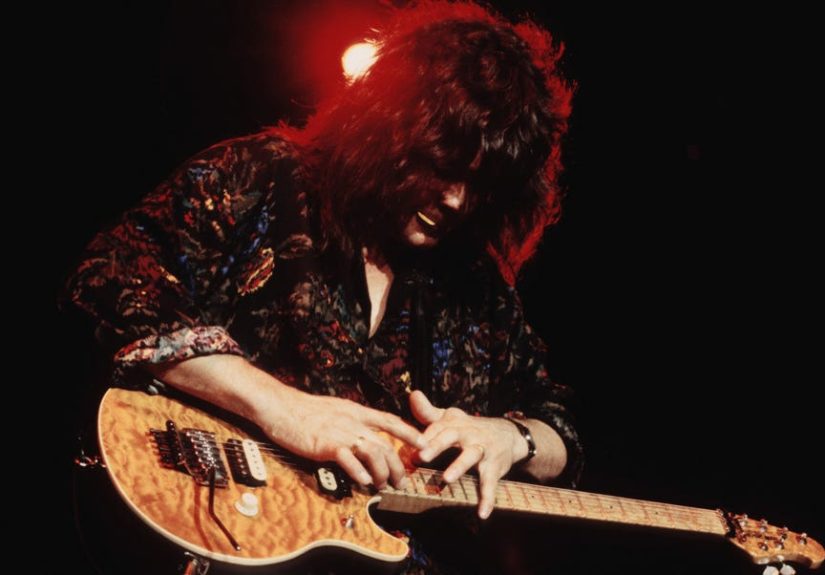
Hack #4: Two-hand tappingturning the fretboard into a keyboard
What made it revolutionary
Two-hand tapping existed in some form before Eddie, but he pushed it into mainstream rock consciousness with a level of clarity and musicality that made it
feel like a new language. The technique is simple to describe and hard to master: using both hands on the fretboard so notes can be hammered-on and pulled-off
in rapid patterns. The result can sound like a cascade of notes without the usual picking limitations.
Listen to “Eruption” and you can hear why it became a rite of passage. It isn’t just speed. It’s structure: bursts of sound that feel composed, punctuated
by harmonic squeals and dramatic dives. It’s a short piece of music that acts like a portalone moment you’re in radio rock, the next you’re in a new era
where the guitar is doing things that sound physically impossible.
Why it wasn’t just a trick
Eddie didn’t treat technique as a trophy. He treated it as a tool. Tapping served melody, drama, and surprise. It created contrast: rapid-fire runs next to
spacious pauses, bright harmonics against thick chords. The musicality is why his style didn’t age like a novelty. Even players who don’t want to “shred”
can learn from his phrasinghow he shapes intensity, when he leaves space, and how he makes rhythm feel elastic.
Hack #5: Songwriting choicesbecause riffs are the real magic trick
Eddie’s legacy isn’t only about solos. It’s about songs that still work when the guitar heroics are turned down. Van Halen tracks often hinge on riffs that
are both muscular and playfulhooks that feel like they’re smiling while they punch through the speakers.
He also refused to be boxed into one “guitar hero” identity. When the music called for new textures, he chased themeven if it annoyed people who wanted him
locked in one lane. That willingness to follow the sound (instead of the stereotype) is part of what kept the band culturally loud for so long.
The inventor’s résumé: patents, prototypes, and the courage to be “unfinished”
Eddie’s tinkering wasn’t casual. It was serious enough to reach into formal invention territory. He discussed patenting a support device related to how he
positioned the guitar for fingerboard techniquesessentially adapting the instrument’s orientation to match what his hands needed. That’s the same story in a
different outfit: make the tool fit the music, not the other way around.
And then there’s his personality as a creator: he famously valued mistakes, arguing that perfection can be boring because the most exciting moments happen at
the edge of losing controlright before everything falls apart (but somehow doesn’t). That philosophy explains why his tone and playing feel human even when
they’re technically intimidating.
What modern players can steal from Eddiewithout copying him
Here’s the paradox: the best way to honor Eddie Van Halen isn’t to become a clone. It’s to borrow his approach to problem-solving. His “hacks” weren’t about
owning rare gear. They were about removing friction between imagination and sound.
- Chase function, not fashion. If a control layout slows you down, simplify it.
- Build your own shortcuts. The “right” way is the way that gets the music out of you.
- Experiment like a musician, not a scientist. Keep the curiosity, skip the obsession.
- Protect the fun. Eddie’s brilliance never sounded like homework.
Fan and player experiences: the Eddie effect in real life
Talk to guitarists across generations and you’ll hear the same story in a hundred different accents: there’s a “before Eddie” and an “after Eddie.” Many
players remember the first time they heard “Eruption” the way people remember seeing a magic trick up close. Your brain understands that it’s just fingers,
strings, and an ampbut your instincts keep whispering, Nope. There’s a portal involved.
For some, the experience is deeply practical. A teenager hears that tone, grabs the cheapest guitar available, and starts experimenting. The first experiments
aren’t glamorous: a pickup swap that squeals, a home-painted body that looks like it lost a fight with a hardware store, a poorly soldered connection that
cuts out mid-riff. And yet, those rough attempts are exactly the point. Eddie made “messy learning” feel legitimate. Your early failures aren’t proof you
don’t belongthey’re proof you’ve started.
Others describe a different kind of Eddie experience: the endless tone chase that eventually becomes a lesson in humility. You can try pedals, amps, pickups,
strings, and every magic knob you can find, and still discover the uncomfortable truth that the biggest ingredient is touchhow hard you hit the string, how
you mute, how you let notes breathe. That realization can be frustrating… until it becomes empowering. If the sound lives partly in your hands, then your
progress isn’t locked behind a price tag.
Live-show memories carry their own electricity. People talk about the physical sensation of his playingthe way a sustained note could feel like it was
vibrating the room’s skeleton, the way a dive-bomb could make the crowd react like a roller coaster just dropped. Even those who weren’t “guitar people”
often walked away saying the same thing: they didn’t understand what he did, but they could feel it. That’s the rarest kind of virtuosity: the kind
that reaches past technique and lands as emotion.
And then there are the quieter experiencesparents teaching kids a simplified Van Halen riff, friends laughing through failed tapping attempts, bands in
garages trying to capture a fraction of that swagger. Eddie’s legacy shows up in those moments not as myth, but as momentum. He gave people permission to
experiment, to sound a little wild, to chase a tone that’s personal instead of perfect. If rock music is partly about freedom, Eddie built a toolkit for it
one striped, noisy, gloriously hacked guitar at a time.
Conclusion: the real hack was turning curiosity into a career
Eddie Van Halen’s greatest innovation wasn’t a single guitar, technique, or tone trick. It was the way he approached problems: with curiosity, stubbornness,
humor, and a refusal to accept “good enough” as a final answer. He heard something in his head, realized the tools didn’t exist, and built the tools anyway.
That’s why his influence lasts. Trends fade. Gear changes. But the idea that you can reshape your instrumentand your soundaround your imagination is as alive
now as it was the first time “Eruption” made the world blink.