Table of Contents >> Show >> Hide
- Meet Super A: The Dutch Artist Behind “Trapped”
- How the “Trapped” Paintings Work Visually
- Iconic Characters Getting the “Trapped” Treatment
- What “Trapped” Says About Pop Culture and Identity
- The Internet’s Reaction: Viral Images and Shared Nostalgia
- Pop Culture, Masks, and the People Behind Them
- Experiencing “Trapped”: What It Feels Like to Encounter These Paintings
- Conclusion: Peeling Back the Stories We Live Inside
What if Mickey Mouse, Snow White, or the Pink Panther were just costumes? Not Halloween costumes, but glossy skins hiding very real humans and animals inside.
That’s the playful yet unsettling idea behind “Trapped”, a painting series by Dutch artist Stefan Thelen, better known as
Super A. In these works, the cartoon shell peels away like ribbons while a realistic figure steps out from within, as if your childhood
favorites were finally done pretending.
First popularized online by Bored Panda, the collection of around 30 paintings reimagines famous cartoon, fairy tale, and pop culture icons
in a way that’s both visually stunning and darkly funny. Thelen uses classical painting techniques to create ultra-polished illusions that blur the line
between fantasy and reality, giving viewers a chance to rethink the characters they grew up with and the mass-media stories that shaped them.
Meet Super A: The Dutch Artist Behind “Trapped”
From Street Art to Surreal Storytelling
Stefan Thelen, aka Super A, is a Netherlands-based artist known for blending graffiti roots with meticulous, old-school painting skills.
Art and culture platforms like Colossal and Design You Trust describe him as an artist who uses traditional painting techniques to
deconstruct well-known cartoon and pop culture characters, revealing what might be lurking beneath their shiny surfaces.
Rather than simply parodying Mickey Mouse or Snow White, Super A treats them like cultural masks. In his canvases, you’ll often see the cartoon character
unfurling in strips, while a hyper-realistic bird, mouse, or human stands half inside and half outside that familiar silhouette. It’s part technical flex,
part social commentary, and part mischievous poke at our pop culture obsessions.
The “Trapped” Series: A Quick Overview
The series “Trapped” has appeared across international art and culture sites, where it’s described as a body of work that
slices open pop culture icons to “explore the truth behind fantasy.” Characters like Tweety, Mickey Mouse, Snow White, Ronald McDonald,
and Hello Kitty become layered sculptures of identity: the outer cartoon shell pulls away to reveal a realistic creature or person inside.
These pieces have been exhibited in galleries, including the “Domestication” show at the Brand Library & Arts Center in California,
where selections from the series were presented as a meditation on how pop culture characters become domesticated icons in our daily lives.
How the “Trapped” Paintings Work Visually
Peeling Away the Cartoon Shell
Visually, the “Trapped” paintings are irresistible. Super A often paints the cartoon character as if it’s made from glossy vinyl or latex. The outer
shell peels away in spirals or ribbon-like strips, curling outward from the body. Underneath, a realistic figure is revealed a bird, a human,
or another animal painted with detailed texture, soft lighting, and believable anatomy.
Imagine:
- Mickey Mouse unwinding to reveal an ordinary mouse standing upright inside.
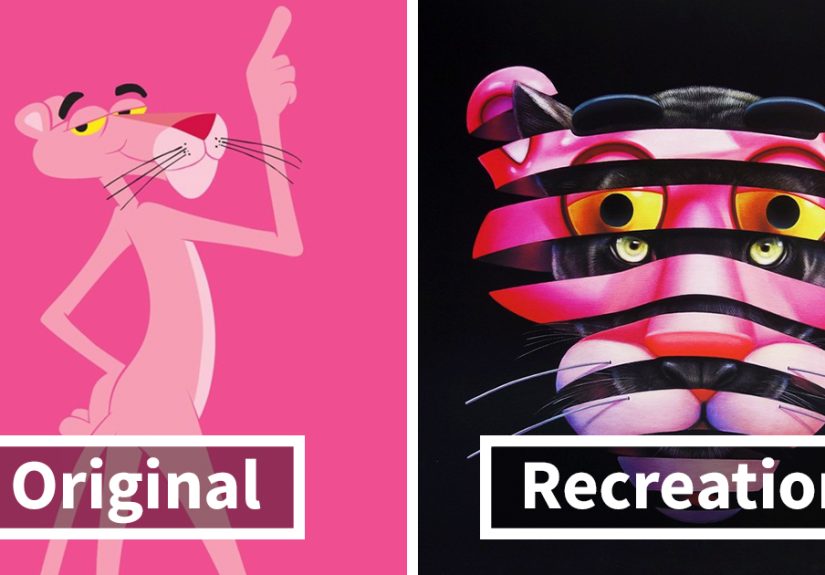
- Pink Panther unraveling into a pink cartoon shell with a realistically rendered big cat emerging from within.
- Snow White splitting open to show a live, modern woman who looks more like a stranger on the subway than a Disney princess.
The effect is part magic trick, part anatomy lesson but instead of X-raying bones, he X-rays identity. The outer character is flat and graphic,
while the inner figure has depth, shadows, and presence. It’s a visual metaphor for the difference between the simplified stories we consume and the messy,
complicated reality behind them.
Hyperrealism Meets Pop Surrealism
Critics often place Super A’s work in the realm of pop surrealism and contemporary pop art a space shared with artists who use cartoons, comics,
and mascots to question consumer culture. Art outlets that track this movement point out that many contemporary artists blend graphic, cartoon-like styles
with fine-art painting to explore how mass media shapes identity.
Super A’s twist is that he doesn’t just reference cartoon imagery he dissects it. Where some artists flatten high art into comic-book panels, he
does the reverse: he takes familiar 2D icons and turns them into 3D illusions that seem to exist in the real world. The polished finish of his pieces makes
the illusion even more convincing, as though you could reach out and tug on a loose strip of cartoon skin.
Iconic Characters Getting the “Trapped” Treatment
From Mickey and Tweety to Ronald McDonald
Across multiple features on arts and pop-culture sites, a recurring cast of characters appears in the “Trapped” series:
Mickey Mouse, Tweety, Snow White, Ronald McDonald, Hello Kitty, Pink Panther, and other cartoon and fairy-tale icons.
Each character is handled slightly differently, but the message stays consistent: beneath the bright branding lies something more ordinary, sometimes
more vulnerable, and often more unsettling. Ronald McDonald, for instance, can be seen unfurling like a mascot suit, revealing a normal person trapped
inside the sugary, corporate clown. It’s hard not to read that as a tongue-in-cheek commentary on advertising, fast food, and the way corporations wrap
simple products in big narratives.
Cartoons, Fairy Tales, and the Human Inside
Fairy tale characters lend themselves perfectly to this idea. Stories like Snow White or other princess narratives were already metaphors about
innocence, beauty, and transformation. By peeling the princess apart and revealing a realistic human underneath, Super A invites viewers to
consider how much of these stories is costume an ideal we’re meant to wear and how much is real, conflicting, human experience.
Even the animals in his “Trapped” series feel symbolic. When Tweety’s cartoon shell unwraps to show a realistic bird, the idea of captivity shifts:
who is trapped? The bird, the character, or the cultural expectations that keep both locked into specific roles?
What “Trapped” Says About Pop Culture and Identity
The Truth Behind Fantasy
Art sites that have covered “Trapped” often emphasize how Super A uses this visual metaphor to explore the “truth behind fantasy”.
The cartoons and characters we know are carefully constructed by studios, advertisers, brands, and decades of repetition. They stand for innocence,
nostalgia, comfort, or corporate friendliness.
By showing something raw and realistic underneath, Thelen suggests a few questions:
- Are these characters disguises we use to make the world feel simpler?
- Do we hide our messy human selves behind curated personas, just like these icons?
- What happens when we finally peel away the mask?
The work is not aggressively cynical, but it does feel like a wake-up call. It invites viewers to see how their favorite characters function as
cultural armor, and how easy it is to get “trapped” inside those roles.
Surrealism for the Streaming Era
In many ways, “Trapped” fits neatly into the longer tradition of surrealism, where artists use strange combinations and dream logic to reveal
deeper psychological truths. Surrealism has long drawn from the subconscious, symbolism, and the clash between reality and fantasy.
Super A’s approach updates that language for the streaming era:
- Instead of classical myths, he uses Disney, fast food mascots, and pop icons.
- Instead of melting clocks, he melts cartoon bodies into ribbons.
- Instead of dreamscapes, he gives us crisp, hyperreal studio lighting and gallery-ready compositions.
The surreal element comes from the clash between what you expect to see a flat cartoon, a simple mascot and what you actually get:
a realistic human or animal quietly occupying the shell. It feels like waking up from a childhood dream and realizing the costume doesn’t fit anymore.
The Internet’s Reaction: Viral Images and Shared Nostalgia
How Bored Panda and Others Amplified “Trapped”
The exact Bored Panda feature that popularized this series has been shared and re-pinned endlessly on platforms like Pinterest, Facebook, and image-centric
art blogs. These posts consistently describe the artist as a Dutch painter who “peels away” the surface of iconic characters to reveal what’s really hiding inside.
Other culture and design websites including Demilked and Fubiz highlight the same core idea: Super A’s paintings show the
“inner truth” of iconic pop culture characters by deconstructing them into spirals and layers.
As these articles circulate, viewers react with a mix of fascination and mild horror:
- Some people find the work deeply satisfying like finally seeing how a magic trick is done.
- Others feel slightly disturbed, as if their childhood idols have been cracked open.
- Many simply love the impeccable technique and the clever concept, sharing it as the ultimate “you have to see this” link.
Why These Paintings Hit So Hard
The emotional impact of “Trapped” comes from how much we’ve invested in these characters. Pop culture icons are more than entertainment; they’re
emotional landmarks. We remember Saturday morning cartoons, happy meals, bedtime stories, and movie marathons through them.
When an artist takes those characters and literally unravels them, we can’t help but feel exposed, too. If Snow White is just a skin, what does that say
about the stories we tell ourselves about romance, beauty, or “happily ever after”? If Mickey is just a costume wrapped around a very normal mouse, what
does that say about branding, nostalgia, and the comfort we find in manufactured smiles?
Pop Culture, Masks, and the People Behind Them
From Mascots to Personas
The “Trapped” series also mirrors something very modern: the way we all curate our own public identities. On social media, at work, or in fandoms, we
build simplified versions of ourselves avatars that are easier to manage than our full, complicated selves. Super A’s paintings echo this by showing
a literal person or animal living inside a simplified, branded shell.
In that sense, the series isn’t really just about Mickey or Snow White. It’s about:
- The influencer carefully maintaining a cheerful online persona.
- The brand mascot hiding messy corporate realities.
- The fan who feels safer living through fictional worlds than confronting their own.
The paintings ask, gently but firmly: Who’s really inside the character you’re playing?
Experiencing “Trapped”: What It Feels Like to Encounter These Paintings
Seeing the Images Online
For most people, the first encounter with “Trapped” happens online. You’re scrolling through Bored Panda, Pinterest, or your social feed, and suddenly
there’s an image of a famous character coming apart at the seams. At first you might think it’s digital art or a 3D render. Only when you read the caption
do you realize these are paintings, crafted with brushes and patience instead of software.
That realization alone is a mini experience. It slows you down. You lean closer to your screen. You notice the subtle texture of fur, the shine on the
cartoon “plastic,” the way shadows wrap around the unraveling strips. You might save the image, send it to a friend, or drop it in a group chat with a
message like, “Okay, this is wild.”
Shared online, the “Trapped” images become a kind of visual icebreaker a way to connect over shared nostalgia and a shared sense of unease. One person
will say, “There goes my childhood,” while another answers, “Honestly, this is how I feel before coffee.”
Imagining Them in a Gallery
Even if you haven’t stood in front of one of these works in person, it’s easy to imagine the experience in a gallery space. Exhibitions that have shown
“Trapped,” such as the “Domestication” solo show, place these paintings in clean, white rooms where the bright colors and graphic shapes hit you
from across the floor.
Up close, the illusion becomes even more intense. You can see the brushwork that makes the realistic inner figure feel alive the shine in the eye, the
softness of fur, the hint of pores on the skin. In contrast, the outer cartoon shell looks almost too perfect: smooth, glossy, nearly fake. That shift in
texture creates a physical sense of separation between fantasy and reality.
There’s also a small, private jolt that comes from seeing something you grew up with taken apart. You might feel:
- Curiosity wanting to understand how the illusion is built.
- Nostalgia remembering when these characters felt like safe, simple friends.
- Discomfort realizing those simple stories hide complex truths.
That emotional mix is exactly what keeps people talking about “Trapped.” It’s not just pretty or clever; it sticks with you the way a half-remembered
dream does.
Why This Series Resonates So Much Today
In a culture saturated with franchises, reboots, and cinematic universes, we’re surrounded by familiar faces. We watch heroes grow up on screen, mascots
rebrand, and characters get reimagined for new generations. Super A’s work taps into that constant recycling of icons and asks: what are we really doing
when we cling so tightly to these branded stories?
The “Trapped” series offers a visual answer: maybe, deep down, we know we’re all a little trapped inside our roles, too. We’ve got our work selves, our
online selves, our “everything’s fine” selves. These paintings gently suggest it might be time to peek behind the mask even if what we find isn’t as
cute and polished as a Disney character.
Whether you encounter them in a quiet gallery or on a noisy social feed, the paintings encourage the same small but powerful move:
look past the surface. Once you’ve seen Mickey unravel to reveal a real mouse, it’s hard not to wonder what else in your life might just be
a glossy shell wrapped around something much more real.
Conclusion: Peeling Back the Stories We Live Inside
“Dutch Artist Reveals What’s ‘Trapped’ Inside Popular Cartoon, Fairy Tale and Pop Culture Characters (30 Paintings)” may sound like classic clickbait,
but Super A’s “Trapped” series goes much deeper than a viral headline. Through meticulous painting and sly symbolism, these works turn beloved icons
inside out, revealing ordinary creatures and people hidden beneath extraordinary branding.
The result is a smart, funny, and slightly unsettling reflection on how pop culture shapes our sense of self. By peeling away the familiar faces of
cartoons, fairy tales, and mascots, the series nudges us to question the roles we play, the stories we buy into, and the masks we’ve worn for so long
we barely notice them anymore.
In the end, “Trapped” isn’t only about what’s hiding inside cartoon characters it’s also about what might be hiding inside us.