Table of Contents >> Show >> Hide
- What the Chicago Faucets 515CP actually is (and what it isn’t)
- Key specs that matter in the real world
- Pot filler reality check: the “solves half the problem” argument
- Where to place it so you don’t hate it later
- Installation: what’s straightforward, what’s not
- Maintenance and longevity: what “commercial DNA” buys you
- Who should buy the Chicago Faucets 515CP (or its replacement)
- Buying tips: how to shop without regret
- Real-world experiences (the stuff people mention after they’ve lived with it)
- 1) The first week is pure joy… because you use it for everything
- 2) Then usage settles into a pattern: “big pot days” and “holiday mode”
- 3) The “leak paranoia” is realuntil you adopt a shutoff habit
- 4) Cleaning is the hidden “cost” nobody puts in the product description
- 5) The best “experience” is when it matches your cooking identity
A pot filler is one of those kitchen upgrades that makes guests say, “Whoa,” while your practical friend says,
“You know you still have to carry the pot to the sink to drain it… right?” Both are correct. And that’s exactly
why the Chicago Faucets 515CP is interesting: it’s a pot filler with a very “commercial-grade
backbone,” built by a brand better known for high-traffic installations than trendy TikTok kitchens.
In this guide, we’ll break down what the 515CP is, what it’s like to live with one, how it stacks up against the
pot-filler pros/cons debate, and what to know before you cut into that backsplash like you’re auditioning for a
home renovation show.
What the Chicago Faucets 515CP actually is (and what it isn’t)
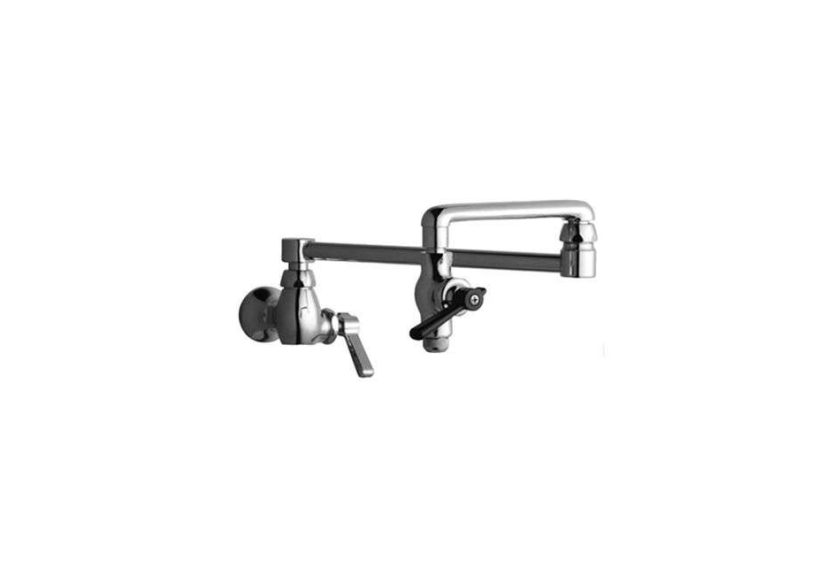
The 515CP is a single-hole, wall-mounted pot and kettle filler with an articulated (double-jointed)
swing spout. Translation: it mounts through the wall behind the range, folds out to reach your burners, and folds
back when you’re done so it doesn’t permanently photobomb your backsplash.
The big headline feature is the 18-inch double-jointed swing spout. In practice, it gives you enough
reach to fill stockpots on front burners and (depending on your cooktop depth and faucet placement) often the rear
burners too. Overall length is listed around 17-3/4 inches with roughly 11-3/4 inches
of spout clearance in its layout dimensionsnumbers that matter a lot when you’re trying to keep the spout from
bumping a range hood or a fancy backsplash ledge.
It uses a Quaturn® compression operating cartridge (right-hand) with a 90-degree turn.
That “quarter-turn-ish” operation is designed for fast on/off control without cranking your wrist like you’re opening
a stuck pickle jar.
A quick note on availability: 515CP is discontinued
Chicago Faucets lists the 515CP as discontinued and notes it has been replaced by the 515-ABCP.
If you’re shopping today, that usually means one of three paths:
- Find remaining stock through certain retailers/distributors.
- Buy the replacement model (515-ABCP) for a current-production route.
- Use 515CP specs as your design template if you already own one and need parts or service.
Key specs that matter in the real world
Pot fillers aren’t complicated appliances, but the details determine whether you’ll love it or quietly resent it
while you make pasta. Here are the practical specs that matter most:
Reach and layout
- Spout type: 18″ double-jointed swing spout (articulated arm).
- Overall reach/length: about 17-3/4″ in typical published dimensions.
- Faucet height: about 4-3/4″ in published dimensions.
- Inlet: 1/2″ NPT female threaded inlet (common for plumbing rough-in planning).
Performance window
- Rated operating pressure: 20–125 PSI.
- Rated operating temperature: 40–140°F.
Those ranges are important because pot fillers tend to be “full-flow” style fixturesmeaning you want solid pressure
so filling a big stockpot doesn’t feel like waiting for a bathtub to fill with a drinking straw.
Handles and control
The 515CP is built with a lever-style handle setup intended to be sturdy and tamper-resistant (a nod to Chicago
Faucets’ commercial roots). The “vandal-proof” language won’t matter to most homeownersunless your household includes
a curious toddler, an overly enthusiastic houseguest, or that one friend who treats your kitchen like a cooking
competition show.
Standards and compliance
On the compliance side, it’s listed as meeting common plumbing standards and being certified for drinking-water
system component requirements (the kind of details you may never brag about at a dinner party, but your plumber will
appreciate).
You may also see a California Prop 65 warning for lead exposure on product listings like this.
That label shows up on a huge range of fixtures and building products sold into California, and it’s different from
the federal “lead free” definition used for plumbing materials and certification frameworks. If you’re concerned,
the best move is to confirm the specific certifications for the exact model you’re buying and follow best practices
like flushing new lines.
Pot filler reality check: the “solves half the problem” argument
Let’s address the pot filler debate honestly, because it’s the internet and somebody is currently typing
“most overrated kitchen feature” into a search bar.
The convenience case
When pot fillers are worth it, it’s usually because of one or more of these scenarios:
- You cook big. Stock, pasta, canning, seafood boilsanything that starts with “fill a heavy pot with a lot of water.”
- Your sink is frequently busy. If the sink is loaded with prep bowls or dishes, having a second water source can keep cooking moving.
- Ergonomics matter. Reducing the carry of a sloshing stockpot can be a genuine quality-of-life upgrade for some households.
- You’re already opening walls. Adding a line during a renovation is simpler (and typically cheaper) than retrofitting later.
The skepticism case
The biggest “gotchas” are also real:
- No drain underneath. A leak over a range isn’t cute. It’s stress, cleanup, and potentially expensive damage.
- You still carry the pot to dump it. Pot filler = fill at the stove. It does not magically strain pasta for you (yet).
-
Grease and grime. Anything near a cooktop gets a fine misting of “kitchen atmosphere.”
Joints and elbows can collect residue. - Cost can surprise you. The fixture may be reasonable; the plumbing work behind the wall is where budgets can wobble.
A good way to decide is to ask: “How often am I filling large pots?” If your answer is “Every weekend,” a pot filler
can feel like a luxury that earns its keep. If your answer is “When I make pasta… in February,” you may be paying for
vibes more than value. And heyvibes are allowed. Just don’t pretend they’re a necessity.
Where to place it so you don’t hate it later
Placement is where pot fillers go from “dream feature” to “why is this hitting my cabinet door?” Here’s the practical
planning logic most homeowners benefit from:
Height: clear the tallest pot, not your knuckles
Many planning recommendations land in a rough range of placing the spout outlet somewhere around
16 to 22 inches above the cooking surface, adjusted for your tallest stockpot plus a few inches of safety
clearance. This keeps the faucet usable while minimizing the chance it gets bumped by big cookware or interferes
with hood components.
Horizontal placement: center vs. “target burner” strategy
- Centered placement gives the best chance of reaching multiple burners, especially with an articulated arm.
- Off-center can make sense if you always boil water on one specific burner (often the high-output burner).
Clearance: account for the fold-back position
When folded, you still need the faucet to “park” without hitting the backsplash trim, a pot rail, or a fancy ledge.
Also consider the handle’s swing and the fact that you’ll operate it while standing near heat.
Installation: what’s straightforward, what’s not
A pot filler install is usually “simple” only if you define simple as “open wall + proper rough-in + a plumber who
has done this before.” The faucet mounts through the wall, connects to a supply line, and needs secure support so
the arm doesn’t wobble like a loose shopping cart wheel.
Three installation truths that save headaches
-
Flush the line before final setup. New plumbing work can carry debris. Flushing helps avoid grit damaging
cartridges or clogging screens. -
Use an actual shutoff strategy. Many owners treat the wall-side valve as the “main” shutoff and the front valve
as the “working” valve. The goal: minimize the chance of a slow drip over the stove. -
Plan support inside the wall. The faucet needs solid backingbecause an articulated arm invites people to swing it
like it’s a mechanical snake.
If you’re remodeling, this is the best time to do it. If you’re not remodeling and you’re thinking about opening a
finished wall just for a pot filler, that’s where the cost-benefit math gets very honest, very fast.
Maintenance and longevity: what “commercial DNA” buys you
Chicago Faucets leans into rebuildable cartridge designs and serviceability across product lines. In homeowner terms:
it’s the difference between “replace a small internal part” and “replace the whole faucet because it’s cheaper than
the headache.”
How to keep a pot filler happy
- Wipe it down regularly with mild soap and waterespecially near the joints.
- Avoid abrasives that can dull a chrome finish.
- Check for tiny drips at the joints and outlet periodically.
- Operate it gentlyit’s a tool, not a gym apparatus.
If you already own a discontinued 515CP, the good news is that the key components (like cartridges and spouts) are
often identifiable by part number, making it easier to find compatible replacements through authorized channels.
Who should buy the Chicago Faucets 515CP (or its replacement)
This is a smart buy if…
- You want a pot filler that feels purpose-built, not just decorative.
- You cook frequently with large pots and hate hauling water across the kitchen.
- You’re already doing a renovation (walls open = easier plumbing).
- You value serviceable parts and standardized components.
You may want to skip it if…
- You rarely fill big pots.
- You’re not opening walls and don’t want visible patching or tile work.
- You don’t want any increased leak risk over a cooking surface.
- You already have a high-performing main faucet and easy sink workflow.
Buying tips: how to shop without regret
1) Confirm which model you’re actually purchasing
Because 515CP is discontinued, make sure the listing is truly 515CP and not referencing the newer 515-ABCP (or vice
versa). This matters for warranty terms, parts, and future service.
2) Match finish and style to the kitchen’s “long game”
Chrome is the classic “goes with everything” finish. It also tends to be forgiving in high-use spaces, which is why
so many plumbers and commercial specs still lean that way. If your kitchen style changes every few years, chrome is
the neutral friend who never judges you for repainting.
3) Don’t forget the hidden cost: plumbing and wall work
Pot fillers can be relatively affordable as fixtures, but installation can vary dramatically depending on whether
you’re routing a new line, drilling through tile, and repairing finished surfaces.
Real-world experiences (the stuff people mention after they’ve lived with it)
Let’s talk about the “experience” sidethe things you only learn after the faucet is installed and the backsplash
grout has dried. These aren’t personal anecdotes (I’m not in your kitchen stealing your soup), but they’re common
patterns reported by homeowners, designers, and plumbers who’ve seen pot fillers in action.
1) The first week is pure joy… because you use it for everything
People often start by using the pot filler constantly: topping up a stockpot, filling a tea kettle, refilling a
humidifier, adding water to a Dutch oven for soup, even filling a vase when the sink is full. It’s the novelty factor
plus the genuine convenience of having water exactly where you’re cooking. The 515CP-style articulated arm makes
those tasks feel smooth and deliberateswing out, fill, swing back, like a tiny kitchen robot assistant that only
knows one trick but does it well.
2) Then usage settles into a pattern: “big pot days” and “holiday mode”
After the honeymoon period, most households fall into a rhythm. If you cook large meals (Sunday sauces, meal prep,
big-batch soups), the pot filler becomes part of the routine. Around holidays, it can feel like a second sink faucet:
while one person preps at the sink, another starts boiling water at the range without traffic jams. This is where a
sturdy, commercial-leaning design shineswhen it’s being used like a tool, not treated like a museum piece.
3) The “leak paranoia” is realuntil you adopt a shutoff habit
The number one emotional experience with pot fillers is not “luxury.” It’s “Did I turn it off?” Because there’s no
drain under it. Many owners get comfortable when they treat the wall-side control as the true shutoff when the pot
filler isn’t in use. Once that habit forms, the anxiety drops. The faucet stops being a risk you worry about and
becomes a convenience you choose intentionallylike using a pressure cooker: great tool, but you respect it.
4) Cleaning is the hidden “cost” nobody puts in the product description
Over a cooktop, you’ll get grease mist, steam, and the occasional “boil-over event” that sprays everything in the
blast zone. Joints and elbows can collect grime in a way that a standard sink faucet doesn’t. Owners who love their
pot filler tend to include it in the weekly wipe-downquick pass with mild soap and warm water, dry it, move on with
life. Owners who hate their pot filler tend to ignore it until it looks a little tired, then blame the pot filler for
existing near heat (which, to be fair, is literally its job).
5) The best “experience” is when it matches your cooking identity
If you’re a frequent cook, the pot filler feels like a small upgrade that makes the kitchen run smootherless
lifting, less sloshing, fewer awkward turns while carrying a heavy pot. If you’re more of a “sheet-pan dinner” or
“air fryer enthusiast,” the pot filler can start to feel like an expensive backsplash accessory. Neither is wrong.
It’s just a lifestyle match issue. The most satisfied owners are the ones who bought it because they actually
use big pots, not because they saw it in a showroom and briefly became the kind of person who makes lobster
every Tuesday.
Bottom line: the Chicago Faucets 515CP (and its modern replacement equivalents) fits best in kitchens where function
matters, reliability matters, and cooking with large cookware is normal. If that’s you, a pot filler can feel like a
daily upgradenot just a design flex.