Table of Contents >> Show >> Hide
- What Happened in the Viral Story?
- The Real Question Is Not “Was She Mean?” It Is “Who Should Carry the Consequences?”
- Why So Many Readers Sided With the Car Owner
- The Legal and Insurance Side Makes This Even Clearer
- Why Parents Make Situations Like This Worse
- So, Was She a Jerk?
- What This Story Teaches About Family Accountability
- Experiences People Commonly Recognize in Stories Like This
- Final Take
Note: This article is for informational and entertainment purposes only and is not legal advice.
Some internet stories are messy. Some are dramatic. And some are the kind of family train wreck that makes readers put their phone down, stare at the ceiling, and whisper, “Oh, absolutely not.” This viral story lands squarely in that last category. On the surface, it sounds like a classic family guilt trip: a teenager demands accountability, the parents lose their vacation fund, and everyone acts like she ruined the magic kingdom. But once you look closer, the real issue is much bigger than a canceled trip. It is about theft, property damage, parental enabling, and the all-too-familiar family habit of handing the bill to the most responsible person in the room.
The reason this story exploded online is simple: people recognized the pattern immediately. One child creates chaos, the parents scramble to protect that child from consequences, and the sibling who got hurt is told to “be understanding.” In other words, the victim is asked to become the family’s unpaid crisis manager. That is not generosity. That is dysfunction wearing a polite sweater.
So, was the teen wrong for forcing a choice between legal consequences for her sister and repayment for the car? In my view, no. Not even close. If anything, the story is a sharp little case study in why family accountability matters, why boundaries are not cruelty, and why “keeping the peace” often just means rewarding the person who broke it.
What Happened in the Viral Story?
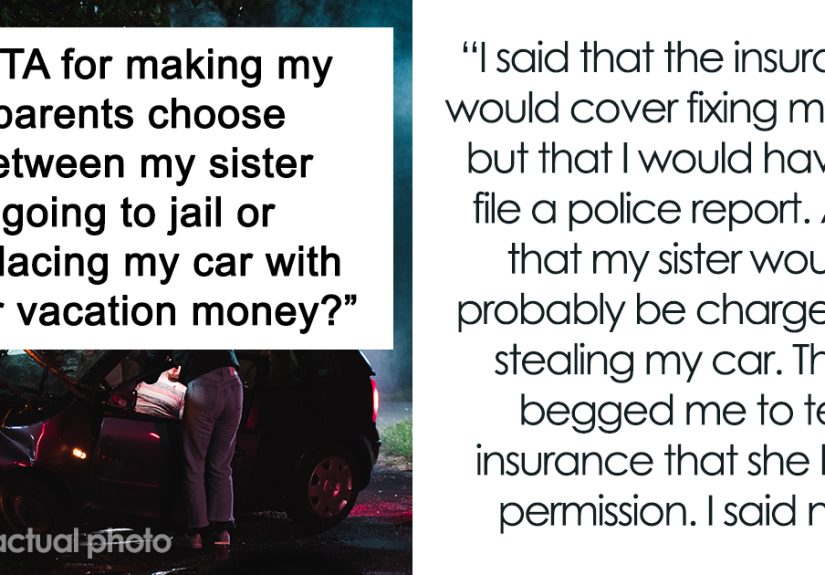
Here is the short version. A 17-year-old girl shared that her 29-year-old sister had a history of bad behavior, including stealing. The sister moved back into the parents’ home, and before long, the younger sister’s fears came true. Her sister took her car without permission and wrecked it. When the teen came home, the vehicle was badly damaged. That alone would be enough to launch most families into serious accountability mode. In this family, though, the first instinct was not justice. It was damage control.
The teen explained that insurance could potentially cover repair or replacement, but filing a claim honestly would likely require a police report. And if the truth came out, her sister could face criminal consequences for taking the car. Instead of accepting that reality, the parents reportedly begged the teen to say her sister had permission. That is the moment this stopped being a simple sibling fight and became a full-blown moral circus complete with emotional juggling and a suspicious number of imaginary clowns.
Eventually, the parents agreed to replace the car themselves. But they did so using money that had been set aside for a family vacation tied to the younger sister’s graduation. Then came the final twist: family members acted like she was the problem because the nieces would miss out on the trip. If you heard a record scratch in your head, congratulations, your moral instincts are still working.
The Real Question Is Not “Was She Mean?” It Is “Who Should Carry the Consequences?”
That is why this story resonated so hard. The title makes it sound like a teenager forced her parents into an unfair choice. But the actual choice had already been created by the sister who stole and wrecked the car. Once someone takes another person’s vehicle without permission and damages it, there are consequences. Those consequences do not magically disappear because the wrongdoer is related to you, because kids are disappointed, or because someone really wanted to go to Orlando.
In family conflicts like this, people often confuse accountability with revenge. They are not the same thing. Revenge is wanting someone to suffer because you are angry. Accountability is insisting that the person who caused harm deals with the fallout. Replacing a damaged car is not a cruel punishment. It is the basic cost of making someone whole after their property was taken and destroyed.
That distinction matters. A lot. If the teen had demanded luxury upgrades, public humiliation, or a dramatic speech performed in front of Cinderella’s castle, then sure, we could debate the theatrics. But asking for the value of what was lost is not extreme. It is actually the least dramatic solution on the menu. The more dramatic option was the one the adults kept flirting with: lie to insurance, shield the sister, and guilt the victim until she backs down.
Why So Many Readers Sided With the Car Owner
1. The sister was not being “imperfect.” She caused real loss.
There is a difference between being flaky and stealing a car. One gets you uninvited from brunch. The other can leave someone without transportation, stuck with repair costs, and pulled into an insurance headache they did not create. A car is not just a shiny object with cup holders. For many people, it is how they get to school, work, appointments, and everything else that keeps life moving.
2. The parents tried to shift the burden onto the person who got hurt.
This is the part that enraged readers. The teen did not destroy the family vacation fund. The sister did when she wrecked a car she had no right to take. The parents were the ones who decided to use that money rather than let the legal or insurance process unfold honestly. Once they made that decision, blaming the teen became a convenient way to avoid saying the obvious truth out loud: their older daughter’s actions cost the family dearly.
3. Emotional blackmail was being used as a management strategy.
When families say things like, “Now the kids do not get their trip because of you,” what they often mean is, “Please accept being wronged quietly so the rest of us do not have to feel uncomfortable.” That is not conflict resolution. That is emotional outsourcing. And it tends to fall on the same person over and over: the one who is expected to be mature, reasonable, and easy to disappoint.
4. The story had all the signs of long-term enabling.
People online quickly recognized a familiar pattern. The sister sounded like someone who had been protected from consequences before, and the parents sounded like people who had confused rescuing with loving. When that dynamic runs unchecked, the “responsible” sibling often becomes the family shock absorber. She gets hit so everyone else can avoid impact. Unsurprisingly, readers were not buying that arrangement.
The Legal and Insurance Side Makes This Even Clearer
Even without getting overly lawyerly about it, the real-world details support the teen’s position. Auto insurance can cover certain losses involving theft, vandalism, or other damage, especially under comprehensive coverage. Depending on the policy and state, unauthorized use by a family member can create a complicated claim, but it does not automatically become the owner’s fault just because the driver shares DNA and childhood photos.
That is one reason the parents’ request was such a problem. Asking the teen to tell insurance that her sister had permission when she did not is not some cute little family workaround. It can drag the victim into dishonesty and make an already stressful claim much messier. Put plainly: “Please lie so your sister avoids consequences” is not a loving parental speech. It is a terrible risk-management plan with side effects.
There is also the broader principle of restitution. When someone commits a property offense, courts can order repayment for repair or replacement costs. Separately, victims may also pursue civil remedies depending on the situation. None of that guarantees jail, and none of it means every case ends the same way. Laws vary. Outcomes vary. But the general principle is steady: people who cause property loss may be required to pay for that loss. That is not radical. That is how consequences work in grown-up land.
Another wrinkle is parental liability. In some states, parents can face civil liability for property damage caused by minors. There are also legal concepts involving family vehicle use when an owner knowingly allows someone to drive. But this case is especially telling because the older sister was an adult, and the victim was reportedly being pushed to pretend permission existed. That makes the parents’ role feel less like responsible guardianship and more like active participation in a cover-up. Not ideal. Also not adorable.
Why Parents Make Situations Like This Worse
The saddest part of stories like this is that the original damage is often not what breaks the family. The damage reveals what was already broken. A wrecked car is terrible, but the deeper pain usually comes from what happens next: who is believed, who is protected, who is blamed, and who gets told to smile while swallowing the loss.
Experts who write about enabling behavior often point to the same problem: when parents repeatedly shield an adult child from consequences, they may accidentally stunt independence, deepen dependence, and reinforce irresponsibility. That sounds dry on paper, but in real life it looks like this: one person keeps making disastrous choices, and everyone around them keeps rearranging the furniture to make the disaster look more decorative.
Healthy boundaries do not mean you stop loving your adult child. They mean you stop financing the sequel. They mean you can say, “I care about you, but I will not lie for you.” They mean support without surrender. They mean helping someone find a job, a therapist, a ride to court, or a plan to move forward, while refusing to make innocent people absorb the cost of their behavior.
Money also turns family conflict radioactive. Consumer guidance on family lending is pretty consistent: when money is involved, vague expectations create strain fast. In this story, the parents did not just pay to replace a car. They used money attached to a meaningful future event and then allowed the emotional fallout to land on the person whose property had been destroyed. That is the kind of financial decision that can leave a bruise long after the balance is gone.
So, Was She a Jerk?
No. She was the only person in the situation acting like reality still existed.
She did not create the choice. She refused to erase it. There is a big difference. Her sister created the consequences by taking the car. Her parents turned it into a tragic family production by trying to protect the wrong person. And when the teen insisted that either the loss be repaid or the truth be reported, she was not being cruel. She was drawing the line that the adults should have drawn first.
Could the situation have been less painful if the parents had calmly accepted responsibility and made sure the nieces understood the truth? Definitely. Could the family have avoided this by taking earlier warnings seriously and protecting the teen’s property? Also yes. But none of that turns the teen into the villain. It just highlights how often the “keep the peace” request is secretly aimed at the person who already paid the highest price.
If anything, the strongest line in the whole story is the implied one: a lock would have been cheaper. That sentence is practically a thesis statement. Families that refuse basic boundaries often end up paying much more later, in money, trust, and relationships.
What This Story Teaches About Family Accountability
- A victim is not responsible for protecting the person who harmed them. Family connection does not erase that principle.
- Children should not be taught that peace matters more than truth. That lesson grows into adulthood and causes serious damage.
- Parents do not help adult children by blocking consequences forever. They often just delay the crash and widen the radius.
- Money used to “solve” a problem can still create deeper resentment if honesty and responsibility are missing.
- Boundaries are cheaper than chaos. Emotionally, financially, and often literally.
Experiences People Commonly Recognize in Stories Like This
One reason this story hit such a nerve is that a lot of people have lived through some version of it. Not necessarily with a stolen car and a Disney-adjacent budget crisis, but with the same emotional structure. There is the irresponsible family member who creates the damage, the parent who rushes in with excuses, and the more dependable sibling who is expected to “be mature” and absorb the hit. People who grow up in that kind of household often become weirdly skilled at reading tension, predicting disaster, and knowing exactly when a conversation is about to become a guilt trap disguised as a family discussion.
Many people in similar situations describe the same exhausting experience: the rules are real until the favored troublemaker breaks them. Then suddenly everything becomes negotiable. Property disappears, boundaries get mocked, promises get rewritten, and the responsible child is told not to “make things worse.” Over time, that can create a deep sense of unfairness that sticks around for years. It is not always the original event people remember most. It is the moment they realized the adults in the room were more committed to avoiding discomfort than protecting what was right.
Others recognize the financial side immediately. In some families, one person’s recklessness quietly drains resources meant for everyone else. Savings disappear. Special plans get canceled. A graduation gift becomes repair money. A holiday fund becomes bail-out cash. Then, instead of naming the obvious cause, the family starts blaming whoever refuses to play along. That creates a really painful double injury: first you lose something tangible, then you get told that speaking honestly about the loss is selfish.
There is also a very specific experience that many younger siblings talk about: becoming more adult than the adults around them. They start keeping evidence, making backup plans, storing valuables carefully, and thinking three steps ahead because someone else in the home is unpredictable. That is not “being dramatic.” That is adaptation. And while it can make a person look impressively composed from the outside, it often comes from living in an environment where common sense is treated like rebellion.
Some readers probably also recognized the relief that comes when one outside adult finally steps in. In the original conversation around the story, the grandparents mattered because they represented something the household had lost: standards. Sometimes it takes a grandparent, aunt, uncle, coach, or teacher to say, “No, this is not normal, and no, the victim is not the problem.” For people who grew up in chaotic families, that kind of validation can feel enormous. It does not fix everything, but it can be the first moment the truth stops sounding like disrespect.
And that may be the biggest reason stories like this travel so far online. People are not only reacting to the drama. They are reacting to recognition. They know what it is like when the family wants silence more than fairness. They know what it is like to be asked to forgive before anyone has taken responsibility. They know what it is like to watch a capable parent become strangely helpless in the face of one difficult adult child. So when someone in that position finally says, “No, either the damage gets paid for or the truth gets reported,” a lot of readers do not see cruelty. They see a boundary they wish someone had taught them sooner.
Final Take
If you strip away the dramatic title, this is not really a debate about whether someone ruined a vacation. It is about whether a teenager had the right to refuse being sacrificed for family harmony. She did. Expecting your car to be replaced after it was stolen and wrecked is not selfish. Refusing to lie to protect the person who caused the damage is not petty. And declining to fund someone else’s bad choices with your own silence is not being a jerk. It is called self-respect.
That is probably why the story continues to stick with people. It captures a brutal but familiar truth: in some families, the biggest conflict does not come from the person who causes harm. It comes from the moment someone finally refuses to pretend the harm did not happen. Awkward? Absolutely. Necessary? Also absolutely.