Table of Contents >> Show >> Hide
- Why Better Batteries Are So Hard to Find
- The AI Toolkit: How Algorithms Actually Help
- Case Files: What AI Has Already Found (and Why It Matters)
- Microsoft + a U.S. national lab: narrowing 32 million candidates to a real prototype
- Stanford: when an AI-predicted material holds up in the lab
- Argonne and the sodium-ion push: abundant elements, serious performance
- Berkeley Lab’s autonomous lab vision: closing the gap between prediction and synthesis
- What “Better Batteries” Really Means
- Where AI Is Hunting Next: The Hot Zones of Battery Innovation
- Solid-state batteries: safer electrolytes, tougher interfaces
- Lithium metal and “anode-free” concepts: huge promise, brutal constraints
- Sodium-ion and beyond: cheaper ingredients, smarter design
- Battery manufacturing: quality control meets machine learning
- Battery health diagnostics: extending life with smarter charging and monitoring
- Recycling and the circular battery economy
- The Catch: AI Can’t Fix Physics (But It Can Waste Less Time)
- What to Watch Next
- Conclusion
- Field Notes: of Very Human Experience in an AI Battery World
If you’ve ever wondered why your phone can stream 4K video, translate a menu, and track your sleep cycles… but still dies at 3% like it’s performing a dramatic
Victorian faint, welcome to the battery problem. Batteries power everything we love, everything we need, and a few things we probably shouldn’t have bought at 2 a.m.
Yet improving them has been painfully slowbecause battery chemistry is less “plug and play” and more “choose your own adventure, but every choice has a tradeoff.”
Now artificial intelligence is joining the search. Not as a magical wand that instantly invents a perfect, cheap, fireproof, forever battery (sorry), but as a brutally efficient
research partner that can sift through mind-bending numbers of material combinations, suggest what to test next, and learn from both successes and spectacular failures.
In other words: AI is turning battery R&D from “hunt-and-hope” into “hunt-with-a-flashlight-and-a-map.”
Why Better Batteries Are So Hard to Find
“Just make a better battery” sounds simple until you realize a battery is a carefully negotiated treaty between chemistry, physics, manufacturing, cost, and safety.
Push one variable and another one sulks in the corner. Want higher energy density? Greatnow deal with heat, degradation, and sometimes a flair for the dramatic
(thermal runaway). Want cheaper materials? Congratsyour battery might now be heavier, slower, or less stable.
The real villain is the size of the search space. Battery performance depends on electrodes (cathodes and anodes), electrolytes, separators, additives, coatings,
microstructure, interfaces, and processing steps. Each part has multiple candidates, and the combinations explode. It’s not a haystack. It’s a haystack made of
smaller haystacks, stacked on a haystack, on top of a haystackinside a warehouse of hay.
Traditional discovery often looks like this: propose a material, synthesize it, test it, learn something, repeat. It’s careful and scientific, but also slow and expensive.
And because labs are busy and budgets are real, researchers have historically explored only a tiny corner of what’s possible.
The AI Toolkit: How Algorithms Actually Help
1) Screening millions of candidates without melting a decade
Machine learning models can estimate properties (like ionic conductivity, stability, voltage windows, or diffusion behavior) far faster than running high-fidelity simulations
on every candidateor building each one in a lab. They don’t replace experiments; they reduce the number of “probably not” options that humans would otherwise test
with precious time and equipment.
2) Active learning: letting the model pick the next best experiment
Instead of testing materials randomly, active learning strategies choose the next experiment based on what will be most informative. Think of it like playing “20 Questions”
with chemistry: don’t ask “Is it a battery?”ask questions that cut uncertainty in half. This can dramatically speed up electrolyte and materials discovery by focusing
experiments where learning is highest.
3) Autonomous and “self-driving” labs: robots that don’t need coffee breaks
Pair AI with robotics and you get closed-loop experimentation: the system plans experiments, runs them, analyzes results, updates its strategy, and repeats. Humans still
guide goals, interpret big-picture meaning, and stop the robot from doing anything… too creative. But the lab can iterate faster, more consistently, and at larger scale.
4) Diagnostics and battery health prediction
AI isn’t only hunting new chemistriesit’s also improving how we use the batteries we already have. Better battery management systems can predict degradation, detect faults,
optimize charging, and extend useful life. That helps EV owners, fleet operators, and grid storage operators who would prefer their batteries not age like milk.
Case Files: What AI Has Already Found (and Why It Matters)
Microsoft + a U.S. national lab: narrowing 32 million candidates to a real prototype
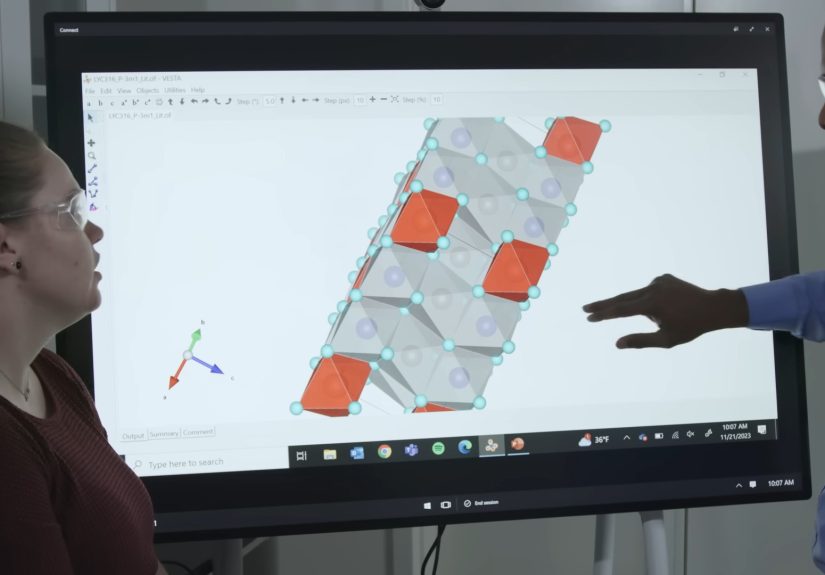
One of the most talked-about examples is a collaboration where AI was used to rapidly screen a huge set of candidate materials and identify a promising electrolyte concept,
with the goal of reducing reliance on lithium while keeping practical performance. The headline-grabber: millions of candidates screened quickly, then a short list
synthesized and tested in the real world. This is the battery discovery story people have been waiting fornot “AI wrote a poem about ions,” but “AI helped pick a material
that showed up in the lab.”
The bigger lesson isn’t one specific material name. It’s the workflow: combine computation, machine learning ranking, and lab validation to compress what used to take
years into months. That doesn’t eliminate the hard work of scaling, safety testing, or manufacturing, but it can move research through the earliest bottleneck faster.
Stanford: when an AI-predicted material holds up in the lab
Another proof point: academic work showing an AI-identified candidate that performed well when actually synthesized and tested. This matters because battery materials
aren’t just numbers on a screen; the real world punishes wishful thinking. When AI predictions survive contact with humidity, impurities, and the general chaos of reality,
researchers gain confidence in using these models to guide the next round of experiments.
Argonne and the sodium-ion push: abundant elements, serious performance
Lithium-ion isn’t going away tomorrow, but alternative chemistries are acceleratingespecially sodium-ion batteries for applications where cost and supply chain stability
matter as much as energy density. Sodium is far more abundant than lithium and tends to be easier to source. Research at major U.S. national labs has highlighted sodium-ion
cathode innovations that aim to make sodium-ion batteries more competitive for EVs and storage, including layered oxide designs that avoid expensive cobalt while delivering
improved performance.
Here, AI helps in multiple ways: predicting stable crystal structures, flagging promising compositions, and optimizing processing conditions so that what looks good on paper
can survive real cycling. Sodium-ion won’t be a universal replacement, but it’s increasingly attractive for certain segmentsespecially where cost per kilowatt-hour and
materials availability dominate the equation.
Berkeley Lab’s autonomous lab vision: closing the gap between prediction and synthesis
Modern AI can propose an avalanche of new materials. The bottleneck is making and testing them. Autonomous lab initiativesrobotic synthesis, automated characterization,
and AI-driven decision-makingare designed to shrink that gap. Think of it as turning “materials discovery” into a more continuous pipeline: propose → build → measure → learn → repeat,
at a pace that actually keeps up with computational predictions.
For batteries, this matters because many of the most important breakthroughs live in the boring details: how to prepare a cathode so it doesn’t crack, how to produce a stable
interface between electrolyte and electrode, how to control microstructure so ions can move efficiently. Autonomous systems can run thousands of variations with consistent
procedures, generating cleaner datasets and faster iteration loops.
What “Better Batteries” Really Means
“Better” depends on the job. Your earbuds want light weight and quick charging. The grid wants low cost, long life, and minimal fire risk. EVs want high energy density,
fast charging, safety, and cold-weather performanceplus a price that doesn’t make shoppers quietly back away from the dealership.
Most battery roadmaps are juggling these goals:
- Energy density: more range or runtime per pound and per liter.
- Safety: reduced flammability and better thermal stability.
- Cycle life: staying useful for thousands of charge-discharge cycles.
- Fast charging: without destroying the battery or overheating it.
- Cost and supply chain: fewer scarce elements; easier manufacturing at scale.
- Sustainability: recyclability, lower environmental impact, circularity.
Where AI Is Hunting Next: The Hot Zones of Battery Innovation
Solid-state batteries: safer electrolytes, tougher interfaces
Solid-state batteries replace flammable liquid electrolytes with solid materials (ceramics, polymers, or hybrids). The safety story is compelling. The engineering story is
complicated. Solid-solid interfaces can have high resistance; dendrites can still form; manufacturing is challenging. AI helps by searching for solid electrolytes with high ionic
conductivity, chemical stability, and compatibility with high-energy electrodes.
Even small improvements matter. A slightly better electrolyte or interface coating can unlock new combinations of electrodes and architectures. AI is especially useful here
because solid electrolytes and additives involve subtle relationships between composition, structure, and performanceexactly the kind of pattern a well-trained model can
learn faster than a human can brute-force.
Lithium metal and “anode-free” concepts: huge promise, brutal constraints
Lithium metal anodes could boost energy density, but they introduce new failure modes and demand better electrolytes. “Anode-free” approaches are particularly tempting:
they aim to form lithium metal during charging rather than using a thick lithium anode from the start. The catch? Electrolytes must be exceptionally well-behaved, and
cycle life becomes a high-stakes game of interface stability.
AI-guided electrolyte discoveryespecially active learning that chooses experiments strategicallycan accelerate progress in this area by quickly mapping what works,
what fails, and where the model’s uncertainty is highest.
Sodium-ion and beyond: cheaper ingredients, smarter design
Sodium-ion batteries are getting serious attention as a supply-chain-friendly alternative. They’re typically lower in energy density than lithium-ion, but they can win on cost,
availability, and certain safety and temperature behaviors. AI assists by optimizing cathode compositions, identifying stable structures, and tuning processing methods
that influence cracking, strain, and long-term cycling.
Beyond sodium, researchers are exploring multivalent systems (like magnesium, calcium, zinc) and other next-gen chemistries. These often face tough kinetic barriers or
electrolyte challengesmeaning AI’s ability to propose candidates quickly is valuable, but experimental validation remains king.
Battery manufacturing: quality control meets machine learning
A lab breakthrough isn’t a product until it can be manufactured reliably. AI is increasingly used to monitor production, detect defects, and correlate subtle manufacturing
variables with performance outcomes. In practical terms: fewer bad cells, less scrap, more consistent packs, and a faster path from pilot to scale.
Battery health diagnostics: extending life with smarter charging and monitoring
AI models can learn to estimate state-of-health and predict remaining useful life from signals such as voltage curves, temperature, impedance, and usage patterns. Better
predictions mean better charging strategies, safer operation, and improved warranty economics. For fleets and grids, it can also mean fewer surprise failures and smarter
decisions about when to repair, repurpose, or recycle.
Recycling and the circular battery economy
Even the best battery is eventually a “used battery.” AI can help sort packs, evaluate degradation, optimize disassembly, and improve recovery of critical materials.
Government and standards organizations have also been developing frameworks for battery circularitybecause the future of batteries isn’t only about what we mine, but
also what we recover and reuse.
The Catch: AI Can’t Fix Physics (But It Can Waste Less Time)
AI is powerful, but it’s not a chemistry cheat code. The hardest parts of battery innovation often live at interfaces and in manufacturing realities: impurities, moisture sensitivity,
microcracks, binder interactions, and the messy fact that a lab-scale success may fail at factory scale.
The other limitation is data. Battery datasets are often inconsistent across labs, proprietary in industry, and influenced by test conditions that are hard to standardize.
A model trained on narrow data can become confidently wronglike a GPS that insists you drive into a lake because the map says it’s a road.
That’s why the most credible progress is happening in hybrid systems: AI suggests, experiments verify, robots scale repetition, and humans supervise goals, safety,
and interpretation. The future looks less like “AI replaces scientists” and more like “scientists finally get a research assistant who never sleeps and loves spreadsheets.”
What to Watch Next
- More closed-loop labs: Expect more “self-driving” experimental platforms that connect prediction to synthesis and testing.
- Foundation models for materials: Models trained on massive materials datasets will increasingly guide electrolyte, cathode, and interface discovery.
- Faster iteration in electrolytes and additives: Tiny chemical tweaks can have huge performance impacts, making this a prime area for AI-driven search.
- Growing roles for sodium-ion: Especially for cost-sensitive storage and certain EV segments where price and supply chain resilience matter.
- Smarter battery management: Better diagnostics and life prediction can deliver “virtual breakthroughs” by extending battery life in the field.
- Recycling optimization: As volumes rise, AI-assisted circularity will become a competitive advantage, not a nice-to-have.
Conclusion
AI is not inventing a perfect battery overnight. But it is changing the tempo of discovery. It can explore more possibilities, learn from experiments faster, and guide
researchers toward better candidates with fewer dead ends. When paired with automation and rigorous validation, AI turns battery R&D into a tighter loopone that
can keep pace with the urgency of electrification, grid resilience, and a world that would like its devices to stop dying at inconvenient moments.
The hunt is on. And this time, the search party brought algorithms, robots, and enough computing power to make a periodic table blush.
Field Notes: of Very Human Experience in an AI Battery World
The first time I heard someone casually say, “AI is going to discover the next battery,” I pictured a robot in safety goggles mixing chemicals like a contestant on a cooking show.
“Today’s challenge: make an electrolyte that doesn’t catch fire and doesn’t cost the GDP of a small nation.” Reality is less theatricalbut somehow more impressive.
I visited a lab demo once where the star wasn’t a single breakthrough material. It was the workflow. A robotic arm moved with the calm confidence of a barista who’s
survived the morning rush. A computer queued experiments like it was building a Spotify playlist: “If you liked Candidate #142, you might also enjoy Candidate #143B with a dash of additive.”
The weird part was how normal it felt after ten minutes. Robots pipetting? Sure. AI choosing the next experiment? Why not. Humans hovering nearby, ready to intervene? Absolutely.
It wasn’t “hands-off science.” It was “hands-on, but with power tools.”
What really stuck with me was how often the system celebrated failurenot emotionally, of course (it’s a robot), but mathematically. A candidate that degraded fast wasn’t
“wasted.” It was a datapoint that tightened the model’s understanding of what not to do. That’s a mindset shift for humans, who sometimes treat failures like personal insults.
The AI treated them like training reps: not glamorous, but essential.
Later, on a road trip in an EV, I got a practical reminder that battery progress isn’t just about exotic chemistry. It’s about confidence. You don’t think about
energy density in watt-hours per kilogram when you’re deciding whether to take the scenic route. You think about range, charging speed, and whether the station you’re
heading to is actually working. That’s where AI-powered diagnostics and smarter charging strategies matter. A battery that lasts longer in real lifebecause it’s managed well,
cooled intelligently, and charged in a way that reduces stresscan feel like a breakthrough even if the chemistry is familiar.
I’ve also watched friends talk themselves out of home battery storage because they worry about safety and lifespan. Those concerns aren’t irrational; they’re practical.
And they’re exactly the kind of concerns AI can chip away at: better early detection of faults, better prediction of degradation, better choices about when a battery should be
repurposed versus recycled. It’s not as headline-friendly as “new super-battery discovered,” but it’s how technology earns trust.
The final “experience” is one I didn’t expect: AI makes battery innovation feel less like waiting for a miracle and more like building a pipeline. You can almost imagine
a future where battery improvement is steady, iterative, and relentlesslike software updates, but for chemistry. That doesn’t mean every year brings a revolution.
It means fewer years are lost to guessing. And if that eventually gives us devices that don’t die at 3% with theatrical flair, I will personally write a thank-you note
to the entire periodic table.