Table of Contents >> Show >> Hide
- Why Crystal-Clear Pool Water Takes More Than Chlorine
- Mistake #1: Skipping Regular Water Testing and Balancing
- Mistake #2: Running the Pump Like It’s on Vacation
- Mistake #3: Relying on Chemicals While Neglecting Physical Cleaning
- Mistake #4: Misusing Chlorine and Shock
- Mistake #5: Forgetting About the Filter and Baskets
- Bonus: A Simple Weekly Checklist for Crystal-Clear Pool Water
- Real-World Experiences: Lessons Pool Owners Learn the Hard Way
- Final Thoughts
If you own a swimming pool, you probably dream of that magazine-cover moment: glassy, blue water that practically begs for a cannonball. But in real life? You’re more likely to meet cloudy soup, mystery foam, or a suspicious green tint that looks like it belongs in a swamp, not your backyard.
The good news is that keeping your pool water clear and pristine isn’t rocket science. Most problems come from the same handful of pool maintenance mistakes that people repeat every season. Fix those, and you’re suddenly the neighbor with the “perfect pool” everyone talks about.
Below are five common mistakes that quietly sabotage your pool water clarity, along with practical tips, real-world examples, and a simple routine to keep your pool sparkling, safe, and swim-ready all season long.
Why Crystal-Clear Pool Water Takes More Than Chlorine
Many pool owners assume that tossing in more chlorine is the answer to everything. Water turning cloudy? More chlorine. Algae bloom? Even more chlorine. But healthy pool water depends on three big “C’s” working together: circulation, cleaning, and chemistry. When any one of those is ignored, problems show up fastno matter how much sanitizer you throw at it.
Think of your pool like a mini ecosystem: the pump keeps water moving, the filter removes debris, chemicals keep germs and algae under control, and your weekly cleaning routine handles the spots chemicals can’t reach. Skip one piece, and you’ll eventually see it in the water.
Mistake #1: Skipping Regular Water Testing and Balancing
What “balanced water” actually means
Clear pool water starts with balanced water chemistry. At a minimum, you should keep an eye on:
- pH: Ideally around 7.2–7.6. Too low can be corrosive and irritating; too high and chlorine becomes less effective, leading to cloudy water.
- Total alkalinity: Helps stabilize pH so it doesn’t bounce all over the place.
- Free chlorine: Typically around 1–3 parts per million (ppm) to keep bacteria and algae under control.
When these levels drift out of range, your pool may still look okay for a bit, but behind the scenes your sanitizer is struggling, metals may start corroding, scale might begin to form, and algae spores are happily planning their takeover.
Why “set it and forget it” doesn’t work
One of the biggest pool maintenance mistakes is assuming that once the pool looks good, you can relax on testing. Heat waves, heavy rain, sunscreen, body oils, and lots of swimmers all change your pool chemistry. Ignore it long enough and your “clear” water can turn cloudy or green seemingly overnight.
Unbalanced pH and alkalinity can also cause eye and skin irritation, even if your chlorine is technically “fine.” Many people blame the chlorine smell for red eyes, but it’s often poor overall water balance or combined chloramines causing the trouble.
A simple testing routine that actually works
To keep your pool water pristine, build a simple habit:
- Test 2–3 times per week during peak season using test strips or a liquid test kit.
- Adjust alkalinity first, then fine-tune pH. Once those are stable, dial in your chlorine.
- Log your results in a notebook or app. You’ll start noticing patterns based on weather and usage, making it easier to stay ahead of issues.
It takes just a few minutes, but it can save you from dealing with a full-blown algae bloom or expensive water corrections later.
Mistake #2: Running the Pump Like It’s on Vacation
Circulation is your pool’s life support system
Your pool pump and filter are like the heart and lungs of your pool. They move water through the filter, remove dirt and debris, and help distribute chemicals evenly. If the water isn’t moving, nothing else works properlyno matter how perfect your chemical levels are on paper.
Most experts recommend running the pump long enough for all the water in the pool to cycle through the filter at least once a day. For many residential pools, that usually means around 8–12 hours per day during the swimming season, depending on pool size, pump type, and local conditions.
Signs your pool isn’t circulating well
- Persistent cloudy water, even after correcting chemistry.
- Algae that keeps coming back, especially in the same corners or steps.
- “Dead spots” where debris just sits instead of drifting toward the skimmer.
- Uneven temperature, with some areas warmer or cooler.
If your return jets feel weak, if the water surface is barely moving, or if you always see leaves collecting in the same corner, your circulation may need attention.
Easy ways to improve circulation
- Run the pump long enough: During hot weather or heavy use, lean toward the higher end of the 8–12-hour range.
- Angle your return jets: Point them slightly downward and in the same direction to create a gentle swirling motion that pushes debris toward the skimmer and keeps water moving in corners.
- Check for blockages: Clean skimmer and pump baskets regularly so leaves and debris don’t choke off flow.
- Consider a variable-speed pump: You can run it longer at lower speeds to improve circulation while saving energy.
Better circulation means clearer water, fewer algae problems, and more efficient use of your chemicals.
Mistake #3: Relying on Chemicals While Neglecting Physical Cleaning
Chemicals can’t scrub your walls
Sanitizer and algaecide are powerful, but they can’t scrape off the film on your pool walls or pull leaves out of the deep end. Many pool owners make the mistake of treating chemicals like magic, then wonder why algae still shows up or stains keep forming.
Algae, biofilm, and dirt like to cling to surfacessteps, corners, tile lines, and seams. If you never brush or vacuum, these spots become a comfortable home base for algae, even if your water chemistry looks good.
Your weekly cleaning routine
To keep water clean and clear, build these tasks into your schedule:
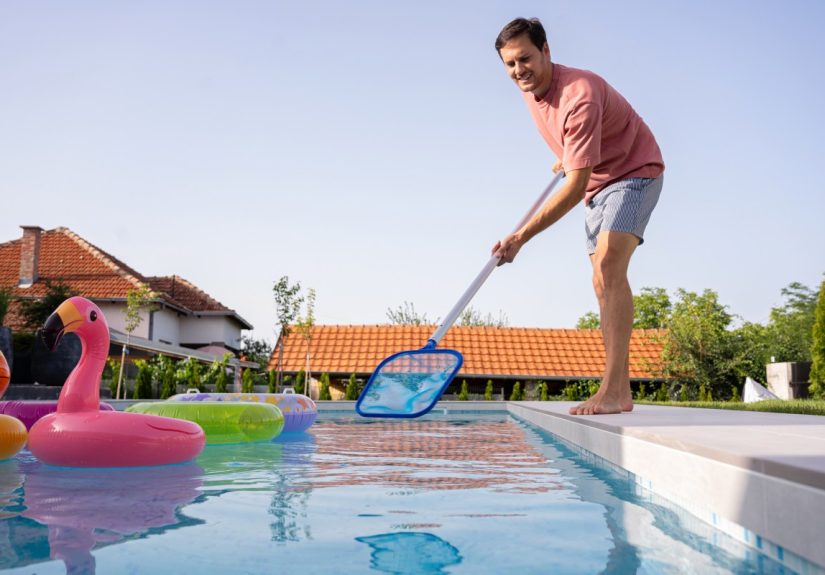
- Skim daily: Use a leaf net to remove bugs, leaves, and debris from the surface before they sink and break down.
- Brush once or twice a week: Brush walls, steps, ladders, and corners to loosen algae and dirt so the filter and chemicals can finish the job.
- Vacuum weekly: Use a manual vacuum, automatic cleaner, or robotic cleaner to remove debris from the bottom.
Consider it a quick “spa treatment” for your pool. Five to ten minutes of regular physical cleaning can prevent hours of troubleshooting down the road.
Don’t ignore problem areas
Some spots always cause trouble: behind ladders, under steps, in corners, and around lights or fittings. These are common dead zones where circulation is weaker. Give them a little extra love with the brush, especially during hot weather when algae grows faster.
Mistake #4: Misusing Chlorine and Shock
Too much, too little, or at the wrong time
Chlorine is essential for safe, sanitized water, but more isn’t always better. Over-chlorinating the pool can irritate skin and eyes, damage equipment over time, and even bleach out liners. Under-chlorinating, on the other hand, lets algae and bacteria run wild and leads to cloudy or green water.
Shocking the pooladding a high dose of chlorine or oxidizeris also important, but it’s not something you do randomly. One common mistake is shocking during the middle of a sunny day. Strong sunlight quickly breaks down unstabilized chlorine, so you lose much of the benefit before it can do its job.
When and how often to shock
In general, it’s smart to shock your pool:
- At the beginning and end of the swimming season.
- After heavy use, such as pool parties.
- After big storms or heavy rain.
- When chlorine drops too low or the pool starts to look cloudy or dull.
Many pool professionals recommend shocking in the evening or at night so the shock has time to work without being degraded by sunlight.
Smart shock and chlorine habits
- Always read the label: Follow the manufacturer’s instructions for dosage and safety.
- Pre-dissolve if required: Some products should be dissolved in a bucket of water before adding to the pool to avoid bleaching surfaces.
- Never pour shock into the skimmer: High concentrations in your equipment can cause damage or dangerous reactions.
- Keep swimmers out until safe: Wait the recommended time and ensure chlorine levels have returned to a safe range before anyone jumps in.
Used correctly, shock is one of the best tools you have for rescuing a dull or slightly “off” pool before it becomes a full algae situation.
Mistake #5: Forgetting About the Filter and Baskets
A dirty filter can’t keep water pristine
Your filter quietly works in the background, catching fine particles that make water look dull or cloudy. When it gets too dirty, water can’t pass through effectively. That means poor circulation, cloudy water, and more strain on your pump.
Different filters have different cleaning schedules:
- Sand and D.E. (diatomaceous earth) filters: Typically need to be backwashed when the pressure on the gauge rises about 8–10 psi above the “clean” baseline.
- Cartridge filters: Need to be removed and rinsed periodically (often monthly during heavy use) and replaced as recommended by the manufacturer.
Don’t ignore your pressure gauge
Make a note of your filter’s pressure right after it’s been cleanedthis is your “normal” level. When the gauge climbs 8–10 psi above that, it’s time to clean or backwash. Waiting too long means your system is working harder and your water clarity may suffer.
Skimmer and pump baskets matter too
Those little baskets in the skimmer and pump housing are your first line of defense against big debris. When they fill up, water flow slows down and your pump has to work overtime.
Get in the habit of checking and emptying baskets several times a week during leaf season or stormy weather. It’s a small, two-minute task that can dramatically improve circulation and protect your equipment.
Bonus: A Simple Weekly Checklist for Crystal-Clear Pool Water
If all of this feels like a lot, here’s a quick weekly checklist you can tape to your pool shed door:
- Daily: Skim debris, quick visual check of water clarity and equipment.
- 2–3 times per week: Test pH, alkalinity, and chlorine; adjust as needed.
- Weekly: Brush walls and steps, vacuum the pool, clean skimmer/pump baskets.
- As needed (often every 1–2 weeks in peak season): Shock the pool, especially after heavy use or storms.
- When pressure rises 8–10 psi: Backwash or clean the filter.
Follow this routine and those “mystery” water problems become rare, manageable, and a lot less stressful.
Real-World Experiences: Lessons Pool Owners Learn the Hard Way
Ask a group of pool owners about their worst water issues, and you’ll hear the same stories over and overusually told with a mix of frustration and dark humor. Here are a few common scenarios and what they teach about keeping pool water pristine.
The “I went on vacation and came back to a swamp” story
One classic tale: the pool owner who left town for a week in midsummer, turned off the pump to “save electricity,” and came home to water the color of split pea soup. Without circulation, the sanitizer couldn’t work, debris sat and decomposed, and algae had an all-inclusive resort.
The lesson? Even if you’re away, your pump shouldn’t take a holiday. Many people now use timers or smart controls to keep the pump running at least several hours a day while they’re gone, and some ask a neighbor to toss in a pre-measured dose of chemicals or check the skimmer baskets.
The “I dumped in more chemicals and made it worse” spiral
Another common experience is the “panic dump”: the water turns cloudy, so the owner dumps in more chlorine, then some clarifier, then algaecide, then something called “miracle sparkle,” all without testing the water. A few days later, the pool looks worse and nobody wants to swim in it.
In reality, the problem might have started with low pH or high alkalinity, making the chlorine less effective. Or the filter was clogged and not moving enough water. Without testing and a step-by-step plan, it’s easy to waste money on chemicals that don’t address the real issue.
Experienced pool owners often say they’ve learned to slow down, test first, correct the basics (pH, alkalinity, chlorine), and then give the system time to work before dumping in more products.
The “mysterious cloudy water that kept coming back” mystery
Another familiar story: the pool looks great after shocking, but within a week it’s cloudy again. The owner keeps shocking over and over, thinking they have a stubborn algae problemuntil they finally notice the pressure gauge on the filter is sky-high and the filter hasn’t been cleaned in months.
Once they backwash or clean the cartridge, the water clears up and stays clear. The recurring problem wasn’t “bad chemicals”; it was a filter that couldn’t keep up with the dirt and dead algae being sent its way.
The “I never brushed, and now I’m scrubbing for days” regret
Neglecting brushing is another mistake people only make once or twice. It’s easy to skip because the pool still looks okayuntil those shady corners and steps suddenly sprout a fuzzy green film. Getting ahead of algae with regular brushing is much easier than scrubbing it off every surface once it’s established.
Many pool owners eventually adopt a “ten-minute rule”: once a week, they spend ten minutes brushing the high-risk spotsstairs, corners, the shady side of the pool, around ladders and railings. That small effort often prevents big problems later.
Why these experiences matter
These real-world stories all point to the same truth: keeping your pool water pristine is less about reacting to emergencies and more about staying consistent with the basicstesting, circulation, cleaning, and sensible use of chemicals.
If you treat your pool like a living system that needs regular care, not a big bucket you occasionally dump things into, you’ll spend more time swimming and less time troubleshooting. And the next time someone complains about how “high-maintenance” pools are, you’ll be quietly floating on your crystal-clear water, wondering what all the fuss is about.
Final Thoughts
Clear, sparkling pool water doesn’t come from one magic product or a once-a-year shock treatment. It comes from avoiding a few key mistakes: ignoring water balance, under-running your pump, skipping physical cleaning, misusing chlorine and shock, and neglecting your filter and baskets.
Dial in those five areas, and you’ll transform your pool from a constant chemistry experiment into the relaxing backyard retreat it’s meant to be. Your water will look better, smell better, feel betterand your pool equipment will thank you with a longer, more reliable life.