Table of Contents >> Show >> Hide
- How to Read These Origin Stories Without Losing Your Mind
- The 35 Origin Stories
- 1) Humpty Dumpty
- 2) Ring Around the Rosie
- 3) Mary Had a Little Lamb
- 4) London Bridge Is Falling Down
- 5) Jack and Jill
- 6) Baa, Baa, Black Sheep
- 7) Mary, Mary, Quite Contrary
- 8) Three Blind Mice
- 9) Little Jack Horner
- 10) Rock-a-bye Baby
- 11) Old Mother Hubbard
- 12) Little Miss Muffet
- 13) Hey Diddle Diddle
- 14) Sing a Song of Sixpence
- 15) The Muffin Man
- 16) Simple Simon
- 17) Little Boy Blue
- 18) Georgie Porgie
- 19) There Was an Old Woman Who Lived in a Shoe
- 20) This Little Piggy
- 21) Pat-a-cake, Pat-a-cake
- 22) Hickory Dickory Dock
- 23) One, Two, Buckle My Shoe
- 24) Here We Go Round the Mulberry Bush
- 25) Star Light, Star Bright
- 26) Rain, Rain, Go Away
- 27) It’s Raining, It’s Pouring
- 28) Twinkle, Twinkle, Little Star
- 29) Little Bo-Peep
- 30) Peter Peter Pumpkin Eater
- 31) Old King Cole
- 32) Teddy Bear, Teddy Bear
- 33) Row, Row, Row Your Boat
- 34) Pop Goes the Weasel
- 35) A-Tisket, A-Tasket
- What These Stories Really Reveal
- Experiences That Make Nursery Rhyme Origins Come Alive (Extra )
- Conclusion: The Real Magic Isn’t the Secretit’s the Survival
Nursery rhymes are basically the internet memes of the pre-internet era: short, catchy, endlessly remixable, and
passed around until nobody remembers who started it. The twist? Many “kids’ rhymes” weren’t written for kids at all.
They often began as street songs, ballads, riddles, satire, or little snippets people sang while working, playing games,
or teasing each otherthen children adopted the ones with the best rhythm (and the silliest characters).
Before we dive in, a friendly reality check: lots of “secret meanings” you’ve heard online are more like folklore
about folklore. In other words, people love attaching tidy historical explanations to messy old rhymes. Sometimes
the evidence is strong. Sometimes it’s… vibes and a PowerPoint. The fun is in the chase: what we can actually trace,
what’s plausible, and what’s just a great story that refuses to die.
How to Read These Origin Stories Without Losing Your Mind
- Best evidence: early printed versions, broadsides, songbooks, and documented children’s games.
- Plausible theories: interpretations that match the era’s language and customs (but aren’t provable).
- Legend level: popular “dark meanings” that show up centuries after the rhyme was already in circulation.
The 35 Origin Stories
1) Humpty Dumpty
The earliest versions read like a riddle: something that “had a great fall” and couldn’t be fixed. The egg image we all
picture? That’s a later visual traditionhelped along by Victorian illustration and pop culture. In other words, Humpty
wasn’t born an egg; he was promoted to egg after years of strong performance in the riddle category.
2) Ring Around the Rosie
The “it’s about the plague” explanation is famous… and very shaky. Folklorists point out that versions were documented
relatively late compared with the 1660s plague, and the “symbol decoding” shows up much later than the rhyme’s early
records. The more likely truth: it’s a singing-game rhymekids moving in a ringwhose meaning is mostly “whee!”
3) Mary Had a Little Lamb
Unlike many traditional rhymes, this one has a clearer paper trail. It connects to a real anecdote recorded in the 1800s
about a lamb following a girl to schoolthen a poem made it famous. It’s one of those rare cases where the origin story
is surprisingly wholesome: a kid, a stubborn lamb, and adults realizing the classroom is not a petting zoo.
4) London Bridge Is Falling Down
This rhyme has cousins across Europe, which is a clue it’s old in spirit even if the exact lyrics vary. London Bridge
itself has been rebuilt, repaired, redesigned, and generally stressed out for centuriesso a “falling down” refrain
makes sense as a communal joke. It also works perfectly as a game-song, which helps explain why it spread so well.
5) Jack and Jill
People have tried to match Jack and Jill to real historical figures, taxes, tragedies, you name it. The safer read is:
it’s a simple slapstick tale with a rhythm that’s easy to memorize, plus a domestic “cure” that reflects everyday life
(vinegar and brown paper show up in old home remedies). The rhyme’s stickiness comes from its cartoon physics: everyone
tumbles, nobody learns.
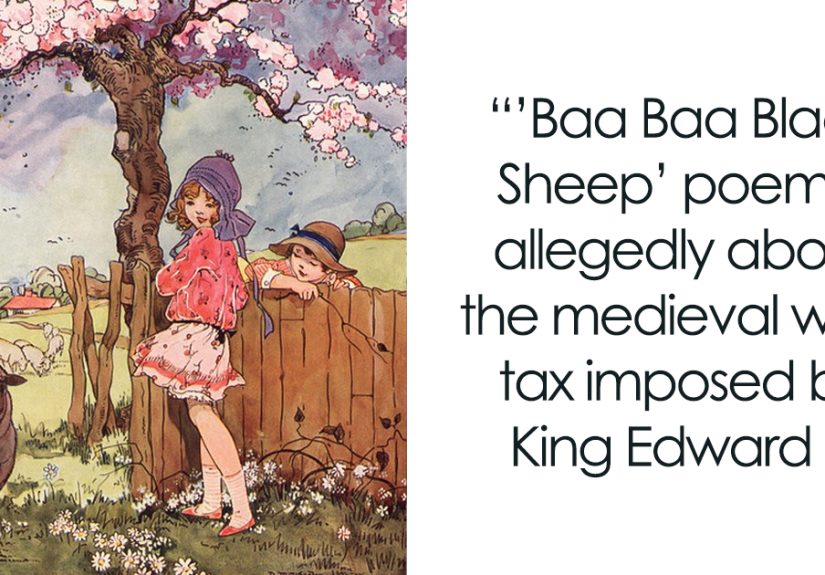
6) Baa, Baa, Black Sheep
One long-running interpretation links the “three bags full” split to old wool taxes and the economics of the wool trade.
Another modern claim ties it to the slave tradean idea most historians treat as unsupported by the rhyme’s early record.
What’s likely true either way: the rhyme reflects a world where wool mattered, and who got a share of it mattered too.
7) Mary, Mary, Quite Contrary
The “Mary” is often identified as Mary I of England (a.k.a. “Bloody Mary”) or Mary, Queen of Scotstwo royals who inspire
strong feelings and strong fan theories. The “garden” becomes a metaphor, the “silver bells” become symbolic, and the
internet does what it does. Scholars generally treat the political readings as possible but not provablestill, the rhyme’s
prickly tone absolutely feels like it’s side-eyeing someone important.
8) Three Blind Mice
This one shows up very early compared to many rhymes, including in musical collections. Because it’s vivid and slightly
sinister, people have tried to pin it to religious conflicts and historical punishments. The trouble is that the timeline
and details rarely match perfectly. It may simply be a dramatic little round that survived because it sounds great sung in layers.
9) Little Jack Horner
The popular story says “Jack” was really a steward during Henry VIII’s dissolution of the monasteries, and the “pie” hid
property deeds. It’s a delicious (sorry) narrative: greed, politics, pastry-based bribery. The evidence is thin, but the
reason it persists is obviousthis rhyme is basically a one-verse crime comedy where the villain wins.
10) Rock-a-bye Baby
If you’ve ever thought, “Why is this lullaby so stressful?” you are not alone. Origin theories range from political satire
to observations of cradleboards or treetop cradles in travel accounts. A simpler explanation: it’s a cautionary image
wrapped in a soothing meterbecause humans are complicated, and so is bedtime.
11) Old Mother Hubbard
One theory connects it to political figures (Cardinal Wolsey gets named a lot), turning the empty cupboard into a symbol
of a fall from power. Another read: it’s just escalating nonsense, the kind of comic piling-on that makes children howl.
Either way, it’s built like a sitcom montage: everything gets worse, faster, and with more outfits.
12) Little Miss Muffet
A famous legend claims the rhyme was about a real girl and a real “Dr. Muffet,” sometimes linked to an early scientist.
The documentation doesn’t cleanly support the story, but it’s a classic example of how people like to “solve” a rhyme by
giving it a cast list. What’s undeniably real: spiders have been ruining peaceful snacks since time began.
13) Hey Diddle Diddle
The “cat and fiddle” imagery shows up in older European tradition, and the whole rhyme feels like a dream you’d have after
eating cheese too late at night. Some scholars look for satirical targets; others treat it as pure nonsense verse. Its secret
weapon is sound: the words bounce and chime in a way that makes your brain want to keep going.
14) Sing a Song of Sixpence
The “blackbirds baked in a pie” detail sounds like fantasy, but elaborate banquet tricks with live birds were documented
in early modern European food culture. Interpretations then pile on: kings as sun, queens as moon, political allegory, and more.
Even if the symbolism is debatable, the rhyme preserves a snapshot of spectacle dining and courtly imagination.
15) The Muffin Man
Muffins weren’t always a cozy café itemthey were sold on streets, and tradespeople had recognizable calls and routes.
The rhyme works like a sing-song introduction to community life: here’s what people make, here’s where they live, here’s a name
you can chant at full volume. It’s local geography turned into a bop.
16) Simple Simon
“Simple Simon” is part of a broader tradition of fool charactersfigures who misunderstand obvious things and create comedy
through their blunders. These verses often circulated as teasing rhymes. The origin story here isn’t one big historical event;
it’s social: communities have always used humor to teach kids the line between clever and clueless.
17) Little Boy Blue
Some versions point toward labor and dutywatching sheep, staying awake, doing your jobthen making the whole thing funny by
letting the kid nap anyway. People have proposed political allegories, but many researchers read it as a work-and-play rhyme:
a miniature story about responsibility… and the universal lure of a cozy haystack.
18) Georgie Porgie
One often-cited theory ties “Georgie Porgie” to George Villiers, Duke of Buckingham, a court figure with a scandal-friendly reputation.
Whether or not that match is accurate, the rhyme’s function is clear: it’s a taunt. Playground culture has always enjoyed
compressing social judgment into a few singable lines.
19) There Was an Old Woman Who Lived in a Shoe
Some interpretations try to map the “many children” onto political symbolismnations, citizens, armies. But it also works as
exaggerated domestic comedy: a cramped home, too much chaos, and a frazzled adult doing her best. It’s basically an early
parenting meme: “Send help (and snacks).”
20) This Little Piggy
Fingerplay rhymes like this often evolve from games adults played with babiesrhythm, touch, and repetition are the point.
The “market” line reflects a world where markets were central, and “wee wee wee” is just irresistible sound play. Its origin
story is less about hidden meaning and more about how caretakers have always hacked entertainment using ten tiny toes.
21) Pat-a-cake, Pat-a-cake
This is another clap game fossilized into text: quick actions plus easy rhymes. The “mark it with a B” feels like a practical
detail from baking culture (identifying loaves), which gives it that satisfying “this used to be real life” vibe. It’s also a reminder
that children’s rhymes often preserve everyday work in playful form.
22) Hickory Dickory Dock
Early versions vary, and some scholars think the “hickory dickory” phrasing echoes older nonsense refrainssounds chosen because
they’re fun in the mouth. The mouse-and-clock image matches the era when household clocks were both common and slightly magical
(a big machine that measures invisible time). It’s domestic life, but make it cartoon.
23) One, Two, Buckle My Shoe
Counting rhymes were educational before “educational content” was a marketing category. This kind of verse helps kids learn sequences,
numbers, and rhythms of speech. The origin story is basically the origin of childhood itself: adults teaching skills by turning them into songs.
Your brain remembers what your ears enjoy.
24) Here We Go Round the Mulberry Bush
This is a singing game that also doubles as a routine guide: “This is the way we wash our clothes,” “brush our hair,” and so on.
Some versions get linked to specific locations (including prisons and workhouses), but the broader truth is that it’s a chore song in disguise.
If you can’t make laundry fun, at least you can make it a chorus.
25) Star Light, Star Bright
This wish-making rhyme reflects a long tradition of looking at the sky and negotiating with the universe. It’s not about one historical event;
it’s about a human habit older than paperwork: seeing a bright point in the dark and thinking, “Okay, cosmos, let’s make a deal.”
26) Rain, Rain, Go Away
Weather rhymes show how children talk back to naturelike tiny poets with zero patience. This one appears in multiple cultures and variants,
which suggests it’s a natural outcome of kid logic: rain ruins games, therefore rain must be reasoned with. It’s meteorology as emotional negotiation.
27) It’s Raining, It’s Pouring
Like many short rhymes, it survives because it’s punchy and easy to chant. Versions shift over time, sometimes growing darker, sometimes staying silly.
Think of it as an old meme format: a setup, a quick twist, and a rhythm that makes the words stick even when the meaning wanders.
28) Twinkle, Twinkle, Little Star
This is a great example of “text + tune” mashups. The lyrics come from an early-1800s English poem, while the melody is famously shared with other
children’s songs. That recycling is the secret to longevity: if kids already know the tune, the new words slip in like they own the place.
29) Little Bo-Peep
Bo-Peep is a cousin to older pastoral songs about shepherdingan occupation that shaped daily life for centuries. The “lost sheep” storyline is a perfect
mini drama: responsibility, panic, consequences, and an ending that feels like a proverb. It’s not just cute; it’s a pocket-sized lesson about paying attention.
30) Peter Peter Pumpkin Eater
This rhyme’s weird domestic image (“kept his wife in a pumpkin shell”) has inspired lots of modern readings about marriage and control.
Historically, it may simply belong to a family of rhymes built on absurd containment jokestiny houses, oversized foods, impossible living arrangements.
The real “origin story” is the comic tradition of taking a phrase and pushing it into nonsense territory.
31) Old King Cole
“Merry old soul” is a timeless character type: the ruler who’s more interested in music than management. Some people connect King Cole to legendary British kings,
but there’s no single proven identity. It may be closer to a tavern song that drifted into children’s collectionsproof that a catchy chorus will eventually move into your head rent-free.
32) Teddy Bear, Teddy Bear
This action rhyme belongs to the “move your body” tradition: simple commands that turn into a game. Its roots are tied to the early 20th century when teddy bears
became a cultural phenomenon and children’s play rhymes exploded in print and classrooms. The origin story is modern compared to Mother Gooseless medieval mystery, more playground choreography.
33) Row, Row, Row Your Boat
This one is proudly American in its documented print history, showing up in mid-1800s children’s collections and later becoming famous as a round.
Its genius is the gentle philosophy tucked into a singable loop: keep moving, enjoy the ride, life’s a dream (or at least a mildly confusing field trip).
It’s a lullaby for the anxiousdisguised as a boating tutorial.
34) Pop Goes the Weasel
This began as a 19th-century dance tune with lyrics that changed depending on where you wereand what people thought was funny that week.
“Weasel” may refer to a tool, a garment, a pawned coat, or simply a nonsense character that “pops.”
The origin story here is urban life: music halls, dancing, slang, and a chorus designed to be shouted by people who have opinions about everything.
35) A-Tisket, A-Tasket
This rhyme was documented in North America as a children’s game in the late 1800s and later leapt into pop history when it inspired a hit recording.
It’s a perfect example of the nursery-to-mainstream pipeline: kids chant it, adults arrange it, the whole country hums it, and suddenly your
“playground lyric” is paying rent.
What These Stories Really Reveal
When you zoom out, nursery rhyme history stops looking like a list of spooky secrets and starts looking like a map of everyday life:
markets, taxes, household chores, local trades, jokes, gossip, court drama, and the kind of nonsense words that keep a rhythm bouncing.
Rhymes survive not because they’re “true,” but because they’re usableeasy to chant, easy to play, easy to remix.
That’s also why the darkest interpretations spread so fast: a neat “hidden meaning” feels satisfying, like solving a puzzle.
But the most interesting truth is often simpler and more human. These rhymes are cultural leftoverslittle edible crumbs
from old songs, old games, and old jokes that children kept because they were fun.
Experiences That Make Nursery Rhyme Origins Come Alive (Extra )
If you’ve ever watched a kid sing a rhyme with total confidencewhile getting half the words wrongyou’ve witnessed the
true engine of nursery rhyme survival: joyful inaccuracy. Rhymes don’t live in libraries first. They live in kitchens,
back seats, classrooms, and playgrounds, where memory is less like a filing cabinet and more like a bouncy castle.
One of the most fun “experiments” you can try is a family-or-friends rhyme swap. Pick a well-known rhyme (say, “London Bridge”),
and ask everyone to say how they learned it. You’ll hear differences in wording, rhythm, and even the game attached to it.
That momentwhen you realize there isn’t one “correct” versionis basically the origin-story lesson in miniature.
Nursery rhymes are not museum pieces. They’re living things. They mutate like language because they are language.
Another experience that changes how you see these rhymes is reading them next to old illustrations. Early children’s books
and song collections often include woodcuts or drawings that nudge your imagination in a specific directionturning a riddle
into an egg, or turning a vague “old woman” into a specific comedic character. You can feel culture “deciding” what a rhyme
looks like. It’s like watching a character get cast in a long-running show: the role existed, but the face became famous.
If you’re exploring with kids, the best part is that origin stories don’t have to be a lecture. Make it a game:
“Is this rhyme a work rhyme, a play rhyme, a tease, or a lullaby?” Suddenly, you’re not hunting for
one correct meaningyou’re noticing patterns. Counting rhymes feel different from court satire. Fingerplays feel different
from dance tunes. And kids love categorizing things, especially when the categories have funny names.
For older kids (and curious adults), try a “myth-busting night.” Take three famous claimslike “Ring Around the Rosie is
definitely about the plague”and compare them with what folklorists say about evidence and timelines. The point isn’t to
ruin the fun; it’s to upgrade the fun. A rhyme can be interesting even if the darkest theory is wrong. Sometimes it’s
more interesting, because you get to see how modern people create folklore about the past.
And finally, there’s the simplest experience: noticing how often these rhymes pop up in modern life. You hear them in movies,
in commercials, in sports chants, in parody songs, in quick jokes on social media. That’s not an accident. Nursery rhymes
are short, rhythmic, and instantly recognizableperfect building blocks for new stories. Once you start spotting them,
it feels like finding secret doors in a familiar house. The rhymes didn’t just come from history; they keep making history,
one remix at a time.
Conclusion: The Real Magic Isn’t the Secretit’s the Survival
Nursery rhymes endure because they’re flexible. Some began as adult entertainment and drifted into childhood. Some were
playground games first and only later became “official” on the page. Some have plausible historical echoes, while others
are pure nonsense engineered for maximum bounce. The best way to enjoy their origin stories is to hold two ideas at once:
the past is real, and people love making stories about the past. Between those two truths, you get 35 tiny talesstill
singing, still shifting, and still oddly unforgettable.