Table of Contents >> Show >> Hide
- What The 2025 Component Abuse Challenge Entry Actually Did
- Why A Transistor Can Act Like A Voltage Reference At All
- The Forward-Biased Version: A Neat Little 0.6 V-ish Reference
- The Reverse-Breakdown Version: When A Transistor Pretends To Be A Zener
- Why Engineers Usually Do Not Use This As A Real Reference
- So Why Is This Still A Great Idea?
- How Real Voltage References Solve The Same Problem Better
- Practical Examples Where A Transistor Reference Might Be Good Enough
- The Real Takeaway From The 2025 Challenge
- Benchroom Experiences Related To Using A Transistor As A Voltage Reference
- SEO Tags
If you have ever looked at a transistor and thought, “You know what? You seem trustworthy enough to act like a voltage reference,” then congratulations: you are either a wonderfully curious analog hacker or a person one bench accident away from greatness. In the 2025 Component Abuse Challenge, one project leaned hard into that spirit by using a transistor in a role that falls somewhere between clever improvisation and polite semiconductor vandalism.
The idea is deliciously simple. A transistor contains junctions that behave a lot like diodes. Under the right conditions, those junctions produce a somewhat predictable voltage. Under the wrong conditions, they also produce a somewhat predictable voltage, plus a strong possibility that the transistor will never quite forgive you. That tension is what makes this topic so interesting. A transistor can serve as a voltage reference. The bigger question is whether it should.
This article breaks down what the 2025 challenge entry was really doing, why a transistor can imitate a voltage reference at all, where the trick is surprisingly useful, and why precision analog designers usually reach for proper references instead of asking a BJT to moonlight as one.
What The 2025 Component Abuse Challenge Entry Actually Did
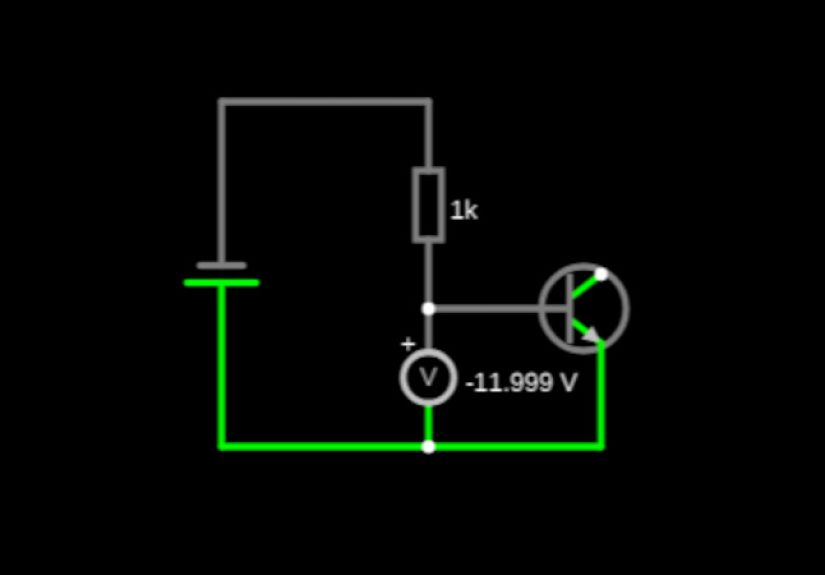
At first glance, the title “A Transistor As A Voltage Reference” sounds almost ordinary. Engineers already use transistor junction behavior inside current mirrors, temperature sensors, and bandgap references. But the 2025 challenge project was not merely using a transistor in a tidy, textbook way. It was abusing the base-emitter junction in reverse breakdown so the transistor behaved like an improvised zener diode.
That matters, because there are really two different transistor-as-reference stories hiding under one headline:
1. The respectable version
A diode-connected transistor, biased forward, can provide a roughly stable base-emitter voltage, usually somewhere around 0.6 V to 0.7 V depending on current and temperature. This is common in simple analog circuits. It is not precision magic, but it is legitimate engineering.
2. The gremlin version
If you reverse-bias the base-emitter junction hard enough, it breaks down at a relatively low voltage. In that mode, the transistor can behave like a crude voltage clamp or rough reference. This is the version that belongs in a component abuse contest, because it can permanently alter the part and its behavior depends heavily on process, device type, current, and temperature.
That second version is what gave the challenge entry its charm. It was not pretending to beat a precision buried-zener reference. It was showing how far you can push ordinary parts when you understand the physics and are willing to accept the tradeoffs.
Why A Transistor Can Act Like A Voltage Reference At All
A bipolar junction transistor is basically a device built around two p-n junctions. Those junctions do not stop being diodes just because the package label says “transistor.” If you connect the device in certain ways, you can expose diode-like behavior that is useful in analog design.
The simplest case is a diode-connected transistor, where the base and collector are tied together. Feed it with a controlled current and the base-emitter junction develops a forward voltage. That voltage is not a perfect reference, but it is repeatable enough for many simple tasks. Designers have long used this trick in current sources, bias networks, and sensing circuits.
The catch is that VBE is not a calm, Zen-like voltage. It changes with current. It changes with temperature. It changes from one transistor family to another. It is more “predictably moody” than “stable.” In normal use, its negative temperature coefficient is one reason transistors work so well in temperature measurement circuits. In reference service, though, that same temperature drift is the reason analog designers start reaching for better ideas.
The Forward-Biased Version: A Neat Little 0.6 V-ish Reference
Let’s start with the polite version, because it helps explain the abusive version.
In a forward-biased, diode-connected transistor, the base-emitter junction drops roughly 0.6 V to 0.7 V at common currents. That makes it a handy low-voltage reference for simple circuits. Need a rough current source? Put that VBE across a resistor and you have current set by Ohm’s law. Need a threshold detector with almost no parts? A transistor junction can get you there.
This is why VBE-referenced current sources appear all over educational analog design material. The circuit is compact, cheap, and intuitive. You are using the transistor’s natural junction voltage as the anchor.
But there is no free lunch. The forward voltage depends on collector current density and drops as temperature rises. That makes the transistor useful as a sensor but shaky as a precision reference. The reference is “good enough for a hack,” not “good enough for your lab instrument unless your lab instrument enjoys lying.”
The Reverse-Breakdown Version: When A Transistor Pretends To Be A Zener
Now we get to the fun part.
If you reverse-bias the base-emitter junction beyond its breakdown region, the transistor can clamp at a fairly consistent voltage for that specific device and test setup. In other words, the transistor starts acting like a rough zener. This is not the transistor’s happy place. It is more like its “I can do this, but I am filing a complaint” place.
That is the principle behind the 2025 challenge entry. A batch of NPN and PNP devices was wired for reverse base-emitter breakdown and measured. The reported results clustered by transistor type, which makes sense because breakdown voltage is strongly tied to manufacturing process. Devices from the same family or batch often behave similarly enough to look encouraging on the bench.
And that is how analog temptation begins: one part works, then five parts work, then suddenly you are staring at a handful of cheap transistors thinking you have discovered a discount zener warehouse. Slow down, MacGyver. There are limits.
Why Engineers Usually Do Not Use This As A Real Reference
Improvised breakdown references are fascinating, but they have several weaknesses that keep them out of serious precision designs.
Temperature Drift
A good voltage reference is supposed to stay calm while the world gets hotter, colder, noisier, and ruder. A transistor junction is not that relaxed. Forward VBE has a clear temperature slope, and breakdown-based behavior can also shift with temperature in ways that are not friendly to accuracy.
Current Dependence
The voltage you observe depends on bias current. Change the current and the knee shifts, the clamp changes, and your “reference” turns into an opinion. That means the surrounding resistor network and supply conditions matter a lot.
Part-to-Part Variation
Precision references are trimmed, characterized, and sold to behave like standards. Random small-signal transistors are sold to behave like transistors. If a transistor happens to clamp at a convenient voltage, that is a bonus feature, not a guarantee.
Potential Damage
This is the big one. Reverse base-emitter breakdown can cause irreversible changes to the device. So even if the part makes a decent ersatz zener today, it may no longer be a transistor you would trust in normal service tomorrow.
Noise And Long-Term Stability
Even when the clamp looks convincing on a multimeter, long-term stability and low-noise behavior are another story. Precision references earn their keep because they are designed for drift, noise, load regulation, and repeatability. Abused transistors are designed to make hobbyists grin and reliability engineers sigh.
So Why Is This Still A Great Idea?
Because engineering is not just about using perfect parts in perfect ways. It is also about understanding the hidden behaviors inside components.
The 2025 challenge entry is valuable for three reasons.
It teaches device physics in a memorable way
You can read for hours about junctions, current density, and breakdown mechanisms. Or you can wire up a transistor backward, measure a weird but repeatable voltage, and suddenly the theory feels very real.
It highlights the boundary between “works” and “works well”
This is one of the most important lessons in analog electronics. Many circuits work. Far fewer work across temperature, across production spread, across time, and across user abuse. A transistor reference is a beautiful example of that distinction.
It has niche practical uses
There are situations where a rough reference or clamp is enough. A one-off fixture, a temporary threshold network, a bench experiment, an educational demo, or a “use what you have in the junk box” build can all justify this trick. If the circuit needs a precise, low-drift, low-noise reference, though, you should back away slowly and buy the proper part.
How Real Voltage References Solve The Same Problem Better
Modern voltage references are essentially the grown-up version of this conversation. They still use semiconductor physics, but they do it with far more discipline.
Bandgap references are a great example. Designers combine a transistor’s negative-temperature-coefficient VBE with a positive-temperature-coefficient ΔVBE term derived from two transistors operating at different current densities. Done properly, those temperature slopes can cancel, giving a reference that stays much more stable over temperature.
That is why real reference ICs feel so much less dramatic. They do not rely on one lucky transistor misbehaving in a convenient way. They engineer multiple effects to cancel each other. Precision is not an accident; it is a balancing act.
Buried-zener references go even further in applications that need especially strong long-term stability and low noise. Those parts are not winning any component abuse contests, but they absolutely win the “please keep my ADC honest” contest.
Practical Examples Where A Transistor Reference Might Be Good Enough
- Simple current limiting: A diode-connected transistor can provide a rough reference voltage across a resistor to set current in a low-cost analog circuit.
- Threshold detection: A transistor junction can establish a crude turn-on point in minimalist battery or indicator circuits.
- Bench experiments: Reverse base-emitter breakdown is a terrific teaching tool for understanding semiconductor limits and process variation.
- Emergency junk-box design: If you need a rough clamp and the parts drawer is giving you attitude, a sacrificial transistor may get the job done.
Notice the recurring word: rough. That word is doing a lot of work here.
The Real Takeaway From The 2025 Challenge
The cleverness of the 2025 Component Abuse Challenge entry is not that it discovered a secret precision reference hidden inside every transistor. The cleverness is that it reminded us how much useful behavior lives just outside the polite boundaries of a part’s datasheet.
A transistor can be a voltage reference in more than one sense. Forward-biased, it can provide a practical little VBE anchor for biasing and current-setting. Reverse-biased into breakdown, it can imitate a zener well enough to make a contest judge smile and an analog purist reach for aspirin.
That is exactly why this topic is worth writing about. It lives at the intersection of theory, experimentation, and engineering judgment. It proves that a component does not stop being interesting once you know its intended use. Sometimes the best lesson comes from asking, “What happens if I use this thing in the most unreasonable way that still kind of works?”
As long as you also ask, “And what does it cost me in drift, stability, noise, and reliability?” you are not just abusing components. You are learning from them.
Benchroom Experiences Related To Using A Transistor As A Voltage Reference
What makes this topic so relatable is that it feels exactly like the kind of discovery that happens during real bench work. You start with a practical problem, usually something annoyingly small. Maybe you need a quick threshold. Maybe you want a rough clamp. Maybe the exact zener value you need is not in the drawer, but a coffee tin full of forgotten transistors is staring at you like a dare. That is usually when curiosity wins.
The first experience most people have is surprise. You hook up a transistor in a weird configuration, measure the junction, and the number is not random chaos. It is an actual, repeatable voltage. Not a perfect one, not a brochure-ready one, but repeatable enough to make you sit up straight. That moment is educational in a way textbooks rarely are. The part stops being an abstract symbol and starts behaving like a physical object with personality.
The second experience is humility. You try another transistor, then another, and suddenly the “same circuit” is not so same anymore. One part clamps a little higher. Another shifts with current more than expected. Another gets warm and starts wandering. This is where the lesson gets good. You realize that making something work once is easy. Making it work reliably is the real craft.
There is also a certain thrill in discovering how often analog design is really about negotiation. You are not commanding electrons like a tiny emperor. You are bargaining with semiconductor physics. “Can I get a roughly useful reference here?” you ask. The transistor replies, “Sure, but I want temperature drift, process variation, and maybe a little permanent damage as part of the deal.” That is funny, but it is also accurate.
Another common experience is that these experiments make you better at reading datasheets. After trying a transistor-as-reference trick, breakdown voltage ratings, test currents, and temperature behavior stop looking like filler text. They become clues. You begin to understand why precision references are engineered products and why cheap workarounds stay cheap only until you count the debugging time.
And yet, even after all that, the experiment still feels worthwhile. There is joy in learning what ordinary parts can do when pushed beyond their résumé. It sharpens intuition. It builds respect for device physics. It gives you a deeper feel for why bandgap references are so elegant and why some “bad” ideas are still fantastic teaching tools. Even when the final verdict is “do not use this in production unless chaos is part of the specification,” the bench experience pays off. You end up with better instincts, better questions, and a healthier suspicion of any circuit that seems too clever by half.