Table of Contents >> Show >> Hide
- 1. The Rosetta Stone dates to 196 BCE
- 2. It is not a random rock but part of a larger stela
- 3. It carries the same decree in three scripts
- 4. The three scripts were used for different purposes
- 5. The text praises King Ptolemy V
- 6. Ptolemy V was very young when the decree was issued
- 7. It was discovered in 1799 near Rosetta, now Rashid
- 8. The Stone may have been reused as building material
- 9. The surviving text is incomplete
- 10. Greek gave scholars their first foothold
- 11. Thomas Young helped crack key parts of the code
- 12. Champollion made the decisive breakthrough in 1822
- 13. The Rosetta Stone was not the only copy of the decree
- 14. It helped launch modern Egyptology
- 15. “Rosetta Stone” became a metaphor for any key to understanding
- Why the Rosetta Stone Still Feels So Powerful
- Experiences Related to the Rosetta Stone
If ancient artifacts had celebrity status, the Rosetta Stone would need sunglasses, a bodyguard, and a velvet rope. It is one of the most famous objects in the world, yet people often know only the headline version: “important old rock helped decode hieroglyphs.” True, but that summary does the Rosetta Stone a disservice. This object is not just a museum superstar. It is a turning point in the history of language, archaeology, and our understanding of ancient Egypt.
The Rosetta Stone matters because it helped scholars unlock writing that had been unreadable for centuries. Once that barrier fell, temples, tombs, monuments, and official inscriptions stopped being silent decoration and started speaking again. Suddenly, historians could do more than guess. They could read names, titles, prayers, political claims, and records left by the ancient Egyptians themselves. Not bad for a broken slab with a complicated travel itinerary.
Below are 15 solid facts about the Rosetta Stone, along with why each one matters. If you have ever wondered why this object gets so much attention, grab your metaphorical magnifying glass. We are going in.
1. The Rosetta Stone dates to 196 BCE
The inscription on the Rosetta Stone was carved in 196 BCE during the reign of Ptolemy V. That makes it more than 2,200 years old. Even more impressive, it was already ancient history by the time European scholars were trying to figure it out in the early 1800s. The Stone comes from the Ptolemaic period, when Greek rulers governed Egypt after the conquests of Alexander the Great. So right from the start, the object sits at the crossroads of Egyptian and Greek worlds.
2. It is not a random rock but part of a larger stela
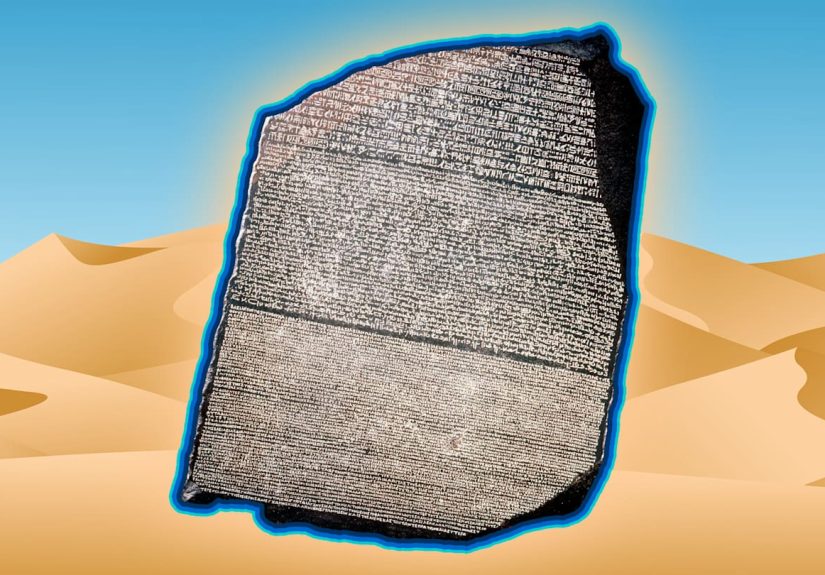
The Rosetta Stone is a fragment of a larger stone monument called a stela, which was essentially a carved slab used for official texts. In other words, the Rosetta Stone is the surviving middle section of what was once a bigger public inscription. The missing top and bottom portions matter because they remind us that scholars worked from an incomplete object. This was not a pristine instruction manual. It was more like finding a ripped-out chapter of a book and still managing to decode an entire writing system.
3. It carries the same decree in three scripts
This is the fact that made the Rosetta Stone legendary. It contains one decree written in three scripts: Egyptian hieroglyphs, Demotic, and Ancient Greek. That three-part setup turned the Stone into the ancient world’s most famous comparison chart. Because scholars could already read Greek, they had a fighting chance to use it as a reference point for the Egyptian texts. Without that multilingual layout, the history of decipherment would have been much slower and much messier.
4. The three scripts were used for different purposes
The inscription was not tripled just for decoration. Each script had a social function. Hieroglyphs were the formal, monumental script often associated with temples and sacred display. Demotic was a more cursive, practical script used in daily administration and common writing. Greek reflected the language of the ruling elite in Ptolemaic Egypt. Together, these scripts show that ancient Egypt was not culturally simple or linguistically one-note. It was a layered society with different audiences, traditions, and power structures.
5. The text praises King Ptolemy V
The Rosetta Stone does not contain mystical secrets, alien coordinates, or a recipe for eternal youth. It records a priestly decree honoring King Ptolemy V. The text celebrates his rule, lists benefits and favors associated with him, and confirms his royal cult. In plain English, the message is political. It is official propaganda with a religious stamp of approval. That may sound less dramatic than hidden treasure, but it is actually more useful to historians because it reveals how power worked in Ptolemaic Egypt.
6. Ptolemy V was very young when the decree was issued
One reason the decree matters is the age of the ruler it supports. Ptolemy V came to the throne as a child, and the inscription dates to the first anniversary of his coronation. That means the Rosetta Stone reflects a moment when royal legitimacy had to be reinforced carefully and publicly. Priests were not just being polite. They were helping stabilize the image of a young king in a politically tense environment. The Stone is therefore not only about language but also about statecraft.
7. It was discovered in 1799 near Rosetta, now Rashid
The Rosetta Stone was found in 1799 near the town Europeans called Rosetta, known today as Rashid, in Egypt’s Nile Delta. The name “Rosetta Stone” comes from that location, not from the text itself. It was reportedly uncovered by French soldiers during Napoleon’s Egyptian campaign, likely while work was being done at Fort Julien. So yes, one of history’s greatest breakthroughs in decipherment began with military activity and a very lucky discovery. Archaeology sometimes arrives in a tuxedo, and sometimes it arrives covered in dust and confusion.
8. The Stone may have been reused as building material
Evidence suggests the Rosetta Stone had been repurposed in later construction before its rediscovery. That means this priceless object was not sitting in a golden spotlight waiting for applause. It was likely embedded in a wall or foundation after its original ceremonial use had ended. There is something wonderfully humbling about that. One civilization’s official monument became another era’s practical masonry. History has a habit of recycling before historians have a chance to panic.
9. The surviving text is incomplete
The Rosetta Stone is famous, but it is not whole. Only part of the original inscription survives. The visible text includes 14 lines of hieroglyphs, 32 lines of Demotic, and 54 lines of Greek. Some sections are damaged, chipped, or missing. That incomplete state makes the decipherment story even more impressive. Scholars were not working with a perfect parallel text. They had to compare fragments, identify patterns, and test guesses with serious care. This was not a crossword puzzle. It was intellectual mountain climbing.
10. Greek gave scholars their first foothold
Because Ancient Greek was already understood by scholars, the Greek section of the Rosetta Stone provided the first major clue. Researchers could identify what kind of text they were dealing with and begin aligning names, titles, and repeated formulas across the three scripts. That foothold mattered enormously. Once scholars recognized that the passages were comparable, the Stone became a bridge instead of a mystery. The Greek text did not magically solve everything, but it supplied the sturdy first rung of the ladder.
11. Thomas Young helped crack key parts of the code
The decipherment of the Rosetta Stone is often associated with Jean-Francois Champollion, and rightly so, but Thomas Young deserves real credit too. Young made important progress by identifying royal names inside cartouches and recognizing that some hieroglyphs could have phonetic value. His work helped move scholarship away from the mistaken idea that hieroglyphs were purely symbolic pictures. In short, Young helped loosen the jar lid. That matters, even if someone else later opened the jar all the way.
12. Champollion made the decisive breakthrough in 1822
Jean-Francois Champollion is widely credited with the great breakthrough because he realized Egyptian hieroglyphs were not limited to one kind of sign. Some signs could function alphabetically, some syllabically, and some as determinatives that clarified meaning. That insight changed everything. In 1822, Champollion announced results that effectively opened the door to reading ancient Egyptian texts. Once that happened, monuments that had stood mute for centuries started yielding names of kings, religious formulas, and historical records. Ancient Egypt suddenly became far less mysterious and far more readable.
13. The Rosetta Stone was not the only copy of the decree
One of the coolest facts about the Rosetta Stone is that it was not unique in content, even if it became uniquely famous. The decree it preserves was meant to be copied and displayed in temples. Other versions and related decrees have been found, and these helped scholars restore missing portions of the Rosetta Stone’s text. That means the Stone was both extraordinary and part of a broader official communication system. Think of it as the surviving star player from a larger historical team.
14. It helped launch modern Egyptology
Once scholars could begin reading hieroglyphs, the study of ancient Egypt changed dramatically. Before the Rosetta Stone was deciphered, Egypt’s carved texts were visually impressive but linguistically sealed shut. Afterward, they became evidence. Researchers could identify rulers, dates, religious ideas, political claims, and cultural practices with far greater precision. That shift helped lay the foundation for modern Egyptology. The Stone did not merely answer questions. It changed the kinds of questions scholars were able to ask in the first place.
15. “Rosetta Stone” became a metaphor for any key to understanding
Today, the phrase “Rosetta Stone” is used far beyond archaeology. People call something a “Rosetta Stone” when it unlocks a code, explains a mystery, or makes a complex system understandable. Scientists, historians, linguists, and tech writers all borrow the phrase. That metaphor exists because the original object really did become a key to understanding a lost script. Few artifacts make the jump from museum case to everyday language. The Rosetta Stone pulled it off without even having social media.
Why the Rosetta Stone Still Feels So Powerful
The Rosetta Stone remains compelling because it represents one of humanity’s favorite victories: the moment confusion gives way to comprehension. We love stories in which a locked door finally opens. In this case, the door led to thousands of years of Egyptian history. The Stone also reminds us that knowledge rarely appears in one dramatic flash. It usually arrives through comparison, patience, rivalry, revision, and a lot of very determined people staring at symbols until their eyes probably begged for mercy.
It is also a useful reminder that language is power. Whoever can read the record can shape the story. Once hieroglyphs became readable again, ancient Egypt could speak in a fuller voice. That is why the Rosetta Stone is not just an object from the past. It is a symbol of how fragile knowledge can be and how thrilling it is when human beings recover it.
Experiences Related to the Rosetta Stone
There is a difference between knowing what the Rosetta Stone is and feeling why it matters. The experience of engaging with it, whether in person, through photographs, or in a classroom discussion, is often surprisingly emotional. At first glance, many people are struck by how physical it is. This world-famous object is not polished, glamorous, or especially tidy. It looks damaged, heavy, and stubborn, like history refusing to make things easy. That first impression matters because it reminds us that major intellectual breakthroughs do not always come wrapped in elegance. Sometimes they come with chips, cracks, and missing lines.
For museum visitors, the experience can feel almost theatrical. You approach the Rosetta Stone already carrying the legend in your head. You know it helped decode hieroglyphs, and you expect a kind of instant revelation. Instead, what you often feel is scale and texture. The scripts are densely packed. The surface is worn. The famous breakthrough suddenly seems less like a magical moment and more like the result of exhausting concentration. That shift is part of the experience. The Stone makes you respect the labor of reading, comparing, and thinking.
Students often experience the Rosetta Stone in another way: as a lesson in how knowledge is built. It teaches that translation is not merely word swapping. It involves context, pattern recognition, history, politics, and educated risk-taking. A class discussion about the Stone can quickly become a discussion about how humans solve problems. What do you do when you cannot read a system? You look for repetition. You identify names. You compare versions. You test hypotheses. The Rosetta Stone becomes more than an artifact. It becomes a case study in human persistence.
There is also an imaginative experience tied to the Rosetta Stone. It invites people to picture the centuries when hieroglyphs were visible everywhere but readable by almost no one. Temples and tombs were covered in signs that had once spoken clearly, yet later viewers could only guess. Then, slowly, patiently, those signs began to make sense again. That arc from silence to speech is deeply satisfying. It makes the past feel less distant. Instead of seeing ancient Egypt as a decorative mystery, you begin to see it as a literate civilization whose records survived long enough to be heard again.
Even for writers and history lovers, the Rosetta Stone offers a powerful creative experience. It is a reminder that every text has a reader somewhere in the future, and every lost language represents a temporary defeat, not always a permanent one. The Stone makes curiosity feel heroic. It tells us that broken evidence can still produce stunning clarity. That is probably why people keep returning to it. Not because it is just famous, but because it captures a thrilling truth: understanding can be recovered. Sometimes the world looks undecipherable, and then one object, one clue, one insight changes everything.
Note: This article is formatted as clean publication-ready HTML body content and contains no source links or citation artifacts.