Table of Contents >> Show >> Hide
- 10. Germany’s Notgeld: Emergency Money With Easter Eggs
- 9. Burma’s 1-Kyat “Democracy” Note
- 8. Oranienburg Concentration Camp’s 50-Pfennig Note
- 7. Canada’s Famous “Devil’s Face” Notes
- 6. Seychelles 50-Rupee “SEX” Note
- 5. Germany’s 10,000-Mark “Vampire” Note
- 4. Windham, Connecticut’s Frog-Fight Banknote
- 3. Burma’s Weird Denominations and Numerology Obsession
- 2. The US $1 Bill’s Tiny Owl (Or Spider) and Hidden Mottoes
- 1. The Quasi Universal Intergalactic Denomination (QUID)
- How Designers Hide Images And Symbols In Money
- Experiences: What It’s Like To Hunt Hidden Images On Banknotes
- Conclusion
If you think cash is just paper (or plastic) with a number on it, your wallet is hiding more secrets than a magic show. Modern and historical banknotes are full of tiny details: ghostly faces that appear only when you hold them to the light, words tucked into palm trees, mysterious dots that confuse scanners, and symbols so small they ignite entire conspiracy threads.
Designers build plenty of these elements for serious reasons like stopping counterfeiters. Others are accidents, private jokes, or subtle acts of protest that slipped past censors and central banks. Either way, once you see them, it’s hard to look at your money the same way again.
Below is a tour of ten fascinating banknotes with hidden images and symbols, told in classic Listverse style: a little history, a little weirdness, and a lot of “wait, that was there the whole time?”
10. Germany’s Notgeld: Emergency Money With Easter Eggs
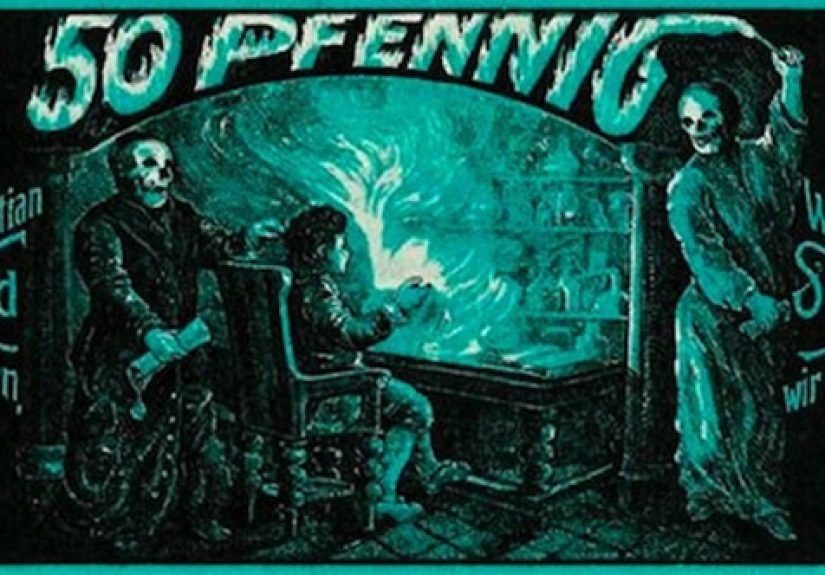
During and after World War I, Germany ran short of small change. Towns, companies, and even museums stepped in and printed their own Notgeld (“emergency money”). These notes weren’t dull stopgapsthey were miniature artworks. Local authorities put everything from fairy-tale scenes and quaint villages to angry political cartoons and black humor on their currency. Some notes even mocked hoarders and politicians with biting satire that people literally spent at the grocery store.
The “hidden” part wasn’t always a single secret shape, but coded commentary. A cute village landscape might contain tiny skeletons or ominous slogans if you looked closely at the border. A romantic scene could double as a jab at inflation or war profiteers. In a period when newspapers were censored and morale was fragile, designers used small images and symbols on these notes to tell people what they really thoughtno editorial page required.
Collectors today love Notgeld precisely because you can stare at one note for minutes and keep spotting new details: a minuscule joke in the background, a pun in Gothic lettering, or a visual metaphor for a collapsing economy tucked into a decorative corner.
9. Burma’s 1-Kyat “Democracy” Note
On the surface, Burma’s (now Myanmar’s) 1-kyat note from the late 1980s looks like typical nationalist currency: the country’s independence hero General Aung San stares out in full uniform. Hidden inside the note, however, is a risky act of visual rebellion.
Look at the watermark. When held up to the light, many observers noticed that the soft features, rounder jaw, and gentle eyes looked less like the stern general and suspiciously more like his daughter, Aung San Suu Kyi, the pro-democracy leader who spent years under house arrest. At the time, simply showing her image in public could lead to imprisonment, so slipping her likeness into official currency was a bold statement. People could literally hold a quiet symbol of resistance in their hands whenever they bought food or paid bus fare.
Whether the engraver intended this or “accidentally” idealized the face a bit too much, the watermark turned into a hidden rallying point. Citizens passed the note around, tilting it toward windows and lamps like a political Rorschach test: “Do you see her?”
8. Oranienburg Concentration Camp’s 50-Pfennig Note
Even in the bleak world of Nazi concentration camps, one designer found a way to smuggle in a message. Oranienburg, one of the earliest camps near Berlin, issued its own scrippseudo-money prisoners had to use inside the camp. A prisoner named Horst-Willi Lippert, a graphic artist jailed for anti-Nazi views, was ordered to design it.
The front of the notes already told a grim story: guard towers, barbed wire, armed sentries, and exhausted prisoners doing hard labor. But the sharpest protest hid in a single word. Lippert is reported to have altered the word Konzentrationslager (“concentration camp”) on the plate by scratching away part of a letter, changing it to something closer to “concentration killer.” The difference is tinya few missing millimeters of inkbut devastating once you notice it.
The authorities apparently never did. The notes were printed and used, complete with a secret editorial cartoon buried in their text. It’s a reminder that even under brutal regimes, small acts of dissent can survivesometimes literally stamped into the money.
7. Canada’s Famous “Devil’s Face” Notes
In the 1950s, Canada rolled out a fresh series of banknotes featuring a young Queen Elizabeth II. They looked perfectly respectable… until people peered closely at the Queen’s hair. Some saw, clear as day, a grinning demonic face lurking in the curls just behind her ear.
Letters started arriving at the Bank of Canada: Who put Satan on our money? Was this a prank? An occult message? In reality, the engraver had faithfully translated a photographic portrait into engraved lines. The “devil” emerged from the way highlights and shadows clustered in the elaborate hairstyle. Our brains are hard-wired to find faces in random patterns, and this note was an unfortunate masterpiece of accidental pareidolia.
Still, perception is everything. To calm public nerves, engravers quietly darkened and simplified the hair on later printings, softening the phantom grin. The original versions are now nicknamed “Devil’s Face” notes and are prized by collectors. Next time you see an old Canadian bill from that era, check the Queen’s hair and see what your brain conjures up.
6. Seychelles 50-Rupee “SEX” Note
Some hidden images are accidents. Others feel suspiciously like a bored engraver having fun. The Seychelles 50-rupee note from the late 1960s shows Queen Elizabeth II against a tropical backgroundpalms, sea, and sun. Rotate the note and look at the palm fronds to the right of her portrait, and many people immediately spot three letters spelled out by the leaves: S-E-X.
The discovery turned this otherwise ordinary Commonwealth banknote into international gossip. Was it deliberate? Investigations suggested that the original artists’ drawings didn’t contain the secret word, which points to somebody tweaking the design during engraving. On another denomination from the same series, sharp-eyed viewers also found the word “SCUM” hidden under a turtle’s flipper.
Regardless of the motivepolitical protest, juvenile joke, or simple coincidencethese palm-tree messages transformed a small-island currency into one of the most talked-about notes in the collecting world. Today, “SEX notes” from Seychelles often fetch high prices precisely because of those controversial leaves.
5. Germany’s 10,000-Mark “Vampire” Note
Hyperinflation Germany in the early 1920s produced some wild banknotesdenominations soared into the millions as money lost value by the day. One of the most infamous is the 10,000-mark note featuring a portrait based on Renaissance artist Albrecht Dürer’s Portrait of a Young Man. At first glance, it’s just a serious man in period clothing.
Now rotate the note 90 degrees and stare at the area around his neck and shoulder. Many observers see the outline of a hooded face pressed to his throat, mouth open as if biting. That eerie second figure earned the design its nickname: the “Vampire Note.” Given the bitter resentment toward France and reparations after World War I, collectors have long speculated that an anonymous engraver slipped in a visual metaphor for a foreign power “sucking Germany dry.”
Whether intentional political art or elaborate coincidence, the image is hard to unsee once your brain locks it in. It’s a perfect example of how hidden imagery on money can carry stories about national trauma long after the economy has moved on.
4. Windham, Connecticut’s Frog-Fight Banknote
Not all hidden images are sinister. Some are just deeply, delightfully local. In 1754, residents of Windham, Connecticut were jolted awake one night by a horrifying noise. Fearing an enemy attack during the French and Indian War, they armed themselvesonly to discover, at dawn, a pond full of dead and dying bullfrogs that had apparently fought over dwindling water. The embarrassing misfire became known as the “Battle of the Frogs.”
Rather than bury the story, Windham embraced it. A local bank later issued notes showing one frog triumphantly perched atop another frog’s lifeless body. At first glance, it’s a tiny vignette in the corner of a banknote; once you know the legend, it becomes an inside joke frozen in ink. The community turned its most ridiculous panic into a mascot, stamping the frogs onto currency, seals, and even modern public art.
Here, the hidden symbol is a shared memory. If you were an outsider, you might never notice anything more than a curious little amphibian. For locals, it was a laughproof that sometimes the loudest “battle” is just frogs being frogs.
3. Burma’s Weird Denominations and Numerology Obsession
Some secrets aren’t buried in graphics but in the numbers themselves. In the 1980s, Burma’s authoritarian leader Ne Win developed a well-documented obsession with numerology. Under his rule, the country issued banknotes in extremely unusual denominations: 15, 35, 45, 75, and 90 kyat. Forget the tidy 10s and 20s you’re used toeverything revolved around his lucky number nine (4+5=9, 9+0=9, and so on).
For ordinary citizens, this “hidden code” had brutal real-world consequences. Sudden demonetizations and reissues wiped out savings when older notes were declared invalid. Entire fortunes vanished overnight because someone’s astrologer thought a different combination of digits would improve the country’s fate.
The symbolism here is chilling: the banknote’s face value became a message about who really mattered. The numerology worked like a secret language only the dictator and his inner circle claimed to understand, while the public was forced to read the consequences in empty wallets and wrecked household budgets.
2. The US $1 Bill’s Tiny Owl (Or Spider) and Hidden Mottoes
America’s humble one-dollar bill might be the most analyzed piece of paper on Earth. People have spent decades hunting for secret Masonic codes, Illuminati signals, and mystical owls. Some of those theories are… a stretch. But there are tiny details worth knowing.
Take the tiny shape near the upper-right “1” on the front of the bill. If you zoom inor just squint really hardyou may see what looks like a tiny owl or a small spider tucked into the decorative border. Officially, it’s simply a quirk of the intricate scrollwork used to make the note harder to copy, but that hasn’t stopped countless debates about what it “really” is supposed to be.
Flip the bill over and the symbolism gets more explicit. The reverse shows the Great Seal of the United States. Above the unfinished pyramid sits an eye in a triangle with the Latin motto Annuit Coeptis (“He has favored our undertakings”), while the phrase Novus Ordo Seclorum (“New order of the ages”) curves below. These phrases are genuine historical mottoes dating back to the founding era, but their placement on currency feeds an endless supply of YouTube essays and late-night conversations.
Whether you see hidden conspiracies or just layered national symbolism depends on your worldview. Either way, the $1 bill proves that the line between security design and mythology can be very thin.
1. The Quasi Universal Intergalactic Denomination (QUID)
The strangest “banknote” on this list isn’t even used on Earthyet. In 2007, currency exchange company Travelex partnered with scientists from the UK’s National Space Centre to dream up a “space currency” called the Quasi Universal Intergalactic Denomination, or QUID. Part marketing stunt, part design experiment, it was meant to answer the question: if tourists ever vacation on the Moon, how would they pay for souvenirs?
QUIDs look like transparent discs with colorful centers representing planets. Each unit would carry a unique code like a serial number, allowing it to be tracked and authenticated. The hidden symbolism is obvious once you think about it: the solar-system design isn’t just pretty, it’s a miniature map of humanity’s expanding economic reach. No watermarks or devils in the hair herejust the quiet suggestion that money will follow us wherever we go.
As of now, QUIDs are more conversation piece than currency. But they show how banknotes and coins double as cultural time capsules. In centuries past, rulers used money to broadcast their power. In the twenty-first century, we’re already printing our sci-fi dreams on it.
How Designers Hide Images And Symbols In Money
These banknotes may feel wildly different, but they rely on a common toolbox. Currency designers use layered line art, fine shading, and complex patterns to create images that can look ordinary at one viewing angle and reveal extra shapes or words at another. Watermarksfaint portraits or emblems embedded in the paperonly appear when you hold a note up to the light. Microprinting hides text so small that you need a magnifying glass to read it. Holographic patches and shifting inks change color as you tilt the note.
Then there are features primarily aimed at machines, not humans. Some modern currencies include constellations of tiny colored dots (often called the EURion constellation) that copier and scanner software can recognize, preventing high-resolution copying. Human eyes might see just a decorative sprinkle of circles; your printer sees a giant “do not reproduce” sign.
When you mix all of that with human imagination, you get unintended devils, secret frogs, and planets orbiting inside plastic disks. The line between “security design” and “hidden picture puzzle” is surprisingly blurry.
Experiences: What It’s Like To Hunt Hidden Images On Banknotes
If you’ve never gone down the “hidden banknote” rabbit hole, fair warning: once you start, it’s hard to stop. For many collectors, the first spark is casualyou hear a rumor about a tiny owl on the dollar bill or a rude word in some tropical palm trees, grab a note from your wallet, and hold it closer to the lamp. When you actually see it, that moment feels a bit like solving a magic trick.
From there, people develop surprisingly methodical habits. Serious banknote fans often keep a simple “inspection kit” on their desk: a bright LED flashlight, a basic magnifying glass or jeweler’s loupe, and maybe even a cheap UV light. A single evening with that setup and a handful of notes from different countries can feel like a world tour. Tilt a Canadian bill and watch holograms shift. Shine light through an older European note and watch layered watermarks emerge. Flip over a small local issue and discover a regional legend captured in a tiny corner vignette.
Traveling adds another layer of fun. You might land in a new country and head straight for the ATMnot just because you need cash, but because you’re excited to see what the local designers have hidden in plain sight. Maybe the smallest denomination carries folkloric animals; maybe a commemorative note quietly celebrates a scientist instead of a politician. In places where politics is tightly controlled, people will sometimes point to a detail on a bill and shrug, half-joking: “You didn’t hear this from me, but we all know what that really means.”
There’s also a social side. Banknote forums and collector groups share high-resolution scans and argue (politely, most of the time) over whether a supposed hidden image is intentional or just wishful thinking. One person traces an outline around what they swear is a vampire; another insists it’s just a fold of fabric. A third poster chimes in with archival documents showing the engraver was simply copying an older painting. Even when a mystery gets debunked, the process teaches people to look more carefully at design choices and historical context.
For casual observers, the experience is more relaxed. You don’t have to become a numismatist to enjoy the hunt. The next time you receive change, pause for a second. Feel the texture. Look for tiny text along the borders, faint shapes in the blank areas, or repeating patterns that might serve a technical purpose. Ask yourself: why this portrait? Why this symbol? Why did a long-gone designer think it mattered enough to carve it into a plate that would print millions of times?
Ultimately, these hidden images and symbols remind us that money isn’t just a tool for buying coffee. It’s a traveling art exhibition, a miniature history lesson, and occasionally a subversive message board passed from hand to hand. When you start seeing the secrets in banknotes, everyday transactions get a little more entertainingand a lot more human.
Conclusion
From accidental demons in royal hairdos to deliberate acts of resistance etched into watermarks, banknotes carry more than face value. They’re dense with stories: of governments trying to secure their currency, of artists sneaking in jokes or protest, of communities turning local legends into mascots, and of everyday people projecting meaning onto tiny shapes in ornate borders.
“10 Banknotes With Hidden Images And Symbols” is really a tour of how we use money as a canvas for our fears, jokes, hopes, and myths. The next time you handle a banknoteany banknotetake a closer look. The most interesting part might be the detail you were never meant to notice.