Table of Contents >> Show >> Hide
- Why KitchenAid’s Espresso Move Makes Sense Right Now
- What Is in the KitchenAid Espresso Collection?
- What Makes This Collection Feel Easier Than Traditional Espresso Machines?
- How KitchenAid Stands Out in a Crowded Espresso Market
- What Reviews and Early Coverage Reveal
- Which KitchenAid Espresso Machine Fits Which Buyer?
- Why This Launch Matters Beyond Coffee
- Real-Life Experience: What Easy Espresso Actually Feels Like at Home
- Final Thoughts
KitchenAid has spent decades owning a very specific corner of the kitchen: the “I know this brand, I trust this brand, and yes, that mixer is staying on the counter forever” corner. Now the company is bringing that same confidence into espresso, a category that can feel a little like joining a secret society where everyone knows what a puck screen is except you. With its new espresso collection, KitchenAid is not trying to turn every home cook into a competition barista. Instead, it is doing something much smarter: making espresso feel less intimidating, more stylish, and a whole lot easier to live with.
That matters because the espresso category has grown far beyond coffee obsessives. More Americans are making coffee at home, and specialty coffee has become a regular part of everyday life instead of a rare splurge. In other words, people still love a café run, but they also love the idea of making a cappuccino in sweatpants without spelling their name for a paper cup. KitchenAid clearly saw that shift and decided there was room for a machine lineup that blends convenience, design, and approachable performance.
Why KitchenAid’s Espresso Move Makes Sense Right Now
Espresso machines used to live at two extremes. On one side, you had ultra-basic machines that promised a latte lifestyle and delivered disappointment with foam. On the other, you had serious equipment that looked amazing but demanded patience, technique, and a willingness to spend quality time adjusting grind settings before your brain had fully clocked in for the day.
KitchenAid’s expansion lands right in the middle of that gap. The brand is targeting people who want better coffee at home but do not necessarily want the full ceremony of becoming their neighborhood’s unofficial extraction scientist. That is why the collection includes both a semi-automatic option for hands-on users and fully automatic machines for people who want quality espresso with fewer steps and fewer opportunities to make a pre-caffeine mistake.
It is also a logical brand extension. KitchenAid already has the design language, countertop credibility, and loyal customer base. If someone trusts the brand with mixers, blenders, and stand mixers that survive years of holiday baking chaos, trusting it with a coffee machine is not exactly a leap into the unknown. It is more like KitchenAid showing up in a new outfit and somehow still looking familiar.
What Is in the KitchenAid Espresso Collection?
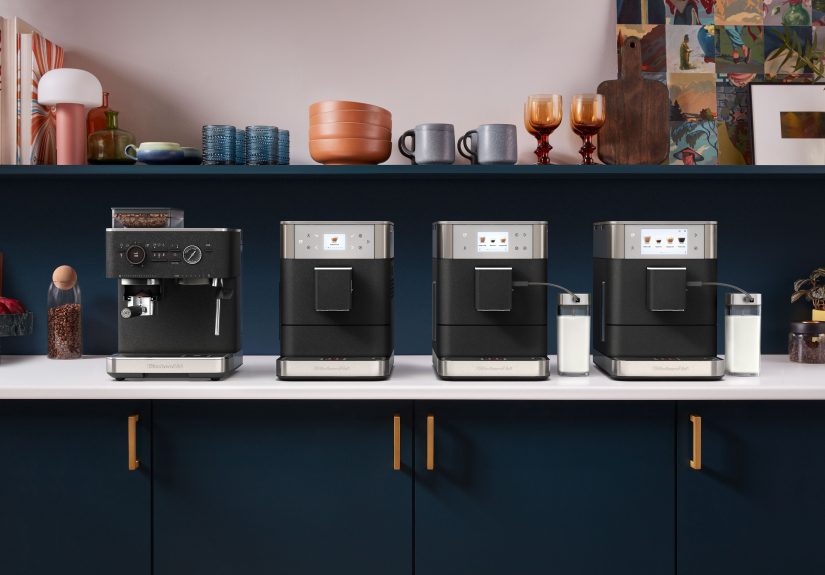
The collection is built around four machines: one semi-automatic espresso machine with a built-in burr grinder and three fully automatic models known as the KF6, KF7, and KF8. Together, they create a ladder for different types of coffee drinkers, from the curious beginner to the “please memorize my cortado settings” crowd.
The Semi-Automatic Model: For People Who Want the Ritual
The semi-automatic machine is KitchenAid’s answer to people who enjoy some participation in the espresso process but do not want a countertop setup that feels like a second job. It includes a built-in burr grinder, smart dosing technology, a 58mm easy-tamp portafilter, a multi-angle steam wand, and fast-heating technology. That combination matters because it removes some of the most annoying parts of learning espresso while still leaving enough hands-on control to keep the process fun.
In practical terms, this machine lets users grind beans, tamp, pull shots, and steam milk with a structure that feels more beginner-friendly than many traditional semi-automatic machines. The flat-base portafilter, for example, makes tamping more stable and less awkward. That may sound like a small detail, but espresso is full of “small details” that turn into “why is my kitchen counter covered in coffee grounds?” in a hurry.
The machine also leans hard into convenience without becoming a button-only appliance. You still get the satisfying ritual of making espresso, but KitchenAid adds guardrails. It is espresso with training wheels, except the training wheels are metal-clad and attractive enough to earn a permanent parking spot on your counter.
The Fully Automatic Models: For People Who Want Coffee Before Conversation
The fully automatic lineup is where KitchenAid really pushes the “easy espresso” angle. The KF6, KF7, and KF8 are designed to automate grinding, brewing, milk frothing, and customization so users can make espresso drinks with far less manual effort.
The model range steps up in drink variety and interface sophistication. The KF6 offers 15-plus recipe options, the KF7 goes beyond 20, and the KF8 expands to 40-plus drink options. Across the lineup, users can personalize drinks by adjusting factors like strength, temperature, and volume. On the higher-end models, that means a home coffee station can start behaving more like a favorite café order history.
KitchenAid also built in features that make day-to-day use less annoying. A removable bean hopper allows users to swap beans more easily, and an auto-purge function helps keep leftover grounds from interfering with flavor when switching roasts. Automatic milk frothing simplifies milk drinks, while “Clean Me” notifications and programmable cleaning cycles reduce maintenance guesswork. The machines also support a range of milk choices, including plant-based options, which feels especially relevant in modern households where one person drinks whole milk, another uses oat milk, and someone else insists almond milk “just foams differently.”
What Makes This Collection Feel Easier Than Traditional Espresso Machines?
KitchenAid is not just selling espresso machines. It is selling relief from espresso anxiety.
That ease comes from a few key decisions. First, the machines reduce guesswork. Smart dosing technology on the semi-automatic side and automated grinding on the fully automatic side remove one of the biggest pain points for beginners: figuring out how much coffee to use. Second, the interface design is intentionally straightforward. Reviewers have noted that the controls are intuitive, and on the fully automatic models, the touchscreen menus help translate espresso jargon into something more usable.
Third, the lineup is designed to lower the maintenance burden. Cleaning cycles, alerts, removable components, and streamlined milk systems all matter because the average home user is not looking for a machine that demands a full spa treatment after every latte. Easy cleaning is not glamorous, but it is one of the biggest reasons a machine actually gets used long-term.
Fourth, KitchenAid emphasizes quiet operation. The collection has been promoted as Quiet Mark certified, and early coverage of the semi-automatic machine praised the grinder for being unusually quiet. That may sound like a bonus feature, but in real homes it is a major quality-of-life upgrade. Great espresso is nice. Great espresso that does not sound like a leaf blower at 6:30 a.m. is nicer.
How KitchenAid Stands Out in a Crowded Espresso Market
The espresso market is not exactly empty. Brands like Breville, De’Longhi, Miele, SMEG, Jura, and Terra Kaffe already occupy different corners of the category. So KitchenAid is not walking into an untouched space. It is walking into a very competitive room and trying to make a memorable entrance.
Its clearest point of differentiation is that it treats espresso as both a beverage tool and a countertop object. Plenty of brands make capable machines. Fewer manage to combine strong everyday usability with the kind of visual identity that helps a machine feel like part of the kitchen instead of a visiting piece of lab equipment.
KitchenAid also benefits from brand familiarity. For many shoppers, buying from a company already associated with durable, premium-feeling kitchen appliances lowers the risk of trying a new category. That is especially useful in espresso, where prices can climb fast and buyer hesitation is very real.
Finally, KitchenAid positions its machines around “easy premium” instead of hardcore coffee maximalism. The message is not “you must learn everything.” The message is “you can make drinks you actually want, at home, with less friction.” That is a strong pitch in a market where many customers do not dream of becoming baristas; they just want better mornings.
What Reviews and Early Coverage Reveal
The early response to KitchenAid’s espresso push has been largely positive, especially around design, ease of use, and drink quality. Reviewers have praised the semi-automatic machine for its compact footprint, intuitive front-facing controls, quiet grinder, and ability to produce rich espresso and silky milk when dialed in properly. That is a meaningful win, because semi-automatic machines often scare off newer users with fiddly setups and inconsistent results.
At the same time, the reviews are not blind cheerleading. Some testers noted that the semi-automatic model still requires a bit of dialing in, especially around grind dose. That is fair. “Easy espresso” does not mean “magically perfect every single time without any learning curve.” It means the machine removes more obstacles than it creates. KitchenAid appears to do that, but it has not abolished the laws of coffee physics.
The fully automatic side of the lineup has also earned strong marks for customization, espresso quality, and ease of cleaning. The KF7, in particular, has been highlighted as a standout super-automatic model thanks to its customizable settings and strong all-around performance. The KF8 has also been praised for the breadth of drink options and user-friendly design. The trade-off, unsurprisingly, is price. These are premium machines, not impulse-buy appliances tossed into the cart next to paper towels and dish soap.
Which KitchenAid Espresso Machine Fits Which Buyer?
Choose the Semi-Automatic If You Want Some Hands-On Fun
This is the best fit for someone who enjoys the craft of espresso and likes the idea of steaming milk, tamping coffee, and adjusting settings without jumping all the way into advanced-barista territory. It works well for buyers who want better control and better coffee but still appreciate a little help from smart design.
Choose the KF6 If You Want Convenience Without Going Full Luxury
The KF6 is a strong entry point for people who want automatic drink making, saved favorites, and simple customization without paying for every bell and whistle in the lineup. It is ideal for households that value convenience and consistency more than endless experimentation.
Choose the KF7 or KF8 If Espresso Is Becoming a Lifestyle
The higher-end fully automatic models make the most sense for users who drink a lot of espresso beverages, care about customization, and want a machine that can handle multiple preferences. These are the models for the family coffee station, the design-forward kitchen remodel, or the person who has quietly replaced takeout coffee with home drinks and is now ready to commit.
Why This Launch Matters Beyond Coffee
KitchenAid’s espresso expansion says something bigger about where the kitchen appliance market is heading. Consumers increasingly want machines that combine performance, simplicity, and aesthetics. They do not want to choose between “works well” and “looks good.” They want both, and ideally they want it in a color that does not start arguments with the rest of the kitchen.
This collection also shows how the idea of the “coffee station” has evolved. Home coffee is no longer just about a drip machine shoved into a corner. It is becoming a personalized ritual space, complete with beans, syrups, mugs, frothers, and machines that reflect how people actually live. KitchenAid understands that espresso is not only a drink category. It is a lifestyle category, a design category, and for some people, a borderline personality trait.
Real-Life Experience: What Easy Espresso Actually Feels Like at Home
The best way to understand KitchenAid’s move into espresso is to imagine the daily experience, because that is where “easy” either proves itself or completely falls apart. A machine can sound brilliant on paper and still become the appliance you avoid because it is too loud, too messy, too confusing, or too needy. KitchenAid seems to understand that the actual user experience begins long before the first sip.
For many households, the first noticeable difference would be the noise level. Traditional grinding can turn a peaceful kitchen into an industrial soundscape before sunrise. A quieter grinder changes the mood immediately. Instead of announcing coffee to the entire household like a town crier, the machine gets on with the job without causing breakfast-related resentment. That matters more than brands sometimes admit. Espresso is supposed to improve your morning, not create a small domestic crisis.
Then there is the flow of the process itself. On the semi-automatic machine, the experience is likely to feel satisfying rather than stressful. You grind, tamp, brew, and steam in a sequence that feels organized and logical. The controls are easy to follow, the portafilter is designed to make tamping less awkward, and the compact footprint helps the machine live comfortably in real kitchens instead of demanding a luxury-countertop estate. There is still a learning curve, sure, but it feels more like learning to cook a good breakfast than trying to decode an aircraft dashboard.
On the fully automatic side, the experience becomes even more seamless. A user can wake up, tap through favorite drinks, adjust temperature or strength, and get a latte or cappuccino without juggling separate grinders, milk frothers, and cleanup routines. In a busy household, that kind of simplicity is not just convenient; it is the difference between using the machine every day and only using it when company comes over and you suddenly feel the urge to look impressive.
The bean-swapping feature adds another real-world advantage. Many coffee drinkers like switching between regular and decaf, or between brighter weekday roasts and darker weekend blends. On some machines, changing beans feels like a chore that practically requires a support group. KitchenAid’s removable hopper and purge system make that process feel much less dramatic. That supports the kind of flexible, casual coffee habit most people actually have.
Cleaning is another part of the experience that deserves attention because it often determines whether the honeymoon phase lasts. Machines with reminders, programmed cleaning cycles, and easier-access parts tend to stay in rotation. Machines that feel high-maintenance tend to become very expensive countertop decor. KitchenAid’s collection appears designed to avoid that fate by reducing friction at the exact moments where home users usually give up.
There is also a less obvious emotional experience at play: confidence. Easy espresso is not just about fewer steps. It is about helping people feel capable. When a machine makes a user feel like they can pull a decent shot, steam acceptable milk, or customize a drink without ruining it, they keep exploring. They try a cortado. They attempt a cappuccino. They learn what they like. That sense of progress is what transforms a machine from a gadget into part of a daily ritual.
And that may be the smartest thing KitchenAid is doing here. It is not just selling espresso. It is selling a version of home coffee that feels welcoming, polished, and realistic for ordinary kitchens. Not every user wants the most technical machine on the market. Many want the machine that gets used, enjoyed, cleaned, and used again. In that sense, easy espresso is not the shortcut. It is the point.
Final Thoughts
KitchenAid’s expansion into espresso feels well-timed and well-judged. The brand is entering a growing category with a collection that speaks clearly to modern coffee habits: people want better drinks at home, but they also want convenience, style, and machines that do not make them regret their life choices before breakfast.
The semi-automatic machine offers a satisfying middle ground between ritual and support, while the fully automatic KF6, KF7, and KF8 models lean into personalization and ease. Together, they make a convincing case that KitchenAid is not simply dabbling in espresso. It is trying to reshape the category for mainstream home users who want premium results without unnecessary drama.
If that strategy continues to land, KitchenAid may do for espresso what it already did for mixers: turn a once-specialized appliance into a true kitchen icon. And honestly, that is a shot worth watching.