Table of Contents >> Show >> Hide
- Why Employers Ask, “Why Do You Want This Job?”
- What a Great Answer Should Include
- A Simple Formula for Answering the Question
- How to Build a Strong Answer Step by Step
- Sample Answers for Different Situations
- Mistakes That Can Sink Your Answer
- How to Tailor Your Answer by Job Type
- What Interviewers Secretly Love Hearing
- Experience-Based Lessons From Real Interview Situations
- Conclusion
Few interview questions look harmless and cause chaos quite like “Why do you want this job?” It sounds simple. It is not simple. It is a polished little trap wrapped in office-friendly language. Answer too vaguely, and you sound unprepared. Answer too personally, and it feels like you only want a paycheck, a shorter commute, or access to the snack wall. Answer too aggressively, and suddenly you sound like you want to run the company by Thursday.
The good news is that this interview question is highly beatable. Better yet, when you answer it well, you do more than survive the moment. You show that you understand the role, you have done your homework, and you can connect your background to what the employer actually needs. That is the sweet spot.
In this guide, we will break down how to answer “Why do you want this job?” with confidence, clarity, and just enough personality to sound memorable without auditioning for a stand-up special. You will learn what hiring managers are really asking, how to structure a strong answer, what mistakes to avoid, and how to tailor your response for different career stages.
Why Employers Ask, “Why Do You Want This Job?”
When interviewers ask this question, they are usually trying to measure three things at once. First, they want to know whether you understand the company. Second, they want to know whether you understand the role. Third, they want to know whether you and the job make sense together.
In other words, this is not just about enthusiasm. It is about fit, motivation, and value. Employers want evidence that you are not applying blindly to 87 jobs before lunch. They want to hear that something about this specific role and this specific organization genuinely caught your attention. They also want reassurance that your interests align with their needs, not drift somewhere in the same zip code.
A strong answer tells the interviewer, “I know who you are, I know what this role requires, and I can see exactly where I can contribute.” That is music to a hiring manager’s ears. Or at least softer background jazz than, “Honestly, I just need to get out of my current job.”
What a Great Answer Should Include
The best answers usually include three ingredients. Miss one, and the whole thing starts to wobble.
1. A specific reason you like the company
This could be the company’s mission, products, culture, reputation, growth, leadership, customer focus, innovation, or industry position. The key word here is specific. Saying, “You seem like a great company,” is polite but forgettable. Saying, “I was impressed by your focus on customer education and how clearly that shows up in your product updates and support resources,” sounds researched and sincere.
2. A clear reason you want the role itself
Interviewers do not just want to hear that you admire the company. They want to know why this position makes sense for you. Maybe it matches your strengths. Maybe it gives you room to grow. Maybe it lets you work on projects you have wanted to tackle for years. The point is to show that your interest is tied to the actual responsibilities, not just the logo on the building.
3. A connection between your background and their needs
This is where your answer goes from nice to compelling. You need to explain how your experience, skills, and working style can help the team. Hiring managers are not only asking why you want the job. They are quietly asking why they should want you in it.
A Simple Formula for Answering the Question
If you tend to ramble under pressure, use this formula:
Company + Role + Contribution
That means:
- Company: What attracts you to this organization?
- Role: What excites you about the position itself?
- Contribution: How can your skills help them succeed?
Here is what that sounds like in plain English:
“I want this job because your company is doing work I genuinely respect, especially in how you approach customer experience. This role also fits the kind of work I do best, which is combining problem-solving with cross-functional collaboration. In my last position, I helped streamline onboarding and reduce client setup delays, so I would be excited to bring that same practical, results-focused approach to your team.”
See what happened there? The answer is warm, specific, and useful. No dramatic speeches. No generic fluff. No accidental autobiography.
How to Build a Strong Answer Step by Step
Study the job description like it owes you money
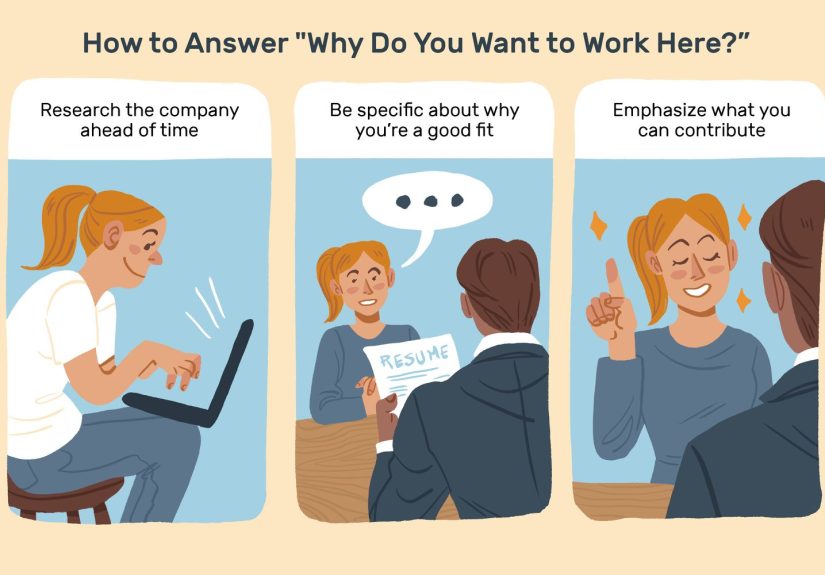
Read the posting carefully and look for repeated themes. Are they emphasizing collaboration, growth, client service, data analysis, creativity, leadership, or speed? Repetition is a clue. Employers often hide their priorities in plain sight.
Once you identify those themes, match them to your own experience. If the posting keeps mentioning stakeholder communication and project ownership, your answer should not focus entirely on how much you love the company’s Instagram feed.
Research the company beyond the homepage
Yes, review the company website. But also check its recent news, leadership messaging, product pages, career page, and public brand voice. Look for concrete details that help you explain why this employer stands out. Your answer should feel like it belongs to this interview, not any interview.
Choose one or two real reasons
Do not cram seven reasons into a two-minute answer. Pick the strongest one or two. Maybe you like the company’s mission and the role’s growth potential. Maybe you are excited about the product and the chance to use a skill you have developed deeply. Focus beats clutter every time.
Make it about mutual fit
Great answers are not selfish, but they are not robotic either. You can absolutely mention what the role offers you, such as growth or challenge, as long as you also explain what you offer the employer. The best tone is, “This is a great match for both of us.”
Sample Answers for Different Situations
Sample answer for an entry-level candidate
“I want this job because it combines two things I have been looking for in my first full-time role: strong training and meaningful client-facing work. I was especially drawn to how your company invests in early-career employees and gives them the chance to build real responsibility quickly. In school and during my internship, I found that I do my best work when I am solving problems for people directly, so this position feels like a strong fit for both my skills and the direction I want to grow in.”
Sample answer for a career changer
“I want this job because it sits at the intersection of my past experience and the direction I have intentionally been moving toward. I spent several years in teaching, which strengthened my communication, organization, and presentation skills. Over time, I became more interested in learning and development, especially how companies train employees effectively. This role stood out to me because it would let me apply those strengths in a corporate setting where I can contribute immediately while continuing to grow in the field.”
Sample answer for an experienced professional
“I am interested in this job because it feels like the right next step in the work I have already been doing successfully. I have spent the past six years leading operations projects, and I was drawn to this role because it combines process improvement with team leadership in a company known for scaling thoughtfully. I was especially interested in your emphasis on cross-functional coordination, because that has been a big part of my recent work. I would be excited to bring that experience here and help the team improve efficiency without losing quality.”
Mistakes That Can Sink Your Answer
Being too generic
If your answer could work for any employer on Earth, it is too broad. Interviewers notice when candidates speak in fog. Specificity is your friend.
Focusing only on your needs
It is fine to care about salary, flexibility, growth, and benefits. You are a person, not a decorative plant in the waiting room. But in the interview, your answer should center on the role, the company, and the value you bring. Keep the spotlight balanced.
Sounding over-rehearsed
Preparation is good. Sounding like you memorized a monologue during a thunderstorm is less good. Know your points, but speak naturally.
Praising the company in vague, empty ways
“You are a leader in the industry” is not wrong, but it is weak if that is all you have got. Explain why you think the company stands out and what specifically resonates with you.
Ignoring the job itself
Some candidates talk only about the company mission and forget to mention the responsibilities of the role. That is like complimenting a restaurant and forgetting to discuss the food.
How to Tailor Your Answer by Job Type
For corporate roles
Focus on business goals, team impact, efficiency, collaboration, and measurable outcomes. Mention how your experience supports the company’s priorities.
For creative roles
Talk about the brand, audience, storytelling, innovation, or creative challenges that excite you. Then connect your portfolio, style, or process to the role.
For healthcare or service roles
Highlight mission, quality of care, service standards, empathy, teamwork, and reliability. Employers in these fields want to hear both commitment and competence.
For tech roles
Discuss the product, problem-solving environment, engineering culture, learning opportunities, and the specific technical challenges that interest you. Then connect your skills to the stack, workflow, or impact area.
What Interviewers Secretly Love Hearing
Interviewers usually respond well when your answer signals these qualities:
- You did your homework.
- You understand the job beyond the title.
- You are motivated by something deeper than desperation.
- You know your strengths.
- You can explain your value clearly.
- You sound like someone who would actually enjoy showing up on Monday.
That last point matters more than people think. Employers are not only evaluating qualifications. They are imagining what it would be like to work with you. A thoughtful, energetic, well-framed answer helps them picture you on the team.
Experience-Based Lessons From Real Interview Situations
One of the most revealing things about this question is how differently it lands depending on the candidate’s experience. Early-career job seekers often panic because they think they need a dramatic, life-changing reason for wanting the role. They do not. In many real interviews, the strongest entry-level candidates are the ones who give grounded answers. They say they want the job because it offers a chance to build skills, contribute to a team, and work for a company they genuinely respect. That sounds mature. It also sounds believable.
Mid-career candidates usually face a different challenge: they know too much, and their answers become bloated. They start with the company mission, take a scenic route through three previous jobs, mention a reorganization from 2021, and somehow end up discussing leadership philosophy, market trends, and a software migration. By that point, the interviewer has mentally left the chat. In practice, experienced professionals do best when they stay focused. The strongest answers usually pick one company-related reason, one role-related reason, and one clear way they can help.
Career changers often worry that they will sound suspicious, like a person trying to sneak into a new industry wearing a fake mustache. In reality, interviewers are often very open to career pivots when the story makes sense. The most persuasive answers in these situations usually explain the shift clearly: what the candidate learned in previous roles, why the new field is a logical next move, and how transferable skills will help them succeed. That combination makes the move feel intentional rather than random.
Another common real-world pattern is that candidates talk themselves out of a strong answer by trying to sound impressive instead of honest. For example, someone might really want a job because the company is known for excellent mentorship and the role would stretch their skills in a good way. That is a perfectly respectable reason. But instead of saying that, they deliver a polished speech packed with buzzwords about synergy, innovation, and transformational excellence. Suddenly they sound like a corporate brochure that gained consciousness.
There is also a practical lesson that comes up again and again: candidates who research the company in a specific way almost always sound better. Not because they memorize more facts, but because they can point to something concrete. Maybe it is the company’s approach to customer support, a new product line, a leadership principle, a recent expansion, or a training philosophy. Those details make interest feel real.
Finally, many candidates underestimate how much tone matters. A good answer is not just informative. It should sound energized, confident, and human. You do not need to perform excitement like you just won concert tickets. But you should sound like someone who sees a genuine fit and is glad to be there. In actual interviews, that balance often separates the forgettable answer from the one that sticks.
Conclusion
At its core, “Why do you want this job?” is not a trick question. It is a focus question. The interviewer wants to know whether you understand the opportunity, whether your interest is real, and whether you can connect your strengths to the company’s needs in a convincing way.
The best answer is not the fanciest one. It is the clearest one. Show that you know the company. Explain why the role fits your goals and strengths. Tie that interest to the value you can bring. Do that well, and your response will sound thoughtful, strategic, and refreshingly human.
And that, in interview terms, is about as close to magic as you can get without pulling a rabbit out of a briefcase.